
Memory, Sorrow, and Thorn · Canonical Character Profile
Brother Langrian
Brother Langrian is the young Hoderundian monk who survives the massacre at Saint Hoderund’s with a hidden head wound, wakes under the care of people his companion initially calls monsters, and reconstructs the attack without pretending he saw more than he did. His testimony separates two armed companies, preserves Abbot Quincines and Brother Sceneseafa’s final choices, and gives the larger war one of its earliest disciplined eyewitness records.
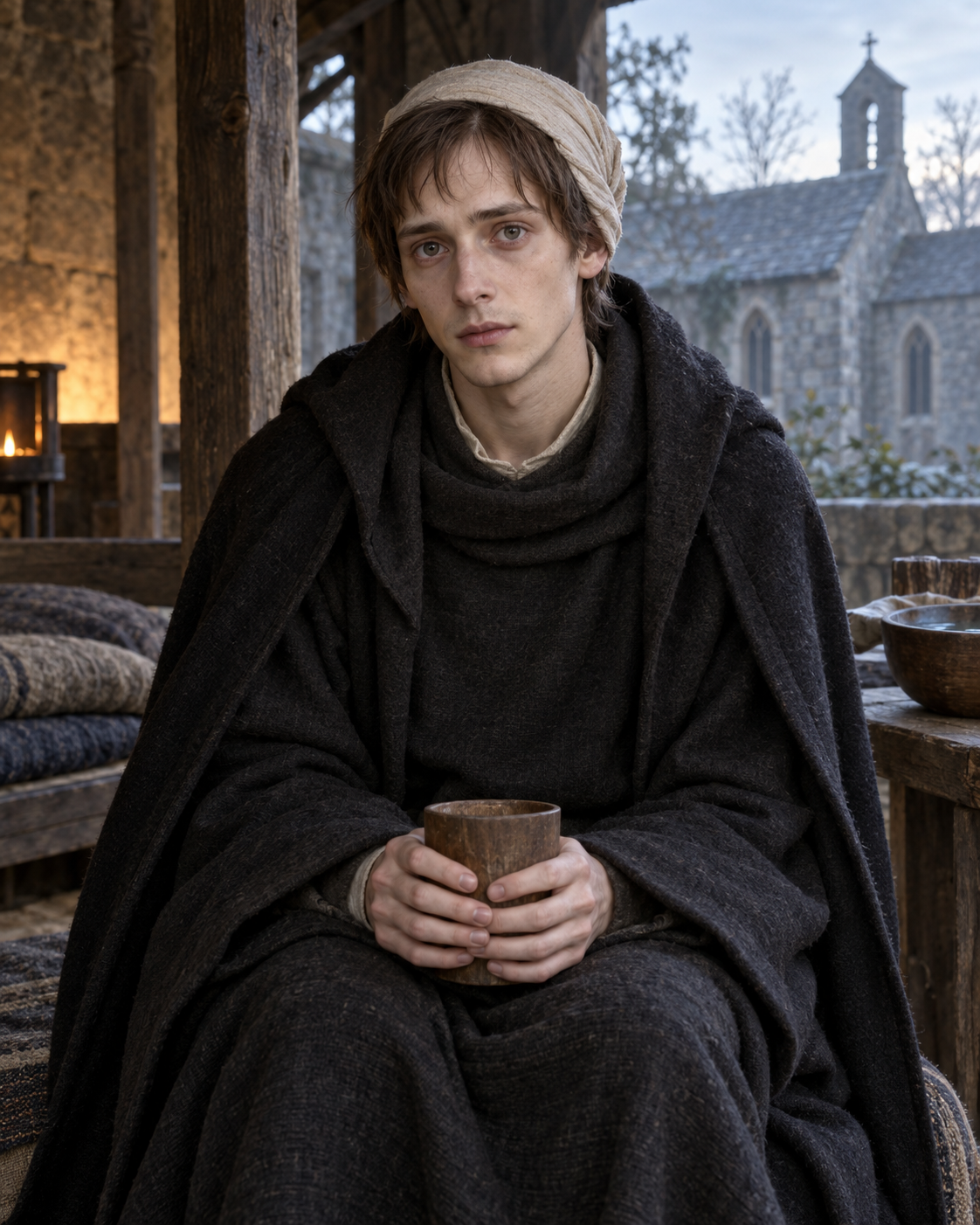
At a Glance
The wounded witness who refuses to turn uncertainty into certainty
- Name
- Brother Langrian
- Order
- Hoderundian monk at Saint Hoderund’s Abbey
- Age
- Under twenty
- Appearance
- Pale waxy skin; bloodied, scarred face; serious head wound
- Role
- Massacre survivor and eyewitness
- Caregivers
- Brother Hengfisk, Binabik, Simon, and Qantaqa
- Status
- Alive after the massacre; remains at the abbey into Book 2
Book 1 · Saint Hoderund’s
A place built for travelers becomes a trap because hospitality gives armed strangers access
Saint Hoderund’s Abbey sits in cultivated terraces, with a vineyard and travelers’ lodging that initially suggest order. Roughly three months before Simon arrives, Binabik found it safe enough to visit. By the return journey, the chapel, outbuildings, and abbey have burned. At least a score of bodies lie across the grounds, monks beside travelers from the Frostmarch.
Langrian survives inside that destruction. He is under twenty, pale and waxy, with a bloodied and scarred face. A rough sacking bandage initially hides the severity of his head wound. Hengfisk has dragged him and Brother Dochais into shelter.
The text does not turn youth into miraculous immunity. Langrian is gravely wounded, unconscious, dependent, and unable to immediately explain what happened. His survival requires care before testimony. The sequence matters: the story does not demand that the injured boy perform useful exposition before anyone spends water, warmth, or labor on him.
The Care Circle
He lives because people work across prejudice while the argument remains unresolved
Hengfisk initially greets Binabik and Qantaqa as pagan monsters and possible murderers. His terror is real; so is the Rimmersman history of violence against Qanuc people that makes the accusation more than harmless confusion.
Binabik challenges the prejudice and still treats Langrian. Simon fetches water, imperfectly but usefully. Qantaqa guards the shelter. Hengfisk gives Langrian his cloak and continues tending him. Care becomes collective without requiring everybody to like or trust everybody else first.
Langrian improves under Binabik’s treatment and returns to consciousness. His pale condition and head injury do not vanish, but he can recognize Hengfisk, ask about the other brothers, and eventually give an ordered account.
This small recovery is one of the novel’s quiet counters to the massacre. Armed companies turn hospitality into slaughter; a monk, a Qanuc healer, a red-haired fugitive, and a giant wolf turn suspicion into enough cooperation to keep one young man alive.
The Eyewitness Record
Langrian separates what he observed, what he inferred, and what he cannot identify
About a dozen cloaked travelers arrive first. Their leader is pale-eyed, dark-clothed or armored, and wears an evil-looking helm. The group asks whether Rimmersmen have come north from Erchester and receives lodging in Travelers’ Hall.
A second company approaches from the south. The original leader greets them as though they might be expected reinforcements, but a brother glimpses a concealed sword. Abbot Quincines distrusts the situation and orders the first group to disarm. Their leader kills him.
Brother Sceneseafa runs toward the courtyard gate to warn the arriving riders and is shot in the back. Fighting engulfs the abbey. The cloaked band attacks unarmed residents, then meets harder resistance from the bearded and braided Rimmersmen of the second company.
Langrian cannot identify either faction. He cannot prove whether they arrived as partners whose agreement collapsed or enemies from the beginning. What he can establish is that the groups fight each other and that the first company’s attack on the newcomers differs sharply from its slaughter of monks.
The later Isgrimnur viewpoint identifies the second force as the duke’s party and confirms that the first group prepared an ambush. Langrian’s testimony survives that later verification because he did not contaminate it with certainty he lacked.
Quincines and Sceneseafa
His account keeps two murdered brothers from becoming anonymous scenery
Abbot Quincines does not die because he blindly trusts every guest. He notices danger, asserts the abbey’s authority, and orders armed strangers to disarm. The pale-eyed leader cuts his throat.
Sceneseafa recognizes that the approaching company is walking into a trap. He runs to warn them and is shot from behind. His warning gives the Rimmersmen enough time to fight back.
Without Langrian, both deaths could disappear into the count of bodies. His reconstruction preserves decision: one authority confronts concealed violence; one brother risks himself to warn strangers. Neither stops the massacre, but both alter what can be known about it.
The distinction fits the novel’s treatment of history. A witness cannot restore the dead. He can prevent the killers’ confusion from becoming the only surviving version.
Dochais
One survivor provides chronology; another provides a supernatural warning nobody can yet diagnose
Brother Dochais survives the initial violence in a profoundly altered state. He recognizes Simon as “marked,” speaks of white foxes and a master who freezes hearts and carries souls away on a black wagon, and finally dies whispering “Storm King.”
Langrian’s role should not be merged with his. Dochais carries visionary or traumatized warning. Langrian carries observable sequence. One account opens the supernatural scale of the danger; the other establishes arrival order, weapons, murders, and armed conflict.
Together they show why the site matters beyond shock. The abbey is both a crime scene and an early intersection between Elias’s political violence, Stormspike forces, Isgrimnur’s flight, and Simon’s marked dreams. Different survivors hold different pieces.
Burial and Remaining
Survival does not grant him the power to repair the entire field
Hengfisk demands burial for every corpse. Binabik refuses to spend days interring all the dead while survivors and a wider danger remain, but agrees to bury Dochais. Langrian sleeps under Qantaqa’s guard while the others use scarce tools.
The disagreement refuses a clean moral winner. Ritual care matters; so do living bodies and approaching danger. Langrian’s continued vulnerability makes the cost of delay concrete.
By Book 2, the unnatural summer snow has buried roads and emptied Naglimund-town. Saint Hoderund’s remains burned. Langrian has stayed behind after judging the weather a curse on creation. The record does not give a detailed second-book scene, but it confirms continued life and a decision not to abandon the ruined religious site.
Remaining can be read as devotion, obligation, grief, or lack of alternatives. The text does not select one private motive. What it establishes is that the massacre does not simply close when Simon leaves. Someone young and wounded continues living beside the place where his community was destroyed.
Connections
The dead, survivors, caregivers, and later confirmation around Langrian’s evidence
Brother Hengfisk
Rescues and shelters Langrian, gives him a cloak, and continues care while struggling with anti-Qanuc prejudice.
Binabik
Qanuc healer whose treatment brings Langrian back to consciousness and preserves the witness.
Brother Dochais
Fellow survivor whose supernatural warning complements rather than replaces Langrian’s chronology.
Abbot Quincines
Challenges the concealed weapons and is murdered by the first company’s leader.
Brother Sceneseafa
Attempts to warn the arriving Rimmersmen and is shot in the back.
Isgrimnur
Later viewpoint whose account identifies the second company and validates Langrian’s careful distinctions.
Why Langrian Matters
He models testimony as care rather than performance
Langrian is not a warrior, prince, or secret magical adept. His importance comes from surviving, remembering, and speaking carefully after violence designed to leave confusion behind.
He tells enough to reconstruct the ambush without claiming omniscience. Later evidence can refine his account instead of correcting reckless invention. That makes him a small but essential part of the series’ larger argument about history: reliable memory requires limits.
His care network also makes the abbey more than a horror tableau. People from hostile traditions preserve a life together. The survival does not redeem the massacre, but it prevents destruction from becoming total.
On the Record
Books 1–2, one survivor identity, and no invented certainty about the attackers
This is Brother Langrian’s one canonical full-spoiler profile. Book 1 contains his direct appearance, treatment, testimony, and survival. Book 2 confirms that he remained at the burned abbey amid the supernatural weather. The existing Books 1–2 scope is retained.
The record confirms that he is a Hoderundian monk under twenty with pale waxy skin, a bloodied scarred face, a concealed head wound, and a rough bandage. It confirms his chronology of two armed groups, Quincines’s murder, Sceneseafa’s warning, care by Hengfisk and Binabik, and later decision to remain. It does not supply hair or eye color, exact age, later fate, private motive for staying, or knowledge of the first company’s ultimate master.
The approved convalescent identity presents Langrian as a nineteen-year-old adult: slight and unmistakably youthful, with pale waxy skin, soft angular features, large gray eyes, uneven ear-length medium-brown hair, and a clean-shaven face beneath a rough cloth head wrap. The hero deliberately omits visible blood and open injury while the prose retains the canonical wound record. His exact age, face, hair, eyes, robe, borrowed cloak, cup, shelter, chapel view, and light are editorial reconstruction. This exact identity now governs wounded shelter, recovered testimony, ruined abbey, directory, hero, social, and later scene imagery. Never age him into a mature romance-cover cleric, sexualize his vulnerability, or turn trauma into grotesque clickbait.