
Memory, Sorrow, and Thorn · Canonical Character Profile
Godstan
Godstan is one of two Erkynguard soldiers lodging beside the Dragon and Fisherman, known to Freawaru and expected on the road at cockcrow. When Cadrach runs and leaves Simon looking like the second half of an inn swindle, Freawaru tries to bring the boy before Godstan and Deorhelm. Simon escapes first. Godstan never speaks or sees him on-page, yet the possibility of his judgment helps send Simon into Aldheorte.
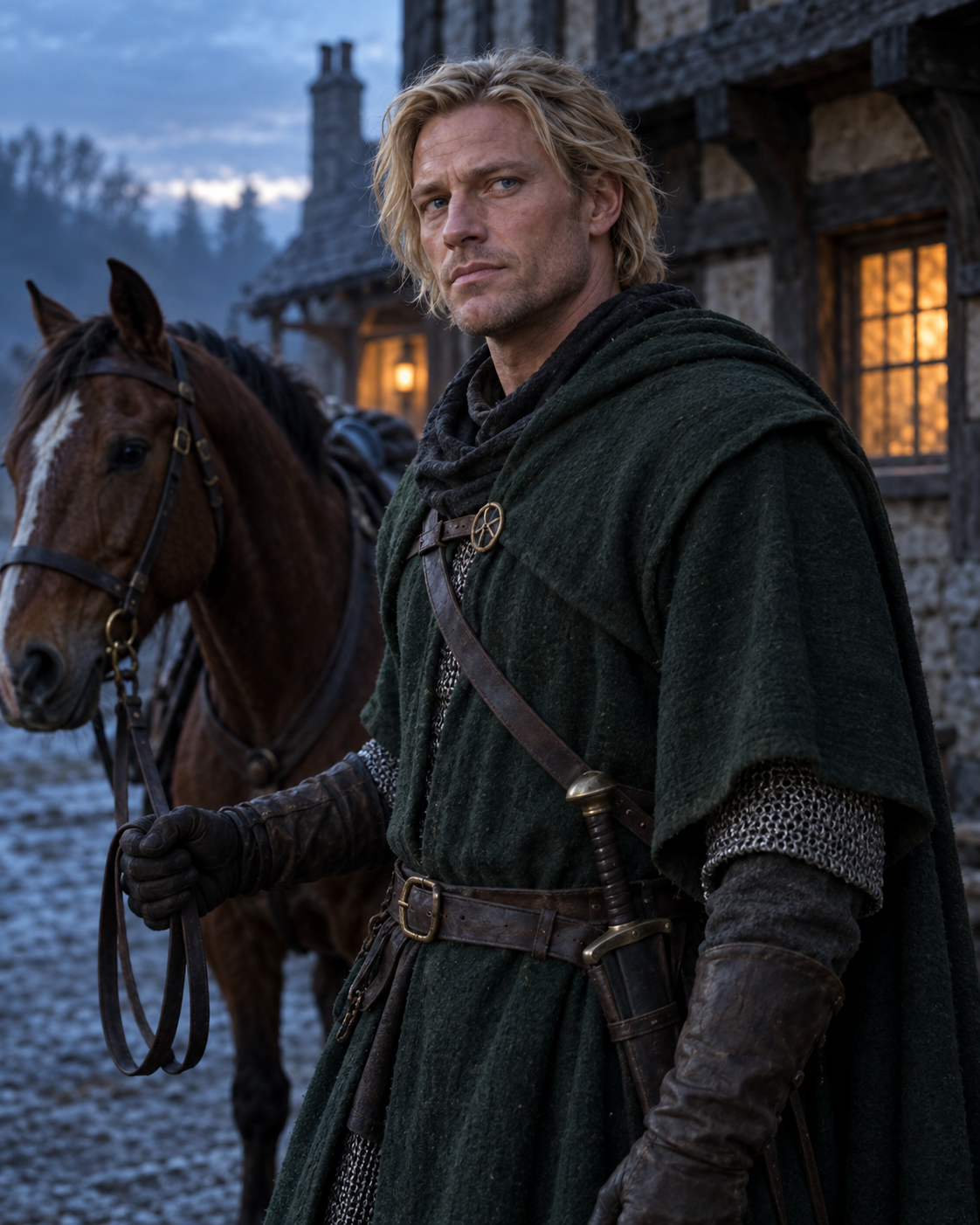
At a Glance
The second named soldier in a judgment Simon refuses to stand still and receive
- Name
- Godstan
- Affiliation
- Erkynguard
- Lodging
- An adjoining cottage beside the Dragon and Fisherman
- Companion
- Deorhelm
- Local connection
- Known to innkeeper Freawaru
- Schedule
- Expected to take the road at cockcrow
- Potential role
- Identification or judgment in the accusation against Simon
- Status
- Alive during the inn scene; later fate unconfirmed
Godstan and Deorhelm
The book names both soldiers while giving neither a completed scene
Godstan enters the record beside Deorhelm. They share Erkynguard affiliation, lodging near the inn, familiarity to Freawaru, and an expected cockcrow departure.
The pairing makes them socially legible. They are traveling soldiers, available nearby, and credible enough for the innkeeper to use as a destination when a theft accusation erupts.
It also risks erasing Godstan. Because Deorhelm’s name comes first and the two never separate on-page, a summary can easily collapse them into “two guards.”
A canonical profile should preserve the name without inventing a personality to force distinction. Godstan is not confirmed quieter, younger, older, kinder, harsher, junior, or senior.
Nor can we assume the pair are friends. They may be unit companions, assigned travelers, habitual road partners, temporary lodgers, or something else the scene does not specify.
Their planned movement at cockcrow proves coordination. Its institutional or personal basis remains open.
Future art can and must give Godstan his own face and body, but those choices must be labeled CVM interpretation rather than recovered physical canon.
The Same Evidence, Two Stories
Godstan would have received a real purse and an unresolved relationship
The purse is not fake evidence. It belonged to Simon and was stolen by Cadrach.
Simon’s recognition proves he is telling the truth about being robbed. It also proves a prior connection to the fleeing thief, which can make Freawaru’s accomplice theory look plausible.
Cadrach’s escape sharpens both readings. A guilty man flees; an apparently abandoned partner remains.
Godstan and Deorhelm are invoked at the point where someone must decide what the connection means.
The scene ends before either soldier hears Simon. Later narrative knowledge establishes his innocence of the inn trick but cannot retroactively reveal how Godstan would have assessed the evidence.
Assigning him a verdict—fair or brutal—would manufacture character from an interrupted procedure.
His page instead preserves the pressure of a possible judgment whose uncertainty is exactly why Simon chooses flight.
Forehead, Forest, Consequence
Simon escapes Freawaru before Godstan can become an active participant
Freawaru is barrel-chested, scarred, bearded, and strong enough to seize Simon. He also tells the boy he would have offered work if asked honestly.
Simon head-butts him and runs.
The escape prevents every anticipated Godstan action. The soldier does not identify Simon, question him, restrain him, hear Cadrach’s name from him, or decide whether Freawaru’s theory is correct.
This negative boundary is essential. Godstan’s character cannot be built from actions he was merely positioned to take.
Yet the aborted encounter changes the plot. Simon spends a cold, miserable night in Aldheorte and continues into the chain of events that brings him to the trapped Sitha and then Binabik.
Godstan does not intentionally direct that journey. He is part of the institutional threat Simon flees.
The moment also marks Simon’s changing relationship to authority. A Hayholt scullion might once have expected adults to sort out a misunderstanding. A hunted boy carrying dangerous knowledge assumes capture could become fatal before truth matters.
Cockcrow and the Unwritten Road
Godstan has a schedule beyond Simon, even though the destination is withheld
Godstan and Deorhelm are expected on the road at cockcrow.
The timing gives them independent motion. They are not permanent fixtures waiting beside the inn for Simon’s plot to arrive.
The record does not reveal where they are going, what orders they carry, whether they travel mounted, how many others accompany them, or whether the incident delays departure.
We should not connect them to a campaign simply because other Erkynguard units commit violence elsewhere. Institutional affiliation matters; individual participation must still be evidenced.
Godstan’s later fate is likewise unknown. No Book 2–4 receipt safely identifies him.
The road at cockcrow is therefore a boundary rather than a missing adventure we may fill. His life continues beyond the scene, but its contents are not ours to counterfeit.
Uniform Is Context, Not Conviction
Godstan serves the Erkynguard; the page still cannot assign him every Erkynguard action
Elsewhere in Book 1, royal soldiers enforce Elias’s seizure of property, occupy religious sites, and participate in violence. Those actions define the institution’s expanding role under the king.
Godstan’s membership places him inside that apparatus, but the Dragon and Fisherman receipt does not connect him personally to Falshire, Saint Sutrin’s, Morgenes’s death, or another named operation.
Responsible analysis can hold both facts at once. His uniform carries the authority and danger of the Erkynguard. His individual moral record remains almost entirely unwritten.
Future directory copy and art must avoid portraying him as secretly heroic merely because evidence is absent. They must also avoid illustrating him committing a specific atrocity the book never assigns him.
Institutional implication is real; personal guilt still requires receipts.
Connections
The fellow soldier, innkeeper, thief, and runaway around Godstan’s unrealized judgment
Deorhelm
Godstan’s fellow Erkynguard lodger and planned road companion.
Freawaru
The innkeeper who knows both soldiers and tries to bring Simon before them.
Simon
The suspected accomplice who escapes before Godstan can see or hear him.
Brother Cadrach
The actual thief whose flight creates the false appearance of partnership.
The Erkynguard
The royal military institution that supplies Godstan’s local authority.
The road at cockcrow
The confirmed next movement whose destination and purpose remain unknown.
Why Godstan Matters
He shows how a person can matter to a scene through a decision nobody waits to hear
Godstan has no dialogue and no completed encounter with Simon.
He still matters because anticipated authority changes behavior. The possibility of being brought before him helps make the forest look safer than explanation.
His paired mention also tests responsible fandom coverage. Naming him matters; manufacturing individuality does not.
The strong version of this page identifies every confirmed relationship, spatial fact, institutional implication, and evidence boundary. It lets Godstan remain a particular person without pretending the book told us which one of the two soldiers joked more at supper.
That discipline is part of making the hub better than an encyclopedia assembled from repeated guesses.
On the Record
Book 1 only, paired evidence preserved, future identity intentionally interpretive
This is Godstan’s one canonical full-spoiler profile. His sole reference occurs in Book 1 at the Dragon and Fisherman. No additional Godstan receipt appears in Books 2–4.
The record confirms his name, Erkynguard affiliation, lodging in a cottage adjoining the inn, familiarity to Freawaru, association and planned cockcrow travel with Deorhelm, and intended involvement when Freawaru tries to bring Simon for identification.
It does not confirm exact age, face, hair, eyes, body, clothing detail, armor, weapon, rank, destination, orders, friendship with Deorhelm, speech, actual view of Simon, later journey, survival, death, or final fate.
Visual state: approved editorial reconstruction. CVM depicts Godstan as an exceptionally handsome adult Erkynlander around thirty-five with a broad road-trained build, ice-blue eyes, wind-reddened fair skin, jaw-length wheat-blond hair, and clean-shaven light stubble. His dark-green Erkynguard wool, restrained mail, weathered leather, ordinary sheathed sword, reins, and predawn cottage setting visualize the confirmed soldier, lodging, and cockcrow-road context without inventing rank, destination, orders, or verdict. Preserve this exact face, body, coloring, grooming, wardrobe, and contained skepticism in every later scene; never clone Deorhelm. The same canonical attachment powers featured image, hero, directory card, and social metadata.