
Memory, Sorrow, and Thorn · Canonical Character Profile
Count Breyugar of the Westfold
Breyugar is Elias’s Lord Constable: a jowly young court favorite with delicate features, a high voice, fine musician’s hands, and a reputation as a terrifying swordsman. He occupies Saint Sutrin’s, humiliates Simon and Jeremias, helps storm Morgenes’s rooms—and discovers at the Anger Stones that serving Pryrates’s system does not prevent the system from pricing your blood.
At a Glance
The Lord Constable who guards the regime until the regime needs a replacement offering
- Title
- Count of the Westfold and Lord Constable of the Hayholt
- Allegiance
- King Elias and the emerging Pryrates-centered court
- Authority
- Royal constables, household soldiers, cathedral occupation, and castle security
- Contradiction
- Soft-featured court presence with a terrifying swordsman’s reputation
- Key actions
- Rejects the boys, attacks Morgenes, fails to hold Josua
- End status
- Dead; sacrificed by Pryrates to open Sorrow’s black container
The Visual Receipt
Delicate face, heavy jowls, musician’s fingers—and a sword reputation nobody laughs at twice
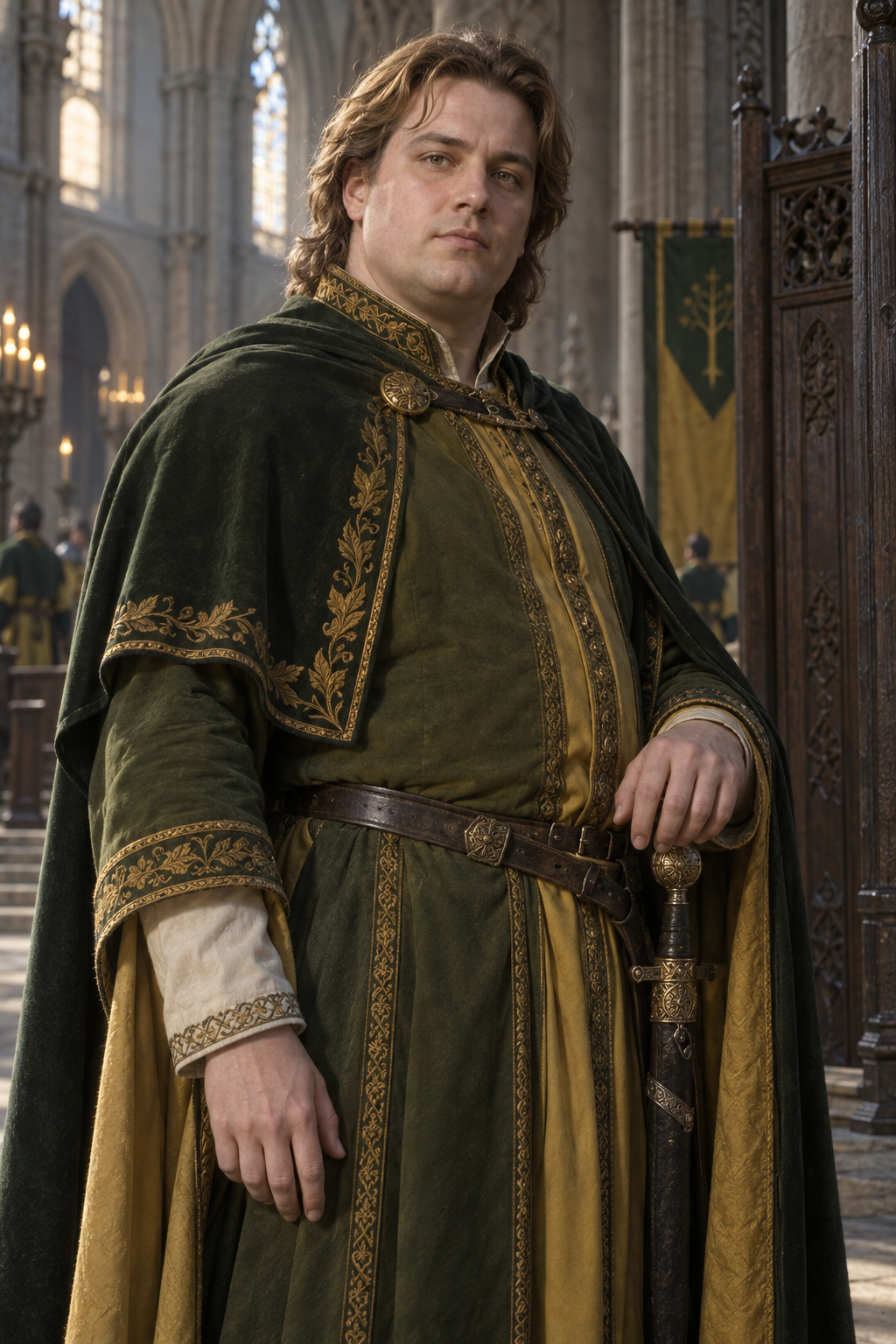
Breyugar’s delicate features are nearly lost inside jowly flesh. His hands are fine, long-fingered, and compared to a musician’s. His voice is high-pitched and coded by observers as effeminate. Against those classed and gendered assumptions stands a reputation as a terrifying swordsman.
CVM’s approved editorial reconstruction resists the lazy equation of body shape, voice, or delicate hands with incompetence. Breyugar is beautiful, soft-looking, richly fed, and genuinely dangerous at the same time: hazel-green eyes, full jowls, dark-gold collar-length hair, luxurious green-and-yellow layers, two fine long-fingered hands, and one controlled hand resting on a sheathed sword. His authority appears through grooming, royal affiliation, fine weapon, and the spatial confidence of someone accustomed to making guards move.
This one approved identity now connects the funeral feast, Saint Sutrin’s headquarters, recruitment refusal, Morgenes assault, captivity, failed escape, and sacrifice. Every later image must preserve the same face, body, hands, coloring, hair, and green-and-yellow costume logic while aging or distressing him only when the scene requires it.
Elias’s New Table
The court announces itself by who gets invited before the crown is even settled
At John’s funeral feast, Elias surrounds himself with Guthwulf, Fengbald, Breyugar, and other younger favored lords. Their loud table contrasts with Josua’s isolation and Isgrimnur’s subdued anger.
Breyugar’s presence identifies him as part of the new regime before his constables become plot machinery. He is not a neutral civil servant inherited from John. Isgrimnur later names Breyugar among the influences drawing Elias toward disaster, with Pryrates singled out most strongly. That is an informed political judgment, not proof that Breyugar supernaturally controls the king.
The distinction matters because Breyugar’s power comes from recognizable patronage. A ruler elevates loyal young men, those men command armed access, and soon their uniforms determine who may cross civic and sacred space.
Saint Sutrin’s Cathedral
Three banners share the entrance, but only one group has turned the church into headquarters
Saint Sutrin’s displays Elias’s green dragon, Mother Church’s Pillar and Tree, and Erchester’s white-and-gold coronet. Breyugar’s royal troops guard the doors and occupy the interior. Boards and stools physically partition soldiers from priests resisting the seizure.
The arrangement is a map of institutional fracture. Royal, civic, and sacred symbols remain visible together, creating the appearance of continuity, while armed men decide access. Breyugar’s constabulary does not need to tear down the Church banner; it can govern underneath it.
Simon and Jeremias arrive carrying Morgenes’s sealed introduction. Even a private request from the king’s doctor now travels through armed scrutiny before reaching the Lord Constable.
The Recruitment Refusal
Breyugar catches one tiny forgery and uses it to explain how thoroughly the gate is closed
Morgenes makes Simon write the letter recommending Jeremias as literacy practice. Simon squeezes himself into the request, turning friendship, ambition, and deceit into his first practical document.
Breyugar notices. He mocks Morgenes, rejects both boys, and says drought has already driven enough trained men to seek food through service. He cannot afford another recruit and considers soft castle servants unfit.
The economic fact is real: starving trained adults are competing for limited places. Breyugar then converts class into permanent proof of softness. If wider war lowers standards, perhaps the boys may carry water, tend horses, or hold pitchforks—but not become the soldiers their romantic histories promised.
Jeremias kneels through the humiliation. Simon returns to the Hayholt and breaks his barrel-stave sword rather than cry. The gatekeeper does not merely refuse employment; he punctures the fantasy that courage automatically makes hierarchy notice you.
Morgenes’s Rooms
The Lord Constable brings royal force to the doctor’s door—and Pryrates brings the real weapon
Armed men arrive claiming the king’s authority. Breyugar leads Erkynguard in green and yellow; Inch crouches behind him; Pryrates follows. The group breaks into Morgenes’s chambers.
Morgenes raises a shimmering barrier. Pryrates attacks with blue sparks. The defense becomes fire as Morgenes orders Simon into the hidden tunnel and throws himself against the intruders.
Breyugar participates as commander of the armed seizure, not as an accidental passerby. He brings the state’s uniformed force to capture Josua’s ally and suppress whatever Morgenes protects. Pryrates supplies power beyond ordinary constabulary, but Breyugar gives that power lawful entry.
The chamber burns and collapses. Official rumor later says Simon, Morgenes, Breyugar, and the guards died there. The rumor is useful because it hides what actually happens next.
Failure Has a Name
Josua escapes, so Pryrates turns the officer responsible into inventory
The conspirators expected a particular captive. Josua escapes. Breyugar, bound and gagged, is brought to the Anger Stones as the substitute.
Pryrates says the Lord Constable allowed the promised one to escape and therefore failed his duty to the king. Elias asks what Pryrates promised on his behalf. Pryrates answers that the king authorized whatever was necessary for the meeting.
The scene exposes the bargain beneath royal service. Breyugar can command cathedrals and smash doctors’ doors while useful. Once he fails to produce Josua, his title becomes less important than the bloodline inside his body.
The Anger Stones
Noble lineage becomes currency when the preferred captive is unavailable
The hooded recipient rejects Breyugar as the wrong offering. Pryrates sells the substitute by emphasizing noble blood and long lineage. The same ancestry that helped place Breyugar above servant boys now makes him acceptable ritual material.
Breyugar tries to flee. Pryrates cuts his throat over a low black coffin-shaped box. The blood opens the container and reveals the dark sword Simon hears named Jinjizu, later identified canonically as Sorrow.
Elias watches the substitution proceed and does not stop it. Breyugar’s death is therefore not rogue punishment hidden from the king. The ruler who empowered the Lord Constable accepts his conversion into payment for a larger alliance.
Victimhood at the Anger Stones does not absolve Saint Sutrin’s or Morgenes’s chamber. Accountability also does not require pretending his murder is deserved. The regime devours one of its own agents because systems built on human expendability do not issue loyalty exemptions.
Connections
The people who employ, fear, serve, and finally spend him
King Elias
Patron who seats Breyugar among favorites, grants armed authority, and permits his sacrifice after failure.
Pryrates
Power behind the assault who binds Breyugar, prices his lineage, and cuts his throat to open Sorrow’s box.
Morgenes
Doctor whose letter Breyugar mocks and whose rooms he later storms with the Erkynguard.
Simon
Servant boy whose forged plural Breyugar detects and whose escape survives both the recruitment gate and chamber assault.
Jeremias
Chandler’s assistant humiliated while asking for a path into the Lord Constable’s guards.
Bishop Domitis
Church leader whose priests occupy the other side of the furniture barrier inside seized Saint Sutrin’s.
Why Breyugar Matters
He links ordinary authoritarian administration to the supernatural bargain underneath it
Breyugar’s arc begins with recognizable institutions: recruitment, constables, headquarters, patronage, and controlled buildings. It ends with blood magic. The transition shows that Pryrates’s supernatural system does not replace politics; it uses political chains of command to reach locked rooms and desired bodies.
His death also reverses the class hierarchy he enforces. He dismisses servant children because pedigree and training govern opportunity. Later, pedigree determines why the conspirators can use him as substitute blood. Privilege protects until power discovers a more profitable use for it.
The profile should hold both truths. Breyugar helps build the machinery that kills Morgenes and terrorizes Erchester. He is also murdered by his patrons. Complexity is not acquittal, and condemnation is not permission to cheer a throat being cut over a box.
On the Record
Scope, status, physical evidence, and responsibility boundaries
This is Breyugar’s one canonical full-spoiler profile. His direct action and death occur in The Dragonbone Chair, so the directory scope remains Book 1. He is dead after Pryrates sacrifices him at the Anger Stones.
The evidence confirms his Westfold title, Lord Constable office, delicate features, jowly flesh, fine hands, high voice, sword reputation, Elias favoritism, cathedral occupation, recruitment refusal, Morgenes assault, failure to hold Josua, attempted escape, and ritual murder. Isgrimnur’s judgment about his influence on Elias remains attributed political testimony.
Visual state: approved editorial reconstruction. Future feast, cathedral, recruitment, assault, captivity, sacrifice, directory, and social images must preserve this exact adult face and body. His appearance must never become a joke, and the death must communicate betrayal and horror without decorative gore. The same canonical attachment powers featured image, hero, directory card, and social metadata.