
Memory, Sorrow, and Thorn · Canonical Character Profile
Peter Gilded-Bowl
Peter Gilded-Bowl is the Hayholt seneschal who appears wherever royal ceremony threatens to collapse into kitchen smoke, dusty corners, empty cups, and exhausted servants. Small, yellow-haired, and fierce, he directs King John’s funeral preparations and later controls the wine at Elias’s midnight feast. Kings make history upstairs. Peter makes sure somebody has heated the ovens.
At a Glance
The small, fierce seneschal running the enormous castle nobody else notices until something goes wrong
- Name
- Peter Gilded-Bowl
- Office
- Seneschal of the Hayholt
- Appearance
- Small and yellow-haired
- Temperament on duty
- Fierce, exacting, and seemingly everywhere at once
- Book 1 work
- Directs King John’s funeral preparations and serves watered wine at Elias’s feast
- Connection to Simon
- One of the Hayholt workers Simon remembers in his river stories
- Status
- Alive in his last confirmed Book 1 appearance; later fate unconfirmed
- Evidence boundary
- No confirmed family, origin, age, politics, or later biography
The Castle After a King Dies
Peter’s first clear appearance is not beside the throne—it is inside the machinery of mourning
King John’s death becomes ritual almost immediately. Priests prepare the body. Nobles travel toward Erchester. Kitchens blaze. Servants carry, clean, bake, arrange, and repeat. The funeral may belong to history, but its history is built out of labor.
Peter Gilded-Bowl is the official making that labor cohere.
The Hayholt’s four kitchens work like foundries while scullions sweat over meats, breads, and festival wafers. Peter moves through the preparations as a small, yellow-haired force, policing dust and servants across the household space associated with Mistress Rachel.
He is described as fierce and seemingly everywhere at once. That language does not prove magic, impossible speed, or omniscience. It records the effect of a competent seneschal during a crisis: wherever standards might fail, Peter appears.
The scale matters. A royal funeral is not one meal and one room. It means visiting rulers, armed retinues, clergy, courtiers, household staff, ceremony, lodging, fuel, supplies, and countless expectations sharpened by grief and status. Peter’s authority operates through all of it.
He does not receive a speech explaining his management philosophy. The work is his characterization. Kitchens run. Dust is hunted. Servants know somebody is watching.
What a Seneschal Actually Does Here
His title turns domestic management into political survival
“Seneschal” can sound decorative when left in a medieval-fantasy glossary. Peter’s scenes make it concrete. He coordinates people, provisions, presentation, and service inside the royal household.
The Hayholt is palace, fortress, archive, religious monument, workplace, and inherited symbol at the same time. Every public claim made by the throne depends on private systems functioning beneath it.
A badly supplied funeral would insult allies. A disordered feast would expose weakness. A servant who does not know where to stand can disrupt rank made visible. Cleanliness, timing, food, and drink are political technologies when the entire court is watching.
Peter therefore belongs to the castle’s administrative spine. He is not identified as a councillor shaping Elias’s policies, and the profile should not promote him into one. His authority is operational.
Operational authority is still authority. The fierce little figure moving through Rachel’s domain can demand work from people whose names the formal histories never preserve.
The books do not tell us how Peter gained the office, how long he served John, whether Elias retained him willingly, or what household faction he preferred. Those absences remain open rather than invitations to manufacture a court career.
From John’s Funeral to Elias’s Table
The second appearance changes the king, the mood, and the moral temperature—but Peter is still serving
Later, Peter serves heavily watered wine near the end of Elias’s feast.
The room is dissolving into drunken performance. Half the revelers have departed or been carried away. Fengbald remains theatrical and disheveled. A red comet stretches across the sky, and the company turns it into a toast to John’s dead age and Elias’s new one.
Peter’s task is narrower than at the funeral, but the detail is exact: the wine is heavily watered. That may reflect ordinary service practice, an attempt to slow intoxication, dwindling supplies, or an instruction from above. The text confirms the drink, not the motive.
His presence links two court spectacles. At one, the household converts John’s body into royal memory. At the other, Elias’s favorites convert an omen into celebration of regime change.
Peter does not narrate an opinion about either king. He keeps the event moving.
That restraint is important. Service is not endorsement. Being the seneschal at Elias’s feast does not prove loyalty to Pryrates, approval of the new reign, or pleasure in the revelers’ cruelty. It proves Peter remains at work inside the institution.
It also places him near danger without making him a witness to everything. Pryrates kills a puppy during the feast, but the surviving Peter receipt does not establish where Peter stands at that exact instant or what he sees.
The Hayholt Below the Headline
Peter keeps the trilogy’s grand history attached to hands, heat, food, and fatigue
Memory, Sorrow, and Thorn is crowded with kings, swords, prophecies, sieges, and immortal grievances. Peter’s value is partly structural: he reminds us that epic events require somebody to organize the bread.
The four kitchens described as foundries make royal mourning physical. Fire is fed. Dough is worked. Meat is prepared. Scullions sweat. Peter’s fierceness emerges inside that pressure rather than as a floating personality label.
His size intensifies the image without defining his worth. “Small” is a bodily description, not evidence that he is weak, childlike, ridiculous, or less masculine. Future art must resist the lazy fantasy habit of turning a short man into comic relief.
Yellow hair is the only confirmed color detail. “Gilded-Bowl” may be a surname, epithet, inherited identifier, or occupationally suggestive name, but the text does not explain it. A portrait should not place a golden bowl in his hands and pretend the object is canon.
Peter’s labor also intersects with women’s labor. He polices servants across Rachel’s domain, while Rachel herself oversees the household world Simon knows most intimately. The exact chain of command between them is not laid out.
The safest reading is cooperative institutional overlap under pressure, not an invented rivalry and not a claim that one simply owns the other’s work.
Inside Simon’s Memory
When Simon tells Miriamele and Binabik about home, Peter is one of the people who makes the Hayholt real
During the river journey, Simon tells stories about Rachel, Tobas, Peter Gilded-Bowl, Ruben, and other Hayholt workers.
The ledger does not preserve which Peter story he tells. We cannot invent a comic kitchen disaster, a punishment, a kindness, or a private conversation.
The act of naming him still matters. Simon’s Hayholt is not merely King John’s castle or Elias’s seat. It is a network of workers whose habits and personalities constitute home.
Peter has become story-worthy to the boy who once drifted through corridors avoiding chores. That suggests memorable presence, but it does not prove affection, fear, friendship, or mentorship.
Placed beside Rachel and the other workers, Peter belongs to Simon’s social map of ordinary castle life. The memory arrives during a temporary pocket of companionship with Miriamele and Binabik, when stories let all three travelers share places the others have not known.
Peter therefore travels farther than his direct scenes. He never enters the boat, but Simon carries the Hayholt’s seneschal into the conversation.
Connections
The kings, workers, guests, and wandering kitchen boy inside Peter’s orbit
King John
John’s death creates the vast funeral operation Peter helps direct; no personal relationship is specified.
King Elias
Peter remains in service during Elias’s reign and controls wine at the new king’s feast.
Mistress Rachel
Her household domain overlaps the servants and cleanliness Peter supervises during funeral preparations.
Simon
Remembers Peter among the Hayholt workers and includes him in stories told during the river journey.
Fengbald
One of the late-night revelers still drinking while Peter serves heavily watered wine.
The kitchen workers
Scullions and cooks transform supplies into royal ceremony under punishing heat and scrutiny.
Why Peter Gilded-Bowl Matters
He is the difference between a castle as scenery and a castle as a functioning human system
Peter matters because the Hayholt does not run itself.
His scenes expose epic fantasy’s hidden logistics without pausing the narrative for a lecture. The funeral works because people work. The feast continues because people serve. Royal symbolism depends on bodies the symbolism rarely celebrates.
He also complicates the transition from John to Elias. The public regime changes, but institutional labor continues. The same seneschal can appear beneath solemn commemoration and drunken triumph because households outlast moods, ceremonies, and perhaps kings.
None of that makes Peter politically neutral in some grand philosophical sense. It means the evidence does not reveal his politics. His documented power is competence.
For a fandom archive, that is enough. A complete character record should not measure importance only by sword fights, bloodlines, page count, or secret destiny. Peter makes an enormous place usable. Simon remembers him. The text notices him twice at work.
The profile earns its depth by following those implications carefully, not by filling blank spaces with invented marriage, childhood, promotion, death, or allegiance.
Character Image Continuity
Small, attractive, mature, and formidable—never a joke in servant’s clothing
Visual state: approved editorial reconstruction. Peter now has one permanent adult seneschal identity and the canonical profile is published.
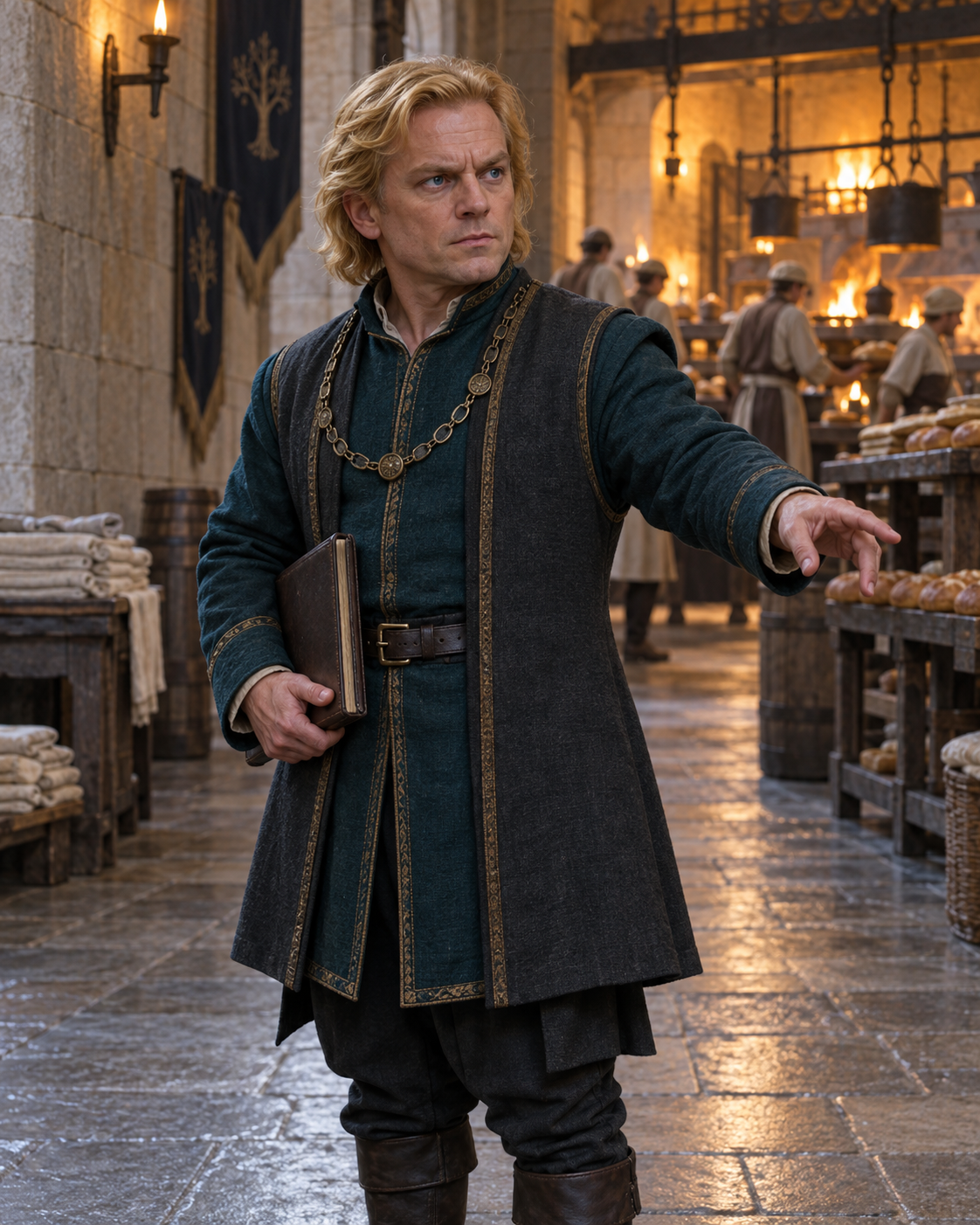
CVM depicts Peter as a sharply handsome mature man around forty-two with a compact proportionate build, steel-blue eyes, fair working-flushed skin, jaw-length swept-back golden-yellow hair, a clean-shaven face, and a focused severe expression. A closed ledger, restrained bronze office chain, and decisive gesture communicate operational authority; each is visual interpretation.
Do not depict him as a child, dwarf, goblin, clown, or sneering caricature because the book calls him small and fierce. Do not add a literal golden bowl as if the name explains itself.
Clothing should fit the Hayholt’s grounded medieval court atmosphere and his senior household office. Exact colors, textiles, facial hair, eye color, age, and scars are not supplied by the text.
Preserve this exact face, mature baseline, compact body, complexion, eyes, golden-yellow hair, clean-shaven state, teal/charcoal/gold wardrobe, chain, ledger, and controlled urgency in funeral, feast, servant-network, directory, hero, social, and every future scene. The same attachment powers featured image, hero, card, and social metadata.
On the Record
Book 1 evidence only, with service confirmed and later life left open
This is Peter Gilded-Bowl’s one canonical, full-spoiler character profile. His confirmed material belongs to The Dragonbone Chair.
The record confirms that he is the Hayholt’s seneschal; small, yellow-haired, fierce, and seemingly everywhere during King John’s funeral preparations; involved in supervising dust and servants while four kitchens produce the funeral food; later serving heavily watered wine at Elias’s late-night feast; and remembered by Simon among the Hayholt workers during the river journey.
The record does not confirm Peter’s exact age, origin, family, romantic life, facial features, eye color, height measurement, clothing, reason for the name Gilded-Bowl, relationship with John, politics under Elias, awareness of Pryrates’s acts, exact authority over Rachel, fate after Book 1, survival through the trilogy, or death.
His last confirmed condition is alive and working. Later status remains unconfirmed.
Visual state: approved editorial reconstruction. One canonical attachment powers the directory card, featured image, hero, Open Graph image, and social preview, with the same Peter preserved across every scene and all unsupported details disclosed as CVM reconstruction.