
Memory, Sorrow, and Thorn · Canonical Character Profile
Noah
Noah is King John’s aged squire, the old retainer trusted with the last intimate objects of a dead king. He brings Fingil’s iron ring to John’s body, places it on the white finger, follows the bier carrying the dragon-crested war helmet, and sobs. His page count is small. His grief is not.
At a Glance
The aged squire carrying a kingdom’s last pieces behind the king he served
- Name
- Noah
- Role
- King John Presbyter’s aged squire
- Book
- The Dragonbone Chair
- Confirmed actions
- Participates in John’s burial preparation, supplies and places Fingil’s iron ring, and carries the dragon-crested helmet behind the bier
- Emotional receipt
- Sobs openly during the final service
- Appearance
- Aged; no other physical description confirmed
- Status
- Alive at King John’s funeral; later fate unconfirmed
- Evidence boundary
- No origin, family, tenure, military history, dialogue, or later biography supplied
The Last Duty of a Squire
Noah’s office is service made personal, and the funeral makes that intimacy visible
Noah is identified as King John’s aged squire.
The title places him close to the practical life of knighthood and royal personhood: equipment, readiness, clothing, ceremonial objects, and the daily work through which a warrior-king’s public image becomes possible.
The book does not enumerate Noah’s ordinary duties. It does not say when he entered John’s service, whether he rode beside him in war, or whether “squire” describes an old formal rank, a household office, or both.
What it shows is the last service.
After John’s death, the king’s body is washed, wrapped, prayed over, dressed in the simple gown of his first knightly vow, and later armored for burial. The ceremony turns a once-living man into an arrangement of dynastic meanings.
Noah stands inside that transformation rather than among the nobles watching it from ceremonial distance.
His age matters because the relationship has duration even when its exact duration is unknown. An aged retainer serving an aged king suggests shared time, but the profile cannot convert suggestion into decades, campaigns, or childhood companionship.
He is neither a generic servant nor a court commentator. He is the named person entrusted with John’s things when John can no longer hold them.
Fingil’s Iron Ring
The object Noah produces carries conquest into the grave
During the preparation of John’s body, Noah produces the iron ring of Fingil.
The ring had been held back earlier in the process. Noah brings it forward and slips it onto John’s white finger.
The action is small enough to miss beside armor, candles, prayers, cloaks, crowns, and the enormous machinery of royal burial. It is also one of the ceremony’s sharpest political gestures.
Fingil was the Rimmersman conqueror associated with the Hayholt’s violent inheritance. Placing his ring on John ties the dead king to mastery, conquest, and the older regimes folded into his rule.
Noah’s custody of the object indicates trust. It does not establish that he owns the ring, chose its inclusion, understands every historical implication, or secretly withheld it.
The text confirms that the ring was held back and that Noah supplies it at the required moment. The reason and decision-maker remain unconfirmed.
His hand completes the symbol. John’s finger is white and passive; Noah must place the inheritance upon it.
That contrast matters. A king celebrated for action has become an object others arrange. His squire performs the final gesture of readiness for a journey no living servant can accompany.
Dressing the Dead King
The ceremony attempts to make John recognizable after death, but Isgrimnur sees the failure
John is dressed in ice-white armor, a dark red velvet tunic, a shining crimson cloak, a black leather sword-belt, and an iron circlet. His beard and hair are arranged in war-braids. Folded gauntlets complete the image.
Noah’s confirmed participation belongs to this burial preparation, with the ring as his clearest named act.
The assembled image is meant to present a warrior-king. Yet Isgrimnur, watching later, rejects the ceremonial body as unlike the laughing and commanding friend he knew.
Noah’s sobbing supplies another kind of resistance. The ritual says ruler, conqueror, knight, founder, and ancestor. Grief says person.
The page should not invent Noah’s opinion of the armor or claim he shares Isgrimnur’s preferred Rimmersman burial. Their reactions sit beside one another without becoming identical.
Nor should it pretend burial dressing is sentimental alone. Every object makes a claim about John’s reign and the authority Elias will inherit.
Noah helps build that claim because service requires him to. His tears show duty has not erased attachment.
The Dragon-Crested Helmet
John’s body goes first; Noah follows carrying the piece that cannot be worn
Once John is wrapped in black cloth-of-gold, six men carry the body away. Noah follows with the king’s dragon-crested war helmet.
The processional placement is exact. Noah is not described as one of the six bearers and does not walk among the royal heirs. He follows with an emblem of John’s martial identity.
The helmet’s dragon crest evokes the king’s defining public legend: John the dragon-slayer, bearer of Bright-Nail, founder of the current order.
Again, the text does not explain whether Noah carried this helmet in earlier years, maintained it, witnessed it in battle, or received it only for the funeral.
What survives is the image of an old squire bearing equipment behind a dead master.
The helmet is empty. That emptiness is the point the ritual cannot hide. The object once shaped around a living head has become a portable sign.
Noah carries the sign while the man is carried ahead of him.
Future scene art may use the helmet only with careful historical styling and clear disclosure that unrecorded ornament is interpretive. The canonical portrait should not rely on it as the only way to recognize Noah.
The Sobbing Retainer
Noah’s tears puncture the polished surface of state mourning
Noah sobs openly.
The detail gives him more than function. He is not an impersonal keeper of regalia moving correctly through a script. The king’s death wounds him.
We are not told whether he cries while placing the ring, carrying the helmet, watching the body, or across the entire sequence. The profile should preserve the emotional fact without staging an exact beat the text does not supply.
His grief also differs from the managed language around John. Priests negotiate competing visions of the afterlife. Courtiers arrange position. Historians and poets begin converting the dead man into public memory.
Noah does not offer doctrine or analysis. He cries while doing the work.
That pairing prevents a false division between competence and emotion. He fulfills the ceremonial role and grieves at the same time.
It also keeps masculine devotion visible without converting it into a speech. The aged squire’s love—whether understood as loyalty, friendship, household attachment, or some mixture—is expressed through service and tears.
The exact private relationship remains unnamed. Calling Noah John’s best friend, foster brother, lifelong companion, or battlefield confidant would exceed the receipt.
A King Becomes Memory
Noah stands at the seam between the private body and the public legend
After death, John increasingly belongs to history-scribes, poets, priests, heirs, and subjects. His body becomes the central object in a ceremony meant to stabilize meaning.
Noah’s work happens at the seam.
He touches the private body while handling public relics. He knows the king as someone who required service, yet he helps prepare the icon future generations will remember.
The iron ring points backward to Fingil. The dragon helmet points toward John’s heroic reputation. Noah carries both historical inheritance and personal loss without narrating either.
This makes him an unusually clean example of how Memory, Sorrow, and Thorn treats history: grand stories survive because particular people hold, arrange, repeat, and mourn material things.
Noah is not credited as a historian. Still, his hands participate in the production of history.
The ceremony would proceed without readers knowing his biography, which is precisely why naming him matters. The archive refuses to let the squire dissolve entirely into “a servant.”
Connections
The dead king, the watching family, and the mourners around Noah’s final service
King John Presbyter
Noah’s royal master and the man whose ring and helmet he handles during burial preparation.
King Elias
John’s elder son and successor, following the bier within the formal procession.
Prince Josua
John’s younger son, placed farther behind the bier amid the divided royal households.
Princess Miriamele
John’s granddaughter, visible in the procession beside Josua.
Duke Isgrimnur
John’s grieving friend, whose rejection of the ceremonial corpse complements but does not define Noah’s sorrow.
The six bearers
Carry John’s wrapped body while Noah follows with the dragon-crested helmet.
Why Noah Matters
Because epic history is most honest when it remembers who carried the helmet
Noah matters because royal death is not self-executing pageantry.
His profile reveals the human labor required to turn a corpse into an ancestor and a reign into memory. More importantly, his tears keep that labor from becoming merely procedural.
He also demonstrates why canonical character coverage cannot be restricted to major players. A one-scene squire may hold the emotional center of an entire ritual.
The proper fandom response is not to invent a sprawling adventure so the page feels “worth” having. It is to organize the scene deeply enough that its existing weight becomes visible.
Noah is old. He served John. He is trusted with Fingil’s ring. He carries the dragon helmet. He sobs.
Those facts already contain service, mortality, political symbolism, material culture, masculine grief, and the conversion of life into legend.
The blanks remain blanks. His later disappearance from the narrative does not become death, retirement, imprisonment, or escape merely because a database wants closure.
Character Image Continuity
The living elderly squire comes first; the funeral objects remain context
Visual state: approved editorial reconstruction. Noah now has one permanent living identity and the canonical profile is published.
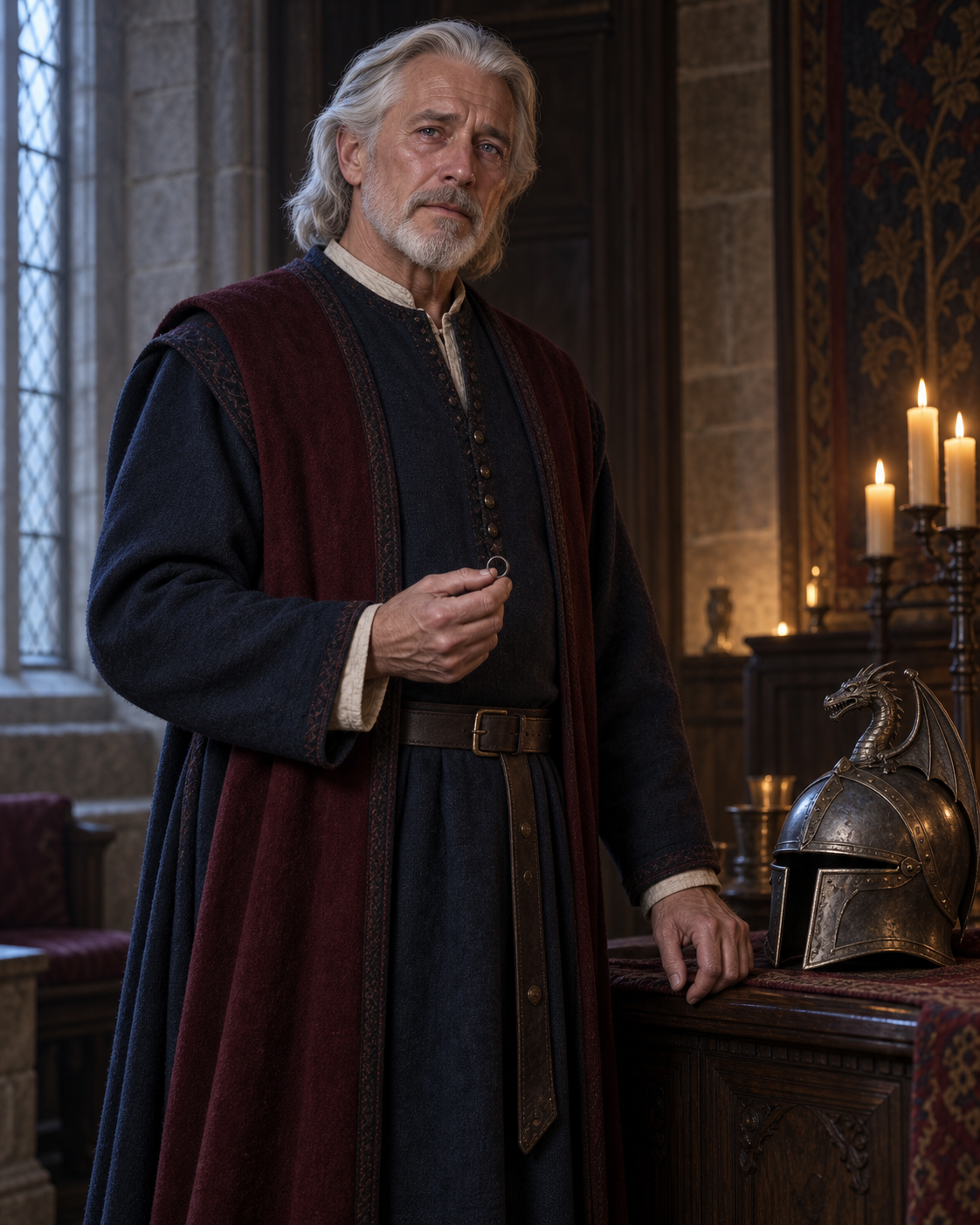
CVM depicts Noah as a dignified, striking elderly Erkynlandish man around seventy-two: tall but age-softened sturdy build, gray-blue eyes, fair skin with honest age lines, swept-back collar-length silver-white hair, and a neat short silver beard and mustache. His wet eyes carry restrained grief without weakening his competence.
Canon does not supply hair color, amount of hair, eye color, skin tone, beard, height, build, scars, clothing, armor, or exact age. The silver-white hair, beard, coloring, body, charcoal-blue and burgundy household clothing, and chamber remain explicitly editorial reconstruction.
The approved portrait shows one small plain iron ring in Noah’s hand and the dragon-crested helmet resting beside him. Both remain secondary to his face and living identity; the helmet’s exact design is reconstruction.
Do not portray John’s corpse as Noah’s featured image. Do not turn the funeral into gore. Do not give Noah a young warrior’s body simply because the house style favors attractiveness.
Preserve this exact face, elderly baseline, body, complexion, eyes, silver-white hair, short beard, charcoal-blue/burgundy wardrobe, and restrained grief across the directory card, profile hero, social image, ring scene, helmet procession, and every historical explainer. The same attachment powers featured image, hero, card, and social metadata.
On the Record
One Book 1 ceremony, one canonical profile, and no manufactured afterlife
This is Noah’s one canonical, full-spoiler character profile. His confirmed appearance belongs to The Dragonbone Chair.
The reading record confirms his name, his identification as King John’s aged squire, his participation in the king’s burial preparation, his production and placement of Fingil’s iron ring on John’s finger, his place following the wrapped bier with the dragon-crested war helmet, and his open sobbing.
It does not confirm his exact age, birthplace, family, appearance beyond being aged, years of service, earlier rank, battlefield experience, private conversations with John, ownership of the ring or helmet, authority over the burial ritual, political allegiance under Elias, life after the funeral, or final fate.
Status is alive at the funeral; later fate unconfirmed.
Visual state: approved editorial reconstruction. One living elderly squire identity now consistently powers the featured image, hero, directory card, Open Graph image, and social preview; unsupported visual details remain disclosed as CVM reconstruction.