
Memory, Sorrow, and Thorn · Canonical Character Profile
Caleb
Caleb is the Hayholt horse-boy who sees what nobody respectable wants to hear. On All Fools’ night, while Green Angel Tower’s bells crash and Simon wakes from a black-ice nightmare, Caleb reports a roar, unfamiliar words, and a green serpent of fire coiling around Hjeldin’s Tower before bursting into sparks. The court answers the clearest waking testimony by laughing at the witness they already crowned King of Fools.
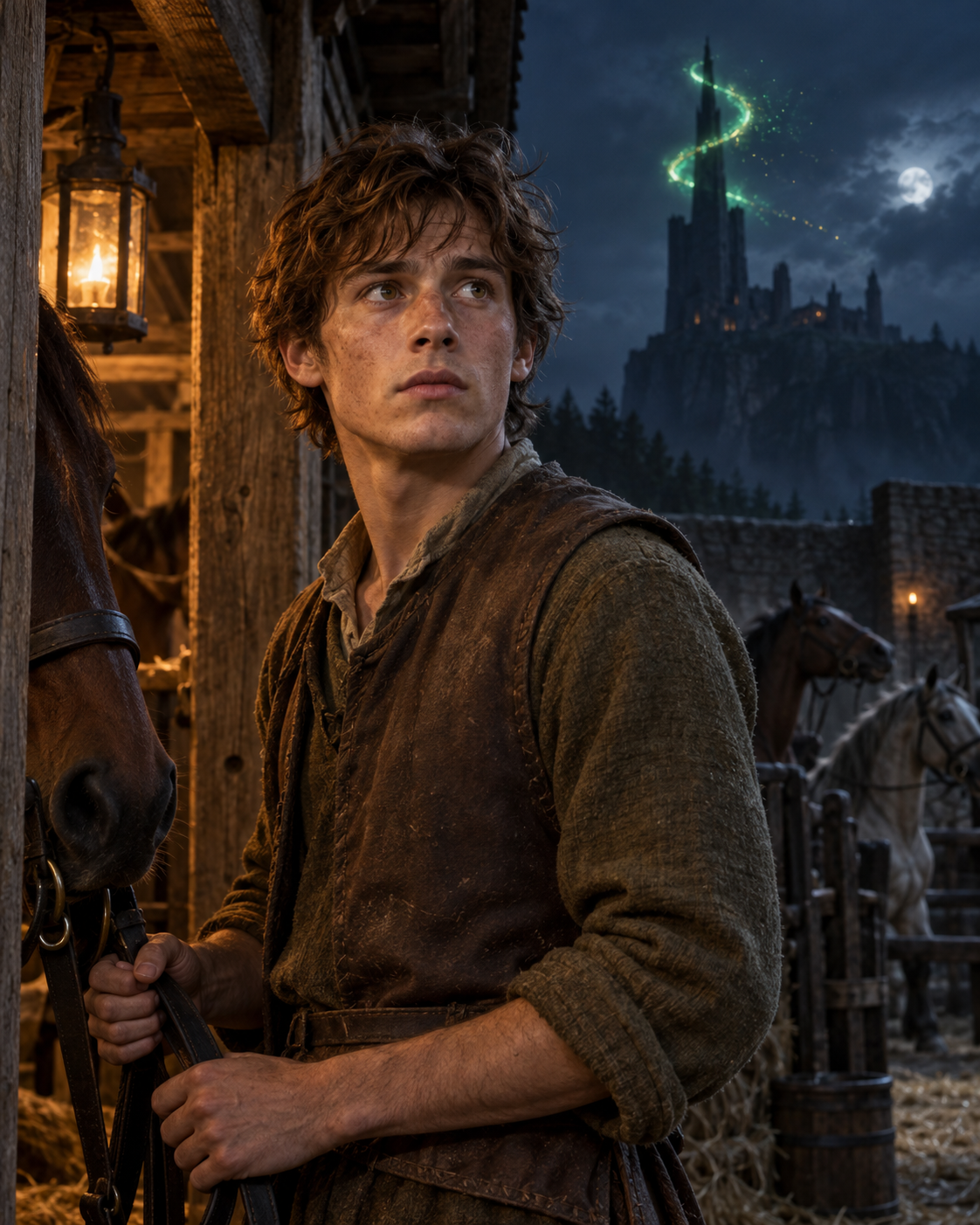
At a Glance
The horse-boy whose social label becomes the court’s excuse not to investigate
- Name
- Caleb
- Work
- Horse-boy at the Hayholt
- Festival role
- Chosen King of Fools
- Social treatment
- Considered slow-witted and easy to ridicule
- Auditory testimony
- A great roar and unfamiliar booming words
- Visual testimony
- A green fiery serpent coiling around Hjeldin’s Tower
- Final visual detail
- The serpent breaks into sparks
- Status
- Alive after his Book 1 report; later fate unconfirmed
All Fools’ Night
The bells ring without a visible hand while the Hayholt’s hierarchy is ceremonially inverted
The disturbance occurs on the cusp of All Fools’ Day, a night already shaped by masks, sanctioned disorder, jokes, and the temporary elevation of people normally kept low.
A tremendous crash shakes the Hayholt. Green Angel Tower’s bells sound without an identified visible cause.
Simon wakes from a dream of climbing black ice with a message clenched in his teeth. Vaporous hands take it, a dark claw grips him, and red eyes appear before the bells break the dream.
Caleb supplies the waking account. He says he heard a roar and words he did not recognize. He saw a green serpent made of fire leap from Hjeldin’s Tower, coil around the spire, and break apart into sparks.
Dawn reveals rain clouds on the northern horizon after prolonged drought. The weather appears ready to reverse, but the record does not prove the tower event caused the storm.
The scene contains multiple phenomena that echo one another without becoming interchangeable proof: Simon’s dream, bells, Caleb’s testimony, the fiery form, and the returning clouds.
Caleb is therefore not “the boy who explains the magic.” He is the witness who gives the most concrete waking sensory report while explanation remains unavailable.
What Caleb Actually Says
His report has sequence, sound, location, movement, color, and an ending
Caleb’s testimony is unusually structured for something dismissed as foolishness.
First comes a roar. Then unfamiliar language or words. The visual event centers on Hjeldin’s Tower rather than the Hayholt generally. A green fiery serpent emerges, loops around the tower, and dissolves into sparks.
Those details do not independently prove a literal supernatural creature. Fire can resemble a serpent; fear and festival expectation can affect perception. The page must preserve testimony as testimony.
But uncertainty is not the same as meaninglessness. Caleb identifies multiple sensory components and a specific spatial path. His account deserves comparison with the bells, Simon’s dream, Pryrates’s work, and later revelations about Hjeldin’s Tower.
The narration does not provide another waking observer who contradicts him. It provides people who dismiss him.
That distinction is crucial. “Nobody believes Caleb” does not mean “the book proves Caleb wrong.” It records the social reception of evidence.
His status as horse-boy may even place him well for observation. Stable labor operates at odd hours and requires attention to animal disturbance, weather, sound, gates, and movement. The book does not explicitly credit him with expert witnessing, so that practical possibility must remain analysis rather than canon.
Waking Witness, Dreaming Witness
Caleb and Simon provide parallel evidence, not a single merged vision
Simon experiences the black-ice climb while asleep. Caleb reports the fiery serpent while awake. The bells connect their moments, but the text does not say they see the same event from different angles.
Simon’s dream contains a message, grasping vapor, a claw, and red eyes. Caleb’s account contains unknown speech, green fire, tower-coiling movement, and sparks. The overlaps create pressure; the differences preserve two distinct forms of witness.
Collapsing them into one solved vision would erase Caleb’s contribution. His report is valuable precisely because it comes from outside Simon’s dream and localizes the disturbance in shared physical space.
Crowned So He Can Be Ignored
The King of Fools title does not temporarily empower Caleb; it pre-discredits him
Caleb has been chosen King of Fools. In festival logic, the low may be raised and ordinary hierarchy mocked for a night.
Yet his elevation does not give his words authority. It makes ridicule easier. The title turns the witness into part of the entertainment.
The record also says others consider him slow-witted. That is their characterization, not a clinical diagnosis and not permission to render him as grotesque, vacant, childish, or less fully human.
Nothing in Caleb’s testimony is incoherent. He reports an event he does not claim to understand.
The court’s response demonstrates that credibility is distributed socially before evidence is evaluated. A horse-boy already treated as foolish can describe the impossible in careful sensory terms and still be dismissed because his identity supplies a ready excuse.
This pattern extends through Book 1. Servants, market people, rural witnesses, northern envoys, dreams, songs, and frightened communities carry pieces of truth that official power labels superstition, treason, or noise.
Caleb’s scene is one compact version of that larger failure. The institution does not have to disprove inconvenient knowledge if it can degrade the person speaking.
The Tower They Should Have Watched
Later knowledge makes Caleb’s report more urgent without rewriting what he knew
Hjeldin’s Tower is the sealed eastern tower associated with mad King Hjeldin and later occupied by Pryrates’s dangerous work.
As the trilogy progresses, the tower becomes inseparable from Elias’s bargain, the swords, Nakkiga’s influence, ritual action, and the widening supernatural crisis.
That later context makes Caleb’s early report look less disposable. It does not make him secretly knowledgeable about Pryrates, Ineluki, the Red Hand, or the exact magical mechanism.
Caleb names what he senses. He does not identify the speaker of the unfamiliar words or the nature of the serpent.
A strong canonical profile keeps those two timelines visible: what the witness knew then, and what the completed series allows the reader to recognize around him later.
This is the difference between full-spoiler analysis and backfilled omniscience. We can connect the event to the tower’s later importance without putting future explanations in Caleb’s mouth.
Connections
The dreamer, alchemist, castle workers, and rulers around Caleb’s ignored warning
Simon
Wakes from the black-ice message dream as the bells crash; his experience parallels but does not duplicate Caleb’s.
Pryrates
Conducts dangerous work within Hjeldin’s Tower, making Caleb’s localized testimony retrospectively urgent.
King Elias
Rules the Hayholt while supernatural disturbance gathers around the tower tied to his counselor.
The Hayholt household
Receives Caleb’s account through a hierarchy already prepared to laugh at him.
Stable workers
Caleb’s labor community, positioned outside the courtly ranks that decide whose speech counts.
The King of Fools
A festival role that appears to elevate Caleb while making his testimony easier to treat as performance.
Why Caleb Matters
He proves the crisis is visible before powerful people agree to see it
Caleb matters because he witnesses an event at the exact place where later catastrophe is being built.
He matters because the book refuses to make access to truth identical with education, title, wealth, or institutional respectability.
Most importantly, he shows how systems protect themselves from warning. The court does not need a coordinated cover-up. Habitual contempt does the work automatically.
His one report belongs beside Towser’s dangerous song, Eolair’s regional evidence, Isgrimnur’s alarm, and market stories about the black death-cart. Each carries information official authority would rather classify as foolish, disloyal, provincial, or superstitious.
Caleb’s profile should therefore never be a novelty page about “the simple horse-boy who saw magic.” It is a page about a worker who reports clearly and a hierarchy that confuses social rank with epistemic worth.
On the Record
Book 1 only, testimony preserved, objective mechanism left unclaimed
This is Caleb’s one canonical full-spoiler profile. His All Fools’ night testimony occurs in Book 1. No direct Caleb receipt appears in the completed Books 2–4 ledger.
The record confirms his name, work as a Hayholt horse-boy, selection as King of Fools, social treatment as slow-witted, report of a roar and unfamiliar words, sight of a green fiery serpent coiling around Hjeldin’s Tower, and its dissolution into sparks.
It does not confirm exact age, physical appearance, family, origin, cognitive diagnosis, literacy, private beliefs, later investigation, relationship to Pryrates, whereabouts during the Hayholt crisis, or final fate. It also does not independently prove whether the serpent was a literal being, magical emission, visual resemblance, or another phenomenon.
CVM’s approved editorial-reconstruction identity portrays Caleb as an attractive young adult with a lean working build, tousled brown hair, hazel eyes, subtly freckled fair skin, practical stable layers, and an earnest alert expression. Canon supplies none of those visual specifics. Preserve this same face, body, coloring, and stable-worker visual language across festival, tower-witness, directory, hero, social, and later retrospective imagery; never turn perceived cognitive difference into caricature or comic degradation.