
STITCH! CHARACTER PROFILE · CREATOR · SCIENTIST · FAMILY DEBT
Jumba Jookiba Character Profile: The Genius Who Keeps Calling His Children Experiments
Jumba can explain what every experiment was built to do. The harder work is admitting what he owes the people they became.
Profile record
Name: Dr. Jumba Jookiba
Role: Scientist, creator of Stitch and the experiment family, household adult
Japanese-branch relationships: Stitch, Yuna, Obaa, Pleakley, returning experiments
Central conflict: Scientific authorship versus responsibility for sentient lives
Japanese voice: Shōzō Iizuka
Appears in: The Japanese Stitch! television branch and specials
The creator arrives before the parent admits himself
Jumba Jookiba prefers the language of invention. It lets him discuss strength, programming, function, and technical success without lingering on the sentient lives created through his ambition. Stitch may be Experiment 626 in the laboratory record, but a child does not stop being a child because the person responsible finds engineering vocabulary more comfortable than family language.
The Japanese anime continues this contradiction after earlier films made Jumba part of a household. He knows Stitch’s body better than anyone, reads new threats quickly, and still slips into treating cousins as devices whose purpose matters more than their interior lives. His brilliance is real. So is the emotional debt attached to it.
Illegal genetic engineering was never a harmless hobby
Comedy can make Jumba’s criminal history feel like a colorful credential. He created beings designed for disruption, destruction, manipulation, and control, then released a family of consequences into systems unprepared to care for them. The fact that many experiments eventually find constructive places does not retroactively make the original design ethical.
A serious profile keeps responsibility attached to intention. Jumba did not accidentally discover Stitch. He built him to satisfy an idea about power and chaos. Stitch’s later capacity for love belongs to Stitch and the people who helped him practice it. Jumba can be proud of growth without claiming that growth proves his methods were wise.
Why Stitch still wants his approval
Stitch can resist Jumba, mock him, ignore warnings, and still listen differently when his creator names a capability or danger. Jumba is the only person who remembers the design before the life. That knowledge gives his praise and rejection unusual weight, even after Stitch has formed families far beyond the laboratory.
The imbalance creates a parental relationship neither character consistently names. Stitch needs recognition that is not limited to performance. Jumba needs to see that technical authorship does not grant permanent ownership. Their best scenes allow expertise, guilt, affection, and frustration to occupy the same conversation.
Yuna makes the consequences personal again
Yuna is not one of Jumba’s creations, which means he cannot explain her needs through programming. When Stitch frightens, injures, embarrasses, or burdens her, Jumba faces the human cost of a power he once treated abstractly. She is a friend and child with boundaries, not an environmental variable around Experiment 626.
Her presence also gives Jumba another chance to practice adult responsibility. He can warn her honestly, intervene before danger peaks, and refuse to make a child responsible for managing alien behavior. When he withholds information because the resulting chaos will be funny, the episode turns his negligence into everybody else’s emergency.
Obaa is his household equal, not his audience
Obaa already understands the impossible through a different system of knowledge. Jumba cannot enter her home and assume scientific vocabulary makes him the sole authority. Izayoi’s spirits, customs, and family rules do not become less real because they cannot be numbered in his database.
Their contrast can produce excellent comedy and a useful correction. Obaa asks what a discovery means for the people living beside it. Jumba asks how it functions and whether it can be controlled. The household needs both questions, but his answer does not automatically outrank hers.
Alien science beside the Chitama Stone
The Chitama Stone promises power after forty-three good deeds, creating a moral technology Jumba cannot fully contain. He can measure energy, speculate about mechanisms, and help the plot translate magic into action. The danger is allowing his explanation to erase the cultural and spiritual structure surrounding the stone.
Jumba’s role works best when uncertainty survives his analysis. A scientist can investigate without converting every mystery into property. The stone also mirrors his own ethical failure: both systems tempt characters to treat behavior as input and power as output while ignoring relationship, motive, and repair.
The cousins expose a factory of abandoned purpose
Every returning experiment carries a designed function and a life that exceeded it. Jumba often introduces them by number, ability, and risk level, which is useful during a crisis and painfully incomplete afterward. A placement is not merely a clever reuse of programming. It is the beginning of a social identity beyond the creator’s intention.
The Japanese branch should remember those earlier placements when cousins return. If Jumba recognizes only their destructive specification, he repeats the worldview the Hawaiian stories worked to challenge. His growth appears when he remembers names, attachments, fears, and choices that have nothing to do with laboratory success.
Pleakley keeps turning genius into a household
Pleakley supplies translation, domestic organization, institutional anxiety, and the social awareness Jumba routinely dismisses until he needs it. Their partnership is funny because their priorities collide, but the joke can hide how much daily labor allows Jumba to remain absorbed in invention.
A fair reading tracks whether Jumba notices that dependence. Affection is visible in their loyalty, arguments, and practiced coordination. Respect becomes visible when he listens before catastrophe, shares the unglamorous work, and stops treating Pleakley’s fear as proof that only the scientist understands the danger.
Hämsterviel and the mirror of ambition
Hämsterviel turns scientific ambition toward domination with far less domestic affection to complicate it. That makes him an enemy and an uncomfortable mirror. Both characters understand experiments as sources of power. The difference lies in what they are willing to learn after the beings they pursue become people.
Jumba’s opposition to Hämsterviel does not erase his own history. It gives him repeated opportunities to reject it. Protecting Stitch and the cousins matters most when he recognizes that nobody, including their creator, is entitled to use them as equipment.
Comedy keeps trying to pay his moral bill
Jumba is hilarious when confidence outruns judgment. He announces danger after causing it, treats an unstable device like a minor inconvenience, and sounds personally offended when the universe follows the rules he ignored. That comedy belongs in the profile because charm is one of the ways the character survives his own history.
Charm cannot be the entire consequence. If every ethical failure ends when the explosion stops, the household learns to absorb his negligence as part of loving him. The sharper episodes let the joke land and then keep the repair visible. Jumba can remain funny while apologizing, disclosing what he withheld, rebuilding what broke, or accepting that somebody else has earned the final decision.
New Town and the danger of becoming an exposition machine
As the anime moves into New Town, Jumba can be pushed toward the edge of Yuna’s school stories. His appearances then risk becoming technical briefings delivered before the younger cast handles the emotional plot. The studio transition changes rhythm, but it should not flatten his unresolved family role.
He remains valuable when science and responsibility stay connected. A warning should reveal what he fears, regrets, or failed to disclose. A gadget should alter a relationship rather than merely solve a chase. His expertise is character material whenever the story remembers who paid for the knowledge.
Shōzō Iizuka’s Japanese performance
Shōzō Iizuka voices Jumba in the Japanese production. His performance gives the scientist enormous comic confidence, gruff affection, theatrical vanity, and a softness that arrives without making Jumba suddenly polished. The voice can make one technical declaration sound like both a boast and a worried parent trying not to admit fear.
This profile records the Japanese performer because it covers the Japanese anime branch. Other-language histories belong in version guides. Iizuka’s performance is the central vocal record for how this production balances scientist, criminal, caregiver, and reluctant father.
What accountability would actually look like
Jumba cannot repair his history by declaring the experiments successful after other people teach them how to live. Accountability requires naming the violence of their design, supporting their choices beyond assigned functions, sharing information before a crisis, and accepting that creation does not equal ownership.
The anime rarely completes that reckoning, which is exactly why he remains interesting. He is loving and negligent, protective and vain, indispensable and frequently responsible for the danger. A deep profile refuses to choose one side and call the contradiction solved.
Sources and image record
Character identification and Japanese casting use the official TV Tokyo character archive, supported by Disney Japan release records and Japanese episode evidence.
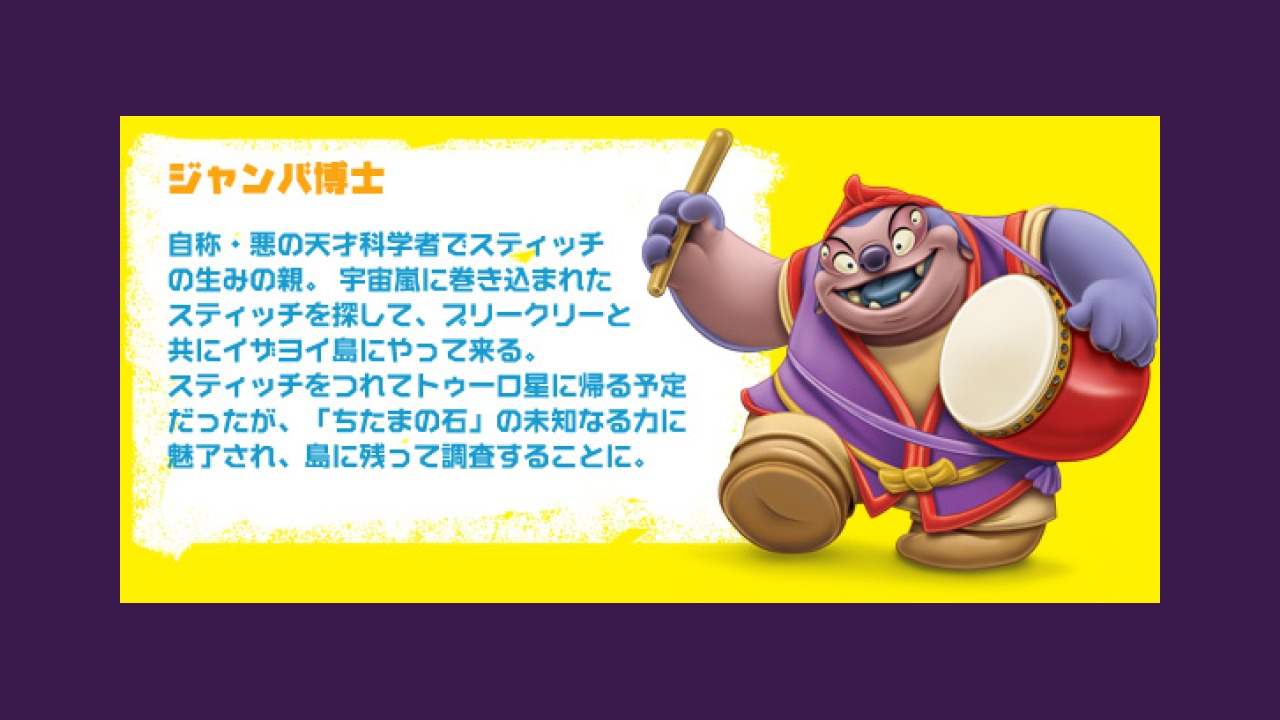
The hero uses official TV Tokyo Jumba artwork stored locally and placed on a CVM Sekai 16:9 canvas without altering the figure. The same local file serves as featured image, hero, and directory card with credit, source, and editorial-use metadata.
Keep exploring
Return to the Stitch! anime hub, open the character directory, or return to the complete franchise.
The character thesis
Jumba Jookiba is Stitch’s creator, technical expert, accidental parent, and the adult most responsible for damage built into Experiment 626. That position should control the profile. A list of appearances, powers, and catchphrases cannot explain why the character matters or what the Japanese series changes by placing this person inside Yuna’s world. The useful question is what responsibility follows from the role, who benefits from the character’s labor, and what the story avoids when comedy arrives before an answer.
Jumba is funniest when the story also remembers that every delightful disaster began as somebody else’s preventable decision. That is the editorial standard for every section below. The profile follows choices, consequences, relationships, performance, and the gap between what the series says the character means and what the episodes actually show.
What the character wants
The central desire is recognition for his brilliance without accepting the accountability that brilliance creates. Desire matters because a character cannot be reduced to the function performed for the plot. Even a recurring comic figure enters a scene wanting comfort, status, information, safety, recognition, privacy, or control. Tracking that want makes repeated behavior legible instead of random.
The conflict the premise keeps reopening
The recurring problem is that he knows more than anyone about Stitch’s body but often treats essential safety information like a punch line or late reveal. A complete profile cannot file that tension under continuity trivia and move on. The premise touches trust every time an episode asks the audience to accept a new rule, new danger, or new emotional arrangement without accounting for who carries the cost.
Body, ability, and restraint
The relevant physical facts include a massive alien scientist whose physical confidence matches his appetite for invention and spectacle. Ability is not personality, and power does not excuse weak emotional writing. The body changes what risks are possible, what other characters fear, and what kinds of help are actually useful. Those facts should remain consistent enough for choices to mean something.
Family is a network of obligations
The relationship map includes Stitch, Pleakley, Lilo, Yuna, Obaa, the other experiments, and everyone forced to live beside his unfinished consequences. Calling these people family is the beginning of analysis, not the conclusion. Family determines who notices an absence, who pays for damage, who gets believed, who performs care, and who is expected to forgive before repair has happened.
Japanese voice performance
The primary performance record here is Japanese: Shōzō Iizuka’s Japanese performance gives Jumba grandeur, comic threat, and flashes of paternal tenderness. Delivery changes the scene. Pace can turn panic into comedy, a pause can expose grief beneath a joke, and a change in pitch can mark the instant confidence breaks. Those choices deserve description instead of a bare cast-credit line.
Where the writing fails the character
The clearest danger is letting lovable-chaotic-scientist energy erase informed consent, repair costs, and creator responsibility. Familiar franchise shorthand can make the audience feel that a scene worked because the character looked and sounded recognizable. Recognition is not development. A repeated gag becomes a writing problem when the same person always loses dignity, privacy, safety, or credit so everybody else can move on.
What growth would actually require
The meaningful growth path is sharing full records, funding repairs, listening before experimenting, and accepting that creation does not equal ownership. Growth must cost more than one speech. It should alter a routine, redistribute labor, change how information is shared, or make a later choice visibly different from an earlier one. Otherwise the episode delivers a lesson that the next script quietly deletes.
Consent and information
Care labor is part of the plot
Meals, cleanup, transport, supervision, translation, repairs, emotional reassurance, and research do not happen by magic. When Jumba Jookiba benefits from or performs that work, the profile names it. Invisible labor often explains why one character appears relaxed while another is always anxious or interrupting.
Comedy, dignity, and the camera
Continuity needs an honest receipt
Place changes the character
Izayoi and New Town are not interchangeable backdrops. A place controls who knows the character, which routines feel ordinary, how quickly help arrives, and whether unusual behavior can disappear into anonymity. Jumba Jookiba should respond to those differences instead of carrying one fixed personality between painted backgrounds.
Knowledge must have a source
Whenever Jumba Jookiba supplies an answer, the profile asks where that knowledge came from. Training, lived experience, observation, records, rumor, and guesswork are not equal. Naming the source makes competence believable and leaves room for another character to know something different.
Friendship outside the central pair
Those connections also prevent the ensemble from becoming a wheel with two characters at the center and everybody else as spokes. Jumba Jookiba deserves scenes where another person’s needs control the conversation and where loyalty is demonstrated through ordinary follow-through.
Repair after the episode ends
Repair is where stated values become measurable without a magical counter. Jumba Jookiba may not be able to undo every harm, but choosing to remain present matters. Leaving somebody else to clean the emotional and physical mess is also a choice, and the profile records it.
Why this character belongs in the franchise
The answer cannot be that the plot already owns the character model. Jumba Jookiba belongs when the Japanese branch discovers a conflict, relationship, or form of humor that only this person can carry. Familiarity should open the door to sharper writing rather than replace it.
The small-scene test
Big climaxes can make almost anybody look important. The better test is what Jumba Jookiba does during breakfast, cleanup, travel, waiting, or an awkward silence. Small scenes reveal habits that spectacle can hide: who listens, who interrupts, who notices discomfort, and who assumes somebody else will handle the boring part.
What future episodes should remember
Future writing should preserve consequences already earned. If Jumba Jookiba learned a boundary, accepted responsibility, or repaired a relationship, the next conflict should begin from that changed position. Repetition can be funny, but total emotional reset makes the character feel rented by each script.
The profile promise
This page will keep separating evidence from affection. Loving Jumba Jookiba does not require defending every choice, and criticism does not erase the pleasure of watching the character. The receipt stays specific so praise can be specific too.
That balance is the point of fandom writing. We can laugh, argue, remember the performance, notice the craft, and still ask the story to honor the person it created.
The final character receipt
Jumba is funniest when the story also remembers that every delightful disaster began as somebody else’s preventable decision. The point is not to punish a children’s comedy for having jokes. The point is to respect the work enough to notice what those jokes, choices, and relationships repeatedly teach.
A JIN-format profile leaves the reader with a person rather than a database entry. Jumba Jookiba should emerge with a desire, a pattern of decisions, a performance history, relationships that demand something, failures that remain visible, and a future that would require actual change.
Jumba, creation, and the bill somebody else pays
Jumba Jookiba is charming because his affection and his irresponsibility arrive in the same enormous body. He can identify an experiment’s hidden function, build impossible technology, and sound genuinely proud when Stitch exceeds his design. He can also withhold exactly the warning that would have prevented the week’s disaster. The Japanese anime needs both truths. Turning him into a harmless eccentric erases the creator whose choices placed dangerous beings into other people’s homes. Turning him into a villain erases the care he has slowly learned to perform.
Creator does not mean owner. Stitch’s body may carry Jumba’s engineering, but Stitch’s decisions belong to Stitch. The same principle applies to the other experiments, especially when Jumba reaches for a control, cure, or upgrade before asking what the subject wants. Scientific competence increases his duty to explain risks in language everybody can understand. It does not grant permission to decide for them. The funniest laboratory accident still has a consent question hiding under the smoke.
Shōzō Iizuka’s Japanese performance gives Jumba the scale the character needs. His voice can fill a room before his invention does, then soften into something unexpectedly parental when bravado stops working. That shift is important because Jumba rarely announces vulnerability cleanly. Pride becomes volume. Worry becomes technical fussing. Shame becomes a joke delivered half a second too fast. Listening for those changes reveals an adult who often knows he failed before he is willing to name the failure.
His partnership with Pleakley exposes the domestic cost of genius. Jumba creates the emergency, Pleakley tracks the schedule, somebody else calms the children, and the household absorbs the repair. A sincere relationship requires more than fond bickering. Jumba has to notice labor before it becomes a crisis, share information before Pleakley drags it out of him, and accept a limit without treating caution as cowardice. Otherwise their comedy depends on one character remaining exhausted enough for the other to stay delightful.
Yuna and Obaa also change Jumba’s accountability. He is no longer operating inside a remote alien bureaucracy or Lilo’s already unusual household. He is a guest in a community with its own routines and spiritual knowledge. His instruments do not automatically outrank local experience, and a technical explanation does not settle a cultural question. The episodes improve whenever Jumba must collaborate with Kijimunaa or Obaa instead of translating their world into data he can claim.
Real growth for Jumba would show up in procedure. He keeps records others can access. He warns the household before activating a device. He funds or performs the repair. He asks Stitch what a modification feels like from inside Stitch’s body. None of that makes him less funny. It gives the explosions a sharper target because the audience knows he had a better option and chose spectacle anyway. Jumba earns tenderness when brilliance finally includes responsibility.
Five receipts the next story cannot skip
Jumba Jookiba needs an episode built around the creator responsibility hidden beneath mad-scientist comedy. That subject cannot remain a line of continuity housekeeping because it determines how every new relationship reads. The script should stage a choice before the crisis, let the choice create a consequence, and return after the spectacle to show who performs the repair. A lesson delivered only in dialogue is too easy to reset. The camera needs to catch the changed routine later, when nobody is announcing that growth has occurred and the character could comfortably repeat the old habit.
The evidence should be ordinary and specific: complete experiment records, advance warnings, bodily consent, and repairs performed by the person who caused the damage. These details turn a profile into a usable record instead of a collection of flattering adjectives. They also give future Reacts something concrete to test. If an episode says Jumba Jookiba has matured while the labor, permission, and information remain distributed exactly as before, the claim has not been earned. If one small decision changes because an earlier failure is remembered, the series has created continuity without sacrificing comedy or pace.
The central contradiction remains a proud scientist who loves his creations but still has to unlearn the belief that knowing their design gives him final authority. Contradiction is not a flaw that needs to be polished away. It is where the character becomes legible. The series can let affection and irritation coexist, let a good intention produce harm, and let an apology be sincere while still insufficient. What matters is that the next scene does not erase the difficult half. Jumba Jookiba becomes more lovable when the writing trusts the audience to notice damage and tenderness at the same time.
A strong visual reading also watches who occupies the frame around Jumba Jookiba. Distance can make a refusal look lonely. A crowded reaction shot can turn embarrassment into public pressure. A close-up held after the joke can return the point of view to the person who absorbed it. Those choices matter in a character whose dialogue may be brief, stylized, frantic, or diverted into comedy. Animation is performance, and posture, timing, eye line, and stillness belong in the receipt beside spoken words.
The final standard is simple enough to remember. Jumba Jookiba should leave the episode with more than restored furniture and a repeated catchphrase. A boundary should be clearer, a relationship should carry new information, or a later choice should reveal that somebody remembered. The franchise can stay bright, strange, and episodic while allowing consequences to travel. That is the version of Jumba Jookiba worth following across films, television branches, cultural settings, and all the messy continuity between them.