
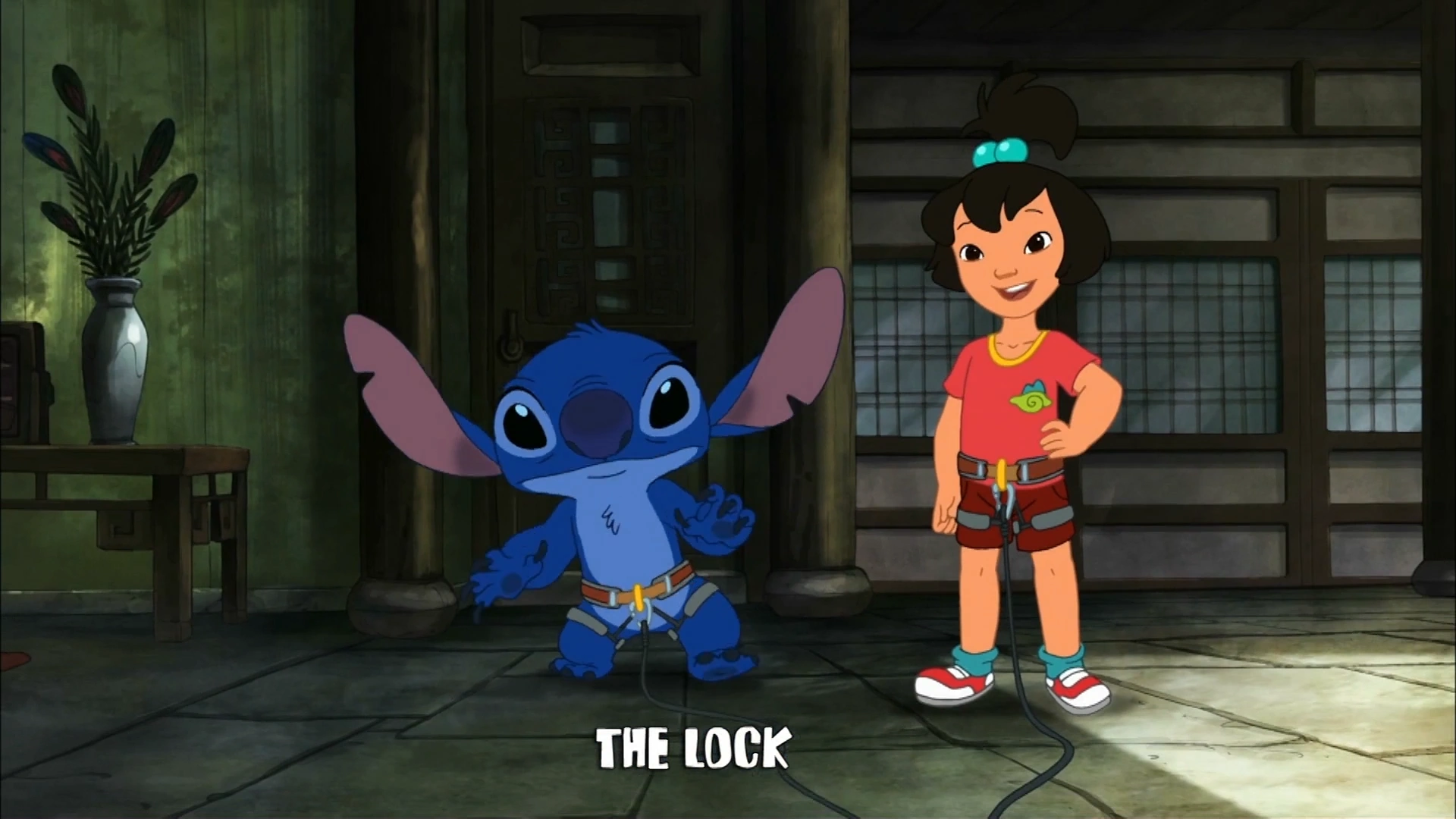
EPISODE 6 · CHINESE TELEVISION BRANCH · THE LOCK · RAE RAE REACTS
Stitch & Ai Episode 6: The Lock
Ai wants a friendship lock to make the bond feel permanent. Stitch disagrees about where it belongs. The lock falls, and the episode has to decide whether an object can secure a promise neither friend finished negotiating.
Ai chooses a lock because she wants proof the friendship will stay
“The Lock” gives Ai a physical symbol for the promise she wants from Stitch. She is already facing the possibility that Daiyu will move her away from Huangshan, and Stitch arrived through abduction, escape, and damaged memory. A permanent lock offers the fantasy that neither distance nor adults nor alien armies can undo what they chose.
That desire is tender and frightened at the same time. The episode works when it lets the object carry anxiety rather than treating it as a simple craft. Ai is trying to secure a relationship in a life where too many decisions happen without her.
A friendship symbol needs two people’s consent
Ai can propose the lock, choose words for her side, and explain what it means. She cannot decide that Stitch must want the same ritual or accept the same placement. A shared symbol only represents the relationship when both people understand and choose it.
Stitch’s disagreement does not mean he cares less. He may dislike the location, the permanence, the public display, or the idea of fastening affection to an object. Ai needs to ask before turning reluctance into rejection.
Stitch has reasons to distrust permanent restraints
He has spent much of his life in cages, restraints, ships, and custody fights. A lock can look romantic to Ai and still carry a different emotional history for him. The episode does not need him to articulate trauma perfectly for the association to matter.
Symbols are not universal. A healthy relationship makes room for different meanings and chooses something neither person experiences as coercive.
The argument over placement is really an argument over ownership
Ai and Stitch each want control over where the lock goes. The conflict becomes less about geography and more about whose interpretation counts. If Ai decides alone, the symbol belongs to her story. If Stitch decides alone, he repeats the same problem from the opposite direction.
They need criteria: safety, permission, accessibility, privacy, visibility, and what the location means to each of them. Compromise is not taking turns ignoring consent.
Public bridges are infrastructure before they become romance displays
Attaching locks to bridges can add weight, damage coatings, trap moisture, interfere with maintenance, create sharp edges, and eventually require removal. Some cities cut thousands of them away because the cumulative load and corrosion become dangerous.
Ai and Stitch should ask whoever maintains the bridge. Affection does not create a private right to alter public property. A removable tag, photograph, drawing, planted tree where permitted, or keepsake at home could hold the memory without burdening infrastructure.
Dropping the lock creates an environmental problem
When the argument sends the object below the bridge, the symbol becomes litter. Metal can corrode, affect water or soil, injure wildlife, and create a retrieval risk. Diving after it without equipment would turn a sentimental mistake into a rescue emergency.
The responsible response is to notify local maintenance, mark the location, and use trained retrieval methods if recovery is safe. Sometimes the object should remain lost until professionals can remove it.
The missing lock does not mean the friendship failed
Ai may interpret the drop as a bad sign because she invested the object with permanence. Stitch may feel blamed for an accident created by both of them pulling against each other. The episode can challenge the idea that a relationship’s future depends on keeping one token intact.
The friendship already exists in choices: Ai helped Stitch when he landed, Stitch protected her, and both refused to let armed factions separate them. Those actions carry more evidence than a piece of metal.
Repair begins by naming the actual hurt
Ai is frightened that Stitch will leave. Stitch is frustrated that Ai turned a shared promise into a demand. If they only argue about the bridge, neither hears the underlying fear. The adults should help them translate accusation into specific feeling and request.
Ai can say she needs reassurance. Stitch can say he needs choice. Then they can create a ritual that answers both needs instead of retrieving the same argument from the water.
Jiejie should not dismiss the lock as childish drama
The object may look small beside alien invasions, but it gives Ai’s relocation fear a visible shape. Jiejie can validate the emotion without promising that nobody will ever move or separate. False certainty will not protect Ai later.
A better response is concrete: explain what decisions are pending, when Ai will be consulted, how contact with Stitch would continue, and what adults are doing to keep both children safe.
Jumba should not solve emotional conflict with technology
His instinct may be to retrieve the lock, create an indestructible replacement, or invent a device that forces agreement. None of those fixes addresses consent. Stronger metal cannot make the promise healthier.
Jumba can help with safe recovery and then step back. The family needs conversation, not a machine that makes separation physically impossible.
Pleakley can recognize why rituals matter
He understands clothing, ceremony, domestic habits, and the emotional importance people attach to objects. That sensitivity makes him useful during the conflict, especially if Jumba treats the lock as trivial hardware.
Pleakley should help Ai and Stitch explore alternatives without declaring one correct Earth custom. Ritual supports a relationship when participants shape it together.
The episode’s qi explanation raises a memory-care problem
The story connects Stitch’s survival during re-entry and his memory loss to special qi energy. That explanation ties the bridge conflict back to the larger identity mystery. Ai wants permanence partly because Stitch’s own past has become unstable inside him.
Jumba must investigate without treating qi as a magical label that ends the medical question. Stitch needs neurological monitoring, culturally informed research, and honest uncertainty about whether memories may return.
Qi cannot become a convenient excuse for every unexplained event
The term carries long histories across philosophy, medicine, martial arts, religion, art, and everyday language. The series uses a fictional energy system. It should say so clearly and avoid implying one mysterious force explains Chinese culture, Stitch’s body, sacred sites, and every creature Jumba builds.
A guide should separate the show’s invention from historical concepts and explain translation choices. Respect begins with admitting the fictional rules are fictional.
Memory loss complicates promises about forever
Stitch cannot fully remember Lilo and the Hawaiian family, so agreeing to a permanent symbol with Ai may feel like making a promise without access to earlier commitments. He should not be pressured to define his whole belonging while injured.
He can promise what he knows now: care, honesty, contact, and no intentional abandonment. Future memory may expand his family rather than invalidate the bond with Ai.
Ai should never be asked to compete with a person Stitch forgot
The continuity problem can tempt the narrative to frame Ai as the current friend and Lilo as the past. That turns two girls into rivals for emotional territory neither created. Ai’s relationship stands on its own without proving she matters more.
When Stitch remembers, adults should support grief and reconnection instead of asking him to choose one home. The lock cannot become evidence in a custody contest.
The bridge is a place of movement, which makes permanence complicated
Bridges exist to cross distance. Ai chooses one as the site for a lock that says the relationship will not move. The tension is beautiful even if the characters do not name it. Their lives are already crossing cultures, planets, memories, and households.
A better symbol might honor movement instead of denying it. They could mark a route they promise to travel back, keep matching maps, or create a message they update as life changes.
Retrieval should not become another dangerous proof of love
Stitch may feel compelled to dive, climb, or use his strength to recover the lock because Ai is upset. Nobody should measure devotion by willingness to risk injury for an object. Ai should not encourage it, and adults should stop the attempt if conditions are unsafe.
If the lock cannot be recovered, accepting loss can become part of the lesson. People replace objects all the time without replacing the relationship.
The alien factions make permanence impossible to guarantee
Jaboodies and Woolagongs continue pursuing Stitch. The Federation has not secured the region, and his memory remains uncertain. Ai deserves reassurance, but no child or alien can honestly promise that external forces will never separate them.
They can promise plans: emergency contacts, meeting points, secure records, people who know how to reunite them, and a commitment to search. Practical continuity is more loving than magical certainty.
A second ritual should include the whole household without erasing the pair
Ai and Stitch may create a new symbol that belongs specifically to their friendship. Jiejie, Jumba, and Pleakley can witness it, help preserve it, or contribute their own promises about safety and communication.
The adults should not take over the ceremony. Their role is making sure the children’s promise exists inside a support system rather than carrying the entire burden alone.
Digital permanence has privacy risks too
Posting the lock, bridge, names, or location online could expose Stitch and Ai to the factions hunting him, tourists, or people seeking the mythical creatures around Huangshan. A public declaration is not automatically safer than a physical lock.
They should choose what remains private, remove location data from images, and avoid identifying routines. Love does not need an audience to be real.
The episode should show who cleans up after sentiment
If locks have accumulated on the bridge, maintenance workers eventually remove, store, recycle, or discard them. Their labor and safety rarely appear in romantic stories. Ai can learn that a tradition affects people beyond the couple or friends using it.
A community-approved installation with limited materials and scheduled removal would respect both ritual and infrastructure. The solution should not shift the burden invisibly to workers.
The next disagreement needs a rule before another object becomes a weapon
Ai and Stitch both pull when they feel unheard. Their physical strength is unequal, and that difference matters even during an ordinary argument. They need a pause word, a rule against grabbing shared objects from each other, and an agreement to involve Jiejie when either person cannot calm down.
Stitch must control his force around Ai, while Ai must stop interpreting every boundary as abandonment. Repair includes practicing a different response before the next crisis, not merely apologizing after the lock disappears.
They can preserve the memory without publishing the location
A photograph of the lock, a copied inscription, or a drawing can remain in a private family archive. The file should omit precise location data because enemies already track Stitch through his routines and meaningful places. Jiejie can keep a backup if the children want one.
The record should explain that the original was lost during an argument, not rewrite the day as a perfect friendship ceremony. Honest memories help people grow. Polished legends make the same mistake easier to repeat.
If workers recover the lock, ownership and disposal still need decisions
Maintenance staff should not be expected to identify every object removed from a bridge. If the family receives the lock back, they can clean it safely, keep it off public infrastructure, recycle it, or reuse the material for a jointly designed symbol.
Returning it to the same railing would ignore the entire lesson. Recovery offers a second choice, not permission to repeat the first one.
What I would keep
I would keep Ai’s need for a friendship symbol, Stitch resisting the location, the argument turning physical, the lock falling, and the realization that the relationship survives even when the object does not.
I would also keep the qi and memory connection because it explains why permanence feels urgent. The emotional problem becomes stronger when it grows from the branch’s continuity wound.
What I would repair
I would require permission before attaching anything to the bridge, avoid unsafe retrieval, name Ai’s relocation fear directly, let Stitch explain why locks trouble him, and create a new ritual based on mutual choice rather than permanent hardware.
I would also give Jumba a medical plan for the memory loss and keep Lilo’s existence present as context without turning her into Ai’s competition.
RaeRae’s verdict
“The Lock” understands that sometimes people fight hardest over a tiny object because saying “I am scared you will leave” feels too exposed. Ai wants forever in metal. Stitch wants a say in what forever looks like. The lock falls because both pull before either listens.
My verdict: retrieve it safely if possible, recycle it if necessary, leave the bridge alone, and make a promise that can change as both lives grow. Friendship is not secure because nobody can open the lock. It is secure because both people keep choosing the relationship when they are free to leave.
Where to watch
Stitch & Ai is not currently available through its former United States DisneyNOW route. CVM Sekai records all thirteen produced episodes in original Chinese broadcast order and will update legal availability when a complete licensed option appears.
Keep exploring
Return to the complete Stitch & Ai episode directory, return to the Stitch & Ai hub, or return to the full franchise hub.