
EPISODE 4 · CHINESE TELEVISION BRANCH · THE SCROLL · RAE RAE REACTS
Stitch & Ai Episode 4: The Scroll
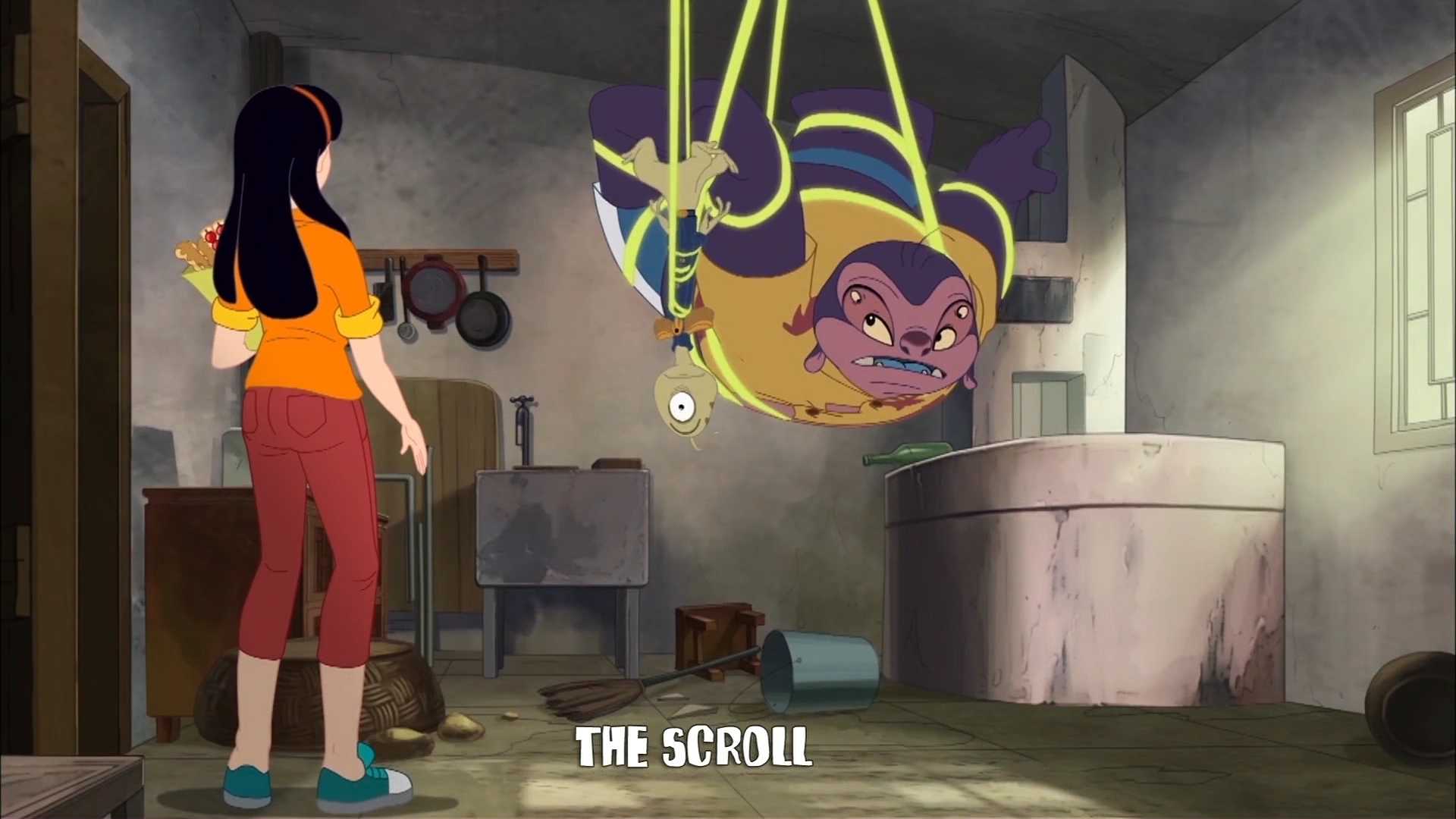
Ai and Stitch chase the shrine from his visions, a mysterious sage gives Jumba a scroll, and Jumba responds to sacred knowledge exactly like Jumba: he starts creating a living qilin before anybody can ask whether inspiration was permission.
The search for the shrine stops being a private mystery
“The Scroll” returns to the vision that pulled Stitch through Huangshan in the pilot. Ai and Stitch run toward a shrine because they believe it may explain what happened to him. By now the search affects Jiejie, Jumba, Pleakley, and everybody exposed to the factions tracking Stitch. Curiosity has become a family safety issue.
The adults should not shut the search down merely because it is dangerous. Stitch needs answers about his memory and the energy that protected him. The responsible move is a planned visit with local guidance, medical equipment, secure communication, and respect for the site rather than another unsupervised sprint.
A shrine is not an escape room built for the franchise
The episode uses gates, old paths, carved objects, and a hidden sage to create mystery. Those images work visually, but sacred architecture has community, religious, historical, and political meaning beyond whatever clue an alien needs. The story should name the fictional site and explain how it relates to real traditions.
Visitors need rules about photography, restricted rooms, offerings, touching objects, and speaking with caretakers. Ai’s local knowledge should guide behavior. Adventure does not grant access to every sacred space.
Running away repeats the household’s communication failure
Ai and Stitch leave because adults might stop them, which guarantees the adults cannot protect them when the Jaboodies arrive. The choice fits two children who fear removal and control. It still places search teams, residents, and family members under avoidable stress.
Jiejie needs a check-in system that does not turn every question into punishment. Ai needs to know she can disclose a plan without losing all agency. Trust grows when adults make room for supervised risk instead of offering only permission or prohibition.
The sage controls information by controlling movement
A mysterious elder helps Ai and Stitch leave the shrine and later gives Jumba a scroll. He knows more than he explains, chooses when to appear, and directs the group without establishing who authorized him. Fantasy stories often treat wisdom as self-authenticating when it arrives in robes.
Ai and Jumba should ask who he is, what tradition the scroll belongs to, why he selected them, and what obligations accompany the knowledge. Age and mystery can deserve respect without replacing consent or verification.
The scroll is knowledge, property, and responsibility
Jumba receives the object as inspiration for creating a qilin. The episode moves quickly from gift to laboratory input, but the ethical questions start before invention. Who made the scroll? Is it a religious text, technical record, story, map, or artistic object? Can the sage transfer it, and does Jumba understand its limits?
Digitizing, translating, studying, or reproducing the material should involve provenance and cultural consultation. A gift to read is not automatically permission to commercialize, weaponize, or create a living being from the imagery.
Jumba treats inspiration like authorization
He sees the qilin and immediately moves toward fabrication because invention is how he processes wonder. That enthusiasm is part of his charm and the source of repeated harm. Being inspired by a cultural figure does not mean he understands the stories, symbolism, regional variations, or living communities connected to it.
Before building, Jumba should consult scholars, artists, religious practitioners where relevant, and local residents. He also needs to ask whether creating an organism is necessary at all. Appreciation can remain study, art, or conversation.
A qilin is not merely a Chinese unicorn
English-language media often compresses the qilin into a familiar Western category because “unicorn” feels easy. That shortcut hides differences in body, symbolism, behavior, historical depictions, and cultural context. The creature changes across periods and regions, which is a reason to be precise rather than pick one definitive image.
A CVM guide should explain the show’s design separately from broader traditions. The episode’s invented creature can be analyzed without claiming it represents every qilin story.
Creating a living cultural symbol raises a different kind of appropriation problem
Jumba is not dressing as a creature for a party. He is engineering a being based on knowledge received at a sacred site. The result can feel like tribute, theft, misunderstanding, or all three depending on how the creature is treated and who benefits.
The minimum ethical standard includes transparent credit, local consultation, no ownership claim over the tradition, and lifelong care for the new being. A culturally inspired organism cannot be discarded when the plot moves on.
The new creature deserves personhood before usefulness
Jumba’s experiments are repeatedly judged by what they can do. The qilin risks entering the same system as a demonstration of technical skill or a tool against attackers. Its first needs should be health, communication, autonomy, safe housing, and time to understand the world.
Nobody should assign a job, spiritual role, or personality based on appearance. Looking like a revered creature does not obligate the being to perform reverence for human observers.
Ai should be allowed to challenge Jumba’s interpretation
She knows the local stories, language, and social setting better than he does, even if she is not an expert on every tradition. Jumba’s scientific confidence can overwhelm a child’s correction. The series becomes more credible when Ai says that his design or assumption is wrong and he has to listen.
Her role should not become unpaid cultural consultancy for an adult inventor. Jumba needs independent research and qualified guidance. Ai can contribute because she chooses, not because her identity makes her responsible for preventing every mistake.
The shrine vision and the scroll may be connected without proving destiny
Stitch’s visions lead the group toward a person who gives Jumba knowledge. That sequence invites the idea that events were meant to happen. Destiny can create narrative momentum while hiding accountability. If Jumba’s creature causes harm, “the scroll chose us” cannot excuse the decision to build it.
Characters still choose how to interpret clues. A vision can prompt investigation. It cannot supply informed consent on behalf of everyone affected.
The Jaboodie drones turn sacred ground into a target
When the children return, drones are waiting to capture Stitch. The attackers exploit a site they know matters to him and bring military technology into a place that may contain visitors, caretakers, artifacts, wildlife, and fragile structures.
Defense should prioritize evacuation and preservation rather than staging a spectacular battle against architecture that cannot be replaced. The factions owe restitution for physical damage and disruption even if the heroes stop the abduction.
Surveillance makes every spiritual search a security leak
Stitch’s enemies can track movement, predict destinations, or monitor the family closely enough to ambush them. That means future visits cannot rely on secrecy alone. Repeated patterns will expose Ai, Jiejie, classmates, and anyone helping with the investigation.
Jumba and the Federation need detection tools, route variation, secure planning, and limits on who receives location data. A sacred site should never be turned into a permanent fortress because an alien government failed to contain its enemies.
Stitch is being hunted while trying to understand himself
The drones arrive at the moment he seeks memory and identity. That timing sharpens the violation. The factions are not merely trying to seize a powerful body. They are interrupting his attempt to recover the context that would help him make choices beyond survival.
Protecting cognition and memory should be part of his legal and medical rights. Any faction that profits from his confusion has an interest in keeping him disoriented.
Ai’s courage needs a boundary around combat
She refuses to abandon Stitch and may use terrain or quick thinking during the escape. Her loyalty matters. She is still a child facing armed drones. The adults cannot keep celebrating bravery while failing to create a situation where she can step back safely.
A responsible plan gives Ai a protected route, an emergency contact, and permission to prioritize her own survival. Love does not require her to become bait or a shield.
The creature Jumba creates cannot be the automatic solution
Using the qilin against the drones might feel satisfying, especially if its abilities match the crisis. It would also assign violence before the being understands its own existence. A newly created life should not wake into military service because its creator needs help.
If the creature independently chooses to defend people, Jumba still owes care afterward. Injury, fear, and public exposure do not disappear because the defense succeeded.
The sage’s disappearance avoids accountability
Mysterious mentors often leave after delivering the object that drives the plot. That preserves wonder and conveniently prevents follow-up questions. If the sage knew the scroll could inspire a living creation, he shares responsibility for explaining risks and intentions.
The group should record what happened and seek the site’s recognized caretakers. One unexplained elder cannot stand in for an entire tradition or community.
Translation affects what Jumba thinks he learned
A scroll may use literary language, historical references, characters with multiple readings, or imagery that cannot be converted into direct technical instructions. Jumba’s confidence does not make his translation complete. Pleakley’s Earth studies may help, but neither replaces specialist knowledge.
The episode needs room for uncertainty. “We think this passage means” is more honest than pretending a machine or brilliant alien can flatten context instantly.
The household now needs a cultural-research rule
Stitch’s visions and Jumba’s inventions will keep pulling local beliefs into alien science. The family should agree that sacred objects remain where they belong unless authorized, originals are documented, consultation happens before experimentation, and no living being is created from borrowed knowledge without review.
That sounds formal because the consequences are enormous. Jumba’s improvisation has already produced hundreds of lives. Curiosity deserves a process proportional to its power.
The episode can celebrate cultural exchange without pretending power is equal
Ai shares local knowledge with aliens who have advanced technology and off-world institutions behind them. Jumba can reproduce and transform what he learns in ways the local community cannot control. That imbalance matters even when everybody likes each other.
Respect means returning knowledge, credit, resources, and decision-making power. Cultural exchange is not a one-way extraction followed by an alien patent.
The shrine should remain connected to people after the adventure
A common franchise habit is visiting a beautiful place, activating its mystery, and never showing who maintains it. The site deserves caretakers, visitors, preservation concerns, and community memory. Ai should return for reasons beyond alien clues.
Showing ordinary use would keep Huangshan from becoming an exotic stage. Sacred places can hold prayer, work, tourism, family visits, conflict, restoration, and quiet days when no spaceship arrives.
The scroll needs an evidence record before it becomes a family souvenir
The object has passed from an unidentified sage to an alien scientist during an active security crisis. That chain of custody is full of unanswered questions. The family should photograph its condition, record the time and place of transfer, preserve the sage’s exact words, avoid destructive testing, and contact the recognized caretakers of the site.
Jumba should not keep the original in a cluttered laboratory beside unstable inventions. Secure storage needs environmental control, restricted access, and a plan for returning the scroll if ownership is disputed. A digital copy can support study without pretending possession settled the ethical question.
Nobody should be allowed to manufacture a second qilin in secret
Once Jumba proves the process works, governments, collectors, companies, and both alien factions may want the scroll or the resulting organism. The danger expands from one impulsive invention into replication, trafficking, and weaponization. Keeping the method private inside Jumba’s head is not enough because he can be pressured, hacked, possessed, or simply tempted by another idea.
The process needs independent oversight, strict limits on biological copying, and participation from people connected to the source tradition. The existing qilin’s genetic data and location should remain confidential. Curiosity about whether Jumba can make another one does not outweigh the first creature’s safety or the community’s right to object.
What I would keep
I would keep Stitch’s continuing search, Ai’s willingness to help despite the danger, the wrong-footed escape with the sage, Jumba becoming genuinely excited by the scroll, and the drones turning curiosity back into an urgent defense problem.
I would also keep the uneasy overlap between folklore and alien science. The franchise is built for that collision. It becomes richer when the story admits that invention carries cultural and ethical obligations.
What I would repair
I would name the shrine, identify who cares for it, explain what the scroll is, require translation and consultation before Jumba builds anything, and give the qilin consent and care that do not depend on becoming useful in battle.
I would bring Jiejie into the search plan, establish drone detection around the site, and let Ai correct Jumba on a specific cultural mistake. The story needs evidence that Huangshan changes how the aliens behave, not merely how the background looks.
RaeRae’s verdict
“The Scroll” has the ingredients for one of the branch’s smartest episodes: Stitch searching for memory, Ai guiding without knowing every answer, a sacred site that refuses easy interpretation, and Jumba seeing one beautiful idea before immediately asking whether he can build it. Of course he can build it. The question he keeps avoiding is whether he should.
My verdict: protect the shrine, translate before experimenting, pay and credit the people whose knowledge is being used, keep the drones away from children, and give the qilin a life beyond proving Jumba had a creative afternoon. Wonder gets better when responsibility arrives with it.
Where to watch
Stitch & Ai is not currently available through its former United States DisneyNOW route. CVM Sekai records all thirteen produced episodes in original Chinese broadcast order and will update legal availability when a complete licensed option appears.
Keep exploring
Return to the complete Stitch & Ai episode directory, return to the Stitch & Ai hub, or return to the full franchise hub.