
Puppets
Katasuke turns a caregiving prototype into a shield, Kara turns stolen research into autonomous weapons, and Ao proves that every tool still carries the choices of its user.
Series: Boruto: Naruto Next Generations
Episode: 184 · Puppets
Arc: Vessel
Release: 2021-01-31
Previous: Episode 183 · The Hand
Directory: All 293 Boruto episodes
Bottom line
Episode 184 takes every friendly laboratory lesson from “The Hand” and throws Team 7 into the ugly field version. Katasuke’s inventions protect people, conserve lives, and expose their own limits. Kara’s inventions erase the operator, hide the mission, and keep attacking after every visible enemy has disappeared. The same broad category of technology serves two completely different moral systems. Then Ao walks into the cave wearing Katasuke’s stolen work across his body and proves that “a tool depends on the user” was never a cute classroom slogan. The user, the institution, the purpose, and the right to refuse all matter.
A quiet opening already knows somebody is missing
A boy watches the sunset before the rescue party reaches the crash site. The calm image does not promise safety. “Puppets” uses that stillness as a breath before the machinery starts moving and the cave becomes a grave.
Konohamaru and Mugino have stopped communicating. Two capable jōnin did not simply forget to send an update. Team 7 leaves the research lab knowing that every minute without contact may mean injury, capture, or death.
Akita packs care into the mission
Akita sends manuals, medical supplies, Chamaru, and enough worry for the entire group. Her fussing remains funny, but her preparation has purpose. Field support begins before the first attack. Somebody has to anticipate wounds, equipment failure, confusing controls, and exhausted users.
Boruto accepted the lab’s argument because specific tools helped specific bodies. Now those tools leave the controlled space where a researcher can pause a test. The rescue mission will show whether the design still supports people when nobody can call time-out.
Katasuke wears a caregiving prototype into combat
Katasuke arrives in a mechanical suit originally developed for caregiving and modified for field defense. The origin matters. Kara builds bodies around obedience and combat value. Katasuke begins with physical assistance, then asks whether the same engineering can protect a rescue team.
Dual use creates responsibility, not automatic guilt. A mobility system can become armor. A medical mechanism can become restraint. Designers cannot control every later use, but they can document limits, protect access, secure research, and refuse to pretend foreseeable misuse came from nowhere.
Sarada leads before anybody throws a punch
Sarada checks readiness, watches the terrain, and questions the evidence around the wreckage. She does not treat Boruto’s urgency as a substitute for a plan. Konohamaru taught Team 7 to investigate as shinobi, and Sarada keeps that discipline when fear could push the group forward blindly.
Leadership here looks less flashy than a Fireball Jutsu. She gathers information, notices patterns, protects Chamaru, and adjusts once the puppets reveal their capabilities. A captain earns trust in those small decisions before any grand speech arrives.
The wreckage tells a story before the puppets move
The airship has crashed, the container stands open, and disabled puppets lie across the ground. Boruto wonders whether Konohamaru defeated them. Sarada searches for a controller. Katasuke studies the technology. Each response fits the person asking.
An empty container matters more than the broken aircraft. Kara did not spend that much money and secrecy transporting air. Whatever escaped or was removed has enough value to trigger murder inside the organization.
Katasuke’s curiosity nearly outruns the danger
Katasuke gets excited by the wreckage because the engineering exceeds what he expected outside Konoha. His curiosity helps identify the threat, but fascination can narrow attention. A scientist sees a discovery where a field team sees an ambush site.
The episode does not shame curiosity. Katasuke’s expertise soon saves everyone. The warning concerns timing. Wonder becomes dangerous when the researcher forgets that unfamiliar machinery may still have orders.
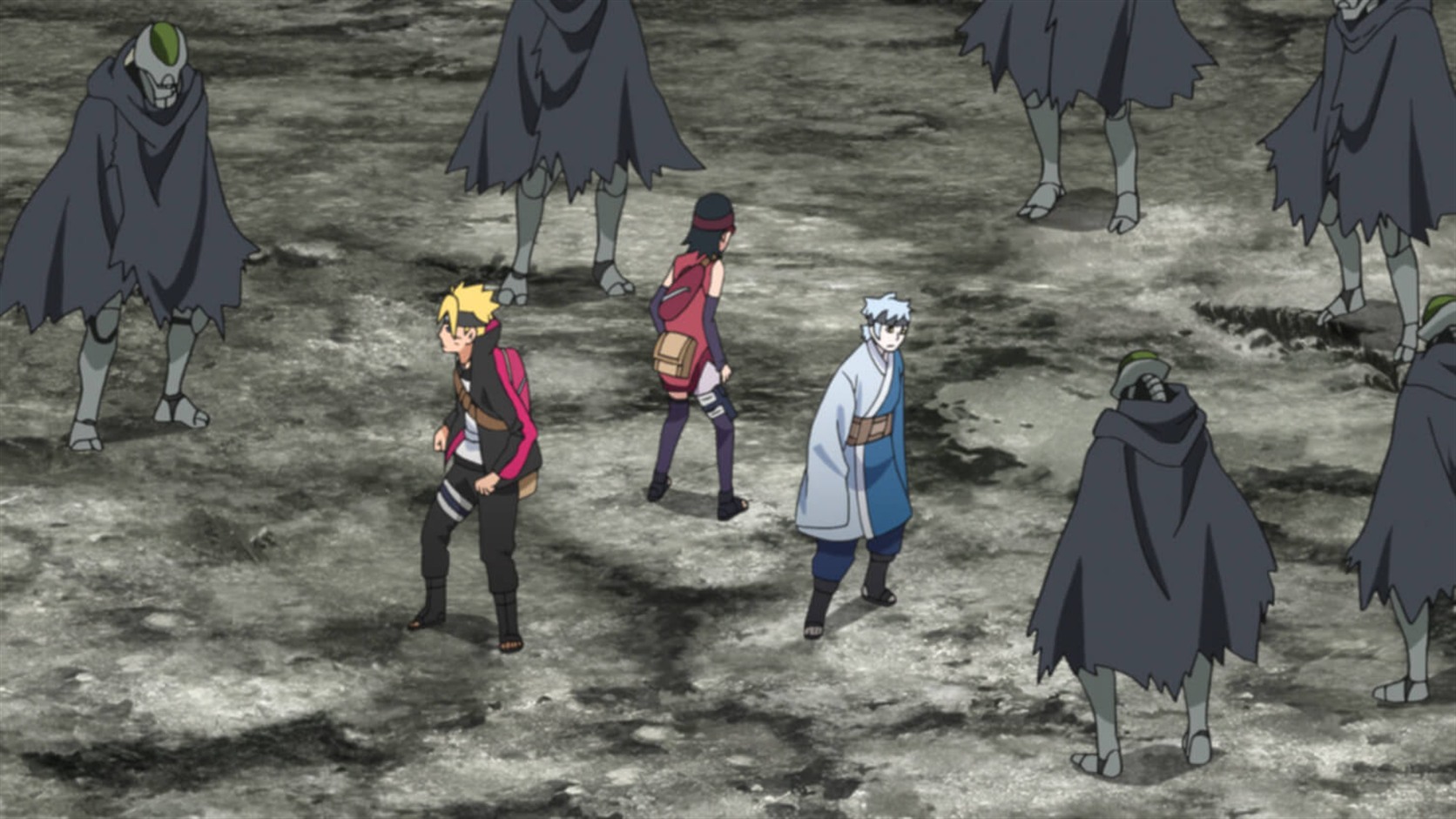
The first puppet does not need a puppeteer
One machine rises and attacks Boruto without chakra threads or a visible operator. Team 7 initially searches for the human control pattern learned from traditional puppet users. Kara has removed that assumption.
Autonomy changes accountability. A hidden designer can launch violence, leave the site, and let software or embedded commands continue the mission. The absence of a person on the battlefield does not make the violence neutral. Somebody selected the target rules and decided acceptable losses.
Team 7 fights like a team
Boruto answers with Lightning Release. Sarada uses taijutsu and Fire Release. Mitsuki brings Wind Release and flexible movement. Nobody waits for one hero to solve the entire circle.
The puppets keep rising because ordinary takedowns do not reach the power system. Team 7 has skill, but skill aimed at the wrong failure point becomes expensive repetition. Katasuke supplies the missing technical diagnosis.
No hand seals means no familiar warning
Sarada notices the machines fire rapidly without hand seals. Traditional jutsu gives an opponent visual information: movement, preparation, likely nature, and a fraction of time to react. Scientific weapons compress or remove those warnings.
Faster activation does not merely increase power. The change alters battlefield literacy. Shinobi trained to read bodies now face weapons whose intent sits inside hardware. Konoha’s curriculum has to catch up.
The puppets keep getting back up
Team 7 knocks the machines down, but they reactivate. That persistence turns a successful strike into temporary delay. Kara’s defense system does not need courage, pain tolerance, or loyalty. The puppets only need power and instructions.
Calling them tireless would miss the real point. Their limits exist, but those limits differ from human limits. Katasuke wins by identifying heat and power supply rather than treating metal bodies like stubborn shinobi.
Katasuke steps between the weapons and the children
Katasuke moves forward in the prototype suit and absorbs the incoming attacks. He does not stand behind Team 7 shouting technical advice while minors take every blast. His research becomes a shield with his own body inside.
That choice does not erase the Chunin Exams. Accountability means using present power differently, not demanding that one brave act cancel previous harm. Katasuke accepts risk because his knowledge makes him the best person for that role.
The absorption system has a visible strategy
The suit absorbs repeated attacks until the puppets overheat. Katasuke does not overpower Kara’s machines through a larger explosion. He lets their programmed firing pattern exhaust their cooling capacity.
Good defense can create time and redirect pressure. The machine’s strength becomes predictable behavior, and predictable behavior creates an opening. Katasuke reads the system rather than admiring the spectacle.
Overheating is a pause, not a defeat
Katasuke immediately warns that the puppets can restart after cooling. That detail separates technical understanding from victory posing. A stopped device may still contain power, instructions, or a delayed trigger.
Team 7 destroys the power supplies and secures one machine for examination. Evidence collection matters because the next unit may improve. Surviving one encounter means little if the village learns nothing.
Konoha no longer owns the future
Sarada believed this level of scientific ninja technology remained exclusive to Konoha. The crash site destroys that comfort. Research spreads through espionage, recruitment, trade, theft, independent discovery, and coercion.
A village cannot build security around permanent monopoly. Konoha needs ethical development, countermeasures, public rules, and alliances. “We invented the better version first” will not stop a weapon already firing.
Katasuke remembers the information stolen from him
Ibiki warned Katasuke that genjutsu may have forced him to leak research. The puppets make that violation physical. Designs once held inside his mind now threaten his colleagues in a remote crater.
Katasuke carries guilt, but blame needs precision. Kara manipulated him. Security failures still require investigation, and Katasuke must help repair the damage, yet coercion remains coercion. Shame should not become free labor for the people who violated him.
Guilt can sharpen responsibility or destroy judgment
Katasuke could freeze, deny the resemblance, or treat every enemy machine as proof that his life’s work was a mistake. Instead, he identifies the system and helps disable the threat.
Useful accountability asks what can be repaired now. Endless self-punishment may feel moral while producing nothing for the people in danger. Katasuke’s expertise becomes part of restitution when he uses knowledge openly and under Team 7’s scrutiny.
Chamaru finds what technology cannot smell
The most advanced wreckage on the field cannot replace Chamaru’s nose. He finds Konohamaru’s kunai and tracks the missing shinobi. His prosthetic leg supports that work without becoming the whole story.
Episode 183 showed the device restoring movement. Episode 184 lets Chamaru use that movement for a rescue. Accessibility becomes participation, not inspiration wallpaper.
The prosthetic leg and the puppet body are not equivalents
Both involve engineered parts, yet purpose and agency separate them. Chamaru’s leg supports his chosen work and relationship with Akita. Kara’s puppets execute hidden commands and attack strangers without refusal.
Technology does not flatten every altered body into the same category. A prosthetic user remains a person or partner. An autonomous weapon remains a weapon. Confusing those two would turn disability into threat imagery, and this episode gives enough evidence to reject that shortcut.
Kara argues about loyalty while others bleed
At Kara’s base, Code wants the authority to handle the traitor. Jigen reminds him about another assignment. Delta trades insults with Code as though cruelty were standard office conversation.
The group possesses astonishing technology and almost no trust. Members compete for access to Jigen, conceal private motives, and measure worth through usefulness. Technical sophistication has not produced a healthy institution. Kara built stronger tools without building a reason for anyone to remain loyal.
Jigen controls information by dividing labor
Code does not receive every answer. Delta does not receive every task. Victor died with incomplete knowledge. Ao operates near the crash site without standing in the Inner circle.
Compartmentalization protects Kara from one captured member, but secrecy also breeds miscalculation. Ao does not know how much Konohamaru recovered. Code does not know the Vessel’s full condition. Every person acts with a fragment while Jigen keeps the map.
Konohamaru has kept Mugino alive
Team 7 finds Konohamaru caring for an injured Mugino in a cave. The reunion brings relief without safety. Konohamaru preserved his partner, secured information, and stayed hidden long enough for help to arrive.
Mugino’s condition carries weight after the previous episode gave him a home, a history, and a friendship with Boruto. He is no longer a spare jōnin placed near the crash. The story has made his life specific before placing that life in Ao’s sights.
The recovered data matters enough to kill for
Konohamaru wants Katasuke to analyze the information gathered from the airship. Intelligence connects the wreckage to Kara and may identify the missing Vessel. Ao appears before that transfer can become secure.
Data functions like another wounded teammate. The group has to protect, transport, and understand the record. Kara’s weapons guard secrecy because information can expose an organization that wins through hidden infrastructure.
Ao arrives wearing the contradiction
Boruto met Ao as a veteran who understood survival, loss, and the burden of advanced prosthetics. Now Ao aims Katasuke’s technology at the people searching for Konohamaru and Mugino.
The betrayal hurts because the train conversation contained truth. Ao really did survive catastrophic injury. He really did struggle with purpose. Kara exploited or redirected that history, but pain does not excuse choosing to murder strangers for a secret employer.
Konohamaru refuses to surrender mission intelligence
Ao demands information about the container. Konohamaru refuses because Ao has no authority over the mission and already arrived armed. That refusal protects Konoha and the unidentified person missing from the wreck.
Professional boundaries matter most when the person asking sounds familiar. Ao’s history as a respected Mist shinobi cannot replace current verification.
Katasuke’s shield meets Katasuke’s stolen weapon
Ao fires the same kind of attack used by the puppets. Katasuke absorbs the barrage, giving Konohamaru an opening to destroy the visible weapon with Rasengan. For one moment, ethical support technology counters stolen offensive technology.
Ao then reveals another weapon hidden in his body and shoots Konohamaru at close range. The concealed system turns apparent disarmament into a trap. Kara’s design language depends on hidden capability and asymmetric information.
Ao’s body is not the villain
Ao uses prosthetics and internal weapons to attack Team 7. The moral failure belongs to Ao’s choices and Kara’s mission, not to an altered body. Chamaru, Naruto, and countless patients already disprove any claim that prosthetic technology causes corruption.
The episode walks near a dangerous trope because the villain’s body contains weapons. Viewers should keep the distinction clear: bodily difference does not make a person deceptive. Ao chooses deception and carries tools designed for surprise killing.
Boruto’s Rasengan meets the lesson from yesterday
Ao tears away one of Katasuke’s absorption arms and uses the stolen device to erase Boruto’s Rasengan. The same principle Naruto demonstrated during their spar now protects an enemy.
Boruto finally sees the full meaning of use. His technique remains real, but one device changes the exchange. Anger at the tool will not solve the fight. Team 7 must understand range, capacity, timing, and the human making decisions behind the mechanism.
Sarada cannot use a plan nobody knows
Sarada considers the Smoke-Flash Bomb, but Konohamaru and Mugino never learned Team 7’s signal. A clever tool without shared procedure can endanger allies. Communication forms part of equipment readiness.
The lab test worked because every participant understood the exercise. The cave has mixed personnel, injuries, low visibility, and no rehearsal. A device can be functional while the plan remains unusable.
Mugino chooses the hold
Mugino grabs Ao and refuses to release him even after Ao drives a hidden weapon through his body. He knows the cave can become the barrier Team 7 needs. His final action creates an escape route by removing himself from that route.
The sacrifice lands because Mugino spent earlier episodes resisting attachment while quietly caring for people. He gave Boruto food, trusted Konohamaru, kept a turtle, and handed over a key he claimed not to need. The man who prepared to vanish chooses exactly who gets to keep going.
Collapsing the cave is not a clean heroic exit
Mugino brings the ceiling down around himself and Ao. Rubble, dust, injury, and panic replace a polished farewell. Konohamaru has to pull the others toward escape because grief cannot stop the enemy.
Shinobi stories often make sacrifice look inevitable after the fact. Mugino’s choice was brave, but the surrounding institutional failures still matter. Kara crossed the border, a hidden operative reached the site, and two jōnin entered without enough support.
Ao survives because the threat is engineered for survival
Ao emerges from the collapse. His augmented body and combat systems turn Mugino’s last move into delay rather than elimination. That outcome feels cruel, and cruelty is the point. Sacrifice does not guarantee narrative fairness.
Mugino still saves time and distance for the others. A rescue action does not become meaningless because the threat survives. The value rests in the lives carried beyond the cave.
Konohamaru has to lead through the shock
Konohamaru does not receive a private minute to understand what Mugino has done. He has injured people beside him, an enemy behind him, and mission intelligence that Kara will kill to recover. Grief arrives as another weight he has to carry while moving.
That pressure explains why command cannot be reduced to giving the best speech in the room. Konohamaru has to recognize Mugino's choice, keep Team 7 from freezing, and prevent Boruto's anger from turning the escape into a second sacrifice. He cannot promise justice yet. He can only get the living out.
The scene also changes the emotional meaning of the rescue. Team 7 came looking for two missing mentors. They find both, but recovery does not mean restoration. One mentor returns wounded and the other stays under the cave. A successful location and a successful extraction are not the same thing.
Boruto cannot punch his way around grief
Boruto wants the world to make immediate moral sense. Mugino protected them, so Mugino should survive. Ao spoke to him with the hard-earned clarity of a veteran, so Ao should not be the person who kills that man. Katasuke built tools to help people, so those tools should not appear in a murderer's hands.
The episode refuses every one of those comforts. Good intentions do not control outcomes. Honest conversations do not guarantee honest loyalties. A worthy sacrifice can buy time without delivering punishment. Boruto's fury is understandable, but fury cannot answer an enemy who already knows what he will try first.
That is the actual test waiting beyond the cliffhanger. Boruto has to keep loving Mugino without turning Mugino's death into permission for reckless revenge. If he charges Ao with the same Rasengan that just disappeared into an absorption device, he honors his own anger more than the man who died to create an escape.
Kara turns every relationship into equipment
Kara's ugliest technology is not the autonomous puppet or the hidden cannon. The organization's ugliest technology is the habit of treating every person as a replaceable component. Victor loses value and disappears. Ao receives a recovery, a purpose, and weapons, but all three come attached to obedience. Code and Delta compete because Jigen keeps affection, information, and status scarce.
Mugino offers the opposite model. His bond with Konohamaru does not make him obedient machinery. Their bond gives him somebody worth protecting and enough trust to make his own terrible choice. Katasuke's caregiving suit follows that same ethic when the suit expands what a person can do without erasing the person inside the equipment.
That contrast keeps the episode from settling for a shallow science-good or science-bad argument. Kara does not become monstrous because the organization uses advanced devices. Kara becomes monstrous because its leaders design bodies, jobs, secrets, and relationships around control. The puppets simply make that philosophy visible.
The title names more than Kara’s machines
The autonomous guards are literal puppets. Katasuke fears becoming a puppet after genjutsu forced information from him. Ao serves Kara while carrying stolen systems. Code and Delta move according to Jigen’s assignments while pretending insults equal independence.
The episode keeps asking who holds the strings. Sometimes commands sit in a machine. Sometimes hierarchy, guilt, coercion, debt, or the need for belonging performs the same work.
What I am watching next
Ao has Katasuke’s absorption arm, multiple concealed weapons, and a reason to erase every witness. Team 7 has incomplete knowledge, wounded adults, fresh grief, and several prototypes whose rules they only learned yesterday.
Boruto also has a personal wound. The veteran who spoke honestly on the train now stands behind Mugino’s death. Episode 185 has to show whether Boruto can separate rage from tactics when the enemy can absorb his most trusted attack.
RaeRae’s verdict
“Puppets” delivers the field exam that “The Hand” promised. Katasuke uses a caregiving suit as a shield, reads the autonomous weapons, and tells Team 7 how to stop them from restarting. Chamaru tracks the missing jōnin because a prosthetic leg returned mobility. Sarada keeps testing evidence instead of assuming every machine follows old puppet rules. Those choices show technology supporting judgment rather than replacing judgment.
Then Ao turns the whole argument inside out. He uses Katasuke’s stolen work, hides weapons inside an altered body, absorbs Boruto’s Rasengan, and kills Mugino for information. The horror does not prove science was a mistake. The horror proves design, access, security, consent, institutions, and users cannot be separated from the object in somebody’s hand. Kara wants tools that obey. Katasuke’s best work helps living beings choose. Episode 184 makes that difference cost a life.
Sources and lawful viewing
Official episode reference: Naruto Official episode guide
Licensed episode route: Crunchyroll licensed series page