
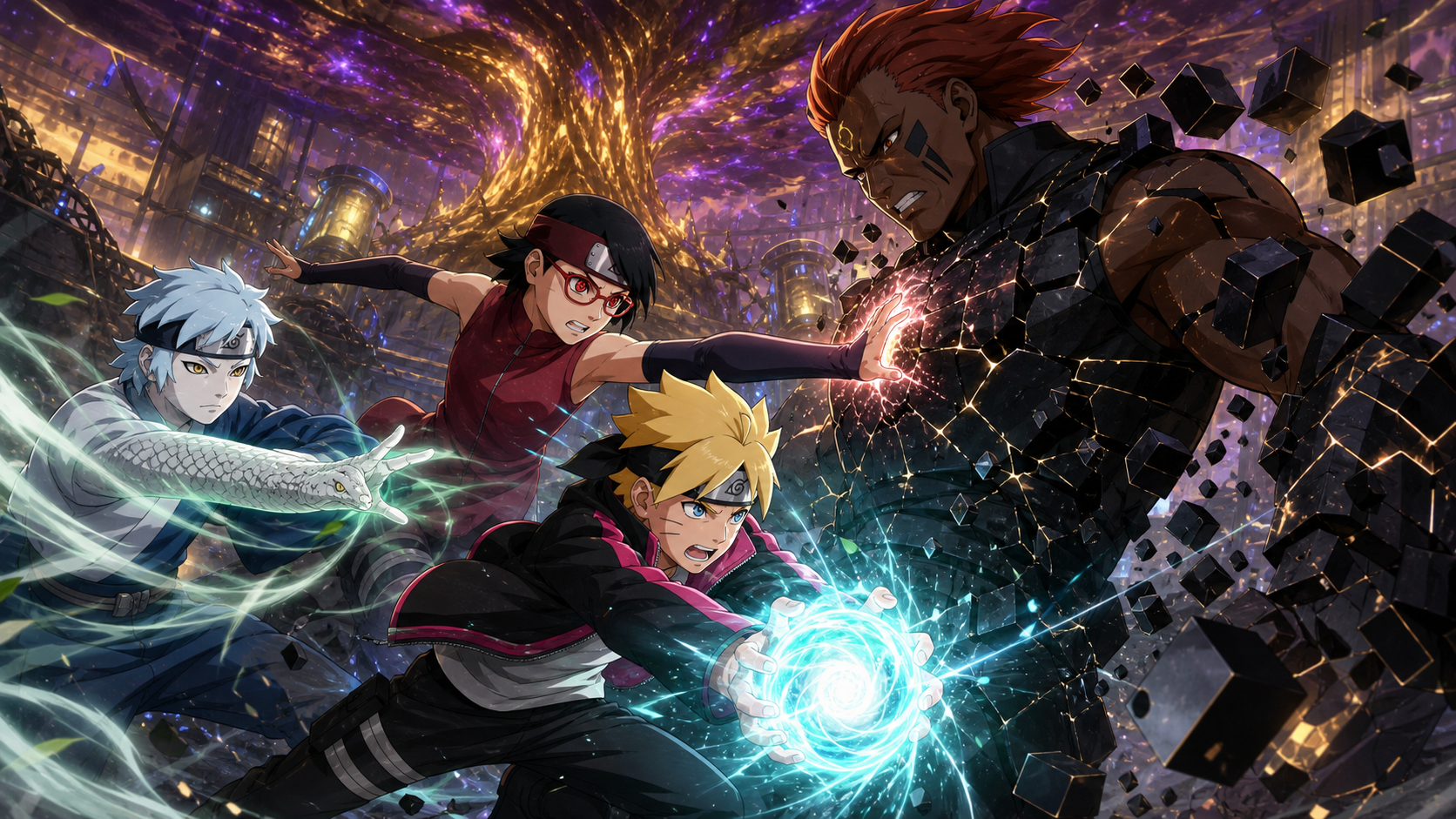
Beyond the Limits!
Team 7 finally defeats Deepa because every member carries part of the win. Sarada sees the opening, Mitsuki returns without stealing the finish, and Boruto learns that stronger power still needs people around him.
Series: Boruto: Naruto Next Generations
Episode: 175 · Beyond the Limits!
Arc: Kara Actuation
Release: 2020-11-22
Previous: Episode 174 · The Revival of the Divine Tree
Directory: All 293 Boruto episodes
Bottom line
Boruto Episode 175 earns the big fight because the victory belongs to Team 7, not one miracle child. Boruto’s High Compression Rasengan finally threatens Deepa’s armor. Sarada’s training lets her read the carbon cubes, survive pressure, and create the opening. Mitsuki returns without stealing the result through forbidden Sage power. They combine wind, lightning, perception, strength, and one dangerous compressed sphere until Deepa’s defense breaks.
“Beyond the Limits!” also understands that exceeding a limit should never mean pretending limits were fake. Boruto’s arm still takes recoil. Sarada’s second tomoe arrives through emotional and physical crisis, not because training owed her an upgrade. Mitsuki returns from critical treatment and still has to protect a body already pushed too far. Team 7 wins because each member knows the others’ boundaries well enough to share the burden.
Across the ruined facility, Orochimaru destroys Victor’s artificial tree and humiliates his research. The irony is loud. A man who pursued immortality through human bodies lectures another man for building a crude imitation. Orochimaru can stop Victor and still remain part of the history that made Victor’s logic recognizable. Useful action is not absolution.
The rematch begins without a guarantee
Boruto and Sarada trained specifically because Deepa destroyed them. Returning to the same opponent creates evidence, not destiny.
Shonen structure tempts viewers to assume a training montage purchases victory. Deepa’s carbon manipulation remains versatile, fast, and lethal.
The children enter with better tools and better information. They do not enter with a contract promising success.
Deepa remembers their weakness
Deepa dismisses Team 7 because the first encounter taught him that their strongest attacks could not penetrate his armor.
His confidence is rational until arrogance stops him from updating the assessment. Boruto and Sarada are not frozen at the mountain-road version he defeated.
Villains lose intelligence when they treat prior data as permanent identity.
Boruto’s new Rasengan changes the pressure
The High Compression Rasengan concentrates force into a small point. Deepa can no longer assume every sphere will disperse across carbon defense.
Boruto still needs time to form and deliver the technique. Deepa recognizes the threat and attacks that preparation window.
An improved finishing move only matters when the team can create enough time for the user to finish.
Sarada becomes the moving shield
Sarada reads projectile paths with improved Sharingan perception and places herself between Boruto and fatal cubes.
She does not become passive protection. Her movement, counters, and chakra-enhanced strikes convert defense into space for the team’s plan.
The role reflects leadership. Sarada protects the decisive technique without surrendering her own agency.
Two tomoe arrive through protection, not ambition alone
Sarada’s Sharingan develops a second tomoe while she refuses to let Boruto fall. The emotional crisis connects fear, resolve, and responsibility.
She wanted stronger eyes for Chidori and the Hokage path. The actual trigger centers another person’s life.
That distinction keeps the awakening from feeling like a trophy handed over for wanting power loudly.
Training made the awakening usable
Emotion may trigger the second tomoe, but Sasuke and Sakura built the foundation that lets Sarada survive the moment.
Her eye can process more because she practiced tracking. Her body can answer because Sakura forced perception into live movement. Her strength can alter the battlefield because chakra control supports delivery.
Power awakening and skill development are not competing explanations. The episode joins both.
Sarada’s Hokage promise becomes tactical
Sarada says she cannot lose because she will become Hokage. The statement could become empty ambition in another scene.
Here, the vow sharpens her responsibility toward Boruto, Mitsuki, civilians, and the mission. Leadership means staying functional while other people depend on the opening she creates.
The dream matters because the behavior begins before the title.
Mitsuki returns as a teammate, not a bailout machine
Mitsuki enters after critical treatment and restores Team 7’s full formation. His presence carries emotional weight because the earlier rescue nearly destroyed him.
The episode avoids making Sage Mode the instant solution. Mitsuki contributes wind, lightning, mobility, and coordination within safer limits.
That restraint shows growth for the whole team. They cannot keep asking Mitsuki’s hidden power to erase every failed plan.
Orochimaru lets Mitsuki choose the risk
Mitsuki’s return implies negotiation with the person treating him. Orochimaru understands the physical danger and still recognizes Mitsuki’s agency.
The choice remains complicated because Orochimaru designed Mitsuki’s body and controls access to specialized care.
Agency means more when the story acknowledges the power imbalance rather than calling every permitted choice freedom.
Team 7 attacks as a system
Mitsuki’s Wind Release shapes pressure. Sarada’s lightning and movement disrupt Deepa’s timing. Boruto compresses the finishing force.
No single technique produces the full result. Their attacks interact.
Teamwork becomes more than shouting names in sequence. Each member handles a different constraint inside the same plan.
Deepa’s carbon armor is both strength and trap
Deepa can harden his body against enormous damage. The defense encouraged him to stop respecting ordinary attacks.
As Team 7 concentrates force, the armor’s rigidity becomes a target. Cracks cannot redistribute pressure forever.
Deepa’s greatest protection also locks him into the belief that endurance will replace adaptation.
The carbon cubes remain terrifying
Deepa’s projectiles can shift size, angle, and speed while attacking from multiple directions. Shinki’s Iron Sand struggled against them.
Sarada’s improved perception does not make every cube harmless. She spends stamina and risks injury with each read.
The action works because defense remains expensive even after the upgrade.
Boruto cannot rush compression
The new Rasengan demands controlled density. Panic can destabilize the sphere or worsen recoil.
Boruto must trust Sarada and Mitsuki long enough to complete the technique. That trust reverses his old habit of charging first and expecting teammates to follow.
Patience becomes part of his offensive power.
Recoil makes support physically necessary
Delivering the High Compression Rasengan threatens Boruto’s arm and balance. Teammates help stabilize the approach and aftermath.
The final strike therefore cannot become a solo hero image without lying about the mechanics.
Team 7 wins because the group carries force no individual body can safely carry alone.
Sarada does not disappear after creating the opening
The episode keeps Sarada active through the finishing sequence. Her strength and positioning matter until contact.
Too many team battles let the girl protect the boy once, then move aside for the signature attack. Episode 175 gives Sarada tactical ownership.
Her second tomoe changes the fight because she uses the perception immediately.
Mitsuki contributes without reopening every wound
Mitsuki’s techniques support the final Rasengan while avoiding the catastrophic transformation used during escape.
That balance honors his desire to fight and the medical reality of his recovery.
Protecting Mitsuki from all risk would deny his profession and choice. Treating his body as limitless would repeat the earlier failure.
Deepa finally has to take them seriously
Cracks in the carbon armor force Deepa to abandon amusement. Team 7 becomes a threat rather than prey.
The recognition feels satisfying, but the children do not need his respect as a prize. They need his defeat because he threatens lives and guards Victor’s disaster.
Villain approval should never become the emotional center of their growth.
The final Rasengan belongs to three people
Boruto holds the sphere, but Sarada and Mitsuki create and stabilize the delivery. The image of one hand at the center should not erase the surrounding labor.
Team 7’s earlier loss happened when isolated strengths bounced off Deepa separately. The rematch joins those strengths into one pressure point.
That structure makes the victory credible inside the episode’s logic.
Defeating Deepa does not restore the dead
Hiruga, Asaka, Kakui, Marui, and every victim of Victor’s experiment remain dead or harmed. Deepa’s defeat cannot refund those lives.
Victory prevents future violence and validates the team’s training. Revenge alone would offer less.
The episode should allow celebration without pretending consequence vanished.
Orochimaru meets Victor as an ugly mirror
Victor wants regeneration, immortality, and knowledge through human experimentation. Orochimaru recognizes the ambition because he pursued similar goals.
The difference lies partly in competence and partly in whatever boundaries Orochimaru has developed after the war.
Watching one abuser mock another’s methods should feel satisfying and uncomfortable at the same time.
Orochimaru’s expertise saves lives
Orochimaru understands Hashirama cells, artificial bodies, barriers, and unstable life systems. That knowledge lets him identify and destroy the imitation tree.
Useful expertise can come from a morally compromised source. Rejecting the help would endanger more victims.
Accepting help does not require rewriting how the expertise was acquired.
Victor confuses longevity with victory
Victor survived war, replaced body parts, built a company, joined Kara, and reached toward a chakra fruit. None of those achievements teach him how to value another life.
He treats continued existence as the highest possible outcome.
The artificial tree exposes the emptiness of survival purchased by consuming everyone nearby.
The fruit fails because the process was never whole
Victor reproduces pieces of Divine Tree biology without the complete conditions. The bud promises more than the system can deliver.
Partial knowledge plus human sacrifice produces instability, not transcendence.
Orochimaru’s contempt targets scientific sloppiness, while the story must also condemn the ethical premise.
Konohamaru cannot overpower Victor alone
Victor uses multiple chakra natures, regenerative modifications, and hidden techniques. Konohamaru struggles.
That difficulty should not erase his competence. He infiltrated the company, exposed the room, protected the daimyō, and survived an Inner.
Leadership is more than winning a one-on-one fight against every threat.
Mugino’s survival remains part of the mission
Mugino entered under an omen and spent the operation beside Konohamaru. Getting him out matters.
The adult pair followed evidence into danger so the younger team would not have to investigate blind.
Extraction honors their work more than a dramatic sacrifice invented for emotional fuel.
Burning the tree protects the Land of Valleys
Orochimaru and his clones form a barrier and destroy the imitation. The act prevents roots from spreading and the bud from opening.
The Land of Valleys avoids becoming the next sacrifice zone for a great-power experiment.
The rescue also proves why regional threats require cooperation without allowing Konoha to claim ownership of the nation afterward.
The facility still contains victims and evidence
Winning the fights does not finish the emergency. Test subjects need treatment. Employees need evacuation and investigation. Records need preservation.
The destroyed tree may leave contaminated cells, unstable roots, or medical complications.
After-action work decides whether the climax becomes justice or only spectacle.
Deepa’s defeat should not erase Kara
Deepa is one operative inside a larger organization. Victor’s company is one node.
Kara has other Inners, Outers, resources, and plans. Team 7’s victory supplies evidence that resistance works without making the network small.
The next mistake would be assuming the threat ended because one armored man fell.
Beyond the limits means shared growth
Boruto exceeds the damage limit of his old Rasengan. Sarada exceeds the perception limit of one tomoe. Mitsuki returns while respecting a physical limit Sage power once shattered.
The phrase does not mean bodies have no boundaries. The team extends capability through training and cooperation.
Shared support turns a dangerous edge into a controlled step.
Team 7 earns the reunion
The three children do not simply stand together for a nostalgic pose. Their separation changed what each brings back.
Boruto carries compression and patience. Sarada carries perception, strength, and leadership. Mitsuki carries the decision to return without destroying himself.
The reunited formation answers Deepa because each person arrives different.
The victory is imperfect enough to matter
Boruto’s arm remains at risk. Sarada’s new tomoe does not equal Chidori mastery. Mitsuki remains medically vulnerable. Orochimaru remains Orochimaru. Victor and Deepa connect to a network larger than this facility.
Episode 175 delivers the payoff without declaring anyone complete.
That is why the climax works. Team 7 does not become perfect. They become capable of protecting one another through a fight that once destroyed them. The difference is training, honesty, support, and the refusal to spend Mitsuki as the emergency exit again.
Boruto's arm is not an acceptable hidden price
The High Compression Rasengan produces enough force to challenge Deepa, but Boruto's body still absorbs recoil. A technique that wins today and destroys the user's arm tomorrow cannot become the team's routine answer.
Kakashi warned Boruto about the danger during training. That warning creates responsibility after the victory. Konoha needs medical evaluation, clear use limits, recovery time, and continued refinement before anyone treats the technique like an ordinary mission tool.
Boruto also needs permission to stop without being called weak. Hero culture can turn pain into proof of commitment. Team 7's better lesson says a shinobi protects the body that must return for the next person who needs help.
Sarada's second tomoe should expand training, not erase caution
The new tomoe improves tracking and prediction, yet sharper perception can tempt Sarada to demand more speed from a body still developing. Seeing an attack does not guarantee muscles can answer safely.
Sakura's training already established that gap. Sarada must keep building movement, stamina, recovery, and chakra control around the eye. Sasuke should also explain strain, emotional triggers, and the history of a clan whose power was repeatedly cultivated through trauma.
Sarada deserves a route to mastery that does not ask her to seek suffering. The second tomoe emerged while protecting Boruto. Future growth should come through disciplined practice and supported relationships, not adults waiting for another crisis to unlock the next stage.
Mitsuki's return needs medical boundaries after the applause
Mitsuki chooses to rejoin the fight, and that choice matters. Choice alone does not make every risk reasonable when specialized treatment barely stabilized his organs. Orochimaru and Konoha still owe him honest information about what his body can withstand.
The team should debrief which techniques Mitsuki used, whether the strain reopened damage, and how long recovery will take. Friends can support his agency by asking those questions instead of celebrating that he arrived on cue.
Mitsuki has spent much of life treating Boruto's safety as a command written into his own purpose. A healthier Team 7 makes room for Mitsuki's goals, fear, pain, and future beyond becoming the person who saves everyone at personal cost.
Deepa loses because he cannot imagine mutual dependence
Deepa treats appetite and invulnerability as proof that other people exist beneath him. Team 7's plan depends on the opposite belief. Each member accepts a moment when another person holds the fight together.
Boruto trusts Sarada to read attacks he cannot watch while compressing chakra. Sarada trusts Mitsuki and Boruto to convert her opening into an ending. Mitsuki trusts the team not to demand Sage Mode as the price of belonging.
Deepa's armor isolates him physically and morally. He can harden alone, attack alone, and consume alone. Once three people coordinate around the limits of that defense, isolation stops looking like strength.
Orochimaru's intervention creates an accountability problem
Konoha benefits from Orochimaru's knowledge because Victor's artificial tree poses an immediate mass-casualty threat. The village still needs a record of what Orochimaru did, which materials he accessed, what samples remained, and whether his clones removed anything from the facility.
Trusting expertise during an emergency cannot mean abandoning oversight. Orochimaru has a long history of treating bodies, bloodlines, and forbidden research as personal resources. A successful rescue does not make unsupervised access harmless.
Naruto's administration should preserve evidence and ensure Land of Valleys authorities receive the findings. Orochimaru can be necessary to the operation without becoming the owner of the aftermath.
Victor's employees do not all carry equal guilt
The facility contains senior researchers, coerced workers, ordinary staff, guards, test subjects, and people who may know only the public company. A raid can flatten those differences if every employee becomes “Victor's people.”
Investigators need to determine who designed experiments, who approved harm, who concealed deaths, who tried to resist, and who never had access to the hidden rooms. Employment inside a criminal company is evidence to examine, not a complete verdict.
That distinction also improves intelligence. A frightened laboratory worker may know shipment routes or unexplained orders without understanding Kara. Treating every witness as an enemy encourages silence and destroys the information needed to find the wider network.
The Land of Valleys owns the crime scene
Konoha shinobi and Orochimaru stop the immediate threat, but the facility stands inside another country. Local authorities and victims should control the long investigation, supported by outside expertise rather than displaced by the most powerful village present.
Evidence includes corporate records, environmental samples, personnel files, medical data, and testimony from survivors. Removing those materials to Konoha without agreement would repeat Victor's habit of treating the nation as a source of resources.
Cooperation becomes ethical when the people who paid the cost retain a voice over truth, repair, and prosecution. Saving the country today does not purchase authority over the country's tomorrow.
Team 7 needs a debrief as much as a celebration
The rematch resolves an emotional wound, but every member experienced a dangerous threshold. A real debrief should cover Deepa's changed tactics, Sarada's awakening, Boruto's recoil, Mitsuki's medical condition, civilian exposure, and the assumptions that nearly failed.
The team also needs to name what worked without turning success into a mandate to repeat the exact plan. Deepa's defense made concentrated force useful. Another opponent may punish the preparation time or target the support formation differently.
Learning preserves the victory. Celebration tells the children they survived something important. Debriefing tells them the village values whether they survive the next mission too.
Sakura should control the return-to-duty decision
Sarada, Boruto, and Mitsuki all leave the fight with reasons to underestimate damage. Adrenaline can hide pain, victory can make weakness feel embarrassing, and the next mission can arrive before a child admits something still hurts.
Sakura's authority as a physician matters more than parental pride or team excitement. She can evaluate Boruto's arm, Sarada's visual strain, Mitsuki's organs, and the cumulative injuries none of them noticed during combat. Return-to-duty standards protect the children from pressure they may place on themselves.
Medical clearance also creates a record for future training. If the High Compression Rasengan produces lasting damage or the second tomoe changes Sarada's recovery needs, the village should know before repetition turns one triumphant technique into a chronic injury.
Sources and lawful viewing
Official episode reference: Naruto Official episode guide
Licensed episode route: Crunchyroll licensed series page