
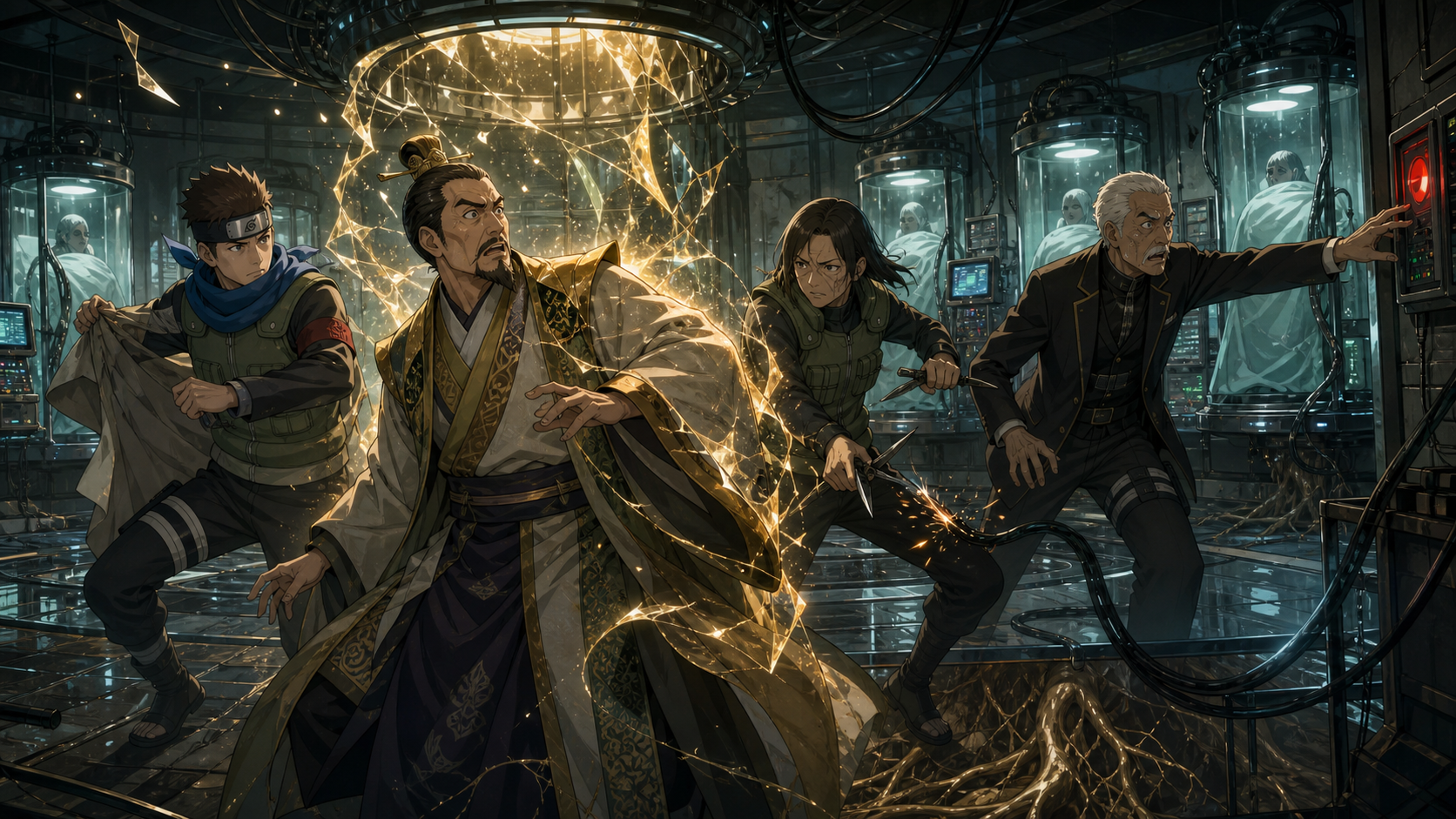
The Secret Behind the Underground Room
Mia receives Anato’s ring while Victor sells a ruler an illusion. Konohamaru and Mugino make the hidden room visible, but discovery is only the beginning of rescue, proof, and accountability.
Series: Boruto: Naruto Next Generations
Episode: 173 · The Secret Behind the Underground Room
Arc: Kara Actuation
Release: 2020-11-08
Previous: Episode 172 · A Signature of Fear
Directory: All 293 Boruto episodes
Bottom line
Boruto Episode 173 exposes two rooms built to protect Victor. The first is the story he gives Mia: Anato died during dangerous research, everybody tried their best, please accept the company line. The second is the laboratory shown to the Land of Valleys daimyō: clean progress, humanitarian purpose, nothing alarming beneath the floor. Boruto, Sarada, Konohamaru, and Mugino break those rooms open from different sides.
“The Secret Behind the Underground Room” is strongest when the victims remain more important than the mystery. Mia receives Anato’s ring and the news that her husband will not return. Human test subjects lie inside Victor’s facility while genjutsu teaches the ruler to see a respectable company instead. Anato was not unlucky scenery for Team 7’s training arc. The people underground are not laboratory props for a cool reveal. Victor built his authority by converting human lives into data and then controlling who gets to see the bill.
The episode also tests whether Boruto and Sarada learned anything beyond new techniques. They want to help Konohamaru and Mugino, but responsible action begins with Mia’s safety and an honest assessment of the danger. A stronger Rasengan does not grant Boruto jurisdiction over grief. A sharper Sharingan does not make Sarada immune to Victor’s preparation. Growth means knowing when evidence, protection, and teamwork matter more than charging first.
Returning the ring is a duty, not closure
Boruto and Sarada bring Anato’s ring to Mia because personal property should return to the person who loved him. The gesture acknowledges a life beyond the mission report.
The ring cannot close grief. No object can replace a husband, explain his final hours, or repair the betrayal hidden inside his employer.
Returning the item gives Mia something tangible while also forcing Team 7 to speak plainly about failure.
Mia deserves the truth they actually know
Boruto and Sarada tell Mia that Anato died. They cannot offer every answer because Victor controlled access, Deepa interrupted the mission, and the investigation remains active.
Honesty includes naming uncertainty. Pretending certainty would repeat Victor’s habit of shaping reality for the listener.
Mia deserves confirmed facts, careful distinctions, and protection from speculation presented as proof.
Anato was more than the Hashirama cell
The arc often discusses Anato through the asset he transported and the mutation that consumed his body. Mia’s grief restores personhood.
He had a home, a marriage, professional hopes, and someone waiting for his return. Victor turned all of that into experimental material.
Fandom recaps can rush past casualties while chasing the next Kara clue. Episode 173 asks viewers to sit with the person left behind.
Mia’s demand to confront Victor is understandable
Mia wants to meet Victor and ask what happened. Anger needs a destination, and Victor owns the company that sent Anato into danger.
Boruto and Sarada warn her that direct confrontation could place her in greater danger. That advice is not an attempt to silence her.
The challenge is preserving Mia’s agency while acknowledging that Victor controls resources, personnel, and lethal secrets. Protection should expand her options, not erase her voice.
Boruto cannot solve grief with a new Rasengan
Boruto has just developed a more powerful technique. Mia’s living room offers no target for that force.
He must listen, answer, and carry responsibility without creating a battle that makes him feel useful. Emotional restraint becomes another result of training.
The scene proves why character growth cannot be measured only through damage output.
Sarada brings a future leader’s obligation
Sarada wants to become Hokage. Sitting with Mia shows the part of leadership that receives grief caused by institutions.
A leader must protect an investigation, respect a victim’s family, and avoid promising justice before evidence can support action.
Sarada’s Sharingan cannot read the future. She must make decisions with incomplete information and still treat Mia as more than a security concern.
Konohamaru and Mugino use the inspection window
The Land of Valleys daimyō visits Victor’s company, creating movement inside a carefully controlled facility. Konohamaru and Mugino disguise themselves as bodyguards.
The plan uses Victor’s confidence against him. He expects officials to accept the approved route and ceremonial explanations.
Infiltration becomes possible because the company must appear open while remaining closed where truth lives.
The daimyō arrives with authority and vulnerability
The ruler can inspect the company, but formal authority does not guarantee accurate perception. Victor controls the building, staff, records, and sensory environment.
Powerful officials often assume access equals knowledge. A staged visit can manufacture reassurance without fabricating every visible fact.
The daimyō needs independent protection and investigators because Victor’s hospitality is part of the defense.
Genjutsu turns oversight into theater
Victor hides human experimentation behind an illusion. The daimyō sees respectable research because the company edits his senses.
That abuse goes beyond deception in a report. Victor attacks the capacity of government to evaluate his work.
An inspection cannot protect citizens when the inspected company controls what the inspector believes he witnessed.
The underground room contains people, not evidence objects
Konohamaru and Mugino reveal restrained test subjects and medical machinery beneath the public operation. The discovery confirms that Victor uses human bodies as inputs.
Those victims matter before their testimony becomes useful. Rescue cannot wait until every person produces intelligence.
The camera should not invite viewers to enjoy suffering as villain aesthetics. Horror belongs in the violation of consent and the system that hid the violation.
Victor’s legitimate work makes the crime easier to hide
The company performs real research and employs ordinary workers. That legitimacy supplies cover.
Victor does not need every scientist to know about the underground room. Compartmentalization lets innocent labor defend a criminal institution unintentionally.
The episode understands that corruption can live inside functioning organizations rather than replacing every function with obvious evil.
Konohamaru breaks the illusion before attacking
The priority is restoring the daimyō’s perception. Without that step, Victor could frame the Leaf ninja as violent intruders disrupting a lawful facility.
Evidence must become visible to the person with local authority.
Konohamaru’s choice shows tactical maturity. Winning the narrative around the room matters alongside surviving the fight.
Mugino cuts the control structure
Mugino moves decisively against Victor’s mechanism and protective setup. His action prevents the company from resetting the performance easily.
The moment also explains why Konohamaru needed an experienced partner. Infiltration requires somebody willing to act while another person protects the official and establishes proof.
Mugino’s earlier omen still hangs over the mission. Every decisive step increases exposure.
Victor’s alarm is a confession of preparation
Victor reaches for emergency controls because the underground room was built with intrusion in mind. Hidden research includes a plan for discovery.
An alarm may summon security, seal exits, destroy evidence, or activate the experiment. Konohamaru and Mugino cannot assume a standard evacuation response.
The company’s architecture reveals intent. Victor knew the work required concealment and force.
The daimyō must decide what seeing creates
Once the illusion breaks, the ruler can no longer claim ignorance. Authority now carries responsibility toward victims and accountability for the company.
The daimyō also has to survive long enough to act. Victor may calculate that one dead official creates fewer problems than a living witness.
Konohamaru and Mugino’s mission shifts from observation to witness protection in seconds.
Boruto and Sarada hear the danger moving
The young ninja learn that Konohamaru and Mugino are inside Victor’s company while the situation escalates. Their instinct is to help.
That instinct comes from loyalty and unfinished guilt. Their teacher protected them during the first mission, and they do not want adults to face Deepa and Victor alone.
The problem is timing. Team 7 has not reunited, and Boruto’s new technique can injure his arm.
Training results do not cancel medical limits
Boruto left the hospital after overusing compression. Rushing into Victor’s facility risks spending the new Rasengan before the real threat appears.
Sarada has improved perception and control, but Sakura’s lessons emphasized that reading danger does not equal dominating danger.
Their upgrades are tools, not permission slips for ignoring condition and context.
Mitsuki remains outside the decision
Mitsuki is still recovering under Orochimaru’s care. Boruto and Sarada cannot treat his absence as an empty team slot.
Going forward without him may be necessary to protect Konohamaru, but the choice should acknowledge that Team 7 is incomplete.
Mitsuki already paid for one rescue. Nobody should assume he would approve another reckless trip simply because friendship supplies the motivation.
Mia’s safety comes before revenge
If Victor realizes Mia has received Anato’s ring and spoken with Leaf shinobi, she may become a target.
Boruto and Sarada need to move her away from the company’s reach before pursuing the investigation.
Protecting the surviving family is not a detour from justice. Protection is part of justice.
Victor controls information through grief
Mia’s lack of answers benefits Victor. Confusion isolates her and makes the company version harder to challenge.
The daimyō’s illusion serves the same purpose at a political scale. One widow receives a managed explanation. One ruler receives a managed tour.
Victor’s power grows through controlling what different audiences believe about the same deaths.
The hidden room exposes a whole system
Finding one laboratory does more than reveal one bad experiment. The room requires funding, construction, equipment, staff access, supply chains, and security.
Victor may centralize control, but the system around him leaves records and participants. A proper investigation must follow those relationships.
Destroying the room without preserving evidence could protect accomplices.
Deepa’s return raises the cost
Deepa has returned to Victor’s company after losing the puppet. Konohamaru and Mugino now operate near two enemies who previously separated and defeated them.
The inspection adds civilians and political stakes. A direct clash could endanger the daimyō and test subjects.
The Leaf ninja need extraction, evidence, and rescue priorities before chasing victory.
Corporate accountability cannot stop at Victor
Victor’s personal guilt is clear, but a company capable of hiding human experiments needs structural consequences.
Victims require identification, treatment, compensation, and the right to tell what happened. Employees need investigation based on evidence rather than collective punishment.
The Land of Valleys must decide how oversight failed and how future inspections avoid becoming staged theater.
The episode makes secrecy physical
The underground room gives shape to every lie told since Anato’s disappearance. Hidden floors, sealed doors, genjutsu, and alarm controls convert secrecy into architecture.
Victor did not merely avoid telling the truth. He invested resources in preventing truth from becoming visible.
That distinction matters when judging intent. Accidents do not build concealment systems.
Boruto and Sarada choose involvement with open eyes
Their decision to move toward Victor’s company comes after seeing Mia’s grief, understanding Konohamaru’s mission, and recognizing the danger.
The choice remains risky, but not identical to the impulsiveness that Deepa punished. Training and evidence have changed their reasoning.
They are not chasing a rematch for pride. They are responding to people trapped inside an active crime.
The secret is not the final reveal
Episode 173 exposes the underground room, but discovery begins another responsibility. Victims must be rescued. The daimyō must be protected. Victor must be prevented from erasing evidence. Deepa remains nearby.
Mia still needs answers that no laboratory image can provide about Anato’s last choices and suffering.
The episode earns the cliffhanger by making the reveal morally expensive. Boruto and Sarada have new skills. Konohamaru and Mugino have proof. Victor has an alarm. The next move will decide whether truth escapes the room or dies underground with the people forced to create Victor’s experiment.
An inspection designed by the company is not independent oversight
Victor chooses the route, the staff, the demonstrations, and the information available to the daimyō. Genjutsu makes the fraud extreme, but the inspection was already vulnerable before the illusion began. The company under review controls the conditions of review.
Independent inspectors need unannounced access, their own technical advisers, protected interviews with workers, and authority to compare inventory against research records. They also need enough time to follow inconsistencies rather than completing a ceremonial tour on Victor's schedule.
The daimyō's title cannot substitute for a system. One powerful visitor remains one pair of senses, and Victor built an entire institution around controlling those senses.
The test subjects need names restored before case numbers replace them
The people underground may have arrived through employment, abduction, fraudulent treatment, debt, or promises of medical help. Victor's records probably reduce them to samples, conditions, and results. Rescue workers should reverse that erasure immediately.
Identity work means preserving personal belongings, asking survivors how they want to be addressed, contacting families safely, and distinguishing confirmed deaths from missing persons. A number can organize emergency care without becoming the only name the public record keeps.
Families also deserve a route to search without proving political influence. Victor hid harm through status. Recovery should not privilege victims whose relatives can reach the daimyō first.
Mia needs protection that does not become confinement
Moving Mia away from Victor may be necessary, but protection can reproduce control when shinobi decide every movement and withhold every explanation. She has already lived inside a company story designed “for her own good.”
Boruto and Sarada should tell her the known risk, offer safe locations, explain who will have access, and preserve contact with people she trusts. If operational danger limits one choice, officials should name the reason and revisit the restriction rather than turning temporary safety into open-ended custody.
Mia remains an adult grieving her husband. Victor endangered her agency. Konoha should not answer by assuming agency is another risk to manage.
Konohamaru understands that evidence needs a living witness
Breaking the genjutsu matters because the daimyō can now describe what Victor tried to hide. The room itself may burn, collapse, or transform. A witness with local authority can preserve the fact of discovery even if physical evidence becomes damaged.
Konohamaru also needs corroboration. Mugino can document the mechanism, victims can describe treatment, records can establish supply chains, and independent medical staff can evaluate injuries. No single testimony should carry the whole case when Victor has resources to attack credibility.
The goal is not a dramatic reveal that everybody believes forever. The goal is a body of evidence strong enough to survive Victor's lawyers, allies, missing files, and manufactured doubt.
Ordinary employees may be Victor's first available rescuers
When the alarm sounds, workers who never knew about the underground room may be closest to exits, medical equipment, floor plans, and trapped colleagues. Treating every employee as hostile could waste crucial knowledge and push frightened people toward Victor's security teams.
Konohamaru and Mugino need clear commands: evacuate, do not destroy records, identify dangerous equipment, and surrender weapons. Compliance can separate an uninformed worker from somebody actively protecting the experiment.
Later investigation still matters. Immediate cooperation does not erase prior knowledge. Emergency response simply recognizes that saving lives and assigning guilt require different timelines.
Sarada's Sharingan cannot certify honesty
Sarada can notice movement and react to attacks, but the Sharingan does not turn every conversation into a perfect lie detector. Victor's operation depends on partial truth, compartmentalized work, coerced participation, and people who believe the company story.
A worker may speak honestly and still provide false information. A frightened witness may avoid eye contact while telling the truth. A confident executive may repeat a rehearsed lie without visible hesitation. Sarada's leadership has to resist the fantasy that powerful eyes remove the need for verification.
Her best tool in the investigation is disciplined curiosity: compare accounts, preserve records, protect witnesses, and admit when evidence remains incomplete.
Boruto's desire to help needs an extraction plan
Reaching Konohamaru feels like the whole mission because Boruto fears losing his teacher. The facility contains multiple people who need routes out, and the team cannot improvise every exit after Deepa appears.
Before entering deeper, Boruto and Sarada should identify a rally point, signal Konoha, estimate Mia's travel time, and decide what condition triggers withdrawal. A plan does not guarantee safety. A plan gives fear somewhere useful to go.
Boruto's new technique can open a blocked route, but power cannot tell him which route remains stable or who has already evacuated. Information has to lead force.
Victor weaponizes uncertainty after causing the uncertainty
Mia lacks answers because Victor controls Anato's records. The daimyō lacks evidence because Victor stages the inspection. Employees lack context because Victor divides the company. Then Victor benefits when every audience hesitates to accuse him without complete information.
That pattern appears in real institutional abuse: the person hiding evidence demands impossible proof from the people harmed by the secrecy. Investigators should preserve fairness without pretending missing records emerged naturally.
Evidence of deliberate concealment changes how gaps are interpreted. A destroyed log does not prove every allegation, but the destruction belongs inside the case rather than becoming Victor's shield.
The alarm turns research infrastructure into a weapon
Laboratory controls should protect workers during fire, contamination, power loss, or equipment failure. Victor's emergency system appears built to secure the project against discovery. Doors, barriers, and machinery become extensions of his authority.
That design creates danger for everyone, including loyal staff. A system that prioritizes evidence destruction or subject containment over evacuation reveals the company's actual safety hierarchy.
After the crisis, investigators should inspect every alarm function and override. Architecture can testify when executives deny intent. Somebody chose what the building would protect first.
Whistleblowers need safety before Victor loses control
Any employee who questioned the underground program may have copied records, warned a colleague, or quietly helped a subject. Victor's alarm creates the moment when those people face the greatest risk from security staff and frightened accomplices.
Konohamaru should establish a protected surrender route and tell workers how to preserve evidence without confronting supervisors alone. Later investigators need confidential interviews, anti-retaliation measures, and a way to separate coerced silence from active concealment.
Victor maintained secrecy by making resistance dangerous and isolation normal. Exposing the room does not automatically remove that fear. Protection has to last through testimony, employment loss, and whatever powerful partners remain after the facility falls.
Sources and lawful viewing
Official episode reference: Naruto Official episode guide
Licensed episode route: Crunchyroll licensed series page