
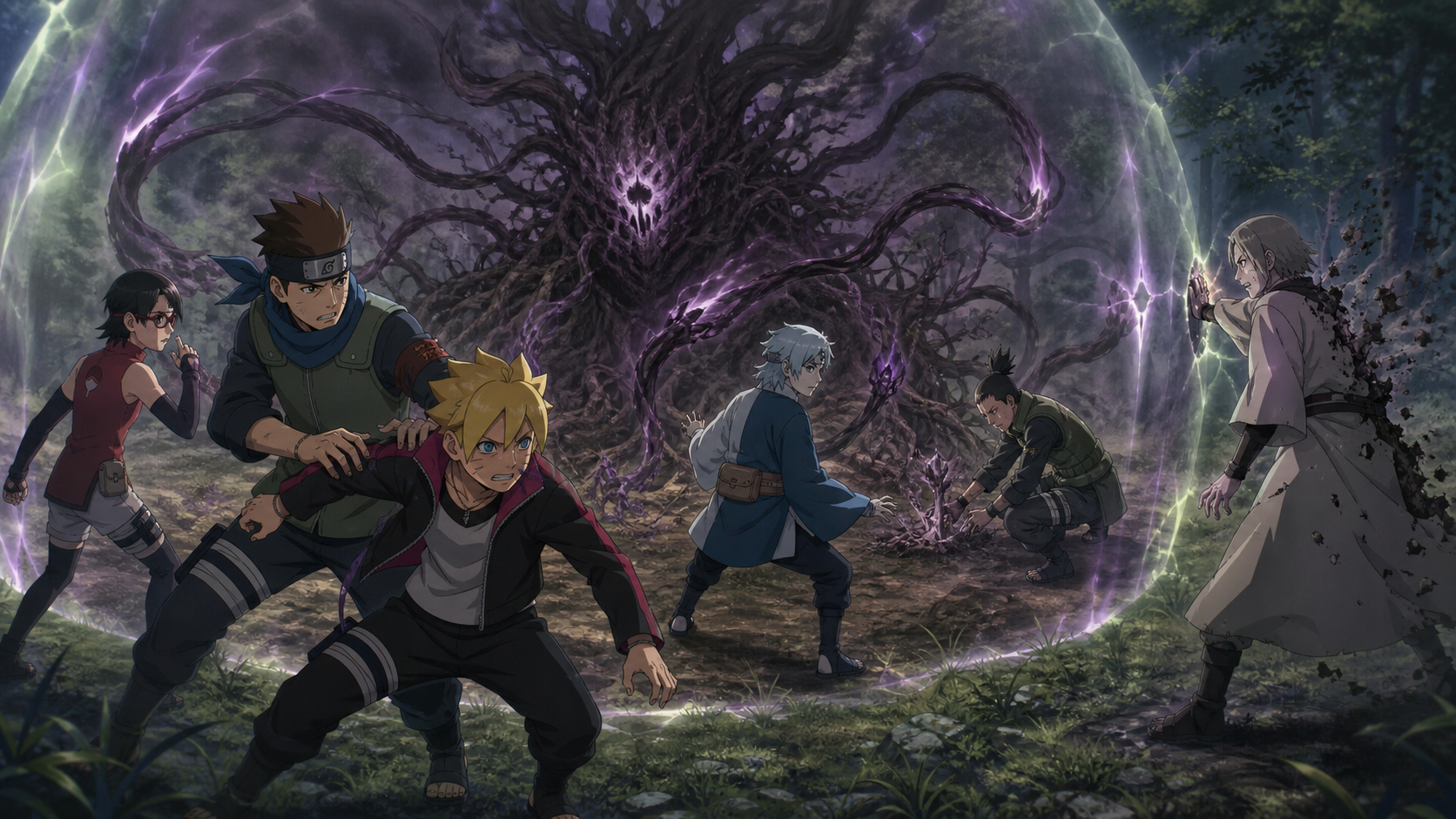
The Forbidden Jutsu of Death
Yuuga has already turned his life into a delay. Boruto wants to beat the monster standing in front of him. Mugino understands that fighting the enemy’s chosen battle may be exactly how Team 7 loses the mission.
Series: Boruto: Naruto Next Generations
Episode: 164 · The Forbidden Jutsu of Death
Arc: Kara Actuation
Release: 2020-09-06
Previous: Episode 163 · The Pursuers
Directory: All 293 Boruto episodes
Bottom line
Boruto Episode 164, “The Forbidden Jutsu of Death,” traps Team 7, Konohamaru, and Mugino inside the price of Yuuga’s mission. Yuuga gives his life to summon a creature that drains chakra from anything living and seals the Konoha group behind a barrier. The technique does not merely risk its user. The technique begins by consuming him. His brothers feel the activation, mourn, and keep carrying the Hashirama cell home.
The episode’s best conflict is not Team 7 against the creature. The real conflict is Boruto against the idea that a shinobi sometimes needs to escape instead of winning the fight in front of him. Mugino wants the barrier broken and the pursuit resumed. Boruto wants to destroy the monster because leaving feels like fear and because Yuuga’s sacrifice demands an answer. Both choices carry risk. Mugino sounds harsh, but his priority remains the mission and the lives still available to save.
Yuuga turns his body into a delay
Yuuga does not expect to walk away from the forbidden technique. His death activates the barrier and summons the chakra-feeding creature.
That changes the meaning of the battle. Team 7 cannot defeat Yuuga because Yuuga has already converted himself into time. Every minute spent inside the barrier belongs to Hiruga and Asaka.
The Haze brothers have reached a point where success is measured by how efficiently each sibling can die for the cargo.
Calling the technique forbidden is not enough
Naruto stories often label a jutsu forbidden because the technique endangers the user, violates bodies, or demands a cost the village refuses to normalize. Yuuga’s technique earns the label without ambiguity.
The jutsu consumes its caster, traps other people, and releases a creature that feeds on living chakra. No version becomes safe through better training.
The disturbing question is why the Land of Haze preserved a method designed to spend one shinobi as a disposable barrier battery. Forbidden knowledge can remain available long after leaders declare that nobody should use the knowledge.
Hiruga and Asaka feel the death from a distance
The surviving brothers recognize that Yuuga has activated the technique. They pause, grieve, and continue moving.
Their reaction refuses the easy claim that the brothers do not care about one another. They care deeply. Their mission has taught them to treat grief as confirmation that another brother completed his duty.
Love remains present while the system eats them. That contradiction makes their loyalty painful instead of heroic wallpaper.
The monster feeds on every living thing nearby
The summoned creature drains chakra from contact. Boruto learns the rule when an attack becomes a feeding opportunity. A nearby deer loses its energy, and the creature uses stolen chakra to restore a damaged limb.
That wildlife receipt matters. Yuuga’s target is Team 7, but the jutsu does not recognize combatants. Trees, animals, and anybody trapped inside the barrier become fuel.
Weapons built for national survival rarely keep their damage inside the intended category.
The deer also kills the comforting idea that this barrier contains violence. A dome can mark a boundary without limiting consequences. The creature eats whatever life happens to remain inside, including life with no role in the brothers’ mission. When shinobi call a weapon controlled, they often mean the weapon is controlled from the user’s perspective. Nobody asks the forest whether the containment worked.
Konohamaru damages the creature and proves almost nothing
Konohamaru’s Rasengan breaks the creature’s arm and pulls Boruto out of immediate danger. For one second, ordinary battle logic appears to work.
Then the creature drains chakra and regenerates.
Damage without understanding can become wasted effort. A powerful attack answers “Can we hurt the body?” while leaving “What sustains the body?” untouched.
Konohamaru’s intervention saves Boruto, but the broken limb cannot serve as evidence that another Rasengan will solve the trap.
Boruto sees a damaged enemy and wants another attack
Boruto notices that the Rasengan worked and argues for defeating the creature. His reasoning is not foolish. If the monster dies, the barrier may fall.
The problem is that the team does not know whether the creature can die through accumulated damage, whether more chakra will strengthen the regeneration, or whether the barrier and creature share a separate mechanism.
Boruto treats visible injury as progress. Mugino treats unknown rules as a reason to stop feeding the experiment.
Mugino wants the mission, not the satisfying fight
Mugino insists that the group attack the barrier and resume the pursuit. The Hashirama cell remains the objective. Hiruga and Asaka are gaining distance while Team 7 studies a creature Yuuga created to waste their time.
That assessment is cold because the situation requires cold arithmetic. The team has limited chakra. The monster steals chakra. Fighting for emotional closure benefits the thieves.
Mugino is not afraid of combat. He refuses combat chosen by the enemy.
“You spoil your genin” is not only an insult
Mugino accuses Konohamaru of indulging Team 7. He sees young ninja who are accustomed to being heard and given chances to prove themselves.
Konohamaru answers that his students are dependable. He does not claim that they are never wrong.
The exchange exposes two adult responsibilities. Mugino wants the children protected from unnecessary risk. Konohamaru wants their skills trusted within a controlled plan. Responsible mentorship needs both limits and meaningful participation.
Boruto hears caution as disrespect
Boruto is disappointed that Mugino seems unwilling to trust the genin. That reaction fits a teenager who has already fought Ōtsutsuki enemies and saved adults.
Past achievement can become dangerous evidence. Surviving one impossible battle does not make every unknown jutsu manageable.
Mugino’s caution is not a verdict on Boruto’s worth. The caution is a verdict on missing information. Boruto has to learn the difference.
Sarada attacks the jewel because she is studying structure
Boruto and Mitsuki restrain the creature long enough for Sarada to strike. Her attack cracks the jewel embedded in the monster.
That visual gives the team something more useful than another damaged limb. A jewel suggests a core, anchor, or point connecting the creature to Yuuga’s technique.
Sarada’s strength matters, but her place in the combination matters more. She hits the part that may explain the system.
Mitsuki’s snakes turn warning into seconds
Mitsuki receives advance notice from his snake when the creature changes direction. Those seconds let the team prepare instead of discovering the attack through impact.
His snakes also help restrain and distract the creature. Mitsuki’s contribution is not a giant finishing move. He manages information, positioning, and time.
Against an enemy designed to delay them, every recovered second counts.
The creature protects the barrier when the barrier cracks
Konohamaru and Mugino begin damaging the enclosure. The monster recognizes the threat and abandons the genin to defend the barrier.
That behavior confirms a relationship between summon and prison. The creature is not hunting randomly. Its purpose includes keeping Yuuga’s targets inside until the remaining brothers gain enough distance.
Once Team 7 understands that priority, the monster becomes more predictable. The barrier can bait the guardian.
Mugino changes the plan when the evidence changes
Mugino begins by rejecting a direct fight. When the creature reveals that the barrier matters, he changes tactics and calls for Boruto and Konohamaru to prepare their Rasengan while Sarada supports him.
That is not hypocrisy. Good leadership updates a plan when new information appears.
Mugino never said attacking was morally wrong. He said attacking without a counter was unnecessary. The team now has a counter based on observed behavior.
That distinction matters for Boruto’s growth. Mugino is not asking him to become timid. He is asking him to stop treating every refusal as fear. Retreat, observation, and redirected effort are active decisions. A shinobi who can only move forward becomes easy to steer because an enemy always knows where to place the next target.
Student and teacher share the finishing responsibility
Boruto and Konohamaru prepare Rasengan together. The pairing places student and teacher inside the same plan without pretending their experience is equal.
Konohamaru supplies power and adult judgment. Boruto supplies power, speed, and the stubborn investment that kept him watching for an opening.
Trust becomes useful when mentorship turns a young ninja’s impulse into coordinated action.
Sarada backing Mugino gives her an adult-sized job
Mugino asks Sarada to support him while the Rasengan pair prepares. He does not bench her after questioning the genin’s judgment.
That assignment proves his criticism was never “children are useless.” He wants every person placed where their skills serve the plan with the least unnecessary exposure.
Sarada earns trust through execution, not through an adult telling her that she is special.
The creature resembles older death techniques without copying them
Konohamaru compares the summon to the Shinigami and Sōma. The resemblance lives in the exchange: a human life opens access to a force that consumes something from the living.
The technique does not need to be the Reaper Death Seal to belong to the same moral family. Shinobi cultures keep inventing ways to turn souls, chakra, and bodies into weapons.
Different villages develop different rituals. The shared assumption remains that somebody’s life can become acceptable material.
The Land of Haze built deterrence from disposable shinobi
Yuuga’s technique would frighten a pursuing force. Catching one Haze operative can place an entire squad inside a lethal barrier.
That deterrent makes strategic sense for a weaker nation. The country cannot match a great village soldier for soldier, so a single person becomes a trap capable of delaying many.
Strategic sense does not equal justice. A defense policy that requires loyal citizens to erase themselves has protected the state by consuming the population.
Deepa and Yuuga represent opposite relationships to pain
Yuuga accepts pain and death because he believes his sacrifice will help his brothers and homeland. Deepa inflicts pain because domination entertains him and clears his route to the cell.
Neither relationship produces safety. One man treats his body as worthless beside the mission. The other treats everybody else’s body as worthless beside his appetite.
Kara’s cruelty and Haze desperation meet around the same stolen tissue, which tells us exactly how dangerous that market has become.
Victory still arrives too late for Yuuga
Team 7 can break the technique, but success cannot return Yuuga to his brothers. The forbidden jutsu took payment at activation.
That finality prevents the battle from becoming a clean heroic puzzle. Figuring out the monster’s rules saves the trapped team. The solution cannot rescue the person whose nation taught him to become the lock.
Yuuga’s brothers gain time, but the family loses another member forever.
The surviving brothers may call that exchange necessary. Necessity deserves more examination than the episode has time to give. Who decided the cell was worth four sons? Who taught the technique, assigned the order of sacrifice, and remained safely behind while the brothers crossed borders? “For the homeland” can hide a long chain of adults who authorize death without volunteering their own bodies.
RaeRae’s verdict
Episode 164 works because Mugino refuses the kind of fight Boruto wants. Boruto sees a monster and assumes courage means attacking until the monster falls. Mugino sees a delay mechanism and asks who benefits from every wasted minute. That argument gives the action a brain.
The creature could look more terrifying for something born from a human life, but the mechanics carry the horror. The summon drains wildlife, regenerates from stolen chakra, and guards the barrier that Yuuga died to create. The team wins by observing those mechanics, not by shouting harder.
Yuuga’s sacrifice remains the ugliest receipt. Hiruga and Asaka mourn without stopping because their national duty has trained them to convert brothers into distance. The Hashirama cell is supposed to save their homeland. So far, the mission has saved nothing. The mission has only become very efficient at deciding which Haze son dies next.
Yuuga's consent exists inside a system built to narrow consent
Yuuga understands that the technique will kill him and activates the jutsu deliberately. Knowledge of the cost does not settle whether the choice was free.
The brothers grew up hungry, received belonging through the Land of Haze, trained around national duty, and entered a mission where sacrifice appears to be the expected family contribution. Refusal may feel equivalent to betraying the people who kept them alive.
Consent becomes fragile when every meaningful source of identity and survival points toward the same fatal answer. Yuuga chooses. The system trained the range of choices he can imagine.
The creature should trigger an environmental response
The summon drains a deer and any other living chakra inside the barrier. Even after Team 7 escapes, the area may contain weakened animals, damaged plants, residual chakra, or another fragment of the jutsu.
Konoha should mark the location, warn travelers, and send specialists to determine whether the barrier fully disappeared. Wildlife harmed by a shinobi mission will never file a report, which makes deliberate follow-up more important.
Containment cannot mean everybody leaves once the human targets survive. The forest also paid for Yuuga's weapon.
Team 7 needs prearranged roles for unknown techniques
The squad spends precious time arguing because nobody knows who leads analysis, who protects the adults, and who conserves chakra when a trap removes ordinary movement. A simple unknown-jutsu protocol could reduce that confusion.
Sarada can observe pattern and structure. Mitsuki can test range through snakes and flexible movement. Boruto can hold offensive power until the team identifies a target worth feeding chakra. Konohamaru or Mugino can control retreat and resource decisions.
Those roles remain adjustable. The value comes from preventing every member from attacking first and learning the same dangerous rule through separate mistakes.
Boruto needs to learn the difference between proof and possibility
Konohamaru damages an arm, so Boruto sees proof that the creature can be hurt. The result establishes possibility, not a complete strategy. Regeneration immediately changes the meaning of the damage.
Shinobi training rewards finding an opening, but unknown systems require another question: what happened after the opening? A wound that restores through stolen chakra may make repeated success actively harmful.
Boruto's instinct remains useful. Mugino's caution turns the instinct into a plan by demanding evidence about what the damage accomplishes.
Mugino's bluntness needs translation for young teammates
Mugino understands mission arithmetic and expects trained shinobi to recognize the stakes. Boruto hears dismissal because the explanation arrives as an order against the action he believes is brave.
Konohamaru can translate without undermining command: the creature gains chakra from contact, the brothers gain distance, and the team lacks evidence that killing the body breaks the barrier. Naming those reasons turns “no” into tactical education.
Young shinobi need boundaries and the logic behind boundaries whenever time allows. Explanation builds judgment that remains useful after the adult leaves the formation.
Sarada's strike creates the first structural clue
Cracking the jewel shows that the creature contains a component different from the regenerating limbs. The team should record the location, reaction, and whether damage changes the barrier.
Sarada's value lies in choosing the target, not merely striking hard enough. Her eye and analytical habits connect visible structure to a testable theory.
That distinction matters for her Hokage ambition. Leadership often depends on identifying which part of a system carries the real control while everybody else fights the loudest symptom.
Mitsuki should not spend every snake as disposable equipment
His snakes scout, warn, restrain, and absorb danger during the barrier fight. They are part of his living technique ecosystem, not endless props that appear without cost.
Mitsuki should track which summons return, which become injured, and when repeated use drains his own chakra. The creature already consumes living energy, making careless deployment especially risky.
Respecting summoned partners also reinforces the episode's moral line. A team opposing Yuuga's self-disposal should avoid treating another living helper as replaceable material.
The Land of Haze needs defensive knowledge that does not consume citizens
A weaker nation faces real danger from larger villages, mercenaries, and organizations such as Kara. The answer cannot remain a forbidden technique that converts one loyal shinobi into a temporary wall.
Allies could provide barrier training, detection tools, evacuation plans, secure communication, and treaty support without demanding the country surrender autonomy. Shared defense should widen the number of people who survive an attack.
The jutsu may delay a squad. The same jutsu guarantees one Haze death before the enemy proves whether any delay was necessary.
Yuuga deserves a record separate from the weapon
Team 7 knows how he spoke, why he activated the technique, and how the brothers reacted. Those details should reach the Land of Haze and any surviving family instead of disappearing into a report titled forbidden-jutsu encounter.
The record must also include people and wildlife harmed by the barrier. Remembering Yuuga as a person does not require praising the choice or ignoring victims.
A complete account resists both erasures: the state cannot reduce him to noble sacrifice, and Konoha cannot reduce him to the caster who delayed pursuit.
Chakra loss needs treatment after the barrier breaks
Escaping the dome does not restore energy drained by the creature. Team 7, Konohamaru, Mugino, and affected wildlife may carry exhaustion, pathway strain, dizziness, or delayed collapse into the pursuit.
The adults need a rapid assessment before running after Hiruga and Asaka. Anyone below a safe threshold should receive stabilization or remain behind with communication support. Continuing at full speed can turn one solved trap into injuries the next opponent exploits.
Medical records also help Konoha understand how quickly the creature drained chakra and whether contact produced lasting effects.
The broken jewel should become evidence
If any fragment remains after the summon disappears, investigators should seal the material, record the location, and avoid direct chakra contact. The jewel may reveal how Yuuga's life connected the creature to the barrier.
Study should focus on defensive countermeasures, not recreating a technique that consumes another caster. Ethical limits need to enter the research order before curiosity turns the forbidden jutsu into a new village asset.
The strongest lesson Konoha can take from Yuuga is how to save the next person trapped by the weapon, not how to build a better version.
Sources and lawful viewing
Official episode reference: Naruto Official episode guide
Licensed episode route: Crunchyroll licensed series page