
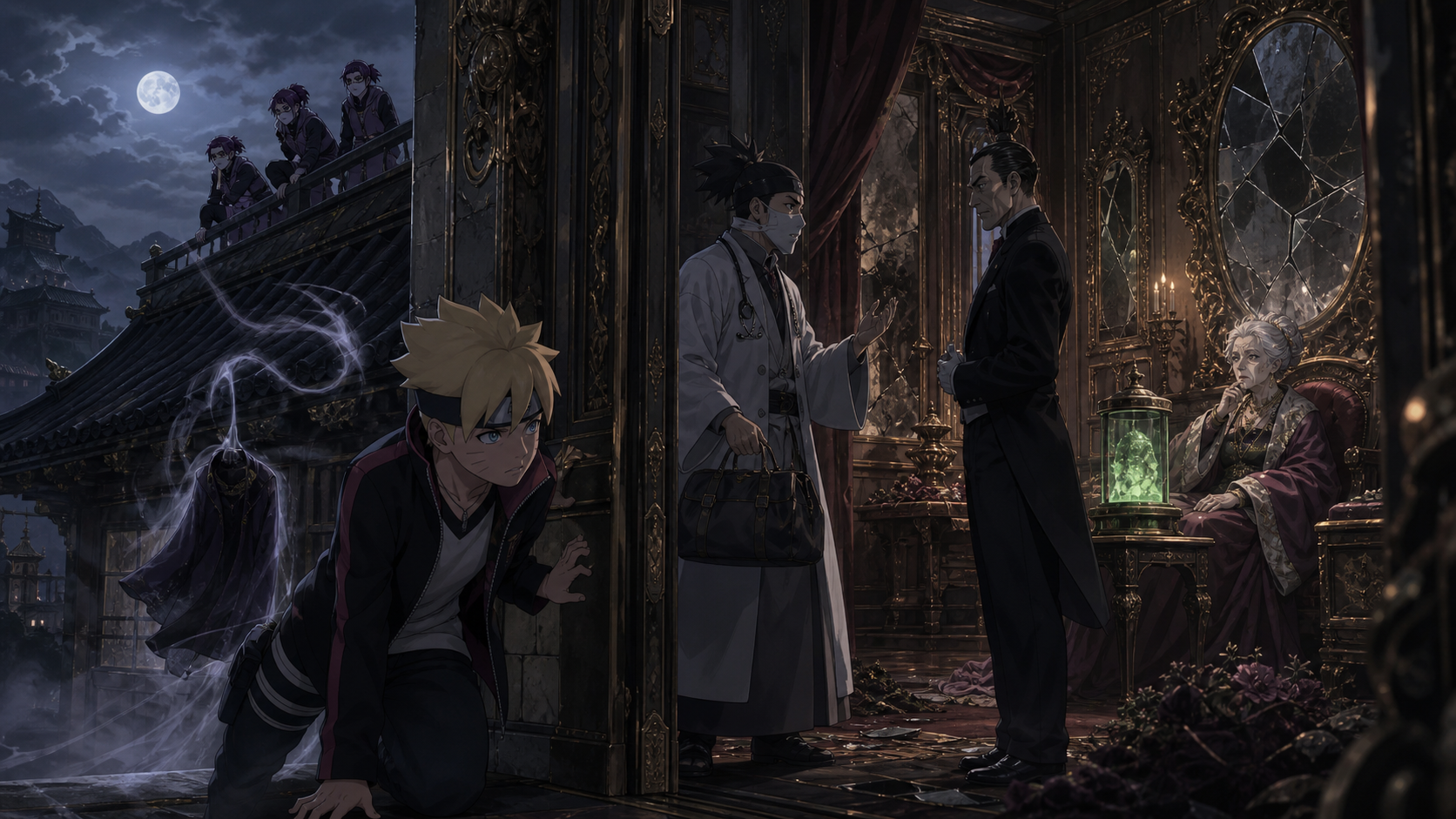
The Castle of Nightmares
Sakuya’s aging face is not the nightmare. The nightmare is a castle where wealth lets her buy stolen tissue, test another girl, consume intruders, and make every body except hers disposable.
Series: Boruto: Naruto Next Generations
Episode: 161 · The Castle of Nightmares
Arc: Kara Actuation
Release: 2020-08-16
Previous: Episode 160 · To the Land of Silence
Directory: All 293 Boruto episodes
Bottom line
Boruto Episode 161, “The Castle of Nightmares,” puts the Hashirama cell inside a castle where money has converted fear into architecture. Sakuya has broken every mirror because she cannot tolerate her aging face, bought stolen human tissue to reverse time, and surrounded herself with a barrier that drains life from intruders. Her butler tests Konohamaru’s fake medical identity by using Boruto as a potential procedure victim. Meanwhile, the Haze quadruplets sacrifice one brother to breach the barrier, murder Sakuya and her staff, steal the cell, and frame Konoha.
The episode wants Sakuya’s vanity to explain the horror, but “old woman hates wrinkles” is the least interesting version of the story. Wealth lets her purchase bodies, silence workers, and convert another girl into an unauthorized trial. The problem is not that Sakuya wants more life. Most people do. The problem is that she believes money entitles her to take risk, tissue, youth, and survival from people whose names she never needs to learn.
Mitsuki’s antibodies become medicine for another victim
Yubina uses antibodies from Mitsuki’s recovery to treat a girl exposed to a weaker Hashirama-cell preparation. His body’s response produces knowledge that can help another patient.
That transfer needs consent, documentation, and limits. Mitsuki should know what biological material was taken and how the material will be used.
The emergency benefit is real. Good results do not erase the obligation to respect the person whose body made the treatment possible.
The unnamed girl proves Sakuya already crossed the line
Sakuya’s people tested a less potent sample on a girl before risking the main procedure on their employer. The butler does not know where the girl went and does not care.
That indifference reveals the castle’s medical ethics more clearly than any broken mirror. A vulnerable person became a compatibility screen for a wealthy client.
The girl’s recovery through Yubina matters, but survival cannot retroactively create consent.
Konohamaru uses Kirisaki’s identity as a key
Konohamaru transforms into the medical criminal Kirisaki so the butler will bring him inside Fushū Castle. The disguise exploits a black-market relationship already built around illegal treatment.
Unlike Boruto’s earlier transformed approach inside an adult venue, Konohamaru is an adult taking the social and physical risk himself.
The plan still depends on convincing people who expect deception. Every medical claim must survive a test.
The butler’s loyalty has consumed his judgment
Sakuya’s butler is willing to die for her and expects everyone else’s body to carry the same price. He protects the castle, controls access, and accepts human experimentation as service.
Loyalty becomes dangerous when devotion replaces ethical limits. His job is no longer helping Sakuya live safely.
He has made her desire the only standard for deciding what anybody deserves.
The remaining servants occupy a different position. Employment inside the castle does not prove that cooks, cleaners, guards, or attendants agreed to biological crime. A household can normalize abuse while workers comply from debt, fear, isolation, or lack of another employer. The Haze brothers erase those distinctions when they murder witnesses as though everyone beneath Sakuya’s roof shares equal guilt.
The castle barrier turns life into private security
Fushū Castle is protected by a barrier that drains intruders. The defense does not merely block entry or alert guards. The system consumes life.
Wealthy clients often push danger outward. Sakuya remains behind doors while trespassers, servants, hired guards, and test subjects absorb the cost of her protection.
The empty cloak outside the barrier becomes another receipt showing how disposable bodies keep the castle comfortable.
One quadruplet dies so three can enter
The Haze brothers deliberately sacrifice one of their number to study or breach the barrier. The surviving three continue without allowing grief to stop the assignment.
Their duty resembles Garashi’s devotion to Kara. Both systems convince followers that a body is acceptable payment for organizational purpose.
The difference is family. These brothers sacrifice someone they love and have trained beside, which makes the discipline feel even more brutal.
Boruto notices the broken mirrors
Inside the castle, every mirror has been shattered. Sakuya refuses to see the face time has produced.
The image communicates fear, isolation, and control. She cannot break aging, so she breaks reflection.
The episode should stop there instead of treating an elderly woman’s appearance as self-evidently horrifying. Her face is not the nightmare. The system built to avoid the face is.
Aging is not a moral failure
Sakuya has survived long enough to become old. Wrinkles, weaker muscles, and changing features are not evidence that she mismanaged womanhood.
Women are taught that visible age reduces desirability, authority, and social worth while older men often gain status from the same passage of time.
Her fear grows inside a culture that sells youth as safety. Understanding that pressure does not excuse buying human experiments.
Wealth converts insecurity into somebody else’s medical risk
Most people who fear aging can buy creams, treatments, or flattering light. Sakuya can buy a Hashirama cell, employ criminal specialists, and test dangerous material on a girl.
Power changes private insecurity into public harm.
The story becomes stronger when Sakuya is judged for what she does with fear rather than mocked for having an old body.
Hashirama’s life force becomes luxury contraband
Victor describes regenerative medicine for war victims. Sakuya wants reversal of age. Different buyers attach different promises to the same stolen tissue.
Luxury demand drives dangerous research because wealthy clients can fund risks no regulated institution would approve.
A cell that might restore organs becomes another product sold to someone who believes ordinary mortality is an insult.
The butler tests the fake doctor on Boruto
Before allowing Kirisaki near Sakuya, the butler traps Boruto and demands a demonstration of age reversal. A child becomes the proposed proof.
The test exposes the logic of the castle. Sakuya’s body receives maximum caution. Anyone without her wealth becomes a disposable preliminary stage.
Konohamaru cannot refuse openly without losing access and possibly Boruto.
Konohamaru turns the hostage into a shadow-clone play
He asks for a drink to steady his hands and uses the delay to coordinate with Boruto. A shadow clone remains in the trap while the real Boruto continues toward the cell.
The tactic shows growth in Boruto’s clone control. He can maintain the deception while moving beyond immediate sight.
More importantly, Konohamaru adapts without sacrificing the child placed under his command.
Infiltration works because both shinobi perform their roles
Konohamaru plays an arrogant criminal doctor who expects comfort and leverage. Boruto plays the assistant until the operation requires separation.
The mission succeeds longer than Boruto’s black-market entry because the pair share a plan, signals, and purpose.
Discipline does not reduce his courage. Discipline directs courage toward an exit everyone can survive.
The perfume trail turns luxury into evidence
Boruto follows Sakuya’s strong perfume through the castle. The scent becomes a practical guide inside a building designed to confuse and trap intruders.
Luxury leaves traces. Guards, flowers, broken mirrors, and perfume all map the person the castle exists to protect.
The detail also contrasts with the clinical danger of the sealed cell. Everything around the tissue has been made decorative except the risk.
Sakuya dies before Boruto can confront her
Boruto finds Sakuya murdered with a kunai in her back. The Hashirama cell is gone, and the Haze infiltrators occupy the room above him.
Her death prevents accountability for the girl, the illegal purchase, and the castle barrier. Murder does not become justice because the victim committed other harms.
The brothers kill her to obtain property and create a false story, not to protect anyone she exploited.
The quadruplets weaponize disguise and timing
The infiltrators entered through sacrifice, copied staff appearances, tracked Boruto’s movement, and waited for him to become the perfect suspect.
One brother’s earring connects them to the women seen near Kirisaki, giving Boruto a visual clue too late to prevent the frame.
Their plan uses Konoha’s reputation against the team. A famous village provides a believable enemy for a lawless crowd already primed to hate great powers.
Boruto freezes while the frame closes
He recognizes the killers and the stolen cell, but the shock costs precious seconds. The butler sees Boruto near Sakuya’s body with a weapon.
An experienced operative would secure the scene, communicate immediately, and avoid standing inside the simplest possible accusation.
Boruto is still a genin learning why undercover missions punish hesitation differently from open combat.
The butler becomes another disposable witness
The Haze shinobi kill the butler and other staff while dismantling the barrier. Everyone who could contradict the accusation disappears.
His loyalty does not protect him from the larger market he helped serve. The castle’s system trained him to treat people as expendable, and another organization applies the same rule to him.
Violence moves easily between systems built on disposable labor.
Poisoned kunai reveal preparation beyond theft
Konohamaru notices poison on the attackers’ weapons. The brothers planned to kill quietly and keep targets from surviving long enough to explain.
Poison also complicates pursuit. A small wound can remove a stronger shinobi without a prolonged fight.
The team now needs medical caution while carrying no dedicated medic because Mitsuki and Yubina remained behind.
Victor sends Deepa toward the cell
Victor informs Deepa of the cell’s location. Kara now enters the pursuit directly while the Haze brothers believe they are completing their own mission.
Multiple groups can chase the same object for different reasons without understanding who manipulated the route.
Victor benefits from letting thieves move the sample away from his company and toward a place where Deepa can reclaim the material without corporate witnesses.
The public accusation turns a market into a weapon
The brothers announce that Konoha shinobi murdered Sakuya and offer a reward for capture. Local gangs need no trial when the accusation comes with money.
Konoha’s symbol, hidden during entry, now becomes the headline attached to the crime.
The team must escape without slaughtering people who are responding to a manufactured story and an economic incentive.
The castle runs on consent that money has already hollowed out
Almost everybody inside Fushū Castle can technically claim to have chosen a role. The butler serves Sakuya. Guards protect the walls. Brokers arrange access. Kirisaki agrees to a criminal procedure before Konohamaru steals his identity. That language of choice collapses once we ask who can safely refuse.
The unnamed test subject has the least room to say no. A rich buyer wants proof, a doctor wants payment, and a servant wants his mistress reassured. Her body becomes the demonstration surface where everybody else settles a business question. Survival after the injection does not make the experiment ethical. A victim can live through exploitation and still have been exploited.
The butler has more status, but devotion has narrowed his moral field until Sakuya’s fear excuses every cost. He does not need to hate Boruto or the test subject. He only needs to believe their safety ranks below his employer’s desire. That is how polite service becomes violence without ever raising its voice.
Sakuya’s fear deserves context without becoming an alibi
The episode invites an easy joke about vanity: an older woman hates mirrors and wants youth. That reading is too shallow for the machinery surrounding her. Sakuya lives in a culture where wealth, desirability, and visible control reinforce one another. Aging threatens the image she built as proof of power.
Fear does not excuse buying stolen human tissue or risking another person’s life. Context explains the road to harm; context does not erase the people harmed along the road.
The tragedy is that Sakuya uses enormous resources to preserve a social position that cannot love her back. Her mansion offers barriers, servants, perfume, and medical access, but no relationship strong enough to tell her the truth. A person can be frightened, socially trapped, and morally responsible at the same time. The episode brushes against that complicated woman and then kills her before she can become more than the arc’s wealthy corpse.
The broken mirrors are confession, security measure, and warning
Boruto reads the shattered glass as evidence because the damage reveals a repeated decision. Somebody did not break one mirror during an argument. Reflection has been systematically removed from the house.
The image works because mirrors do several jobs in this episode. A mirror would show Sakuya the face she fears. A mirror could also reveal an intruder, expose a disguise, or multiply a room’s angles. Destroying reflection gives her emotional relief while weakening the visual order she supposedly controls.
Konohamaru arrives wearing another man’s face. One Haze brother enters by sacrificing another body and borrowing identities. Boruto uses a shadow clone to survive the butler’s test. Fushū Castle is full of false surfaces after Sakuya has smashed the literal ones.
Nobody knows who stands in front of them, yet Sakuya believes ownership can guarantee authenticity. The castle proves the opposite. Money buys performances. Fear rewards the performance that says what the buyer wants to hear.
One brother’s sacrifice exposes the mission before the theft does
The Haze quadruplets plan around a sibling’s death. The sacrificed brother triggers the barrier and creates the opening the others need. Later grief confirms that the bond was real, which makes the decision harder to dismiss as villainous emptiness.
Their homeland has apparently made the Hashirama cell valuable enough to justify a family member becoming equipment. Duty turns love into leverage: if the brothers care about one another, each brother must be willing to die for the shared mission.
Shinobi institutions use the same pressure with better flags. Teams praise sacrifice, villages memorialize the dead, and leaders call obedience loyalty. Episode 161 strips away the ceremony. A brother dies at a rich woman’s wall so the remaining brothers can steal biological power for another political authority.
The plan succeeds tactically. That success cannot answer whether the mission deserved the price. An operation can be clever and still reveal a rotten chain of command.
Konohamaru’s infiltration is smart because Boruto is allowed to matter
The disguise gets the team through the door, but Konohamaru cannot carry every beat alone. Boruto notices the mirrors, survives the butler’s suspicion, uses a clone under pressure, and responds to the human stakes instead of treating the castle as a puzzle box.
Their partnership works best when adult competence creates room for younger judgment. Konohamaru understands identity work and mission control. Boruto sees details because he has not learned to dismiss the strange emotional atmosphere as irrelevant.
The episode also lets the plan become imperfect without making either shinobi foolish. A criminal doctor’s identity has limits. A suspicious servant tests the assistant. An outside team arrives with better intelligence and a willingness to kill. Competence means adapting inside uncertainty, not predicting every person who might enter the building.
Boruto’s later freeze frustrates me because the earlier sequence establishes sharper instincts. The plot needs the Haze brothers to gain distance, so his response slows exactly when urgency peaks. A stronger version would let him act and still fail because the brothers prepared a counter.
Victor and Deepa reveal the market above the market
Sakuya looks powerful inside her walls, but Victor’s interest reminds us that she is one buyer in a larger contest. Kara-linked operators do not need her vanity. They need access to research, regenerative capacity, and leverage over any nation that wants Hashirama’s cells.
Deepa’s assignment widens the danger beyond a murder mystery. Team 7 is not chasing one family of thieves through an isolated black market. Multiple networks are converging on the same tissue, and every network has different resources for turning possession into power.
That layered pursuit is what makes the arc more interesting than contraband retrieval. A stolen object can be returned. A biological technology already desired by buyers, states, doctors, and covert organizations will keep producing theft attempts.
Recovering this sample cannot solve the underlying problem. As long as Hashirama’s body remains a shortcut to power and institutions accept body theft as strategy, another broker will find another buyer. The mission needs containment, but the world needs an argument about ownership that hidden villages have spent generations avoiding.
Victor understands that delay favors the organization with deeper pockets. A frightened buyer may guard one mansion, while a research company can fund laboratories, agents, replacements, and repeated attempts. Team 7 enters thinking about recovery from one transaction. Kara’s shadow forces a larger question: who can keep trying after everybody else runs out of people, money, or time? That imbalance makes Deepa more dangerous before he throws a single punch. He represents an institution prepared to absorb failure and send another body toward the prize.
What Episode 161 gets right
The castle reflects Sakuya’s fear through broken mirrors, traps, barriers, and controlled access. Konohamaru’s disguise and Boruto’s clone give the infiltration real structure.
The episode also shows how a biological black market uses trial victims, fake credentials, wealthy buyers, brokers, assassins, and competing recovery teams.
The Haze brothers win through preparation rather than superior raw power.
What Episode 161 gets wrong
Sakuya’s motivation leans on the exhausted trope of an older woman terrified by lost beauty. The script barely explores illness, dependency, social erasure, or the politics of who receives regenerative medicine.
Boruto watches the killers move while the frame forms around him, which makes his response feel delayed for plot convenience.
Sarada and Mugino remain outside the castle without detecting the escape or preventing the accusation from spreading.
RaeRae’s read
Sakuya’s face is not the nightmare. Her castle is.
She built a home where mirrors must die, intruders feed a barrier, servants surrender judgment, a child can become a medical demonstration, and another girl can vanish after testing stolen tissue. Fear of aging explains why she wants the Hashirama cell. Wealth explains why everybody else has to carry the danger.
The Haze brothers do not liberate anyone when they kill her. They repeat the castle’s logic with different uniforms: sacrifice the disposable person, take what has value, kill the witnesses, and buy the crowd with a story. Boruto and Konohamaru entered to retrieve hazardous tissue. They leave blamed for murder because the real contraband in Fushū Castle was always the belief that some lives are payment for other people’s futures.
Sources and lawful viewing
Official episode reference: Naruto Official episode guide
Licensed episode route: Crunchyroll licensed series page