
Kara’s Footprints
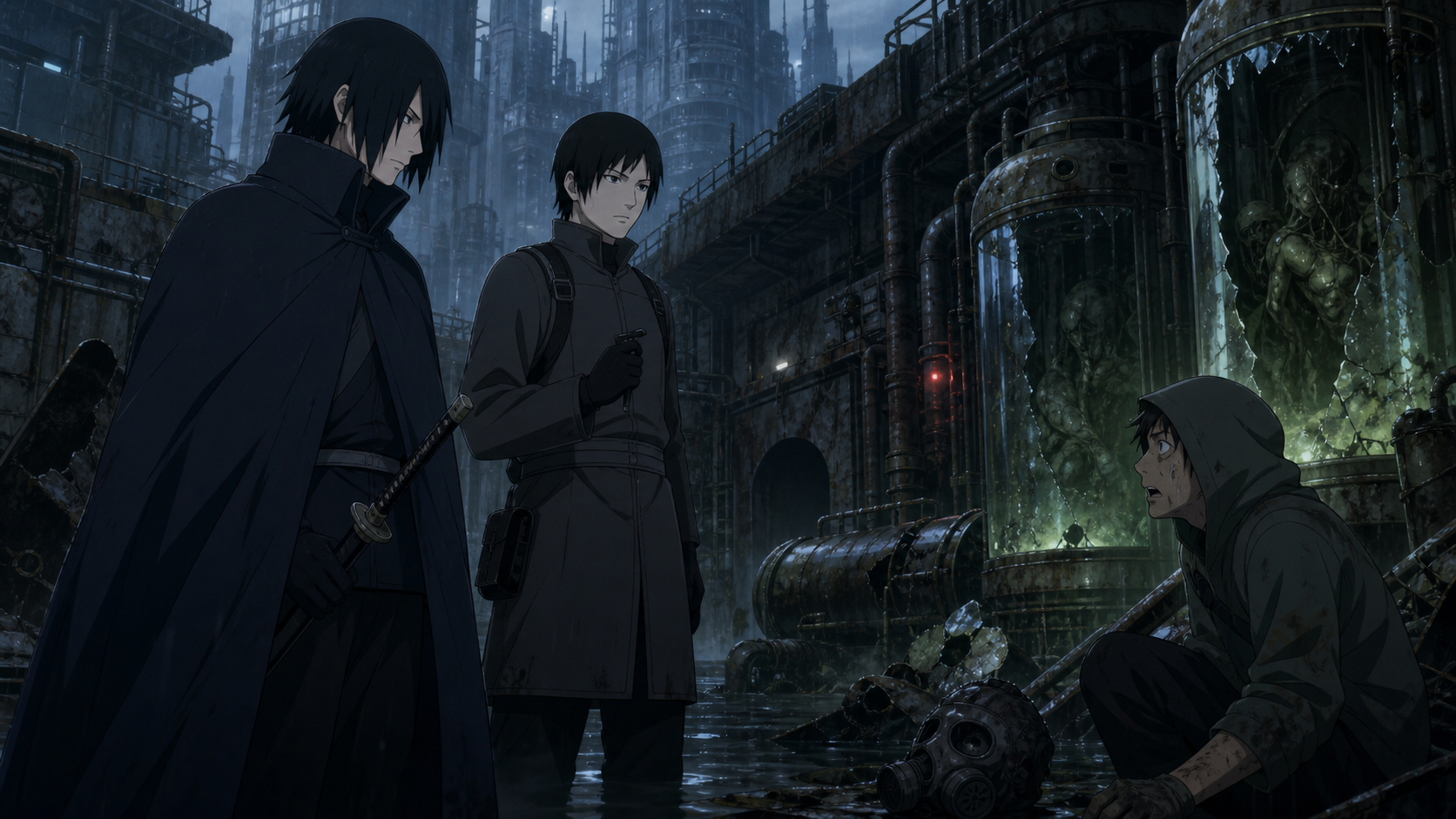
Sai and Sasuke find Kara’s discarded laboratory and disposable follower in a Hidden Rain Village that still has not received the peace Naruto promised Nagato.
Series: Boruto: Naruto Next Generations
Episode: 157 · Kara’s Footprints
Arc: Kara Actuation
Release: 2020-07-19
Previous: Episode 156 · I Can’t Stay in My Slim Form
Directory: All 293 Boruto episodes
Bottom line
Boruto Episode 157, “Kara’s Footprints,” finally makes Kara feel like an organization instead of a name Shojoji dropped to frighten Boruto. Sai and Sasuke follow the Mujina Gang intelligence into Amegakure, find an abandoned biological-research site, survive Garashi’s gas trap, and return with proof that Kara recruits wounded people while treating their bodies as expendable equipment.
The episode’s ugliest truth is not hidden in a laboratory tank. Hidden Rain is still broken while Konoha enjoys the peace Naruto helped create. Nagato entrusted Naruto with a future beyond the old cycle of suffering, yet Amegakure’s towers remain wet graves, neglected infrastructure, and recruitment ground for the next organization promising abandoned people meaning. Kara leaves footprints because the great villages left empty roads for the group to walk through.
Kara stops being a rumor
Shojoji gave Sasuke a name and enough fear to justify investigation. Episode 157 turns that fragment into physical evidence.
Kara has facilities, scientific equipment, biological experiments, trained followers, communication networks, and a cleanup process. An organization capable of abandoning a laboratory without abandoning influence has reach beyond one villain’s hideout.
The discovery changes Konoha’s problem. Naruto is not tracking a criminal gang that can be arrested after one raid. He is facing a system with money, technology, ideology, and people willing to die before answering questions.
Team 25 proves intelligence work belongs to young shinobi too
Hōki Taketori, Hako Kuroi, and Renga Kokubō report their findings to Sai and Sasuke. They identify the suspected facility, explain the toxic-gas history, and provide maps of the surrounding waterways.
Sai praises the team and sends the genin to notify nearby Anbu units while the senior investigators continue. The division of labor respects their contribution without pretending three young shinobi should enter an unknown biological site.
Team 25 does the invisible work that lets powerful people arrive prepared. Intelligence gathering rarely receives the applause attached to a Rasengan, but the map may save more lives than a dramatic attack.
Sai treats information as a weapon
Sai reads the briefing, the site, and Team 25’s limits before moving. His calm is not empty politeness. He has spent a lifetime noticing what people conceal.
The former Root operative knows that an abandoned facility may be most dangerous after the visible staff leaves. Documents can be destroyed, traps can wait, and disposable followers can guard ruins without understanding the whole operation.
Sai also knows what recruitment looks like when an organization targets children and gives pain a job. Kara’s methods should feel familiar to somebody raised by Danzō.
Sasuke knows ruins can keep secrets alive
Sasuke approaches Kara with the caution of someone who has entered Orochimaru’s laboratories and watched forbidden research survive its creator’s defeat.
A sealed room does not mean a dead project. Scientific tools, samples, followers, and instructions can outlive the person who ordered the work.
His presence makes the investigation credible. The episode does not need to weaken Sasuke so Garashi can appear threatening. Garashi’s danger comes from poison, ideology, and willingness to die, not superior combat ability.
Amegakure still has not received peace
Sai notices that reconstruction has barely progressed. The rain continues falling over damaged towers, abandoned systems, and people living beside the remains of several wars.
The great nations used the Land of Rain as a battlefield, buffer, weapons route, and political inconvenience. Konoha, Iwa, and Suna carried their conflicts through a smaller country, then celebrated peace at home.
Naruto’s era looks prosperous from the Leaf’s new trains, computers, restaurants, and research centers. Amegakure reveals who did not receive the same future.
Naruto’s promise to Nagato hangs over every broken tower
Nagato believed Naruto might find an answer to the cycle of hatred. Naruto carried his book, his faith, and the memory of Jiraiya’s students into the Fourth War.
Political memory cannot stop at inspiration. If Amegakure remains isolated and ruined, Naruto’s personal understanding has not become policy.
The Hokage cannot repair every country by decree, and foreign intervention carries its own danger. Konoha can still offer transparent rebuilding partnerships, medical support, infrastructure funding, and diplomacy shaped by accountability for past harm.
The sewage facility tells a story before anyone enters
The suspected Kara base once handled waste treatment before a toxic-gas incident killed people and forced abandonment. That history gives the organization camouflage.
A neglected industrial disaster site attracts little public attention. Officials can call sickness an old contamination problem. Missing people disappear into an area everyone already fears.
Kara does not need a gleaming secret fortress when damaged infrastructure provides walls, hazards, and official excuses for free.
Garashi appears as a survivor
Sai and Sasuke discover Garashi watching them inside the facility. He accuses the Konoha shinobi of killing his friends and presents himself as the remaining witness to Kara’s cruelty.
The accusation carries enough plausibility to interrupt immediate judgment. Amegakure has good historical reasons to distrust outsiders wearing great-village symbols.
Garashi uses that history as cover. The manipulation works because real injustice has already damaged the ground beneath the conversation.
Sasuke listens before deciding
Sasuke asks Garashi to explain what happened because Kara may have killed the young man’s friends. He does not demand trust or defend Konoha’s reputation first.
That restraint reflects his own history with institutional lies. Sasuke knows a village can call violence necessary while survivors remember the bodies.
Listening does not make him vulnerable to every claim. He and Sai continue testing the story against the building, traps, and Garashi’s behavior.
The gas trap uses the site’s official history
Garashi guides them through the facility and attempts to kill them with poison gas. The weapon fits the location’s recorded disaster, allowing Kara to hide murder inside an accepted explanation.
Biological and chemical threats change the rules of shinobi combat. Strength, speed, and ocular power do not replace air.
Sai and Sasuke anticipate the betrayal and protect themselves. Their competence keeps the trap from becoming a cheap victory over two experienced investigators.
Garashi describes death with the wrong distance
His account of his friends’ deaths contains a detail that exposes his role. He describes their final suffering with the familiarity of someone who watched rather than escaped before the killing.
The episode gives Sasuke and Sai enough evidence to recognize the performance. Garashi’s grief may still be real. His allegiance has taught him to convert grief into recruitment language.
Kara does not need followers without feelings. The group needs followers willing to place those feelings under Kara’s meaning.
Kara recruited from the wound the great villages ignored
Garashi believes Kara offered purpose after his friends died. The organization names his pain, blames the existing world, and gives sacrifice the appearance of agency.
That method resembles every successful extremist recruitment system. Find people abandoned by institutions, confirm that the abandonment was real, then insist that obedience to a new authority is the only honest response.
Kara’s diagnosis can contain truth while the prescribed cure becomes another form of exploitation.
Outsiders are disposable by design
Kara separates its central members from the wider network of Outers who provide labor, facilities, political access, money, experiments, and bodies.
Garashi protects an abandoned site and dies without learning enough to threaten the leadership. His devotion does not grant membership, safety, or a future.
Organizations built around secrecy often make followers feel specially chosen while withholding every form of real power. The believer receives danger. The inner circle receives options.
Garashi’s suicide is Kara’s final lock
When capture becomes unavoidable, poison and belief close the remaining route to information. Garashi chooses death rather than cooperation.
The scene frustrates because Sasuke possesses genjutsu and Sai has interrogation experience. The investigators should have more tools for stopping or reading a compromised witness.
Even with that plot convenience, Garashi’s death communicates the depth of Kara’s control. The organization has trained a young survivor to treat his own life as classified material.
Sasuke’s genjutsu absence needs an answer
Viewers are right to ask why Sasuke does not use genjutsu earlier. A quick mental restraint or interrogation attempt could create time before the poison completes its work.
The story may imply that Garashi’s body was already failing and that a forced extraction could produce unreliable information. The episode never states that limit clearly enough.
Powerful characters require specific obstacles. Silence around an obvious ability makes the plot feel protected rather than dangerous.
The laboratory evidence changes the threat category
Sai and Sasuke identify equipment and remains consistent with biological experimentation. Kara is not only collecting strong shinobi or forbidden jutsu.
The group is investigating how bodies can be modified, reproduced, healed, weaponized, or made compatible with technology. That work points toward a future where bloodline power and scientific engineering merge.
Konoha’s own scientific-ninja-tool program now has an enemy mirror. Research can reduce suffering or industrialize human experimentation depending on consent, oversight, and purpose.
Katasuke’s manipulation makes the mirror personal
Ino’s investigation confirms that an outside force placed Katasuke under genjutsu during the Chūnin Exams. His reckless technology disclosure was manipulated rather than arising only from ego.
Naruto allows him to return to research because the village needs his knowledge and because coerced conduct should not erase an entire life of work.
Reinstatement still requires safeguards. Kara already proved that scientific access can become a target. Forgiveness without security reform would repeat the same vulnerability.
Ino’s mind work protects the village without spectacle
Ino traces the interference that distorted Katasuke’s judgment. Her contribution connects mental health, intelligence, and counterespionage.
The Yamanaka techniques can expose manipulation, but using them also raises questions about consent and evidence. Konoha needs rules for when a mind can be examined and how findings become accountable decisions.
Episode 157 benefits from letting an adult specialist solve a problem in her actual field rather than handing every discovery to Team 7.
Scientific progress needs protection from secrecy and shame
Katasuke’s disgrace stalled useful research. Kara benefits when ethical institutions abandon skilled people after manipulation or failure.
Konoha should not hide what happened to preserve institutional pride. Transparent review, supervised return, and shared responsibility would make the program harder to exploit.
Shame isolates experts. Isolation creates access points for organizations willing to offer secrecy instead of accountability.
Kara’s meeting finally gives the threat a face
The episode closes with Kara’s central members learning that the old facility has been destroyed. Jigen leads the discussion while figures such as Victor occupy a network larger than Konoha can currently map.
The scene changes perspective. Viewers no longer see only footprints and discarded followers. The people directing the system know the investigation has reached one obsolete site and remain confident.
Kara’s calm is more threatening than a loud declaration. Losing one facility was already part of the organization’s acceptable cost.
Victor connects money, medicine, and Kara
Victor’s presence matters because Kara does not live outside respectable society. Wealthy executives, research companies, medical promises, and political relationships can carry the organization into places a masked criminal could never enter.
Episode 155 examined a company president protected after worker deaths. Episode 157 moves into a larger version of the same problem: scientific authority and corporate money can hide violence beneath public service.
Kara understands that legitimacy opens doors force cannot.
The anime gives Kara an activation ramp
The manga moves quickly from Shojoji’s warning toward Kara and the vessel. The anime creates a longer investigative path through Amegakure, Victor, Mugino, and Team 7’s coming mission.
Expansion earns its place when the added material deepens institutions and consequences. Hidden Rain’s condition, Garashi’s recruitment, and Katasuke’s manipulation make Kara’s influence feel systemic.
The arc must keep paying off those details. Extra episodes become padding if characters and institutions reset once the vessel plot begins.
Hidden Rain is evidence of an unfinished peace settlement
Konoha can describe the Fourth War as finished because Konoha rebuilt, expanded, and entered a prosperous scientific age. Amegakure’s broken towers tell another chronology. Peace arrived as an announcement without enough reconstruction, political recognition, or durable support.
Naruto made a personal promise to Nagato, but a head of state cannot fulfill a political promise through memory alone. What aid agreements followed? Who represents Hidden Rain in regional decisions? Which roads, hospitals, schools, and water systems received support? Who monitored armed groups moving into abandoned facilities?
Those questions do not make Konoha solely responsible for every condition. They make Konoha responsible for examining the gap between celebrated peace and lived peace. Powerful villages helped turn Rain into a battlefield repeatedly. Power creates obligations after the fighting stops.
Kara enters that gap with attention, purpose, and resources. Neglect becomes recruitment infrastructure.
Garashi is responsible for his choices and still visibly manufactured by the system
The episode should not reduce Garashi to a passive victim. He lies, traps investigators, assists Kara, and chooses a death designed to protect the organization. Those actions endanger people who did not create his suffering.
Responsibility does not require pretending that recruitment happened in a vacuum. Garashi survived friends dying inside a poisoned facility, lived among ruins, and encountered an organization willing to name his anger. Kara gave political injury a target while ensuring that the target never became Kara itself.
That is how exploitation becomes loyalty. The recruit receives language for real pain, then the organization edits the explanation until obedience feels like justice. Garashi can correctly identify abandonment and still serve the people using that abandonment.
The tragedy is not that he cared too much about Amegakure. The tragedy is that Kara converted care into a disposable security mechanism.
Sai and Sasuke need a hazardous-site protocol, not only sharp instincts
Their investigative behavior is careful by shinobi standards. They read the building, question inconsistencies, and avoid treating Garashi’s story as settled fact. The site still contains poison gas, biological evidence, hidden records, and unknown contamination.
Experienced ninja are not automatically laboratory responders. Entering without air monitoring, sealed evidence containers, decontamination equipment, or medical backup risks carrying Kara’s work back to Konoha.
The problem grows once Garashi dies. His body, the gas delivery system, residue, documents, and experimental material all become evidence. A proper response would secure the perimeter, record the scene, collect samples under protection, and track every item from removal through independent analysis.
Sai can lead intelligence. Sasuke can handle extraordinary threats. Specialists should handle the biological chain of custody. Respecting expertise makes the investigation stronger, not less heroic.
Sasuke’s missing genjutsu option weakens the scene
The episode establishes Garashi as deceptive, gives Sasuke reason for suspicion, and places a Sharingan user inside an interrogation. Viewers will naturally ask why genjutsu never becomes a serious option.
Genjutsu would not guarantee a clean answer. Kara could train operatives against intrusion, implant false memories, create triggers, or make mental contact lethal. Any of those explanations could deepen the threat.
The script instead leaves the option unspoken so Garashi can complete the suicide lock. That silence makes Sasuke look forgetful rather than making Kara look prepared.
A stronger scene would show him attempt a careful read and encounter a countermeasure, or refuse because the gas and possible mental conditioning create unacceptable risk. Mystery works best when the characters test the tools the audience knows they possess.
Katasuke’s recovery should include institutional protection from coercion
Mind control made Katasuke expose technology and damaged his confidence. Treating the event only as personal shame helps Kara twice: the organization steals information and leaves the victim less willing to participate in the response.
Ino’s work matters because psychological and cognitive care can separate manipulated conduct from chosen conduct. Katasuke needs that distinction stated by leadership, not whispered as private reassurance.
Konoha also needs security procedures that do not depend on blaming the person whose mind was attacked. Access controls, compartmentalized research, post-mission screening, and confidential reporting can reduce harm without pretending perfect defense exists.
Scientific workers will hide mistakes if disclosure ends careers. Kara benefits from silence. Accountability should target negligence where negligence exists while protecting coerced people who report quickly and cooperate honestly.
What works: the episode turns investigation into action
Nobody wins a tournament or destroys a giant weapon. Team 25 notices a pattern. Sai evaluates intelligence. Sasuke reads a hostile site. Ino supports a manipulated scientist. Naruto receives a threat assessment that changes policy.
That chain is action because every contribution changes what the village knows and can do. Information has consequences before combat begins.
The episode also lets younger shinobi matter without sending them into the laboratory for applause. Team 25’s competence produces the lead; adult investigators take the hazardous assignment. That division respects their work and their level.
Kara becomes frightening through systems: recruitment, research, secrecy, money, and disposable personnel. A threat built through systems requires more than one chosen hero. Episode 157 finally makes the response look collective.
What Episode 157 gets right
Sai and Sasuke behave like experienced investigators. Team 25 contributes useful intelligence without entering a mission beyond their level. Kara’s abandoned facility contains evidence rather than a convenient villain waiting for battle.
The episode also remembers Amegakure. The ruined village gives Kara’s recruitment a political context that Konoha cannot dismiss as individual madness.
Garashi’s death shows how the organization converts pain into obedience and followers into disposable security systems.
What Episode 157 avoids saying
Naruto’s administration receives information about Amegakure’s condition, but the episode does not ask what Konoha has done since the war.
Sasuke’s missing genjutsu response weakens the interrogation logic. Garashi’s death feels inevitable because the script needs Kara to remain mysterious, not because every available option failed on screen.
The biological evidence also needs preservation, quarantine, and specialist review. A verbal report cannot carry the full danger of an abandoned experiment site.
RaeRae’s read
Kara did not create Amegakure’s abandonment. Kara found the abandonment useful.
That difference places responsibility in more than one room. Garashi chose to serve an organization that killed his friends and spent his life as a trap. Kara trained and discarded him. The great villages helped build the conditions that made Kara’s promise sound like the first honest attention he had received.
Sai and Sasuke confirm the threat, but confirmation should trouble Naruto for reasons beyond national security. Nagato asked him to break a cycle. Hidden Rain is still standing inside the damage while Konoha’s children enjoy the peace. If Naruto wants to defeat Kara without growing the next Kara, Konoha has to investigate laboratories and abandoned promises with equal seriousness.
Sources and lawful viewing
Official episode reference: Naruto Official episode guide
Licensed episode route: Crunchyroll licensed series page