
A New Mission!!
Kāma fear breaks Boruto’s focus, while Tentō Madoka arrives in Konoha convinced that money can purchase the respect his father’s title cannot give him.
Series: Boruto: Naruto Next Generations
Episode: 148 · A New Mission!!
Arc: Mujina Gang
Release: 2020-03-15
Previous: Episode 147 · The Fateful Moonlit Battle
Directory: All 293 Boruto episodes
Bottom line
Boruto Episode 148, “A New Mission!!,” looks like a comedy about a rich child buying every snack and trading-card pack in Konoha. Underneath the candy wrappers, the episode introduces two boys who live beneath famous fathers and have learned opposite ways to fight that shadow. Boruto rejects status so loudly that he misses how much protection the Uzumaki name gives him. Tentō throws money at every room because money is the only part of his father’s power that anybody lets him hold. Their first meeting is irritating, funny, and far more honest than a polite introduction would have been.
The episode also refuses to let the Mujina Gang disappear after Hōzuki Castle. Boruto may believe Team 7 closed that case, but Shōjōji is already watching Konoha. That decision gives the prison arc a consequence and turns Tentō’s arrival into more than a manga-canon detour. The threat has followed Boruto home, and Boruto is distracted by a mark on his palm that he still cannot understand.
Momoshiki is back before Boruto opens his eyes
The first image matters. Boruto dreams about Momoshiki Ōtsutsuki’s warning and wakes staring at the Kāma mark on his right palm. The mark is not hurting him, flashing, or announcing a new power. The silence makes the mark worse. Boruto remembers Sasuke telling him that the answer will require patience, which is excellent advice for almost anybody except a twelve-year-old carrying alien evidence in his skin.
Boruto cannot place the fear anywhere useful. He has no enemy to punch and no mission objective attached to the problem. His mind circles the warning while his body moves through ordinary work. That split explains why Team 7’s bank-robber operation goes sideways. Sarada and Mitsuki follow the plan. Boruto sees the criminal meant to lead them to the boss and drops him instead. The capture looks successful until Sarada points out the obvious: knocking out the bait destroyed the route to the larger target.
This is one of the episode’s best choices because Boruto’s mistake is not random incompetence. Anxiety narrows his attention. He reacts to the body in front of him because the bigger danger has no shape yet. Sarada does not know the full reason, but she is still right to call him out. Teammates cannot build a mission around private panic when the panicked person refuses to explain anything.
Sarada is not nagging him
Boruto has a bad habit of treating correction like a personal attack, especially when Sarada delivers the correction. Here, Sarada is protecting the mission. Team 7 needed information, not merely one unconscious robber. Boruto made the satisfying move and sacrificed the useful result.
That distinction runs through the entire episode. Buying every card pack feels powerful, but the purchase does not produce friendship. Owning a rare Hokage card feels impressive, but the card does not create a relationship with Naruto. Capturing one robber feels heroic, but the arrest does not dismantle the group. Episode 148 keeps placing quick wins beside the deeper need that remains unsatisfied.
Mitsuki watches more than he argues, as usual. His quiet presence also keeps the scene from becoming another Boruto-and-Sarada bickering routine. Team 7 works because Sarada notices the broken structure, Mitsuki notices Boruto, and Boruto supplies the instinctive force. The problem arrives whenever Boruto decides instinct can replace the other two.
The Mujina Gang did not end at Hōzuki Castle
Kōtarō Fūma reports that Mujina activity has gone quiet since Tsukiyo’s death. Quiet does not mean gone. Shikamaru understands that distinction, even while Naruto’s attention shifts toward the Fire Daimyō’s visit. The scene quietly repairs the emotional cruelty of Episode 147. Kokuri died, Shōjōji escaped inside his face, and the stolen notebook entered Mujina hands. Konoha does not magically know everything the audience knows.
Shōjōji’s people observing the village at the end confirms the cost. The Hōzuki mission gave Team 7 experience, but the enemy also gained information and freedom. Naruto has a political guest inside the village while a criminal organization studies the security around him. That setup makes Tentō both a child and a target before he understands either role.
Tentō arrives as a title before he arrives as a boy
The Land of Fire’s Daimyō, Ikkyū Madoka, comes to Konoha for a formal meeting with Naruto. His son travels with him, attended by Yamaoka and surrounded by all the signals of wealth. Tentō recognizes Sai from an Extreme: Shinobi Picture Scrolls card. That little burst of genuine excitement is our first clue that the spoiled performance has a child trapped underneath.
Tentō likes shinobi cards for the same reason children inside Konoha like them. Ninja become collectible heroes with ranks, poses, and rarity values. The cards flatten complicated adults into something a child can understand. Sai becomes a cool card. Naruto becomes a rare card. Fathers, wars, village politics, and trauma disappear behind shiny printing.
Then Ikkyū leaves for his meeting, and Tentō loses the one audience he actually wants. The episode does not excuse the tantrum that follows. Tentō behaves horribly. Still, the timing explains the behavior. He cannot make his father stay, so he tries to make every shopkeeper, customer, and child respond to him.
Money becomes Tentō’s loudest voice
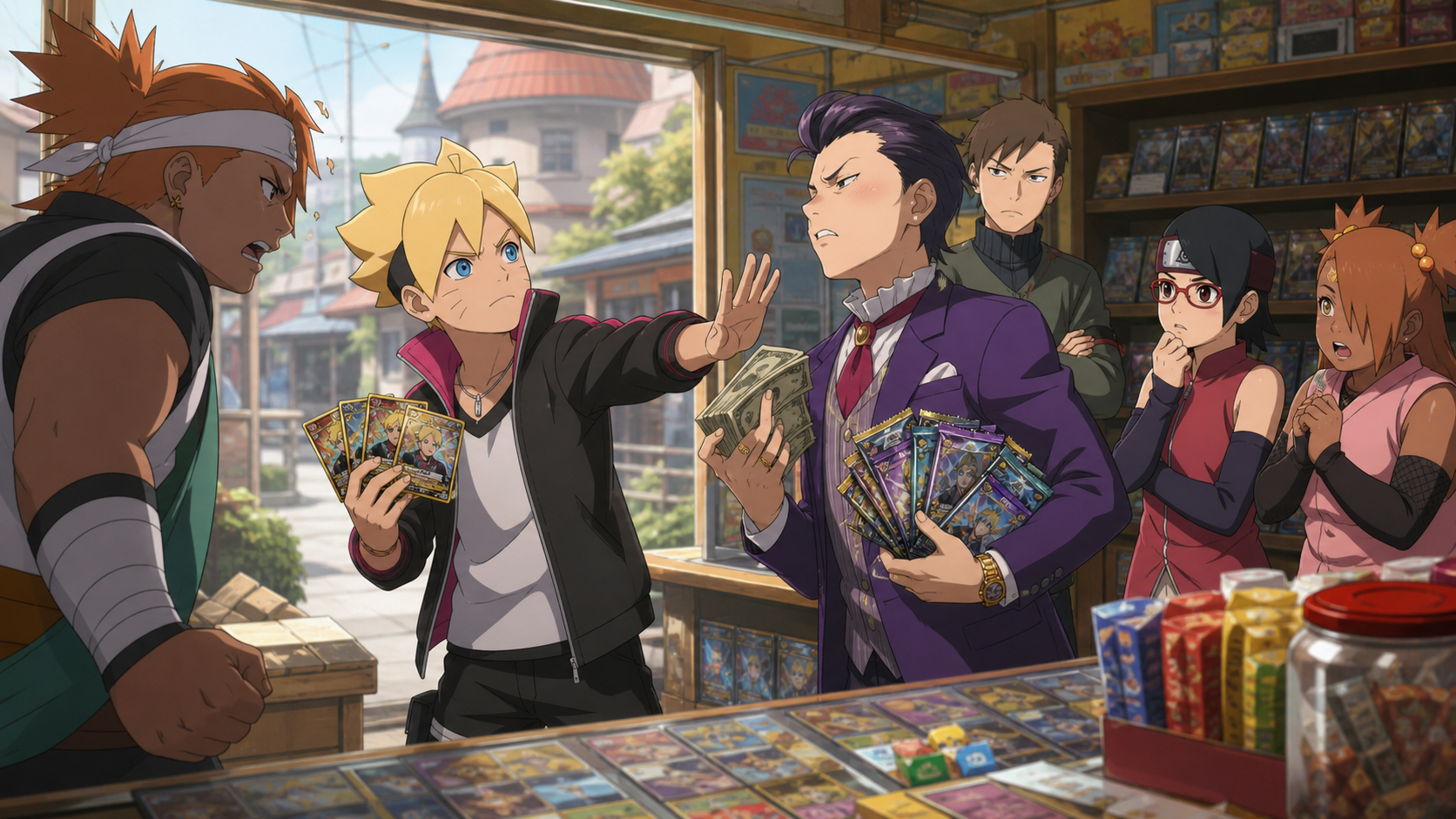
Tentō wants every pack in the store. When Iwabee will not sell the rare Seventh Hokage card Boruto gave him, Tentō escalates by buying out other shops and food counters. The tactic is petty on purpose. Tentō turns money into pressure because ordinary conversation has failed him.
The comedy works because Iwabee is exactly the wrong person to bully this way. Iwabee respects effort, pride, and directness. A rich kid waving cash at him hits every nerve. Tentō thinks every refusal is a price negotiation, while Iwabee hears an insult. Violence is one bad second away when Boruto steps between them.
Boruto’s intervention is not soft or diplomatic. He protects Tentō and immediately mocks him. Boruto claims he owns five copies of the Seventh Hokage card, then refuses to sell even one. Tentō finally meets a boy who cannot be bought and does not care about the daimyō’s name. That refusal is the first useful thing anybody gives Tentō all day.
Boruto’s five Naruto cards are the joke and the wound
Boruto complains whenever another pack gives him Naruto. He hands a duplicate to Iwabee because the card means less to him than the rare card he actually wants. Yet Boruto also keeps multiple copies and uses that fact to needle Tentō. The contradiction feels perfectly Boruto.
Naruto is ordinary inside Boruto’s house and legendary everywhere else. Boruto knows the exhausted father who misses dinner, leaves clones at family events, and lives behind the Hokage desk. Konoha sees the Seventh Hokage. Tentō sees a rare collectible. Neither version contains the whole man.
Boruto’s frustration with the card also reveals privilege he cannot see. He can dismiss the Hokage image because he has access to Naruto the person. Tentō has money, servants, and political protection, but apparently very little ordinary access to his own father. One boy resents having to share his father with the village. The other boy appears willing to buy the whole village if somebody will stay in the room with him.
That parallel is the reason their relationship has somewhere to go. Boruto does not need to admire Tentō’s behavior. He needs to recognize the loneliness underneath. Tentō does not need another paid companion. He needs somebody stubborn enough to tell him no.
The episode understands class without pretending money is harmless
Tentō’s loneliness does not erase the damage his behavior causes. Buying out stores affects workers and customers who do not exist merely as props in a rich child’s tantrum. Pressuring Iwabee with money is still bullying. The episode lets Tentō be wounded and obnoxious at the same time.
Boruto also occupies a strange class position. He is the Hokage’s son, lives in a comfortable home, and can speak to powerful shinobi without ceremony. He rejects the idea that those advantages define him, but rejection does not remove them. Tentō sees expensive clothes as proof of rank and judges Boruto for dressing like an ordinary kid. Boruto sees the judgment as ridiculous because Konoha has taught him to measure ninja through ability. Both boys grew up inside systems that made their family identity public property.
The difference is that Boruto has peers who challenge him. Sarada corrects him. Iwabee argues with him. Chōchō laughs at the card obsession. Mitsuki watches for the person underneath the noise. Tentō arrives with an attendant whose job requires obedience. Money removes friction until Tentō has no idea how to build a relationship that is not a transaction.
Yamaoka’s presence should make the audience uneasy
Yamaoka appears to be the responsible adult keeping the daimyō’s son safe while Ikkyū meets Naruto. He follows Tentō through the village and watches the shopping spectacle without stopping the deeper spiral. For a first-time viewer, Yamaoka reads as an overwhelmed attendant. After Episode 147, any adult positioned near a valuable target deserves a second look.
Shōjōji’s Corpse Clone Technique changed the rules. A familiar face no longer guarantees a familiar person. The episode does not announce the trap because the audience already received the warning. Kokuri’s stolen identity taught us to distrust appearances, and the Mujina Gang’s final surveillance shot keeps that lesson active.
Konohamaru gives Boruto the mission he does not want
The next morning, Boruto learns that he will serve as Tentō’s escort and bodyguard. Boruto’s reaction is immediate disgust. He already decided Tentō is spoiled, arrogant, and exhausting. Konohamaru does not promise fun. He frames the assignment as part of shinobi work.
That answer matters because ninja missions are not a reward system built around personal preference. Boruto likes dangerous work when danger lets him prove himself. Guard duty requires patience, restraint, attention, and service to a client he dislikes. The mission attacks the exact weakness exposed during the bank-robber operation. Boruto must stop reacting only to the most irritating object in front of him and identify the larger threat around the client.
Ikkyū specifically requests Boruto, which adds another layer. Boruto cannot disappear into Team 7. He must carry responsibility as an individual, and his connection to Naruto becomes part of the assignment whether he likes the family-name pressure or not.
Manga material gives the anime a sharper spine
Episode 148 adapts material from Boruto Chapter 11 and feels different from the long anime-original Hōzuki build-up. The dialogue moves faster, the political stakes enter quickly, and the Kāma thread returns to the foreground. The anime still earns the transition by connecting Shōjōji’s escape to the new target.
That bridge is important. A weaker adaptation would behave as if the previous episodes never happened. Instead, Boruto carries Momoshiki’s mark, the police track Mujina activity, and Shōjōji positions his people around Konoha. The prison mission now reads as the first half of a larger failure rather than an isolated side story.
The card-shop material also benefits from earlier episodes that established the Extreme: Shinobi Picture Scrolls craze. Boruto’s duplicate Naruto cards, Iwabee’s pride, and the girls’ confusion all belong to a village where children have already argued over rarity and status. Continuity turns a merchandising gag into character language.
Boruto’s card duplicates are funny because the hurt remains unresolved
Pulling Naruto repeatedly should feel lucky inside the game. For Boruto, every duplicate repeats the public version of a father whose private availability remains scarce.
The joke works because he knows other children would treasure the card. He cannot separate rarity from resentment. A collectible turns Naruto into an image that can appear on demand while the actual man remains trapped behind work, security, and the Hokage title.
Boruto is not ungrateful for disliking the result. Tentō is not wrong for wanting what Boruto rejects. The same object carries different family histories.
That difference later makes the gift meaningful. Before the gift can matter, Episode 148 has to show why money and rarity cannot settle Boruto’s relationship with the card.
Tentō uses money as a language because adults taught him that language works
He rents attention, clears shelves, commands service, and expects desire to become logistics. Those habits did not appear from nowhere. A powerful household solves inconvenience through staff and spending while the person Tentō wants most remains unavailable.
Money gets faster responses than vulnerability. Bragging therefore feels safer than saying, “My father does not know me.” Buying every card protects him from wanting one card another child might refuse to trade.
The behavior still harms people. Shop customers lose access, workers absorb demands, and Boruto gets treated like another purchasable experience. Explanation cannot become exemption.
The child needs boundaries from adults who remain present after enforcing the boundary. Boruto’s refusal begins that lesson, but Boruto should not have to carry the whole emotional education of a client.
The protection assignment needs a child-safeguarding plan
Tentō is a political target, a lonely child, and a client who may resist restrictions. Assigning Team 7 requires more than telling Boruto to stay nearby.
The team needs verified staff lists, secure routes, emergency signals, rules about unscheduled shopping, medical contacts, and clarity about who can alter the itinerary. Tentō needs those rules explained in language that respects him rather than using security as another wall adults hide behind.
Boruto also needs a private reporting channel because suspected infiltration changes every normal assumption. Sarada and Mitsuki should not learn about danger only after he disappears.
A protection mission succeeds when the child remains alive, informed, and capable of participating in safety. Treating Tentō as cargo would reproduce the emotional neglect making him easy to manipulate.
Yamaoka’s passivity reads differently once the audience knows what Shōjōji can do
The servant appears familiar, compliant, and close enough to Tentō that nobody questions access. Those qualities can describe long professional trust. They can also describe a performance built from stolen memory.
The episode wisely plants unease without announcing the answer. Small absences matter: limited initiative, acceptance of Tentō’s excess, and movement through spaces where authority follows the face.
Once identity theft becomes possible, security based on recognition collapses. A household must verify behavior, schedules, and paired contact without teaching a child that every caregiver might be false.
The horror is not only that Shōjōji can look like Yamaoka. He can weaponize the emotional safety Yamaoka spent years building.
Kāma and money create two different performances of control
Boruto cannot explain the mark or predict the next activation. Tentō cannot make Ikkyū become emotionally available. Both boys respond by controlling visible things.
Boruto trains, chases immediate tasks, and redirects attention toward whatever he can hit. Tentō buys inventory, schedules entertainment, and orders adults to react. One performance looks disciplined and the other looks obnoxious, but both protect frightened children from admitting powerlessness.
Their pairing works because each boy can eventually recognize the other’s strategy from outside. Boruto sees that money does not calm Tentō. Tentō sees that talent does not calm Boruto.
Friendship will not remove Kāma or repair Ikkyū overnight. Friendship can make the performance less necessary for a few honest minutes.
What works: the episode refuses to confuse a difficult child with an empty child
Tentō behaves badly. The script lets viewers feel Boruto’s irritation and the shop’s disruption. Then the story keeps looking.
His entitlement contains loneliness without becoming harmless. His spending creates attention without creating connection. His title gives adults reasons to please him and fewer reasons to correct him.
That layered presentation gives the arc somewhere to go. Instant sympathy would feel manipulative. Permanent contempt would waste the child beneath the behavior.
Boruto’s assignment becomes meaningful because he must protect somebody he does not initially like. Professional care begins before personal affection and creates the time in which affection may develop.
What Episode 148 gets right
The episode gives Boruto a believable emotional distraction without making him helpless. His mistake has a concrete mission consequence. Sarada’s criticism stays professional. Tentō’s behavior is funny, embarrassing, and rooted in a recognizable need without becoming harmless. The political visit creates danger without forcing Naruto into an exposition speech.
Most of all, the episode lets Boruto and Tentō dislike each other. Instant friendship would have been fake. Their bond needs the resistance. Boruto is the first peer who refuses Tentō’s money, while Tentō is a living reminder that famous fathers can fail their children in very different houses.
The ending also lands. Mujina eyes watch Konoha while Boruto accepts responsibility for the most obvious target in the village. The audience knows more than Boruto, but not enough to relax.
What still bothers me
The card-shop sequence pushes Tentō’s behavior so far that some viewers will stop looking for the child underneath. A little more time with Ikkyū before the meeting could have made Tentō’s emotional trigger clearer without excusing him. Yamaoka’s passivity also strains belief if read only as ordinary household service.
Boruto’s Kāma anxiety fades once the shopping comedy begins. That change makes sense for episode pacing, but the mark is too serious to function only as an opening alarm. The strongest reading connects both halves: Boruto cannot control the mark, Tentō cannot control his father, and both boys grab the nearest thing they can control instead. The episode leaves that connection for the audience to make.
RaeRae’s read
Tentō is not interesting because he is rich. He is interesting because wealth has ruined his ability to tell the difference between attention and affection. Every purchase makes people look at him, so he keeps buying. Boruto’s refusal feels almost cruel in the moment, but refusal creates the first honest boundary Tentō receives.
Boruto needs the same lesson in another form. He cannot punch uncertainty out of his palm, and he cannot complete a mission by grabbing the first visible criminal. Protecting Tentō will require attention to what the boy says badly, what the adults around him miss, and what the Mujina Gang sees from outside the village.
Episode 148 opens a short arc with a smart pairing. Two famous sons enter the same room carrying different kinds of resentment. One has too much access to the person behind the title and hates sharing him. The other has access to the title’s money and cannot reach the person at all. Konoha is about to find out what happens when those boys are forced to spend time together.
Sources and lawful viewing
Official episode reference: Naruto Official episode guide
Licensed episode route: Crunchyroll licensed series page