
A Test of Willpower
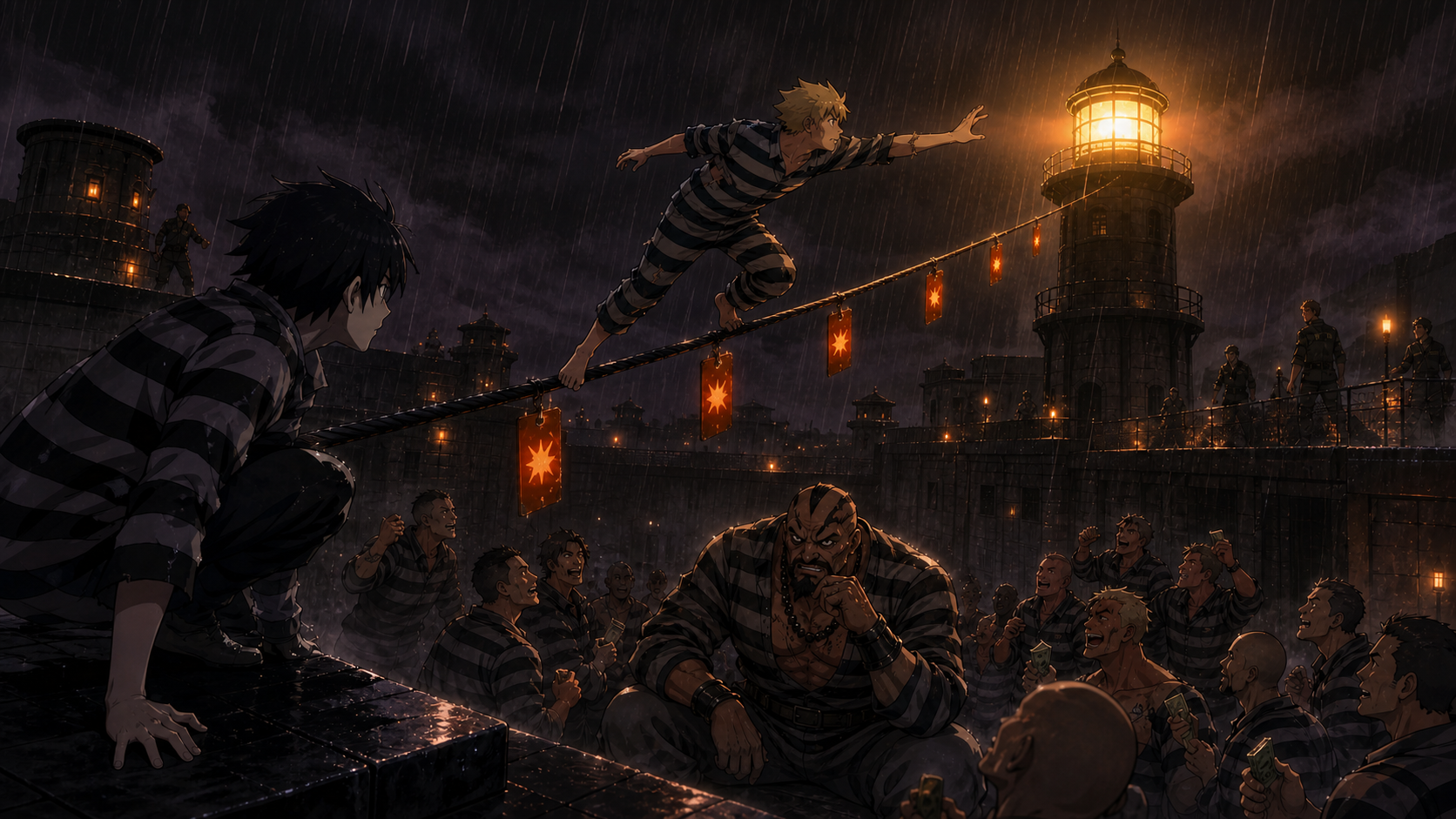
Boruto crosses a prison wire for one light bulb because Benga’s corruption has made danger the fastest currency for buying information.
Series: Boruto: Naruto Next Generations
Episode: 142 · A Test of Willpower
Arc: Hozuki Castle
Release: 2020-02-02
Previous: Episode 141 · The Shinobi Prison: Hozuki Castle
Directory: All 293 Boruto episodes
Bottom line
Boruto Episode 142 turns a prison light bulb into currency, spectacle, and leverage. Team 7 needs Kokuri transferred into Boruto and Mitsuki’s cell before another Mujina Gang assassin reaches him. Benga hides behind prison rules while using those same rules to run secret deals. Doragu knows where the corruption is buried, but information inside Hozuki Castle costs more than money.
Boruto accepts Doragu’s “test of willpower” and crosses a tagged steel wire in heavy rain to steal the lighthouse bulb. The task is a scam designed to entertain prisoners, create a betting market, and leave the challenger trapped when guards arrive. Boruto succeeds because Mitsuki creates an opening without exposing their false Heavenly Prison seals, while Boruto uses nerve and physical skill instead of a convenient jutsu.
The episode’s smartest idea is that every institution inside the castle has a shadow version. Guards assign cells; bribes assign cells too. The lighthouse provides security; prisoners convert the bulb into a wager. Mujo holds the title of warden; Benga controls daily decisions. Team 7 cannot protect Kokuri by obeying the official prison alone because unofficial power has already captured the official rules.
Kokuri identifies an inmate uniform, not a face
Kokuri survives the medical-ward attack with only a minor wound, but he cannot identify the assailant. The attacker wore prison clothing and moved too quickly for a useful description.
That clue narrows the threat while making the prison feel less safe. A uniform means the assassin did not need to break through the outer walls. Someone already inside reached a protected ward.
The medical staff insists prisoners cannot enter without a wooden tag. Kokuri’s wound proves that policy and reality no longer match.
Boruto promises protection before he has control
Boruto tells Kokuri that he will protect him. The promise is emotionally sincere and operationally premature.
Kokuri remains in a ward Team 7 cannot monitor continuously. Boruto and Mitsuki sleep in another block. Sarada’s visitor cover gives her access only when prison officials permit the visit.
Boruto’s promise therefore becomes a mission demand: change Kokuri’s placement before the next attacker tests the same weakness.
The empty bed should solve the problem
Boruto and Mitsuki’s cell has space for another inmate. Moving Kokuri there would allow both undercover shinobi to watch him at all hours.
Sarada asks Mujo to approve the transfer. Mujo agrees that the arrangement makes sense, but Benga rejects the request because the bed is reserved for a future prisoner and discharged patients normally return to their original cells.
The explanation sounds procedural. Procedure becomes suspicious when a reasonable safety exception threatens someone’s private power.
Benga uses consistency as a shield
Benga argues that making one exception will encourage every inmate to demand special treatment. Administrators often use that logic because consistency sounds fair even when the underlying conditions are unequal.
Kokuri is not requesting a preferred view or better meal. An organized gang has already attacked him inside the medical ward. Treating that danger like an ordinary housing preference protects the appearance of equal rules while ignoring unequal risk.
Benga’s refusal is later exposed as self-interest. He wants control over cell assignment because cell assignment produces bribes.
Mujo has authority without practical command
Mujo is the warden and clan representative, but Benga manages the prison’s daily machinery. Mujo apologizes because he cannot make an arbitrary decision without a reason Benga will recognize.
His restraint can be read as respect for procedure. The same restraint shows how a leader becomes a figurehead when subordinates control information and implementation.
Rehabilitation means little if Mujo cannot protect a cooperating inmate from an obvious assassination threat.
Tsukiyo tries to buy Kokuri’s disappearance
From solitary confinement, Tsukiyo summons Benga and offers payment to make Kokuri disappear. Benga resists the direct request, but the conversation confirms that criminal influence reaches prison leadership.
Tsukiyo speaks in riddles about luck and gifts because corruption prefers language that preserves deniability. Nobody has to say “murder” when everyone understands the desired result.
Benga’s anger does not prove integrity. He already accepts smaller bribes. Tsukiyo is testing the price and limits of a system built for private transactions.
Sarada searches for leverage outside the cells
Sarada investigates Benga’s habits under her journalism cover. She has greater mobility than Boruto and Mitsuki, but direct questions risk exposing why a student cares about one chief officer’s weaknesses.
The search shows the value of Team 7’s divided roles. Boruto can access prisoner society. Sarada can observe administration. Mitsuki can connect information and create quiet openings.
No single cover could reach every layer without drawing attention.
Prisoners know that power collects information
Boruto asks inmates about Benga and learns that ordinary prisoners know little beyond shared hatred. Arai directs him toward Doragu, the unofficial leader among the inmates.
The logic is simple: where power gathers, information gathers. Doragu controls enough favors, bets, and social pressure to hear what others miss.
His authority is not moral. Prisoners respect him because he can reward, punish, and connect people inside a closed economy.
Doragu prices information through risk
Doragu refuses to reveal Benga’s weakness for free. He asks Boruto to steal the lighthouse bulb, claiming the light disrupts his sleep.
The request is deliberately absurd. A powerful prisoner could find many practical uses for a favor, but spectacle creates a different kind of value. Doragu gets entertainment, betting action, and proof of how far the new kid will go.
Information becomes gold because nobody can obtain facts through transparent channels. Doragu charges in danger because danger is one currency Boruto still possesses.
The lighthouse challenge is built to create losers
The lighthouse stands beyond a wire marked with warning tags. Guards patrol the area. Rain makes every surface dangerous. Boruto cannot openly use ninjutsu because chakra would expose the false nature of his seal.
Doragu knows the guards will eventually notice. Even if Boruto reaches the bulb, arrest becomes part of the trap.
The prisoners understand this and bet on the outcome. Boruto’s body becomes public entertainment in the same institution that claims to maintain order.
Boruto accepts because time matters more than pride
Boruto says yes quickly, and the decision looks like familiar recklessness. The mission context gives the risk a practical reason.
Kokuri may be attacked again before paperwork changes his cell. Team 7 has no verified weakness to use against Benga. Doragu offers the fastest route to information.
Boruto is still gambling with the mission. Getting caught stealing security equipment could extend his cover sentence, isolate him, or reveal inconsistencies in his identity.
Crossing without ninjutsu tests the correct skill
Boruto balances on the wire under heavy rain while tags hang below. He cannot rely on clones, chakra-enhanced movement, or a flashy escape.
The limitation makes the scene more interesting. Boruto has spent his life around overwhelming techniques, yet infiltration requires control over ordinary movement and fear.
His physical ability remains impressive without turning the prison into another arena where the loudest jutsu wins.
The prisoners turn danger into a betting market
Doragu’s group immediately begins wagering on Boruto. Money changes hands while he risks injury and punishment overhead.
The scene is funny, but the humor carries institutional rot. Hozuki Castle offers little autonomy or stimulation, so inmates create excitement from another person’s danger.
Doragu profits socially whether Boruto succeeds or fails. The boss remains seated while the newcomer proves his usefulness.
Mitsuki protects the cover instead of stealing the scene
Mitsuki watches the guards close in and understands that direct ninjutsu would expose both boys. He creates a diversion subtle enough to open Boruto’s escape route.
That restraint is important. Mitsuki possesses abilities that could solve the wire crossing instantly. The mission demands that he know when not to display power.
His support lets Boruto complete the visible test while preserving the hidden operation. Teamwork inside cover roles often means making someone else’s success look solitary.
Boruto answers Doragu in Doragu’s language
After escaping, Boruto demands the promised information. When Doragu asks how he managed the disappearance, Boruto refuses to explain and repeats the prison lesson: information is gold.
The comeback works because Boruto has learned enough of the social economy to stop acting like an outsider demanding fairness.
Doragu respects the response. Boruto has paid the price and shown that he can protect a secret as well as request one.
The evidence travels through the mail system
Team 7 uses an inmate who handles outgoing items to send evidence of Benga’s secret deals. The prison’s informal smuggling route becomes a tool for exposing prison corruption.
That reversal is satisfying. Benga benefits from hidden exchanges, but he cannot control every exchange other people have built around him.
The records connect his handwriting to bribes used for cell assignments. Team 7 finally has a reason Mujo cannot dismiss as an arbitrary request.
Mujo acts only after corruption becomes documentable
Mujo confronts Benga with written evidence and removes his cell-assignment discretion. Kokuri will be placed with Boruto and Mitsuki after leaving medical care.
The outcome protects Kokuri, but Mujo’s response also exposes a leadership weakness. The assassination risk did not move him enough. Proof of administrative corruption did.
Institutions often respond faster to documented rule violations than to human danger because paperwork fits existing authority.
The missing wooden tag changes the suspect pool
The medical ward reports that a wooden access tag vanished three days earlier. The timing matches Boruto’s poisoning and Kokuri’s attack.
Mitsuki reconstructs the opportunity. When medical staff came for Boruto, cell doors were closed and prisoners were confined. Their cell was the only open cell.
The attacker is therefore likely one of their own cellmates: Arai, Kamata, or Kedama. The threat moves from the wider prison into the few feet surrounding their beds.
The lock-down threatens the mission again
Benga orders a full search. If the culprit is found, every cellmate may be sent to solitary as collective punishment.
That rule gives the actual attacker another weapon. One person’s crime can separate Boruto and Mitsuki from Kokuri just as the transfer is approved.
Team 7 has to solve the theft before prison discipline destroys the protection arrangement they nearly died to secure.
The empty bed is evidence that authority chooses not to see
Cell assignments should identify who sleeps where. An unoccupied bed creates a record problem before Team 7 begins any elaborate investigation.
Benga hides behind routine because routine benefits him. If the roster says the cell is full, he treats the paper as reality even when bodies contradict the paper.
Mujo should order a physical count, compare intake and transfer logs, interview guards separately, and preserve every alteration. The missing prisoner may be a victim, accomplice, or invented entry. Each possibility threatens prison security.
The episode needs the delay for its mystery. The institution’s refusal remains part of the story: obvious evidence becomes invisible when acknowledging evidence would create work or expose corruption.
Mujo’s title cannot substitute for command authority
He appears reasonable and possesses formal rank, yet Benga controls food, cells, guards, medicine, paperwork, and daily punishment. Practical power has migrated downward while accountability remains attached to the warden’s office.
That split allows Mujo to appear fair without preventing abuse. Good intentions matter less when subordinates can ignore orders, hide records, or threaten prisoners under the same institutional seal.
Mujo needs direct reporting channels, independent audits, staff rotation, and the ability to suspend Benga pending investigation. If laws prevent immediate action, the episode should name those laws. If habit prevents action, habit becomes negligence.
Authority that cannot protect one identified witness is ceremonial authority.
Doragu’s challenge prices desperation as entertainment
He controls information and chooses a payment suited to prison culture: risk visible enough to become spectacle. Boruto’s need raises the price.
The lighthouse crossing tests balance and nerve, but the betting crowd changes the meaning. Prisoners turn danger into a market because entertainment, currency, and status are scarce.
Doragu can claim that Boruto accepted freely. The choice exists inside a coercive situation where Kokuri may die if the information remains unavailable.
Boruto answers the only language Doragu respects. The prison administration should still ask why essential safety information lives behind an inmate’s lethal paywall.
Mitsuki’s restraint is active teamwork
He could intervene, expose shinobi ability, and end the crossing faster. Doing so would destroy the cover protecting Kokuri.
Mitsuki instead watches the physical risk, prepares an opening, and acts only where his help can remain plausibly ordinary. That discipline requires judgment, not passivity.
Boruto receives the visible moment because his body is on the wire. Mitsuki protects the larger mission by refusing the visible moment.
The episode treats support correctly here. A teammate does not have to reproduce the hero’s action to contribute equally. Sometimes competence means controlling the impulse to solve a problem in the most powerful available way.
Sarada converts suspicion into a record officials cannot dismiss
She works outside the cell because leverage must reach somebody with authority to move Kokuri. Observation alone cannot change the assignment.
The mail trail matters because corruption creates documentation even while trying to remain private. Dates, favors, messages, and repeated access can reveal a pattern stronger than one accusation from a prisoner.
Sarada needs copies stored beyond Benga’s reach and a direct transmission to Konoha. Evidence held only inside Hōzuki Castle can disappear with the same ease as the wooden tag.
Her role proves that investigation includes making truth administratively usable. A fact nobody will act on remains another trapped witness.
Bribery evidence should trigger protection before confrontation
Once Benga knows investigators possess records, Kokuri, Doragu, Kamata, Kedama, mail staff, and guards connected to the trail may face retaliation.
Mujo should restrict Benga’s access immediately, preserve communications, separate witnesses, and notify outside authorities. Leaving him in place while changing one cell assignment gives him time to destroy evidence and reshape stories.
Team 7 also needs a safer extraction plan. Moving Kokuri into their cell reduces one risk while concentrating the suspect pool and placing the undercover agents beside whoever stole the tag.
Exposure creates urgency. Accountability has to protect the people whose information made accountability possible.
The missing wooden tag is a chain-of-custody failure
The tag controls movement and therefore functions as a security credential. Staff should know when each tag is issued, returned, inspected, and reported missing.
A stolen credential should trigger immediate deactivation or replacement, a review of access points, and identification of everyone who could reach the storage location. Locking down prisoners treats the population as the problem while ignoring staff custody.
The theft narrows the suspect pool inside the cell, but the supply path may extend beyond the cell. Somebody could provide the tag, look away, or alter the log.
Finding the person carrying the credential will not answer how prison security lost control of the credential.
The lighthouse victory should not make the stunt a good protocol
Boruto survives, wins information, and earns status. Success can tempt Team 7 to treat the risk as justified.
The team had no rescue plan compatible with cover, no medical backup, and no guarantee Doragu would honor the bargain. One slip could end the mission and Boruto’s life.
Urgency explains the choice. A debrief should still identify alternatives: staged debt, traded labor, information from another source, or a controlled demonstration with a hidden safety line.
Courage deserves respect. Professional growth means building methods that do not require the same courage to survive the next information request.
Lockdown protects the institution first unless somebody audits the purpose
Restricting movement after a credential theft can preserve evidence and prevent escape. The same restriction traps Kokuri beside a suspected attacker, blocks Team 7’s routes, and gives Benga more control over communication.
Officials need to state the objective, expected duration, medical exceptions, review authority, and conditions for release. Prisoners should know whether meals, medication, counsel, and emergency reporting remain available.
Lockdown cannot become punishment for an investigation the administration failed to secure. Staff custody of the tag, missing logs, and Benga’s conduct require equal scrutiny.
Kokuri’s witness status should trigger separate protection. Placing him in a closed cell with the unknown thief converts a security response into an assassination opportunity. A neutral guard, monitored room, or immediate outside transfer would reduce the risk without announcing every detail of Team 7’s cover.
The episode treats lockdown as the next obstacle. The policy question is who becomes safer once the doors close.
What worked for me
The episode turns prison politics into action without abandoning character. A light bulb, cell assignment, mail favor, and missing wooden tag all carry operational meaning.
Boruto’s stunt has consequences beyond spectacle. Mitsuki contributes through restraint and timing. Sarada creates the administrative path that lets the evidence matter.
Doragu is entertaining because he understands the prison better than the officials who claim to run the institution. His help remains transactional, which keeps the alliance believable.
What needed more room
Mujo’s inability to overrule Benga needs a clearer legal basis. A warden who cannot move one endangered inmate appears dangerously weak.
The lighthouse test also risks becoming too playful for the stakes. Guards discuss killing an unidentified prisoner, yet the episode moves quickly back toward banter.
Team 7 should question whether exposing Benga’s bribes will create retaliation. Removing one decision does not remove the officer from the prison.
The verdict
“A Test of Willpower” succeeds because Boruto’s courage is only one piece of the solution. He crosses the wire, Mitsuki creates the opening, Sarada carries the leverage, and the prison’s own informal networks move the evidence.
Benga loses control over Kokuri’s cell because his private deals leave records. Doragu provides information because Boruto survives the price. The missing tag then reveals that the protection team has been sleeping beside a suspect.
Hozuki Castle keeps turning victories into new confinement. Kokuri finally has a route into Team 7’s cell, but somebody already inside that cell may be waiting to kill him.
Sources and lawful viewing
Official episode reference: Naruto Official episode guide
Licensed episode route: Crunchyroll licensed series page