
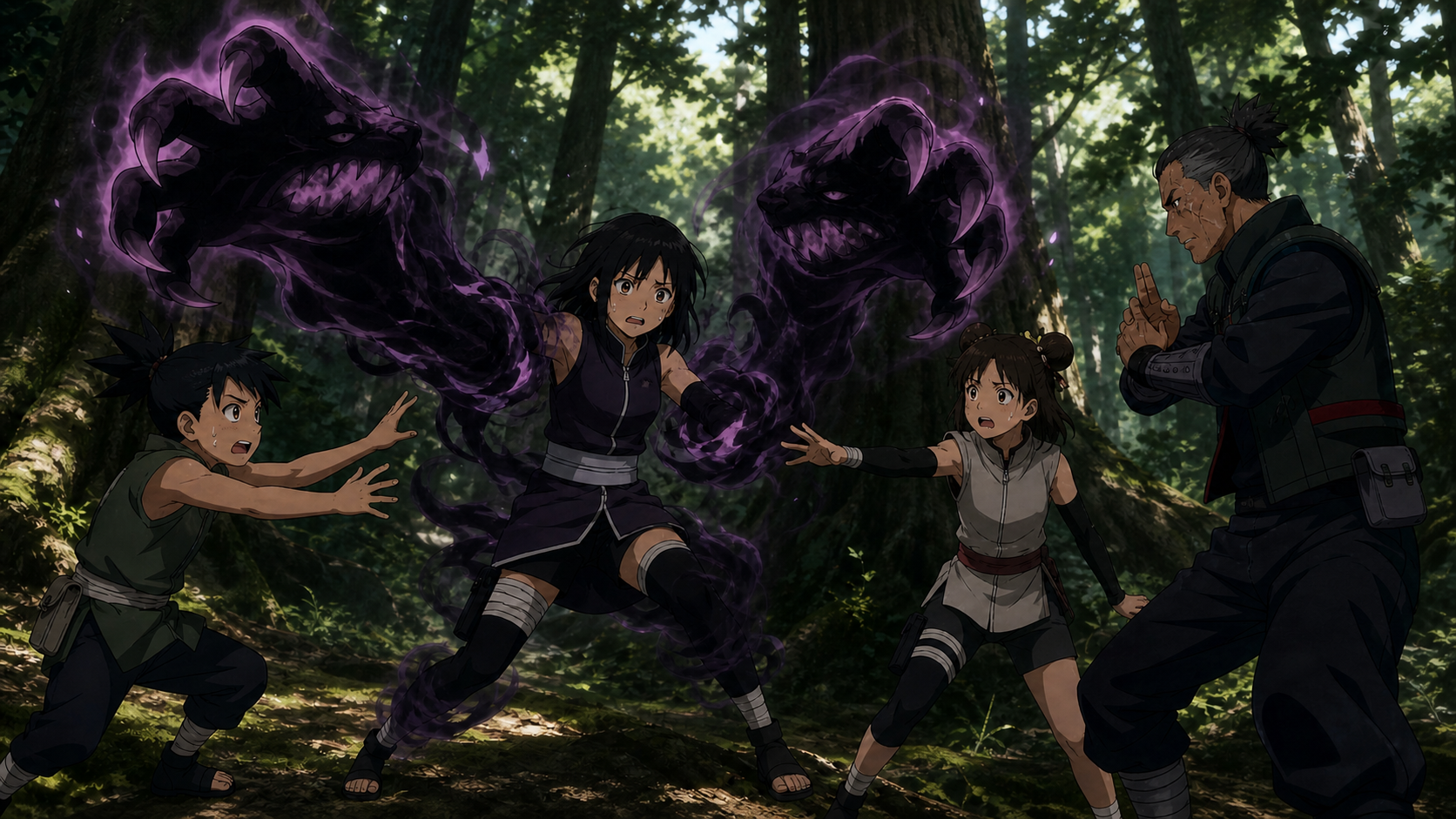
The Terror! Enko Onikuma
Enko’s clan technique looks monstrous, but Team 40 learns that fear and distance can create the loneliness that makes her power harder to control.
Series: Boruto: Naruto Next Generations
Episode: 139 · The Terror! Enko Onikuma
Arc: Team 40
Release: 2020-01-12
Previous: Episode 138 · Hiashi’s Birthday
Directory: All 293 Boruto episodes
Bottom line
Boruto Episode 139 gives Enko Onikuma the kind of attention side characters rarely receive. Her clan technique makes her arms look monstrous and gives her frightening strength, but the real trigger behind her loss of control is loneliness. Team 40 fears the power, pulls away from the girl, and accidentally creates the exact emotional condition that makes the power harder to contain.
Ibiki Morino understands the cycle because Konoha has spent years looking at his scars before deciding who he is. His first solution is brutally practical: disband Team 40, remove frightened teammates from the field, and train Enko for interrogation work where terrifying people can become an advantage. The plan protects everyone from an immediate accident. The same plan also confirms Enko’s worst fear that friendship disappears when people see her fully.
The episode lands because Tsuru and Doushu do more than announce that they are no longer afraid. They follow Enko, face the transformed arms again, apologize for abandoning her emotionally, and trust her to respond. Enko still needs control training. Her teammates still need procedures for danger. Love is not a substitute for preparation, but isolation was never treatment.
Team 40 finally steps out of the classroom background
Enko, Tsuru, and Doushu have existed around Boruto’s generation since the Academy days, yet most viewers know them as faces in a crowd. Episode 139 treats that background status as an opportunity rather than proof that they have nothing to offer.
Their lost-pet mission is small, which fits a genin team still building reliability. Nobody needs to save the village for the relationships to matter. A frightened animal, a volatile inherited technique, and three teenagers trying to complete ordinary work provide enough pressure.
The Naruto world becomes richer when side teams have problems unrelated to Team 7. Konoha should feel like a working village full of shinobi whose careers continue outside the protagonist’s camera. Team 40 gives that wider generation another texture.
Enko’s power was inherited before she could consent
Enko carries the Onikuma clan’s hidden possession-type summoning technique. A summoning beast entered her body during childhood, leaving her able to manifest enormous, demon-like arms.
The language of inheritance can make clan abilities sound like gifts. Enko’s experience complicates that assumption. Her technique changes how strangers look at her, how teammates approach her, and what kind of work adults imagine for her future. She did not choose those social consequences.
Many Naruto clans turn children into containers for family power. The Aburame accept insects into their bodies. The Hyuga mark Branch House children. Jinchuriki carry tailed beasts because villages need weapons. Enko’s story belongs to that larger pattern of adults calling a burden tradition after a child learns to survive the cost.
The monstrous arms hide a friendly girl
Enko is kind, social, and deeply invested in keeping friendships. Her secret technique creates a visual contradiction because the arms look like the body of a horror villain.
The episode knows viewers will react before thinking. Large claws, dark chakra, and uncontrolled movement activate fear. Enko has already watched that reaction on other people’s faces often enough to anticipate rejection.
Her long mittens are therefore more than costume design. They function as concealment and social armor. Covering the arms lets other people meet the girl before confronting the power. The arrangement may make daily life easier, but concealment also teaches Enko that acceptance depends on keeping part of herself out of sight.
Fear changes how Tsuru and Doushu behave
Tsuru and Doushu care about Enko. They also know she can injure them when the technique overwhelms her. Both facts are true, and the episode is strongest when neither fact gets dismissed.
During the pet mission, they attempt trained restraints. Tsuru uses her hair to bind Enko, and Doushu reinforces the hold. When Enko breaks free, Doushu uses a blowgun to knock her unconscious. Their response is not cowardice. They are genin trying to survive a teammate’s uncontrolled power without killing her.
The failure comes afterward. Repeated fear begins reshaping the friendship. Every flinch tells Enko that she has become a mission hazard before she remains a person. Their physical safety plan lacks an emotional recovery plan.
Enko asks them to run before she attacks
Enko recognizes the loss of control beginning and tells her teammates to get away. That warning proves she is fighting from inside the transformation.
Stories about possession often erase the person once the monster appears. Episode 139 keeps Enko’s awareness central. She knows the danger, fears hurting people she loves, and carries responsibility even while her control is failing.
That awareness makes the cycle crueler. Enko sees Tsuru and Doushu retreat, understands why they retreat, and still experiences their distance as confirmation that she will be abandoned. Fear does not become irrational simply because Enko can explain the cause.
Knocking her out solves the emergency, not the problem
Doushu’s tranquilizer ends the immediate rampage. Everyone survives, and the team can bring Enko back safely. Operationally, the choice works.
The same solution cannot become the entire management system. Waiting for Enko to lose control and then rendering her unconscious leaves her with no path toward mastery. Her teammates become wardens who monitor for failure.
Konoha has a long history of containing dangerous bodies instead of caring for the person inside. Naruto grew up watched as the Nine-Tails vessel while adults rarely addressed his loneliness. Enko’s scale is smaller, but the emotional logic is familiar. Containment without belonging can preserve a village while destroying a child.
Ibiki’s decision sounds cruel because the risk is real
Ibiki arrives as Team 40’s replacement leader and announces that the team will be dissolved. Tsuru and Doushu will be separated from Enko. Enko will train and work under him.
His reasoning is not absurd. Frightened teammates hesitate, and hesitation around uncontrolled power can kill everyone. Ibiki also sees a professional use for Enko’s frightening appearance and strength within interrogation work.
The problem is how easily institutions turn adaptation into destiny. Enko scares people, so Konoha considers placing her in a division built around fear. The assignment could give her expert supervision and meaningful work. The assignment could also trap a gentle girl inside the role everyone assumed from her arms.
Ibiki knows what a frightening face costs
Ibiki’s scars announce pain before he speaks. He survived torture without surrendering information, and his body carries the record. People who know his history may see courage. Strangers can see a threatening man associated with interrogation.
Tsuru later asks whether he understood Enko because he also feels lonely when people find him scary. Ibiki refuses a neat confession. That restraint fits him.
His behavior still answers. He steps between Enko and the others. He recognizes loneliness as the trigger. He chooses to supervise a child whose appearance causes fear. Ibiki may never describe himself with Enko’s emotional vocabulary, but he knows what happens when a body enters the room before the person does.
Team 7 helps without taking over Team 40’s story
Boruto, Sarada, and Mitsuki become involved as classmates and fellow shinobi. Their presence gives Tsuru and Doushu support while they decide whether to follow Enko.
The episode wisely keeps the decisive emotional work with Team 40. Boruto cannot deliver one speech and repair a friendship he does not inhabit. Sarada cannot command trust into existence. Mitsuki cannot analyze the risk away.
Team 7 can help create the opportunity. Tsuru and Doushu have to cross the distance themselves. Side-character focus means allowing side characters to make the choice that resolves their own episode.
The trigger is loneliness, not fear
Ibiki identifies the emotional mechanism everyone else misread. Enko does not lose control because she becomes afraid. The summoning power overwhelms her when she feels alone.
That distinction changes the response. Telling Enko to be braver would place the entire burden on her. Demanding suppression would treat every visible symptom as personal failure. Understanding loneliness forces the team to examine the environment surrounding each episode.
Emotional triggers do not eliminate personal responsibility. Enko must still learn control because her teammates can be hurt. The diagnosis simply reveals that responsibility is shared. A team cannot repeatedly signal rejection and then act surprised when isolation worsens the condition.
Tsuru and Doushu follow after being dismissed
Ibiki orders the separation, but Tsuru and Doushu refuse to let the announcement become the final word. They follow because fear has not erased attachment.
Following Enko is not automatically heroic. If they arrived only to panic again, their presence could deepen the wound. The meaningful change is their willingness to see the transformed arms and remain engaged.
They also accept that their earlier behavior contributed to Enko’s loneliness. An apology becomes useful when the speaker names a choice and behaves differently under the same pressure.
Ibiki shields the children with his own body
When Enko attacks, Ibiki moves between the summoning arms and the genin. The interrogation captain famous for intimidation becomes the physical shield.
That action clarifies his leadership. He is not recruiting Enko because he wants a convenient monster. He believes an adult should absorb risk while young shinobi learn.
Konoha has failed this principle many times. Children were sent into wars, exams, clan conflicts, and secret programs while adults justified the danger as training. Ibiki’s methods are harsh, but his body placement says the adult goes first when control collapses.
The apology reaches Enko inside the transformation
Tsuru and Doushu tell Enko that their fear created distance and made her lonely. They do not ask her to pretend the attacks were harmless. They tell her the friendship still exists while the frightening power is visible.
Enko regains control because the message addresses the real trigger. The resolution is emotionally clean, perhaps cleaner than a recurring possession problem would be in life. Still, the scene earns the release through established cause and changed behavior.
The episode does not claim that one apology permanently cures the technique. Team 40 finishes the next mission successfully because they now understand what must be monitored beyond chakra and restraints.
Re-forming Team 40 is a risk worth managing
Ibiki reverses the disbandment after seeing the three genin work through the crisis. Keeping them together is not sentimental surrender. Their bond becomes part of the control system.
Tsuru’s binding technique and Doushu’s restraints remain practically useful. Their knowledge of Enko’s emotional state becomes equally important. Ibiki adds an adult capable of taking the front position when danger exceeds genin limits.
The re-formed team has an unusual but coherent specialization: capture, restraint, intimidation, and interrogation support. Enko does not have to become only a weapon. Her power can fit a team where the others know both the technique and the girl.
The lost pet gives the episode the right ending
Team 40 completes the original mission without another crisis. Success looks ordinary after the emotional confrontation, which is exactly why the ending works.
The animal takes a liking to Ibiki, puncturing his terrifying reputation with a simple visual joke. A creature responds to behavior rather than scars or job title.
Enko receives the same grace from her teammates. They have seen the claws and still recognize the person. Ibiki holds the pet, Team 40 finishes the assignment, and nobody needs a speech about appearances.
Enko and Naruto share a painful Konoha pattern
Enko is not a jinchuriki, and her clan technique should not be flattened into a Nine-Tails copy. The comparison matters at the level of social response.
Both children carry power that can emerge violently. Adults and peers fear the danger, then create isolation around the carrier. Isolation makes emotional control harder. The village interprets the resulting instability as proof that distance was necessary.
Naruto broke that cycle through relationships with Iruka, Team 7, Jiraiya, and others who saw a child before a vessel. Enko needs a smaller version of the same social correction. Tsuru and Doushu cannot control the arms for her. They can stop treating loneliness as an acceptable safety measure.
The Onikuma inheritance needs an adult-accountability file
Enko received the possession technique as a child, before meaningful consent was possible. Clan tradition cannot answer who evaluated the risk, which alternatives existed, and what support adults promised after passing the burden down.
Konoha should hold medical and sealing records, trigger histories, prior incidents, emergency plans, and names of every adult responsible for training. Enko should have access to those records rather than learning about her own body only during crisis.
If the clan treats possession as duty, the village must separate cultural respect from automatic approval. Tradition can carry knowledge and still harm children.
The episode focuses on Team 40’s response. Accountability begins earlier, with the adults who made a dangerous inheritance feel inevitable.
Separation can reduce immediate danger and intensify the trigger
Ibiki sees uncontrollable force and proposes distance. The logic is understandable: fewer nearby bodies mean fewer people can be injured.
Loneliness triggers Enko’s loss of control, so isolation removes the social support helping her regulate. A safety plan that worsens the known trigger cannot remain the only plan.
The answer is not unlimited closeness. Team 40 needs trained proximity: safe distances, verbal cues, restraints Enko accepts in advance, evacuation roles, medical backup, and a signal allowing her to ask for space before panic peaks.
Care becomes safer when everyone knows what to do. Abandonment only makes the frightened person responsible for surviving the abandonment and the technique at once.
Tsuru and Doushu owe more than courage during the transformation
They become afraid, change behavior, and create the loneliness Enko already dreads. Following her after dismissal proves loyalty, but repair needs a direct account of what they did.
An apology should name avoidance, secret conversations, and the moments Enko had to manage their fear while managing her own body. They should ask what support she wants rather than assume friendship grants access.
Both teammates also need education and emotional support. Fear does not make them cruel. Unexamined fear can make their actions cruel.
Team trust grows when people can admit danger without turning the dangerous condition into the whole identity of the friend carrying the condition.
Ibiki’s body makes him empathetic and does not make every harsh assignment ethical
He knows strangers can decide character from appearance. His scars and reputation allow him to recognize the friendly girl behind Enko’s monstrous arms.
That insight makes him a strong mentor. Assigning her automatically to interrogation because the technique frightens people risks repeating the same reduction.
Enko may choose intelligence or interrogation work. The choice should follow aptitude, training, consent, and safeguards, not the convenience of turning stigma into a job description.
Surviving a frightening appearance does not obligate a person to monetize that appearance for the state.
Knocking Enko unconscious needs medical follow-up, not a reset
Ending the transformation prevents immediate injury. Loss of consciousness can carry concussion, chakra exhaustion, memory gaps, and fear about what happened while control was absent.
A medic should examine her, document the duration and trigger, confirm injuries to everyone involved, and review whether the restraint method remains appropriate. Enko should hear the account when stable and participate in revising the plan.
Stories often use unconsciousness to close a dangerous scene cleanly. The body still experienced the technique and the intervention.
Recovery becomes part of training when the team learns from each episode rather than treating survival as proof the existing plan worked.
Naruto and Enko expose Konoha’s habit of socializing containment
Naruto grew up surrounded by adults who feared the Nine-Tails and expected a child to absorb the village’s discomfort silently. Enko faces a smaller but recognizable pattern.
People withdraw, watch for danger, and interpret loneliness-driven behavior as evidence that distance was correct. The social response helps produce the crisis later cited to justify the social response.
Relationships did not remove Kurama’s danger. Relationships gave Naruto reasons, skills, and witnesses strong enough to prevent danger from defining every future.
Team 40 can offer Enko the same principle without pretending friendship replaces sealing expertise or medical care. Belonging and professional support must work together.
Konoha succeeds only when the frightening moment triggers more care, better planning, and greater accountability instead of another child’s permanent isolation.
What worked for me
Episode 139 gives a background kunoichi a specific burden, personality, team dynamic, and future. Enko’s technique is visually memorable, but the story refuses to make spectacle the whole character.
Ibiki is an inspired team leader because his frightening appearance and protective conduct mirror the episode’s argument. Tsuru and Doushu receive enough responsibility to make the reconciliation belong to Team 40.
The lost-pet structure also keeps the scale honest. Konoha’s future depends on whether ordinary teams learn how to support dangerous abilities, not only whether Team 7 defeats the next god.
What needed more room
The Onikuma clan remains frustratingly vague. A childhood possession technique raises immediate questions about consent, training, family expectations, and previous users. The episode gives Enko a burden without fully examining the adults who passed the burden down.
Ibiki’s proposed interrogation path deserves more scrutiny. Matching a frightening body with frightening work can become exploitation even when the assignment looks practical.
Tsuru and Doushu also needed more life outside the crisis. Friendship feels stronger when viewers know what the three enjoy together before danger becomes the only shared identity.
The verdict
“The Terror! Enko Onikuma” is a side-character episode with a real reason to exist. Enko’s loss of control exposes a team failure, an institutional temptation, and a familiar Konoha habit of confusing containment with care.
Ibiki begins with separation because separation looks safe. Tsuru and Doushu prove that informed closeness can become part of safety. Enko proves that the frightening power never erased her ability to hear, choose, and return.
Team 40 finishes with better knowledge rather than perfect confidence. They know which restraints work, which emotions matter, and who must stand close when the arms appear. That is a believable beginning for trust after fear.
Sources and lawful viewing
Official episode reference: Naruto Official episode guide
Licensed episode route: Crunchyroll licensed series page