
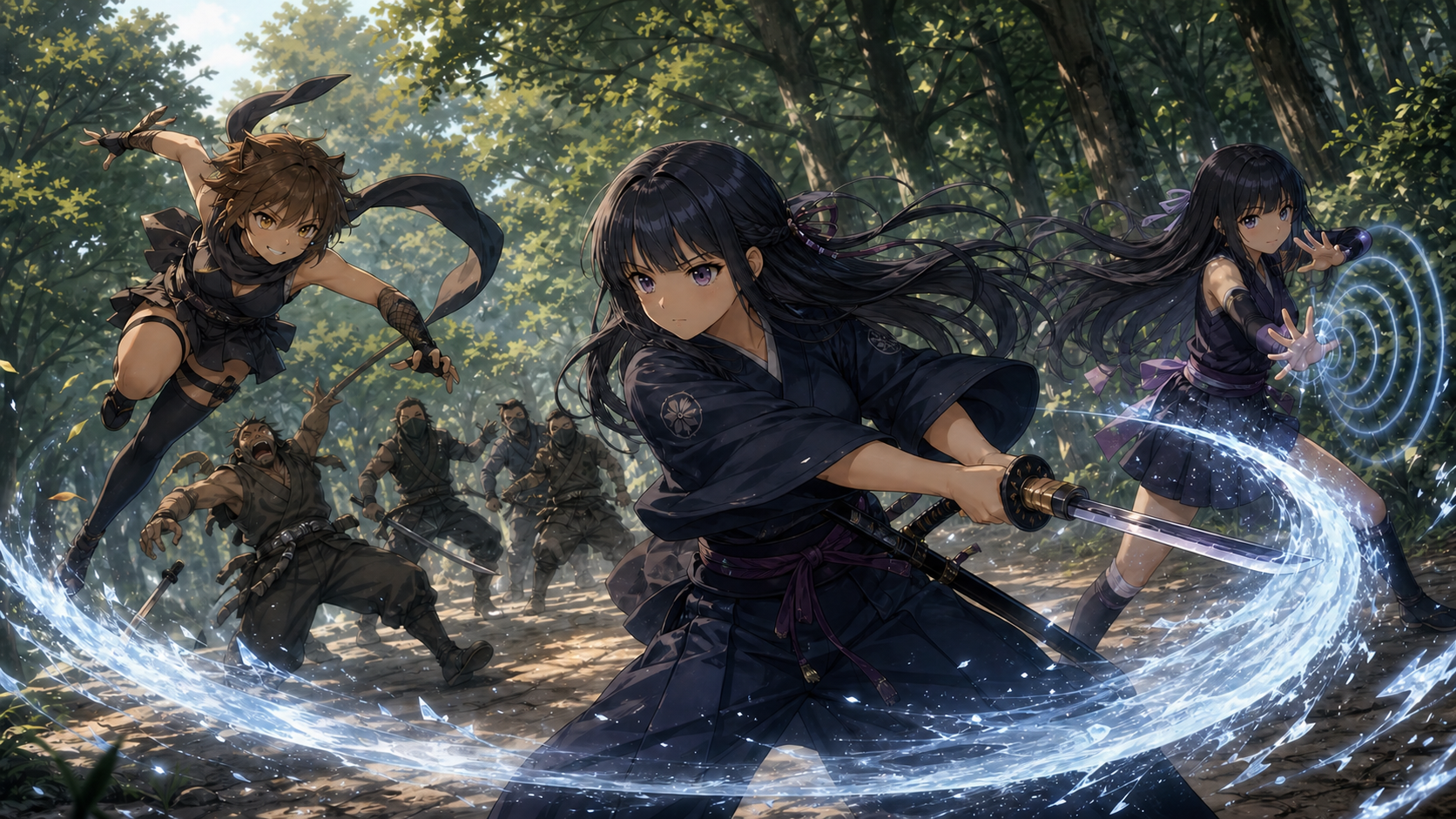
The Samurai Exchange Student
Tsubaki Kurogane enters Team 15 carrying a sword, samurai pride, and no idea how much courage can hide inside messy shinobi teamwork.
Series: Boruto: Naruto Next Generations
Episode: 137 · The Samurai Exchange Student
Arc: Team 15
Release: 2019-12-22
Previous: Episode 136 · Crossing Time!
Directory: All 293 Boruto episodes
Bottom line
Boruto Episode 137 gives Team 15 a new beginning without pretending that change feels comfortable. Sumire earned the right to follow her interest in scientific ninja tools, but Wasabi and Namida still experience her transfer as a loss. Tsubaki Kurogane arrives from the Land of Iron carrying discipline, pride, and a very narrow opinion of shinobi. She can cut down an opponent with frightening precision. She has no idea how to join a friendship that already has an empty space shaped like somebody else.
That tension makes “The Samurai Exchange Student” much better than a routine introduction. Tsubaki is funny because her confidence keeps colliding with ordinary Konoha life, yet the episode never reduces her to a joke about old-fashioned manners. Her mistake is sincere. She believes individual skill proves personal worth, while Wasabi believes loyalty and mutual trust are what make a team survive. Namida understands both girls long before either one stops arguing.
The final mission does not magically turn three strangers into best friends. Tsubaki sees that shinobi methods carry conviction even when those methods look casual from the outside. Wasabi sees that Tsubaki’s pride is attached to years of training rather than empty arrogance. Team 15 leaves the episode unfinished, prickly, and finally capable of becoming interesting.
Sumire leaves a real absence behind
Sumire’s transfer to the Scientific Ninja Tools Team is good for her. The series has spent enough time showing her intelligence, patience, and curiosity around technology that the move feels earned. She is choosing a future that fits the person she became after surviving the burden her father left behind.
Wasabi and Namida can support that choice and still feel hurt. Fandom stories sometimes treat a healthy departure as though nobody is allowed to grieve because the person leaving made the correct decision. Human relationships are messier. Sumire is not betraying Team 15, but every mission, meal, and conversation will change after she goes.
The farewell party acknowledges that emotional truth. The girls celebrate Sumire instead of making her responsible for their sadness. Their restraint says more about the friendship than a dramatic goodbye would have. Sumire leaves with affection, and the remaining teammates have to discover who they are without the girl who often steadied the room.
Tsubaki enters Konoha carrying the Land of Iron
Tsubaki Kurogane is Mifune’s last disciple and part of an unprecedented exchange between samurai and shinobi. That background matters. She does not arrive as a random transfer student who happens to own a sword. Tsubaki represents a military tradition with its own history, hierarchy, ethics, and suspicion of ninja behavior.
The Land of Iron remained neutral through much of the shinobi world’s conflict. Samurai discipline emphasizes direct martial training, visible loyalty, and a code that Tsubaki understands as more honorable than deception. Konoha shinobi use transformation, misdirection, traps, teamwork, and improvisation because survival often depends on making an enemy misunderstand the field.
Neither system can be summarized as noble samurai versus sneaky ninja. Mifune fought beside the Allied Shinobi Forces and understood cooperation across traditions. Tsubaki has inherited the discipline, but she has not yet inherited her teacher’s breadth. The exchange exists because both sides still have something to learn.
Her first impression of shinobi is almost designed to fail
Tsubaki meets Wasabi under circumstances that confirm every prejudice she brought to Konoha. Wasabi is informal, quick-tempered, and physically expressive. Tsubaki reads looseness as a lack of discipline. Wasabi reads Tsubaki’s composure as an announcement that everybody nearby has already failed an inspection.
Their early clash works because both judgments contain a sliver of truth. Wasabi can rush ahead when pride takes over. Tsubaki can make skill look like a moral ranking. The problem begins when each girl decides that one visible trait explains the other person completely.
Tsubaki’s criticism lands especially badly because Team 15 is already emotionally exposed. Wasabi has just lost the shape of the team she knew. A stranger arrives and immediately suggests that shinobi lack honor and conviction. Of course Wasabi pushes back. She is defending her profession, her village, and the friendship Tsubaki cannot see.
Wasabi is angry because loyalty is personal for her
Wasabi’s temper can look like simple comedy, but her reaction has a clear emotional source. Team 15 is not an abstract formation on a mission chart. Sumire and Namida are people Wasabi protected, argued with, encouraged, and relied on. When Tsubaki dismisses shinobi teamwork, she dismisses the way Wasabi understands care.
Wasabi also knows that strength does not always arrive in a polished package. Namida’s crying once embarrassed her. Sumire hid fear and guilt beneath perfect manners. Wasabi herself uses speed and bravado to cover uncertainty. Their team learned to recognize ability before every member could display confidence consistently.
Tsubaki judges from finished technique. Wasabi judges from shared effort. Both standards matter, but only one leaves room for a teammate who is still growing. Wasabi cannot explain that difference calmly because calm explanation has never been her strongest language. She proves loyalty by showing up.
Namida becomes the bridge nobody thanks enough
Namida spends much of the conflict between two stronger personalities. That position is familiar. She notices the emotional temperature, tries to stop arguments from escalating, and keeps reaching for cooperation even when Wasabi and Tsubaki would rather win.
Her gentleness is not the absence of conviction. Namida has spent the series learning how to control a voice powerful enough to become dangerous. Her growth required humility, practice, and teammates willing to remain close while she made mistakes. She understands why Tsubaki trusts training. She also understands why Wasabi refuses to let friendship be measured only by clean performance.
The episode could have given Namida more direct authority, because she sees the central problem first. Still, her role matters. A team does not become functional only through the loudest fighter or the sharpest blade. Somebody has to listen well enough to identify what the argument is actually about.
Konoha looks undisciplined from the outside
Tsubaki’s tour of Konoha is played for culture-clash comedy, but her confusion deserves a fair hearing. The village mixes military infrastructure with restaurants, shopping streets, children, family homes, and casual social behavior. Shinobi eat loudly, tease each other, arrive with personal quirks, and treat improvisation as ordinary.
From Tsubaki’s perspective, the relaxed surface can look unserious. A samurai student trained under Mifune would expect visible restraint to demonstrate readiness. Konoha has learned to let people carry readiness beneath daily life. The village wants children to buy snacks and complain about homework even though those same children may be sent into danger.
That contradiction is part of Naruto’s peace. The next generation has enough safety to look less hardened. Tsubaki mistakes the evidence of relative peace for weakness because she has not seen the wars, losses, and political labor that created Konoha’s ordinary afternoon.
Tsubaki’s appetite makes her human before the sword does
The food comedy is important because Tsubaki’s formality needs a crack. She can speak like a representative of the Land of Iron, hold herself with exact posture, and discuss honor as though every sentence belongs in a training hall. Then Konoha food reaches her, and the disciplined mask has to negotiate with delight.
That contrast is fun without humiliating her. Enjoyment gives the audience access to the teenager beneath the title of samurai exchange student. She is curious about a world she has already judged. Her body admits interest before her pride can revise the official position.
Food often performs this work across the Naruto franchise. Ramen, barbecue, dumplings, chips, and shared meals create social space where rank becomes less rigid. Tsubaki can refuse Wasabi’s argument. Refusing every pleasure in Konoha would require a much more exhausting kind of stubbornness.
The mission exposes the weakness in solo excellence
Once Team 15 faces real criminals, Tsubaki has the most polished individual attack. Her sword technique is fast, controlled, and visually decisive. A viewer can understand why she trusts the training that produced such ability.
The danger comes from assuming that superior technique removes the need to read teammates. Shinobi teams distribute attention. One person pressures the enemy, another notices an escape route, and a third adjusts when the plan changes. No fighter can watch every angle while protecting civilians and anticipating deception.
Tsubaki approaches the battlefield as a place to demonstrate mastery. Wasabi and Namida approach the same field as a shared problem. Their methods initially interfere with one another because nobody has learned the others’ timing. The criminals do not need to be legendary opponents. A modest threat is enough to reveal how easily pride creates openings.
Samurai honor and shinobi conviction are not enemies
Tsubaki’s language places honor on the samurai side and flexibility on the shinobi side. The mission complicates that division. Wasabi risks herself for a teammate she barely likes. Namida acts despite fear. Their choices come from conviction even though neither girl follows Tsubaki’s preferred form.
Shinobi history provides plenty of reasons to distrust claims of honor. Villages sent children to war, concealed atrocities, used clan prejudice as policy, and called obedience a virtue. Samurai tradition is not automatically clean either. Any code can protect people, and any code can become an excuse for hierarchy.
The useful question is what a principle asks someone to do when another person is vulnerable. Team 15 answers through action. Wasabi and Namida do not abandon Tsubaki because she insulted them. Tsubaki does not cling to her first opinion after evidence contradicts her. That willingness to revise judgment is more honorable than winning the argument.
Tsubaki’s sword technique is character writing
Tsubaki’s Secret Sword technique is not merely a flashy introduction. The clean arc of the strike tells us how she thinks. Preparation becomes control, control becomes precision, and precision becomes proof that training can make chaos obey.
Wasabi’s movement has a different personality. Her speed feels instinctive and bodily, especially when her catlike technique takes over. Namida’s sound technique begins from breath and emotion, then expands beyond the body. The three fighting styles reveal three relationships with power.
Tsubaki contains power. Wasabi releases momentum. Namida amplifies feeling into force. Team 15 becomes promising because those methods can cover one another’s weaknesses. The sword supplies a decisive line, Wasabi changes position before an enemy settles, and Namida controls space. Their future depends on learning rhythm, not erasing difference.
The episode refuses an instant friendship
The ending offers respect before affection. That choice saves the introduction. Tsubaki does not become a cheerful Konoha convert after one mission, and Wasabi does not suddenly decide that aristocratic composure is charming.
They have enough evidence to stop treating one another as caricatures. Tsubaki recognizes that shinobi conviction may appear through loyalty and adaptation. Wasabi recognizes that Tsubaki can back up her pride with work and courage. Namida gains teammates who may finally listen after spending most of the day shouting past her.
Friendship can grow from that foundation because the agreement is limited. Nobody has surrendered identity. Tsubaki remains a samurai. Wasabi remains loud. Namida remains sensitive. A functioning team should make those traits useful rather than sanding everyone into the same personality.
Sumire and Tsubaki represent two kinds of exchange
Sumire moves from a combat team into scientific development. Tsubaki moves from one martial culture into another. Both changes ask the village to understand that service can take more than one form.
Sumire’s scientific path points toward the future Konoha is building. Technology may protect shinobi, distribute power, or create new dangers depending on who controls the tools. Tsubaki’s arrival carries an older tradition into the same future. Her presence argues that modernization does not require every culture to disappear into Konoha’s methods.
The parallel gives Team 15 a stronger identity than a simple roster replacement would. One girl leaves to cross the boundary between ninja and scientist. Another arrives to cross the boundary between samurai and shinobi. The team becomes a place where the postwar world tests whether cooperation can survive real difference.
Sumire’s departure deserves grief alongside pride
Moving into scientific research fits her curiosity, technical ability, and desire to prevent tools from becoming another route to harm. The decision can be right and still hurt her teammates.
Wasabi and Namida lose daily routines, shared mission shorthand, and a person who survived their earliest team formation. Pride does not cancel fear that Sumire is moving toward a future where they no longer fit.
A fuller farewell should let each girl say what she will miss and how they intend to remain connected. Friendship after a roster change needs deliberate time rather than vague promises.
The transfer becomes healthier when nobody has to perform happiness so completely that loss disappears.
Tsubaki arrives through an exchange program that owes her real support
Cross-cultural placement cannot stop at assigning a uniform and team number. She needs orientation to Konoha law, mission structure, housing, food, emergency contacts, money, slang, and the difference between classroom expectations and field command.
Team 15 needs preparation too. Wasabi and Namida should know what samurai training emphasizes, which customs deserve accommodation, and how to ask questions without turning Tsubaki into a museum exhibit.
An adult coordinator should monitor conflict during the first months. Tsubaki is a student, not a diplomatic symbol responsible for proving the entire Land of Iron compatible with Konoha.
Peace becomes ordinary through institutions that support exchange after the welcome ceremony ends.
Wasabi’s anger protects Sumire and traps Sumire in the old team
Wasabi interprets quick acceptance of Tsubaki as disloyalty. The emotion makes sense because replacement sounds like erasure while the departure remains fresh.
Protecting memory cannot mean refusing the person who arrives after the memory. Sumire chose a new path. Treating Team 15 as permanently frozen could turn affection into pressure for her to return.
Wasabi needs permission to grieve without making Tsubaki pay for the grief. Tsubaki needs patience without accepting hostility as a permanent initiation ritual.
The team can honor Sumire by carrying forward what she built rather than preserving an empty space nobody else is allowed to approach.
Namida’s mediation is skilled labor that must not become her only role
She notices emotional undercurrents, translates intent, and keeps two forceful personalities from escalating every disagreement. Those abilities belong inside leadership.
The risk is that everybody begins expecting Namida to absorb tension while Wasabi and Tsubaki retain the freedom to express anger directly. Emotional work becomes invisible when the group labels the gentle person “naturally good at calming people.”
Both teammates should learn to repair their own conflict and follow Namida’s tactical judgment when she speaks.
A balanced Team 15 will protect her from becoming the permanent bridge everybody crosses without maintaining.
Tsubaki’s discipline is real and incomplete outside its original context
Her training produces sword control, restraint, posture, endurance, and a clear relationship to duty. Konoha’s casual surface looks unserious because she reads discipline through visible form.
Shinobi discipline often appears as improvisation, hidden preparation, or trust strong enough to change a plan mid-mission. The style looks loose until results depend on flexibility.
Neither culture owns seriousness. Samurai structure can expose sloppy habits in Team 15. Shinobi adaptation can expose rigidity in Tsubaki.
Exchange becomes valuable when each side revises practice rather than deciding which tradition deserves to win.
Food humanizes Tsubaki without turning culture into a gag
Her appetite breaks the polished image she presents and gives the other girls an ordinary point of connection. Enjoyment reaches across formality faster than a lecture about alliance.
The joke should not reduce the Land of Iron to stiffness and Konoha to delicious freedom. Tsubaki can love local food while retaining cultural pride and preferences from home.
Meals also create a low-stakes space where the team can ask questions, misread one another, and build routines not organized around combat.
Friendship needs those spaces. A squad cannot learn every difference while somebody is attacking the client.
What worked for me
Tsubaki arrives with a point of view strong enough to disturb the existing cast. Her confidence is funny, irritating, and earned. Wasabi’s anger grows from loyalty rather than random shouting. Namida provides emotional intelligence without becoming a lecture machine. Sumire receives a departure connected to her established interests.
The episode also remembers that peace creates cultural contact. Naruto’s generation built alliances during catastrophe. Boruto’s generation has to turn those alliances into schools, exchanges, careers, and friendships. A samurai joining a ninja team may look like a small administrative experiment, but small experiments are how peace becomes ordinary.
Most of all, Team 15 gains conflict that can produce growth. The girls do not need another enemy standing outside the team every week. Their different assumptions about discipline, courage, and loyalty can generate better character stories from inside the formation.
What needed more room
Sumire’s farewell could have lasted longer. Her bond with Wasabi and Namida deserved more private conversation, especially after everything Team 15 survived together. The transfer is treated as a clean progression when Wasabi and Namida are likely carrying fear that their friend has outgrown them.
Tsubaki’s understanding of samurai ethics could also use greater specificity. “Honor” becomes vague when the story does not show the daily rules, obligations, and costs behind the word. Mifune’s last disciple should have memories of training that explain why visible discipline matters so much to her.
Namida needs a moment where both louder girls follow her judgment. Serving as a bridge is valuable, but perpetual mediation can trap a gentle character in emotional support work. Team 15 will feel balanced when Namida’s analysis changes a mission plan and receives explicit trust.
The verdict
“The Samurai Exchange Student” is a transitional episode with enough friction to matter. The plot introduces Tsubaki, closes Sumire’s time on the active team, and gives Wasabi and Namida a new formation. The stronger achievement is making the replacement feel socially difficult instead of administratively simple.
Tsubaki is not memorable because she owns a katana. She is memorable because she enters Konoha convinced that discipline has one recognizable shape. Wasabi and Namida force her to see courage expressed through improvisation, attachment, and trust. Tsubaki forces them to confront whether friendship has become an excuse to resist change.
Team 15 does not end the day perfected. The girls end the day with bruised pride, new respect, and a reason to show up again. That is exactly where a fandom story should leave a team worth following.
Sources and lawful viewing
Official episode reference: Naruto Official episode guide
Licensed episode route: Crunchyroll licensed series page