
The Last Battle, Urashiki
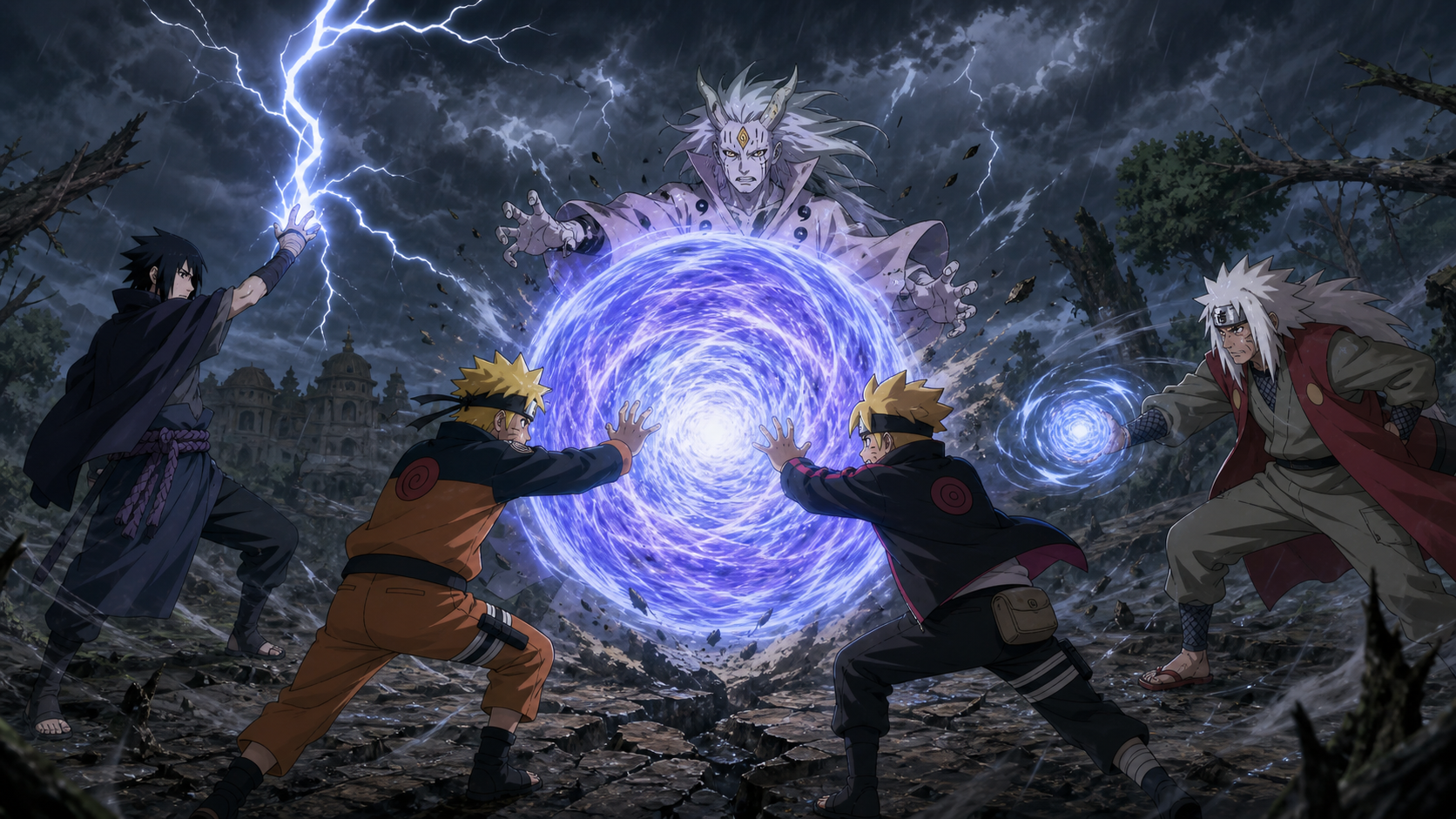
Urashiki consumes every stolen advantage, but Naruto and Boruto finally synchronize while Jiraiya, Sasuke, and Sakura make the shared victory possible.
Series: Boruto: Naruto Next Generations
Episode: 135 · The Last Battle, Urashiki
Arc: Time Slip Arc
Release: 2019-12-08
Previous: Episode 134 · The Power to See the Future
Directory: All 293 Boruto episodes
Bottom line
Boruto Episode 135 delivers the loud finish the Time Slip Arc has been building toward, but the real payoff is not Urashiki's transformation. Naruto and Boruto finally create the cooperation ninjutsu Jiraiya demanded. Jiraiya and Sasuke make the opening. The two boys carry one shared Rasengan through an enemy who has spent the entire arc treating other people's chakra, bodies, and futures as resources he can consume.
The episode is messy about power. Urashiki eats his chakra gourd and one of his own Rinnegan, grows stronger, absorbs techniques, and still loses to a team that includes two exhausted children. Fans are right to question the scale. The emotional logic lands better than the combat math. Every person contributes the specific strength Urashiki dismissed: Sakura's care restores Sasuke, Jiraiya reads the battlefield, Sasuke times Kirin, Boruto reaches Naruto through the Nine-Tails shroud, and Naruto trusts him.
That combination makes the final clash worth watching even when the route there strains credibility. Urashiki hoards power. The heroes circulate power through teaching, healing, protection, and timing. The episode does not say that in a speech, thank goodness. The fight shows the difference.
Urashiki eats everything he collected
Urashiki rises after the Rasengan and consumes the chakra gourd he used to store stolen techniques. When that supply does not satisfy him, he eats one of his own Rinnegan. A golden eye opens in his forehead, his Byakugan changes, and his body transforms.
The sequence turns his entire philosophy inward. Urashiki has treated chakra as food from his first appearance. Now he consumes his tools and part of himself because domination matters more than preserving any stable identity.
The transformation looks grotesque because the power-up is not growth. He has learned nothing, repaired nothing, and built no relationship. He converts accumulated theft into a larger body and calls the result superiority.
Team Ebisu chooses the useful job
Konohamaru, Udon, and Moegi realize the fight has exceeded what they can handle. They head toward the village to raise the alarm rather than charging into a god-level confrontation.
That choice deserves respect. Naruto stories sometimes confuse courage with joining every battle. Team Ebisu contributes by moving information and bringing help. Young genin recognizing their limits is smarter than becoming three extra hostages.
Konohamaru struggles to convince adults that Naruto is in danger until Shikamaru listens. Once the warning reaches someone willing to connect the details, the wider friend group mobilizes.
Jiraiya keeps the boys alive
Urashiki attacks Naruto and Boruto with speed the boys cannot match. Jiraiya repeatedly pulls them out of the killing line, catches them when they are thrown, and takes control of the next exchange.
His role is not glamorous. He buys seconds, tests defenses, and absorbs danger while the younger shinobi search for a workable opening. That labor is what a teacher is supposed to do.
Jiraiya also notices that transformed Urashiki may have lost access to space-time movement. Every transformation changes the rules. He does not assume the previous power set remains intact.
Absorbing fire creates a different weakness
Jiraiya sends Fire Release toward Urashiki, who absorbs the technique instead of teleporting away. The response confirms that the transformation traded one kind of freedom for another kind of defense.
Absorption sounds unbeatable until the team stops treating ninjutsu as the only route. Jiraiya moves through binding hair, swamp techniques, positioning, and distraction. Each failed tactic teaches him what Urashiki can break and how long the release takes.
The episode could have made this testing clearer through stronger choreography. Jiraiya's thought process remains visible enough to show that the adults are not throwing random moves.
Sakura gives Sasuke enough to stand
Sasuke wakes while Sakura continues medical treatment. He tells her to conserve chakra, but Sakura refuses to leave a patient half-healed. She wants answers about the damaged note and the name Sasuke, then collapses before she can ask.
Sakura's exhaustion becomes the reason Sasuke can return to the battlefield. She spends her reserves on a stranger because the stranger protected Naruto. Adult Sasuke accepts care from the girl his younger self abandoned.
The exchange quietly completes a loop. Sasuke once believed bonds obstructed power. Sakura's bond to Team 7 restores enough of his strength to save Naruto, Boruto, and Jiraiya.
The village finally believes Naruto is in danger
Shikamaru hears Konohamaru's warning and treats the pattern seriously. Choji, Ino, Kiba, Akamaru, and Shino move to help.
The group does not reach the central clash in time to take over, but their response matters. Naruto spent much of childhood believing nobody would come for him. A network of peers is now running toward danger because his absence matters.
Boruto has watched the lonely apartment and the village's suspicion. This mobilization shows another part of Naruto's childhood: relationships are already forming, even before Naruto recognizes how many people care.
Urashiki tries to force out the Nine-Tails
Urashiki pins Naruto with a black receiver and attacks Jiraiya and Boruto. He wants pain, fear, and helplessness to push the Nine-Tails chakra through the seal.
The tactic treats Naruto as a container instead of a child. Urashiki does not care whether the chakra destroys Naruto from inside as long as the harvest becomes available.
That cruelty connects him to the village's worst behavior around Naruto. Different people have wanted to fear, control, use, or isolate the jinchuriki. Very few asked what carrying the fox cost the boy.
Sasuke returns because Sakura made return possible
Urashiki attacks Boruto without concern for the boy's importance as a future vessel. Sasuke arrives, blocks the strike, and cuts Naruto free.
The timing gives Sakura an invisible place in the rescue. Sasuke could not have returned without her medical work. Urashiki sees one adult opponent rejoining the fight. The audience sees a chain of care extending from Sakura to Sasuke to Naruto and Boruto.
Sasuke's return also answers Boruto's fear from Episode 134. His teacher survived, chose the mission again, and arrived when Boruto needed him.
Jiraiya and Sasuke stop competing for the spotlight
Jiraiya lands Rasengan. Sasuke attacks with Fire Release, closes the distance with an Amaterasu-coated blade, and forces Urashiki to divide attention across several kinds of pressure.
Neither adult defeats Urashiki alone. Their job becomes creating a narrow opening for Naruto and Boruto. That restraint fits both men better than another speech about trusting the next generation.
Jiraiya never learns the full future on screen, but he fights beside the adult result of Naruto's greatest promise. Sasuke fights beside the teacher whose death helped shape Naruto's adulthood. The timeline is crowded with meaning nobody has time to discuss.
Rain gives Sasuke the sky he needs
Urashiki's energy attacks and the worsening weather build charged storm clouds. Sasuke recognizes the environmental route to Kirin, a lightning technique that uses natural lightning rather than demanding the same chakra cost as a fully created storm.
The setup matters because Sasuke remains depleted. Kirin lets skill, preparation, and weather substitute for reserves he does not have.
Using the sky also fits the episode's larger answer to Urashiki. The team keeps turning surrounding conditions into weapons. Acid vapor defeated the rewind advantage. Storm clouds now give Sasuke one decisive strike.
Jiraiya takes the hit meant for Naruto
Jiraiya blocks an attack aimed at Naruto. Seeing his teacher fall pushes Naruto deeper into the Nine-Tails shroud.
Urashiki celebrates because the eruption is what he wanted. Jiraiya sees the opposite danger. The chakra gives Naruto enormous force while damaging his body and eroding his control.
The scene returns Boruto to the fear that disrupted their training. He has already been attacked by Naruto inside the shroud. Reaching him again requires courage, not because Boruto forgot the danger, but because he understands the child trapped inside.
Boruto runs toward the red chakra
Boruto charges through Naruto's attacks and refuses to treat the shroud as Naruto's whole identity. He knows the fox chakra can hurt him. He also knows young Naruto does not want Urashiki using his body.
That choice completes Neji's lesson from Episode 132. Boruto stops pitying Naruto and starts trusting him as a person capable of responding. Respect requires risk.
The moment also reverses Boruto's earlier recoil. His body remembered danger before. Now his body carries him toward the same danger because the relationship matters more than pretending fear never existed.
Cooperation ninjutsu becomes a relationship
Naruto and Boruto combine their chakra into one enormous Rasengan. The technique succeeds because they have aligned intention, flow, and trust under pressure.
The shared sphere connects Minato's invention, Jiraiya's teaching, Naruto's stubborn mastery, and Boruto's inherited technique. Four generations sit inside one movement even before Sasuke and Jiraiya add their own attacks.
The power is visually satisfying, but the training history gives the moment weight. The boys failed because fear broke synchronization. Success means the relationship changed.
Jiraiya and Sasuke create the final opening
Jiraiya attacks with another Rasengan, pulling Urashiki's attention away from the central clash. Sasuke calls down Kirin through the storm and holds Urashiki vulnerable long enough for the shared Rasengan to connect.
The finish works as a coordinated sequence rather than one miracle blast. Teachers and students act in order. Every person trusts the next person to complete a specific job.
Urashiki collected countless techniques but never learned this kind of exchange. He can absorb chakra. He cannot absorb the relationships that decide when and why each technique arrives.
The power scaling deserves the side-eye
Urashiki is an Ōtsutsuki with absorption, Byakugan, Rinnegan abilities, stolen techniques, and a transformed body. Two children contributing to his defeat will always raise questions, even with Jiraiya, Sasuke, poison damage, and a perfect team attack involved.
The episode improves the animation and emotional rhythm compared with the previous fight, but stronger presentation does not erase the mismatch. Sasuke's recurring chakra problem also feels designed around the desired result.
Fans can enjoy the father-son Rasengan and still say the arc mishandled Urashiki's threat level. Loving a payoff does not require pretending every step toward that payoff was convincing.
Teachers complain after doing everything for their students
Naruto and Boruto collapse once the Nine-Tails chakra recedes. Sasuke and Jiraiya look at the exhausted boys and comment on the difficulty of having idiots for students.
The joke works because both teachers have spent the battle protecting those students with their bodies. Irritation sits beside pride and relief.
Sasuke gets to share a teacher's complaint with the man who taught Naruto Rasengan. Jiraiya gets to see that the suspicious traveler cares for Boruto with the same weary commitment he feels toward Naruto.
Urashiki consuming his collection turns theft inward
He has spent the arc treating chakra as inventory removed from other bodies. Swallowing the collection and his own eye makes the logic visible: acquisition eventually consumes the collector too.
The transformation gives him power while destroying whatever distance remained between person, weapon, and stolen material. He cannot build relationships with what he takes, so every resource has only one destination inside him.
That image works better than much of his characterization. Urashiki’s personality remains thin, but the body tells a coherent story about extraction without limit.
He becomes larger and less capable of recognizing why smaller people coordinate against him.
Team Ebisu chooses evacuation because usefulness is not measured by the final blow
Konohamaru, Udon, and Moegi cannot match an Ōtsutsuki in direct combat. Helping civilians reach safety prevents the fight from creating additional victims.
That assignment is not a consolation prize. Evacuation requires route knowledge, crowd control, first aid, communication, and the willingness to leave the spectacular battlefield for work nobody will celebrate as loudly.
The episode respects them when the work changes outcomes rather than forcing every familiar child into the Rasengan formation.
Heroism includes reducing the number of people who need heroic rescue later.
Sakura’s medical work powers Sasuke’s return to the battlefield
She finds an injured stranger, evaluates him, spends chakra, and accepts incomplete explanations because the patient needs care before the mystery needs resolution.
Sasuke later contributes to Naruto’s rescue and the final opening. That chain begins with Sakura’s labor.
The episode should credit her more explicitly. Medical support often disappears once the healed fighter stands up, as though recovery proves the fighter’s resilience alone.
Sasuke carries her chakra, judgment, and compassion into every action afterward. The future depends on a young girl who had no reason to trust him and chose care anyway.
Boruto entering the Nine-Tails shroud is trust with a real injury risk
The red chakra previously terrified him and disrupted synchronization. Running toward Naruto does not make the danger imaginary.
Boruto acts because he understands that fear cannot be the only information guiding him. Naruto is trapped inside the power and needs a relationship strong enough to reach through the violence.
The scene works because trust develops from failure. Boruto does not magically become immune. He accepts risk with better knowledge of whom he is trying to reach.
Afterward, both boys need medical evaluation. Emotional victory does not remove burns, chakra damage, exhaustion, or delayed effects.
Jiraiya’s protection proves he is reading people as carefully as techniques
He studies absorption, timing, weather, and battlefield geometry. He also understands which child will run forward and where the lethal response will land.
Taking the hit meant for Naruto is not reckless martyrdom detached from strategy. Jiraiya preserves the relationship needed for the final cooperation technique.
That choice foreshadows the teacher he becomes without requiring him to know Boruto’s full identity. He protects possibility before knowing what the possibility will produce.
The episode gives him the best balance of tactical intelligence and emotional instinct in the arc.
Sasuke and Jiraiya stop competing because the students need both teachers
Suspicion has made their cooperation uneven. The final battle forces them to divide work according to strength rather than ego.
Jiraiya reads Urashiki and protects the boys. Sasuke uses the storm, movement, and precise timing. Neither mentor can create the winning opening alone.
Their coordination mirrors Naruto and Boruto’s Rasengan. Generations do not merge into sameness. Different knowledge arrives at the correct moment.
The teacher joke at the end lands because both men recognize the same exhausting commitment from opposite sides of time.
The power scaling problem is structural, not a fandom refusal to have fun
Urashiki owns multiple ocular abilities, stolen chakra, absorption, future sight, and a transformed body. The heroes are injured, young, or depleted.
Poison damage, teamwork, environmental tactics, and his arrogance can explain vulnerability. The episode still asks those explanations to cover a very large gap.
Sasuke’s chakra shortage repeatedly expands or contracts according to the desired scene. Urashiki forgets advantages when the emotional payoff needs room.
The father-son Rasengan can remain wonderful while the combat logic remains strained. Honest fandom discussion can hold pleasure and criticism together.
Urashiki’s defeat needs an aftermath beyond relief
The battlefield contains absorbed chakra residue, transformed tissue, damaged terrain, injured civilians, and evidence about an Ōtsutsuki operation.
Jiraiya should secure samples carefully, document what he witnessed, and assess whether any stolen chakra remains recoverable. Medical teams should examine everyone exposed.
Time-travel secrecy complicates the record, but ignoring the evidence leaves the past less prepared for threats the future already knows exist.
Victory ends the immediate attack. Responsible aftermath determines whether the same knowledge disappears with the villain.
The village believes Naruto is in danger only after the threat becomes visible
Young Naruto has spent years being treated as the source of danger. Urashiki’s attack briefly forces residents to recognize that the child carrying the Nine-Tails can also be a targeted child needing protection.
That shift should survive longer than the emergency. Adults who evacuate, worry, or assist cannot return immediately to ordinary contempt without confronting the contradiction.
Jiraiya and local leaders should document who helped, who spread panic, and how information moved. Naruto needs a safe place to recover without becoming public spectacle.
The episode uses collective concern to raise the stakes. The emotional value comes from a village almost seeing Naruto clearly. The frustration comes from knowing memory erasure will later remove even that brief social correction.
The final Rasengan belongs to several people before the boys form the sphere
Naruto and Boruto supply chakra, synchronization, and the emotional image the episode wants viewers to remember. The attack reaches Urashiki because other people built the opening.
Sakura restored Sasuke. Jiraiya protected Naruto and read the absorption rule. Sasuke used weather and timing. Team Ebisu reduced civilian risk. Every earlier action made the final charge possible.
Calling the move father-son cooperation is emotionally accurate and operationally incomplete. The sphere carries a network.
That distinction protects supporting labor from disappearing behind the largest light effect. Naruto’s best victories have always depended on people whose names do not fit inside the technique title.
Recovery should include the children who watched a god attack their friend
Konohamaru, Udon, Moegi, Sakura, and Naruto experience fear, evacuation, injury, and a battle beyond their normal understanding. Boruto experiences the same crisis while carrying future knowledge he cannot share.
Adults should not assume relief completes recovery. Medical checks, sleep, truthful age-appropriate explanation, and space for fear would help prevent the event from becoming another unspoken trauma.
Time travel complicates disclosure, but care can remain honest about what people felt without revealing future identities.
Jiraiya knows children often turn terror into bravado. His responsibility continues after Urashiki disappears and before Sasuke removes the memory.
Final reaction
“The Last Battle, Urashiki” gives the Time Slip Arc an emotionally satisfying finish even when the power logic wobbles. Urashiki consumes stolen chakra and his own eye to become larger. The heroes win by connecting work across people: Sakura heals Sasuke, Sasuke frees Naruto, Jiraiya protects the boys, Boruto reaches Naruto, and every fighter contributes to the final opening.
Boruto running toward the Nine-Tails shroud is the heart of the episode. Fear broke the father-son synchronization two episodes earlier. Trust does not remove the danger. Trust gives Boruto a reason to cross that danger and call Naruto back.
Jiraiya and Sasuke deserve equal credit for the finish. Jiraiya keeps reading the changing rules and commits his body to Naruto's safety. Sasuke uses Sakura's borrowed strength and the storm itself to land Kirin at the precise moment the boys need.
Urashiki remains an uneven villain. His abilities are more interesting than his personality, and the arc never fully reconciles his stated power with his losses. The final battle still proves the point the best Naruto fights return to again and again: power becomes meaningful through the people willing to carry the cost together.
Sources and lawful viewing
Official episode reference: Naruto Official episode guide
Licensed episode route: Crunchyroll licensed series page