
Jiraiya’s Assignment
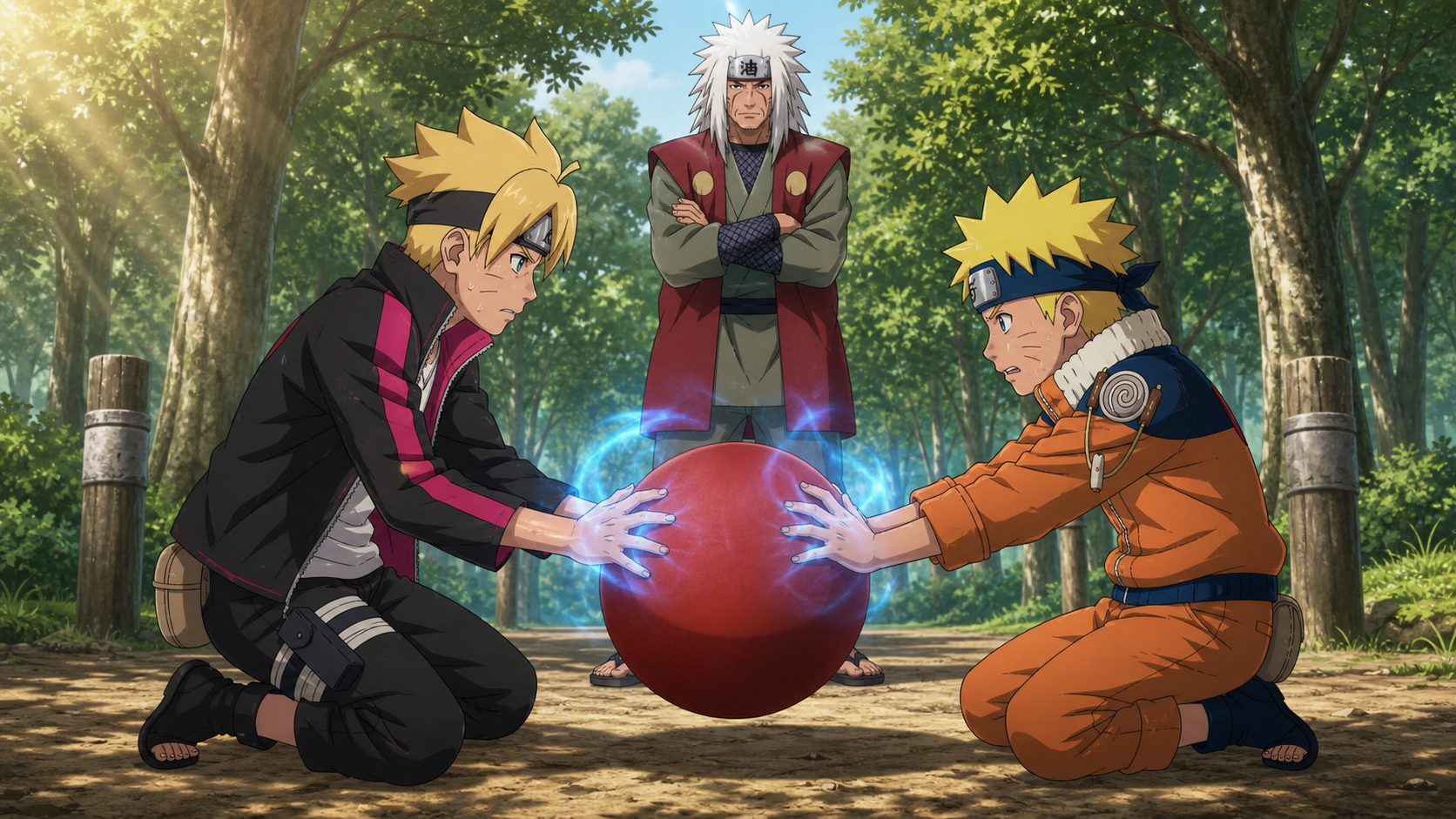
Naruto and Boruto should match naturally, but Boruto’s fear of the Nine-Tails breaks the rhythm until Neji and Sasuke help them face what neither boy can say.
Series: Boruto: Naruto Next Generations
Episode: 132 · Jiraiya’s Assignment
Arc: Time Slip Arc
Release: 2019-11-10
Previous: Episode 131 · The Power of the Nine Tails
Directory: All 293 Boruto episodes
Bottom line
Boruto Episode 132 turns father-son similarity into a training problem neither boy can solve through stubbornness alone. Jiraiya noticed that Naruto and Boruto's chakra synchronized during the previous fight. He wants them to align chakra nature, power, and flow well enough to create a cooperation ninjutsu. The assignment sounds almost unfairly suited to them because they share blood, Rasengan knowledge, instincts, and a habit of rushing the answer. Boruto's fear of the Nine-Tails shroud breaks that natural connection.
The episode understands that trauma can sit inside the body after the mind decides to continue. Boruto wants to train. He knows Naruto did not choose to attack him. His hand still recoils when Naruto reaches toward him, and his chakra loses the rhythm they need. Naruto notices, feels guilty, and interprets Boruto's fear as proof that he harmed someone who trusted him.
Neji and Sasuke become the emotional teachers while Jiraiya handles the technique. Neji tells Boruto not to pity Naruto and explains that Naruto taught him people can choose a path beyond the fate assigned to them. Adult Sasuke tells young Naruto about a friend who kept reaching for him after he lost his way. Both conversations rely on future pain the listener cannot fully know. Boruto receives courage from a man his family will lose. Naruto receives hope from the man he refuses to abandon.
Naruto catches Boruto's first lie
Naruto complains about the early training and confronts Boruto about hiding that he is a shinobi. Boruto falls back on the secret-mission explanation. He cannot reveal his village, family, era, teacher, or real reason for knowing Rasengan. Naruto decides to trust him anyway.
That choice fits Naruto before adulthood. He has every reason to be suspicious of a stranger with unusual techniques who appeared during a security crisis. He also knows what rejection feels like, and he wants the connection Boruto offers. Trust arrives before proof because Naruto has spent his childhood wishing someone would extend the same grace to him.
Boruto benefits from that generosity while continuing to deceive him. The lie protects the timeline, but protection does not make the emotional imbalance disappear. Boruto knows Naruto's future. Naruto barely knows Boruto's name. Their growing closeness depends on information only one of them can use.
Jiraiya sees the chakra resemblance before the family truth
Jiraiya explains that Naruto and Boruto's chakra synchronized during the fight with Urashiki. He does not know what final jutsu they will create. He knows the compatibility is unusual enough to test deliberately.
Chakra carries physical and spiritual energy, training habits, control, and nature. Boruto inherited Uzumaki vitality and Naruto's fundamental chakra relationship while developing under a very different life. The similarity gives them a starting point. Their different control, experience, and emotional state prevent automatic success.
Jiraiya's observation also sharpens his suspicion. Boruto resembles Naruto, knows Rasengan, reacts to Naruto with family-level concern, and carries chakra capable of matching his. A spy does not need a confession after gathering enough independent evidence. Jiraiya keeps teaching because the training doubles as a test.
Cooperation ninjutsu requires more than matching blood
Their first attempt fails. Jiraiya breaks synchronization into three parts: nature, power, and flow. Boruto realizes their chakra nature is already similar, so they need to concentrate on matching power and flow. Jiraiya praises the analysis.
That exchange shows why Boruto is not simply Naruto with better technology. Boruto has stronger classroom foundations and tends to understand the structure of a technique quickly. Naruto often learns through physical repetition, shadow clones, stubborn experiments, and unexpected workarounds. Boruto can name the variables. Naruto can outlast the failure.
The assignment needs both kinds of intelligence. Boruto's analysis identifies the problem, but analysis cannot force his body past the memory of Naruto's red chakra. Naruto's persistence keeps them practicing, but persistence cannot repair fear without acknowledging the injury.
Boruto's body remembers the attack
When they try again, Boruto remembers Naruto inside the Version 1 shroud. His concentration breaks. The flashback is not an excuse or a lack of loyalty. Boruto reached for his father and received violence from a face he trusted. He understands that the Nine-Tails chakra caused the attack. His nervous system still reads Naruto's touch and chakra as danger.
The episode avoids a cheap recovery. Boruto does not announce that family love cured the fear, then succeed on the next attempt. He struggles, hides the reason, exhausts his chakra, and recoils again when Naruto reaches toward him.
Naruto notices the recoil. Shame enters the training from the other side. He knows the fox hurt Boruto through his body. Naruto has spent years fearing that the power inside him will confirm every ugly belief the village holds. Boruto's reaction looks like that fear becoming true.
Rasengan becomes their shared mental picture
Jiraiya asks what each boy visualizes while trying to align chakra. Boruto's answer reveals that he knows Rasengan, shocking Naruto. The technique gives them a common model for rotation, power, containment, and flow.
Boruto proposes that both visualize Rasengan while synchronizing. The idea makes sense because Naruto recently learned the technique and Boruto built much of his own combat identity around variations of the same jutsu. Rasengan connects Minato, Jiraiya, Naruto, Konohamaru, Boruto, and later users across generations.
The history creates another clue Jiraiya cannot ignore. Boruto did not learn Rasengan from an unknown traveling-performance school. The technique has a narrow lineage. Every competent demonstration points back toward Naruto's future.
The rubber ball sends Naruto back to basics
Jiraiya gives them a rubber ball and tells them to burst the rubber through synchronized chakra. The exercise returns Naruto to the second stage of his original Rasengan training, where power and containment mattered more than raw output.
They cannot pop the ball, but they make the rubber expand slightly. That small result proves the chakra can align when fear does not interrupt the flow. Jiraiya leaves them practicing while he handles an errand and watches Sasuke observing from a distance.
Jiraiya's training methods often look casual because he walks away while students struggle. He chooses exercises that force the student to discover the missing mechanism. The approach can be frustrating and sometimes neglectful. Here, the rubber ball gives the boys an honest measurement. The ball either expands or does not. Friendship speeches cannot fake the result.
Naruto realizes Boruto is afraid of him
Boruto runs out of chakra after repeated attempts. Naruto reaches toward him, and Boruto flinches. Naruto finally understands why their coordination keeps failing.
The moment hurts because Naruto does not become defensive. He feels guilty. He has lived with villagers looking at him as a threat, but Boruto's fear matters differently. Boruto chose to stay close, defended him, and treated him like a person. Hurting that one new friend seems to confirm Naruto's deepest fear about the fox.
Boruto cannot explain that he has seen Naruto master the chakra, become Hokage, raise a family, and save the world. He has to solve the immediate relationship without using the future as reassurance. Their silence leaves both boys carrying blame that belongs partly to the adults and systems surrounding Naruto's seal.
Boruto has nobody he can tell
During the break, Boruto walks through Konoha because he cannot discuss the real problem with Sasuke, Naruto, Jiraiya, or anyone from this era. Sasuke prioritizes the mission and timeline. Naruto is the person Boruto fears hurting. Jiraiya would hear too much truth inside an honest explanation.
Time travel isolates Boruto even while surrounding him with family. He can see his mother, uncle, father, teacher, and family friends. He cannot call them by those relationships. Every familiar face becomes someone he knows and a stranger who does not know him.
The Hyūga estate gives him the conversation he needs by accident. Boruto watches Hinata and Neji train. Their formal and informal ways of addressing each other reflect the main and branch family history that shaped their relationship.
Neji gives Boruto advice from a future he will not see
Neji notices Boruto watching and approaches him after sparring with Hinata. Boruto asks about the tension and formality between them. Neji briefly explains their history, then recognizes that Boruto carries a separate problem involving Naruto.
Boruto describes the fear without revealing the family connection. Neji tells him not to pity Naruto. Naruto changed Neji's understanding of fate by proving that a person can choose a path beyond the role imposed at birth.
The advice lands with brutal dramatic irony. Neji will later die protecting Naruto and Hinata during the Fourth Shinobi World War. Boruto grew up inside the family shaped by that sacrifice. Now Neji gives him courage to repair a relationship with Naruto, unaware that Boruto is Naruto and Hinata's son.
I am glad the episode does not make Boruto tell him. A warning could not honor Neji without rewriting lives around the knowledge. Boruto listens, accepts the gift, and carries a memory nobody else in his time will share.
Do not pity Naruto is the harder lesson
Neji's wording matters. Pity can turn Naruto into a passive victim and place Boruto above him. Naruto suffered abandonment and prejudice, but Naruto also chooses, fails, boasts, learns, annoys people, protects friends, and changes them.
Boruto has begun looking at young Naruto through sorrow. The empty apartment, bad meals, village rejection, and dangerous seal invite that response. Neji reminds him that Naruto does not want to be reduced to suffering. He wants respect, rivalry, friendship, and a chance to act.
The lesson applies to Boruto's fear. He cannot help Naruto by treating him as a fragile tragedy or a dangerous container. He needs to acknowledge the injury, trust Naruto's effort, and rebuild coordination through shared work.
Sasuke brings food and a confession disguised as a story
Jiraiya sends Sasuke to bring the boys food. Sasuke speaks with Naruto and describes a friend who lost his way while another person kept trying to bring him back. He does not name himself, but the story belongs to their relationship.
Young Naruto is living at the beginning of that long pursuit. Sasuke has deserted the village. Naruto feels he failed to stop him and does not know whether the promise to Sakura can succeed. Adult Sasuke stands before him as proof of the ending while pretending to discuss someone else.
The conversation gives Sasuke a rare opportunity to thank Naruto without demanding recognition. He knows Naruto spent years refusing to abandon him, fought him, forgave him, and welcomed him back into a future Sasuke repeatedly endangered. Young Naruto receives encouragement from the person he is trying to save.
Adult Sasuke cannot repair the past early
Sasuke's restraint keeps the scene from becoming easy absolution. He does not reveal his identity, ask Naruto to stop worrying, or claim the future makes every decision worthwhile. Naruto still has to live through the Valley of the End, years of separation, war, and the final fight that costs both men an arm.
The disguised confession cannot remove those consequences. The words give Naruto enough hope to continue. Sasuke offers the emotional result of his redemption without stealing the work required to reach that result.
For Boruto, Neji supplies the same kind of bounded help. Neither conversation solves the entire timeline. Each adult or older teen gives one listener what he needs for the next attempt.
Sakura finds a paper the future should have kept hidden
Sasuke bumps into Sakura and rushes away before she can study him. A paper falls from his clothing into a puddle. Sakura retrieves the damaged note and examines what remains.
The dropped paper becomes another failure in the mission's timeline discipline. Boruto already mentioned Thunder Trains. Sasuke has shown advanced techniques and suspicious knowledge. Now written evidence enters Sakura's hands during the week of his younger self's desertion.
The scene also hurts on a personal level. Sakura is searching for any information about Sasuke. The adult version stands near her and cannot offer comfort. A paper connected to him may carry names and clues from a family she has not built yet.
Jiraiya asks the question Sasuke hoped to avoid
Jiraiya meets Sasuke and asks directly whether he is Sasuke. The question confirms that the traveling-performer story failed. Jiraiya has assembled the Rasengan, chakra, behavior, knowledge, and resemblance clues into a working conclusion.
The episode ends before Sasuke answers, which works because the tension comes from recognition rather than combat. Jiraiya does not need a dramatic reveal. His quiet question shows how much he has noticed while appearing to focus on training.
Sasuke now faces a choice between another lie and limited trust. Jiraiya can help defeat Urashiki, protect Naruto, and manage the seal. He can also change the timeline if Sasuke gives him too much information.
Boruto’s trauma needs more than another synchronization attempt
His body remembers the Nine-Tails shroud as heat, danger, and loss of control. Asking him to repeat chakra contact without naming that memory turns training into exposure without support.
Jiraiya correctly identifies the emotional block. The adults should also establish a stop signal, safe distance, medical monitoring, and a way for Boruto to describe symptoms without shame.
Fear is information. The goal is not to erase fear through force. The goal is to help Boruto distinguish present Naruto from the earlier crisis while retaining the right to stop.
Successful cooperation becomes healthier when consent remains active throughout practice.
Naruto’s shame makes him withdraw at the moment Boruto needs honesty
He realizes that Boruto is afraid and interprets the fear as proof that he is monstrous. That conclusion echoes years of village treatment.
Boruto does not need Naruto to disappear. He needs Naruto to acknowledge what happened, explain what he remembers, and participate in making the next attempt safer.
Children often assume responsibility for an adult’s shame when the adult goes silent. Boruto already has too many secrets to carry Naruto’s self-condemnation too.
Repair begins when Naruto can say, “I hurt you while I was not in control, and your fear makes sense.”
Neji gives advice without knowing Boruto is part of the family he protects
Boruto receives wisdom from an uncle whose future sacrifice he knows and cannot reveal. Every ordinary sentence becomes painful because Boruto understands the missing years around the speaker.
Neji rejects pity because pity can freeze Naruto inside suffering. Respect means recognizing choices, effort, and agency alongside hardship.
The advice also applies to Neji. Boruto cannot reduce him to the man who will die. He must meet the living teenager who is still making decisions.
Time-travel restraint becomes ethical here because confession would turn Neji’s present into a countdown he never requested.
Sasuke’s story gives young Naruto gratitude without stealing the future reveal
He cannot say, “You saved me.” He can describe a person reached by persistent friendship and let Naruto decide whether hope still feels worth carrying.
The indirect confession matters because Sasuke finally witnesses the burden before the outcome. Naruto has no guarantee that pursuit will lead home.
Adult Sasuke offers reassurance while preserving enough uncertainty for young Naruto’s later choices to remain his own.
The moment does not settle the debt. The future still needs direct apology and sustained repair. The story simply lets gratitude travel backward without rewriting the whole road.
Sakura’s paper exposes careless evidence handling and emotional cruelty
Sasuke carries written material into a period where names, technology, or family facts could disrupt the timeline. Losing the paper is an operational failure.
Sakura finds the clue while desperate for information about the younger Sasuke. A misleading fragment can intensify hope, fear, and self-blame.
Recovering the paper should involve the narrowest deception possible. Sasuke must avoid making her feel foolish for noticing real evidence.
Timeline protection does not grant permission to manipulate a vulnerable girl more than necessity requires.
Jiraiya earns limited trust because he follows evidence without demanding control
He notices Rasengan knowledge, chakra resemblance, behavior, and the travelers’ interest in Naruto. His question emerges from accumulated observation.
Sasuke should share only what helps protect Naruto and defeat Urashiki: the threat’s abilities, the time-travel boundary, and why identity secrecy matters.
Jiraiya can agree to conditions, build contingencies, and decide how much responsibility he accepts. Limited truth becomes safer than an increasingly fragile performance.
The episode respects him by making recognition quiet. Intelligence does not need a theatrical reveal to become power.
Cooperation ninjutsu should measure recovery, not force a family milestone
Naruto and Boruto share chakra compatibility and emotional investment. Neither fact means they owe observers a successful fusion on schedule.
Training should progress through small tolerable steps: proximity, brief contact, separate Rasengan formation, timing drills, and only then full synchronization.
Failure can reveal which part of the process needs attention. Treating every failed sphere as personal rejection makes technique harder and the relationship less safe.
The best outcome is not a pretty combined attack. The best outcome is two children learning that honesty can survive imperfect coordination.
Final reaction
“Jiraiya's Assignment” succeeds because the training failure belongs to emotion and mechanics at the same time. Naruto and Boruto have compatible chakra, a shared technique, and natural affection. Boruto's body remembers the red shroud. Naruto's shame disrupts his confidence. Synchronization requires them to repair trust instead of pretending the injury never happened.
Neji's conversation is the episode's heart. He refuses to let Boruto turn Naruto into an object of pity and returns Naruto's own lesson about choosing fate. Boruto receives that wisdom from an uncle he cannot save or properly thank. The restraint makes the scene more painful than a full confession would.
Sasuke's conversation with Naruto works for the opposite reason. Sasuke knows the ending because he lived through the pursuit. He tells Naruto that persistent friendship can reach someone who lost his way, which allows young Naruto to hear gratitude from the person he is still chasing.
Jiraiya remains the smartest person in the room. He identifies chakra compatibility, chooses an exercise that exposes the real blockage, watches Sasuke from a distance, and asks the identity question once the evidence becomes impossible to ignore. The pervert jokes never erased the spy, teacher, and seal expert underneath them.
The episode leaves several dangers open. Sakura has the paper. Jiraiya suspects Sasuke. Boruto still has to face the chakra fear. Urashiki remains free. That unfinished pressure gives the training story weight. Father and son cannot synchronize until they stop hiding the fear from each other, even while almost every other truth must remain hidden.
Sources and lawful viewing
Official episode reference: Naruto Official episode guide
Licensed episode route: Crunchyroll licensed series page