
The Village Hidden in the Leaves
Boruto walks into old Konoha looking for his father’s past, then finds young Naruto’s empty apartment and learns why nostalgia cannot soften every answer.
Series: Boruto: Naruto Next Generations
Episode: 129 · The Village Hidden in the Leaves
Arc: Time Slip Arc
Release: 2019-10-20
Previous: Episode 128 · Urashiki's Target
Directory: All 293 Boruto episodes
Bottom line
Boruto Episode 129 gives Boruto the family history he wanted and immediately makes that knowledge dangerous. Karasuki confirms that a navigation error sent Boruto and Sasuke several days ahead of Urashiki, giving them time to locate young Naruto. The turtle also warns them that careless interference could change the future. Boruto hears the warning, changes clothes, and then starts reacting to old Konoha like a child who entered a living museum where everybody happens to know his parents.
The comedy comes fast. Lightning Burger does not exist. Ichiraku is tiny. Sakura nearly catches Sasuke staring at the girl who will become his wife. Boruto meets Naruto, accidentally says “Dad,” and gets dragged into Jiraiya's latest bathhouse disaster because the legendary Sannin throws him the incriminating binoculars. Tsunade questions the strangers, Sasuke claims that they are traveling performers, and Naruto receives the assignment to watch Boruto while Jiraiya escapes the work he was given.
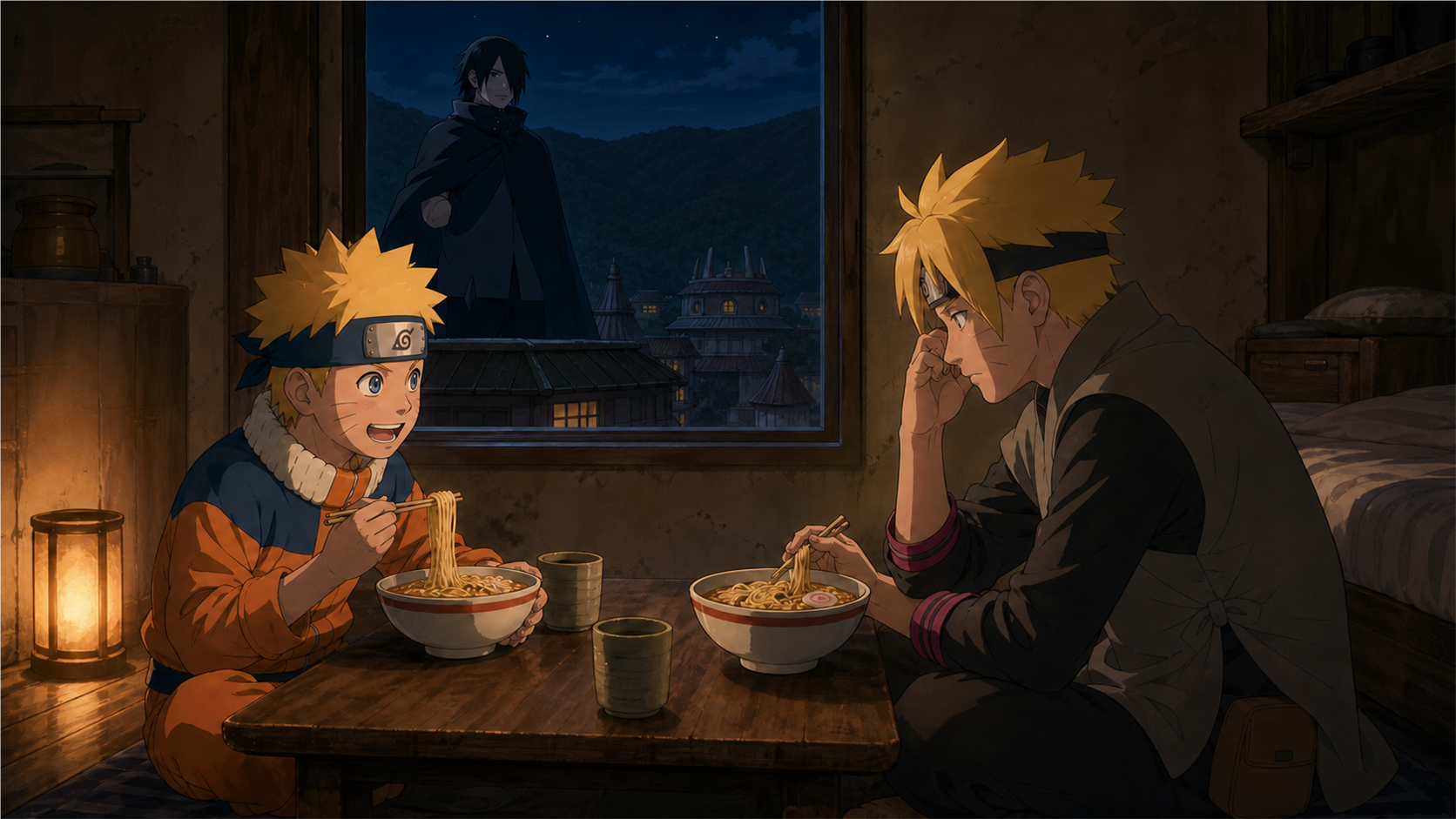
The real episode begins when Naruto takes Boruto home. Boruto recognizes adult mannerisms inside a loud, lonely child. They eat together, fail to sleep, and talk about family without Boruto admitting that he is describing Naruto's future household. Young Naruto listens to a stranger speak about parents, siblings, and an imperfect father while he has none of those things waiting in the next room. Nostalgia makes the scene sweet. Naruto's empty apartment makes the sweetness hurt.
Karasuki gives them days and a warning
Boruto notices that the village looks wrong before he understands the date. Karasuki explains that the device deviated from Urashiki's intended coordinates. The mistake separated the travelers, which means Urashiki will arrive several days later. That delay becomes the only strategic advantage Boruto and Sasuke possess. They can identify the era, locate Naruto, and prepare before the chakra thief reaches the village.
Karasuki also warns them not to alter the past. The instruction sounds simple until every street places Sasuke and Boruto beside somebody connected to their lives. An ordinary conversation could change where a person goes, what somebody notices, or which secret enters a relationship early. Boruto wants to see everything. Sasuke understands that every answer could become evidence that does not belong in this time.
They change into less recognizable clothing, but a costume does not erase faces, voices, techniques, or emotional reactions. Sasuke has one of the most distinctive histories in Konoha. Boruto resembles Naruto closely enough that Sakura notices the similarity within minutes. Their best disguise is distance, and Boruto is not built for distance.
Old Konoha is smaller than Boruto's memory
Boruto moves through the village comparing the past with his home. Lightning Burger has not opened. Ramen Ichiraku is a much smaller shop. Buildings, signs, streets, and technology reflect a Konoha that has survived the invasion but has not reached the prosperity of Naruto's Hokage years. The differences turn peace into something visible. Boruto's ordinary conveniences came from reconstruction, trade, modernization, and a generation that kept the village alive long enough to build them.
His disappointment about fast food is funny because children measure history through what they use. Boruto does not begin with policy or architecture. He notices where he eats. Ichiraku provides a stronger connection because the little stall already exists and already matters to Naruto. Some parts of Konoha expand with peace. Some relationships begin small and survive every version of the village.
The title calls attention to the place rather than one person. Boruto knows the Hidden Leaf as a large modern home led by his father. He now sees a village under increased security because Sasuke recently deserted. The streets hold people who do not know the war ahead, the Pain attack, the reconstruction, or Naruto's eventual status. Boruto has entered Konoha before the story everybody told him reached its comforting conclusion.
Sakura is the first family collision
Boruto and Sasuke encounter young Sakura. Boruto almost asks her where Naruto is, but Sasuke stops him because a direct question would invite the wrong attention. For Sasuke, the risk is more personal. Sakura is living inside the period immediately after he abandoned the village. Her feelings, anger, hope, and confusion belong to the boy he used to be and the damage he caused.
Adult Sasuke retreats rather than let her study his face. The movement says more than a speech. He can fight gods and cross dimensions, but meeting Sakura before he made amends exposes him in a different way. Boruto sees the woman who becomes Sarada's mother without fully understanding what she is carrying. Sasuke sees someone he hurt before she had any proof that he would return.
Time travel creates an unfair emotional advantage. Sasuke knows the future marriage, child, forgiveness, and continued absences. Sakura knows only that Sasuke left. He cannot use future love to excuse present pain, and he cannot offer comfort without changing the path that leads them home. Distance becomes both operational caution and accountability.
Boruto meets Naruto through a bathhouse disaster
Boruto bumps into young Naruto and lets “Dad” slip before he can control the reaction. Naruto barely processes the word because Jiraiya races past a furious crowd after peeping at the bathhouse. The famous author and legendary shinobi from Episode 127 appears in the least dignified way possible. Jiraiya throws Boruto the binoculars, transferring the evidence and the angry crowd in one movement.
Tsunade catches Naruto, Jiraiya, and Boruto inside the mess and makes them apologize. The sequence is broad comedy, but Boruto learns something important immediately. Jiraiya is not the clean heroic profile he imagined while searching for a book. He is brilliant, loyal, brave, invasive, irresponsible, and willing to let a child absorb the consequences of his bad behavior. Loving what Jiraiya gave Naruto does not require pretending the bathhouse habit was harmless.
Naruto's involvement fits his childhood pattern. Trouble finds him, adults assume the worst, and punishment arrives before anybody sorts the full story. This time the audience knows he followed Jiraiya rather than planned the peeping. Boruto gets a small taste of how quickly his father's reputation could decide the verdict.
Tsunade recognizes the security problem
Tsunade questions Sasuke and Boruto because two unknown shinobi appeared in a village already on alert. Sasuke claims that they are traveling performers who use basic ninjutsu in their act. The explanation is flimsy, but Tsunade does not simply release them. A genin has recently deserted Konoha, and security has tightened. She orders Naruto and Jiraiya to monitor the strangers.
The unnamed deserter inside her explanation is Sasuke himself. Adult Sasuke stands in front of the Hokage while his younger choice shapes village policy. Boruto hears the history as a current emergency rather than a chapter that ended before he was born. Tsunade has teams searching, Sakura is hurting, Naruto wants his friend back, and the village treats unknown shinobi as possible threats because Sasuke crossed the boundary.
Jiraiya complains about the assignment until Boruto uses Sexy Technique. That gag convinces him to cooperate for exactly long enough to dump the work on Naruto. The scene stays true to Jiraiya's worst running behavior, but Tsunade's decision has an accidental strategic benefit. The person Urashiki plans to target now lives beside one of the future defenders sent to protect him.
Sasuke chooses surveillance from a distance
When Sakura appears again, Sasuke withdraws and tells Boruto that direct contact is too risky. He will watch from farther away while Naruto handles the visible monitoring assignment. That choice leaves Boruto alone with his father, which increases the emotional danger even as Sasuke reduces the historical risk around himself.
Sakura recognizes Boruto from earlier and comments on how similar he and Naruto look. Both boys reject the comparison because neither wants to see himself inside the other yet. Boruto thinks of Naruto as his father, Hokage, and occasional source of frustration. Young Naruto thinks of Boruto as a suspicious visitor wearing a strange outfit. The resemblance reaches beyond hair and whisker marks. They interrupt, boast, rush toward curiosity, and become defensive when another person gets too close to the truth.
Sakura also notices that Naruto is watching only one traveler even though Tsunade assigned two. Naruto realizes that Jiraiya abandoned the work and fears the punishment waiting later. Boruto learns another part of his father's childhood: adults trusted Naruto with responsibilities and left him holding consequences that were not fully his.
Naruto's apartment changes the nostalgia
Naruto takes Boruto home because monitoring one visitor is easier when the visitor stays in the same room. Boruto sees the apartment where his father lived alone. No Hinata prepares dinner. No Himawari fills the house with warmth. No exhausted Hokage returns after work. The space contains young Naruto's habits without the family that later makes those habits look ordinary.
They eat together, and Boruto recognizes gestures Naruto still uses as an adult. That continuity matters because Boruto has spent much of the series treating Hokage Naruto and private Naruto as competing people. The child at the table shows that the father did not appear from nowhere. Adult habits carry the boy who ate alone, wanted acknowledgment, hid hurt behind noise, and grabbed connection whenever somebody stayed.
The episode does not need the apartment to become a museum of suffering. Naruto jokes, eats, argues, and makes room for a stranger. His loneliness is visible because the home lacks other lives, not because the script forces him to explain every wound. Boruto has enough context to notice what nobody says.
The family conversation is both kind and cruel
Neither boy can sleep. Naruto asks Boruto about his family, and Boruto describes them while avoiding the fact that Naruto is the father under discussion. He talks about a mother, a younger sister, and a father whose important job keeps him busy. The complaint contains love, irritation, and the newer understanding Boruto gained after the Chūnin Exams.
Young Naruto listens without knowing that he will become the parent Boruto finds difficult. He hears about a home where somebody waits, siblings annoy one another, and a father has enough responsibility to disappoint his son by being absent. Those are ordinary family problems. Naruto would give almost anything to have them at this age.
Boruto is not trying to hurt him. He cannot reveal the future, and he needs somewhere to place the emotions raised by seeing his father as a child. The scene becomes cruel because the audience knows the full relationship. Boruto complains about an imperfect family to the orphan who will build that family through years of pain. Naruto responds with interest rather than envy, which makes the exchange harder to watch.
Sasuke carries the part Boruto cannot see
While Boruto experiences wonder and recognition, Sasuke manages the mission's historical boundaries. He knows which people must not identify him, which techniques would expose the future, and how much damage Urashiki could cause by reaching Naruto before Kurama cooperation or adult power exists. His caution is not resistance to nostalgia. Caution comes from knowing the cost of this era.
Sasuke has arrived shortly after his own desertion. Somewhere nearby, his younger self is chasing power under Orochimaru. Naruto is preparing to spend years trying to bring him home. Sakura is living with the departure. Tsunade is managing the security response. Adult Sasuke walks through consequences before anybody receives proof that he will change.
The mission therefore has two protection jobs. Boruto and Sasuke must keep Urashiki away from young Naruto, and Sasuke must keep his own future knowledge from interfering with the people around him. Fighting the villain may be simpler than standing near the child he abandoned.
Time travel turns ordinary conversation into an ethical problem
Karasuki's warning sounds like a familiar genre rule: do not reveal the future, do not interfere, and do not leave evidence behind. Episode 129 makes the rule personal. Boruto cannot ask a harmless question without risking information that may alter a relationship. Sasuke cannot explain why Sakura's face stops him cold. Even a restaurant complaint can introduce an idea before Konoha was supposed to hear that idea.
The danger is not limited to famous events. History changes through ordinary choices. One person takes a different street. Another remembers a strange word. A suspicious Hokage assigns surveillance. A lonely child decides that a visitor's family story proves some future remains possible. Boruto has no way to measure which small moment becomes important later.
That uncertainty creates a moral problem beyond protecting the timeline. Boruto knows people will suffer and cannot warn them. He sees Jiraiya alive, Sakura wounded by Sasuke's departure, and Naruto alone. Telling the truth might prevent pain, but prevention could erase the people and relationships Boruto came from. Silence preserves his world by allowing known tragedies to continue.
The episode does not force Boruto to debate that cruelty out loud yet. His face carries enough. Every reunion contains information he must withhold, which means every joyful discovery also asks him to cooperate with history.
Naruto offers hospitality before the village offers him belonging
Naruto brings a suspicious stranger into his apartment because Tsunade assigned him a job, but duty does not explain the ease with which he makes room. Young Naruto knows what exclusion feels like. When somebody needs food, a place to sleep, or a guide through Konoha, he responds with the welcome he rarely receives himself.
That generosity complicates the village's treatment of him. Adults fear Naruto as a possible threat while Naruto repeatedly chooses connection. He can be loud, intrusive, competitive, and exhausting. He can also notice another isolated person faster than people raised inside secure families. Loneliness sharpened his attention without making the loneliness necessary or good.
Boruto has experienced adult Naruto's absence as a failure of attention. The apartment reveals the earlier version of the same impulse. Naruto wants to care for everyone because nobody consistently cared for him. The instinct produces extraordinary compassion and terrible boundaries. A boy who believes every visitor deserves a place can become a Hokage who believes every village problem deserves his personal sacrifice.
Boruto's presence gives young Naruto one ordinary evening with someone close to his age. Naruto does not know the guest is his son. The warmth still counts. Family arrives before either boy can name the relationship.
Boruto's complaint about his father deserves room beside Naruto's childhood
The scene could have shamed Boruto by placing his frustration next to Naruto's isolation. That would be easy and dishonest. Boruto has a mother, sister, home, food, and a father who loves him. Boruto also experienced a father who missed family time, sent a shadow clone to a birthday, and allowed the Hokage office to dominate the household. More privilege does not make every hurt imaginary.
Young Naruto's life gives Boruto context rather than a command to stop complaining. He begins to understand why adult Naruto treats duty as proof of love and why the village's needs trigger a response stronger than any family request. Understanding the origin can help Boruto challenge the pattern more accurately. Naruto does not need accusations that he never cared. Naruto needs permission to believe care can survive delegation, rest, and a closed office door.
The conversation also lets Naruto imagine a future measured by ordinary annoyance. Boruto describes a father who is too busy, not a father who is dead or absent forever. Young Naruto hears family conflict as evidence that a family exists. The sadness comes from the distance between what Naruto longs for and what Boruto takes for granted. The tenderness comes from knowing Naruto eventually builds that home.
Neither perspective cancels the other. Boruto can become more grateful without becoming silent. Naruto can deserve sympathy without receiving automatic absolution for future mistakes.
Jiraiya's first impression refuses the clean mentor myth
Boruto entered the Time Slip Arc curious about the man whose writing inspired Naruto's name and whose training shaped the Hokage. His first direct encounter involves binoculars, a bathhouse, angry women, and Jiraiya transferring blame to children. The introduction feels deliberately rude to the legend.
That rudeness protects the story from turning death into sainthood. Jiraiya later gives his life gathering information on Pain. He teaches Naruto Rasengan, helps stabilize the Nine-Tails seal, investigates Akatsuki, and offers a damaged child attention that Konoha withheld. He also violates women's privacy, wastes money, disappears for long stretches, and uses other people to escape consequences.
Fans do not need to choose between gratitude and criticism. Jiraiya's courage does not make the peeping harmless. His misconduct does not erase the knowledge and love he gave Naruto. RaeRae editorial coverage works best when both receipts remain on the table, because fandom affection should survive contact with the whole character.
Boruto will soon meet the teacher and intelligence operative beneath the running gag. Episode 129 makes sure that admiration begins without a halo.
Sasuke stands inside the consequences of a choice he cannot undo
Adult Sasuke rarely explains himself, which can become frustrating when Sarada and Sakura carry the cost of his absences. In old Konoha, silence has a sharper purpose. Any confession would arrive years before the people around him had lived through the events that give the confession meaning.
Sakura has not received an apology, Naruto has not completed the pursuit, and Sasuke has not learned the truth about Itachi. Adult Sasuke knows every later revelation. Young Sakura only knows that someone she loves chose power under Orochimaru and left her unconscious on a bench. Offering future reassurance would make Sasuke feel better while asking Sakura to trust an ending she cannot verify.
Boruto sees his mentor hesitate without receiving a lesson packaged for him. That discomfort matters. Mentors are not finished products who hand wisdom downward. Sasuke's guidance grows from failures that still have living witnesses. Walking through the village forces him to face those witnesses without demanding recognition for becoming better.
The episode gives Sasuke no public punishment and no sentimental reunion. Distance becomes the consequence. He can see Sakura, Naruto, and the home he abandoned, but he cannot safely join them.
Final reaction
“The Village Hidden in the Leaves” succeeds because the episode lets nostalgia feel joyful and uncomfortable at the same time. Boruto sees old Ichiraku, meets Jiraiya, argues with young Naruto, and walks through the Konoha fans remember. He also enters a village frightened by Sasuke's desertion, watches adults misjudge Naruto, and sleeps in the apartment where his father had no family.
The bathhouse sequence is funny, but Jiraiya's behavior should stay inside the criticism. Throwing the binoculars to Boruto protects Jiraiya by making a child look guilty. The franchise has always used his peeping as comedy. Boruto's hero research becomes more honest when the legendary teacher remains brave, influential, and deeply flawed.
Sasuke's silence gives the episode its other weight. He cannot comfort Sakura, explain the deserter alert, or tell Naruto that the promise to bring him home will eventually succeed. Future reconciliation does not erase the damage surrounding his younger choice. Adult Sasuke has to protect the past without asking the past to forgive him early.
The final family conversation lands hardest. Boruto finally meets Naruto before the title, office, marriage, and children. Young Naruto asks about a stranger's home and unknowingly hears his own future. Boruto wanted to know the father behind the Hokage. The empty apartment gives him the answer before any battle begins.
Sources and lawful viewing
Official episode reference: Naruto Official episode guide
Licensed episode route: Crunchyroll licensed series page