
Urashiki Returns
Boruto and Shinki finally turn opposite instincts into a working team, only for Urashiki to arrive after the puppet battle has drained everybody protecting Shukaku.
Series: Boruto: Naruto Next Generations
Episode: 123 · Urashiki Returns
Arc: One-Tail Escort Arc
Release: 2019-09-08
Previous: Episode 122 · The Puppet Battle!
Directory: All 293 Boruto episodes
Bottom line
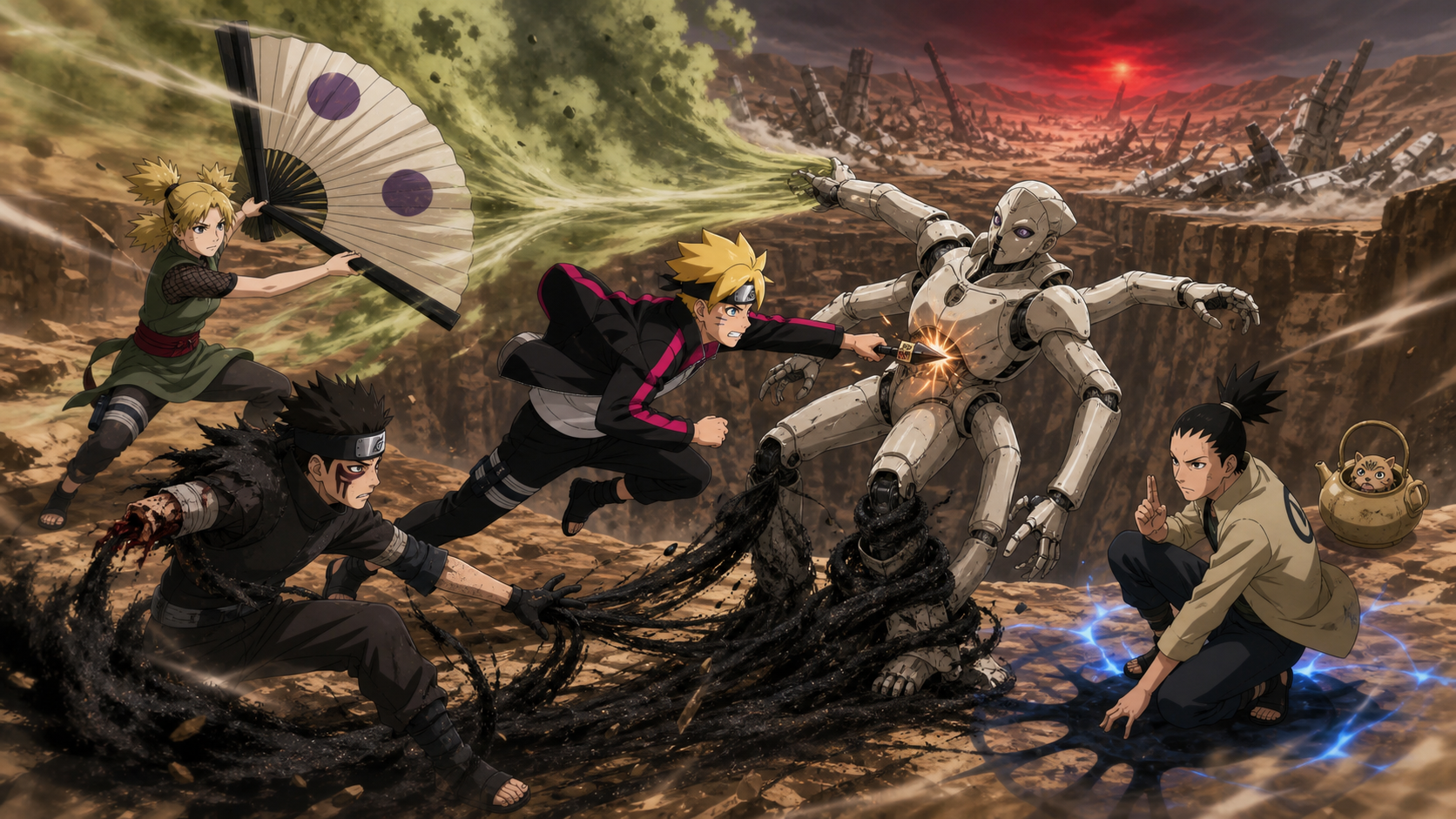
Boruto Episode 123 proves that caring about people and completing the mission only become useful when somebody can turn both beliefs into coordinated action. Shinki continues alone with Shukaku and meets the surviving Otsutsuki puppet. Poisoned needles partially paralyze his arm, yet he traps the machine with Iron Sand and keeps moving. Boruto arrives with Temari and Shikadai, apologizes for dismissing Shinki's feelings, then immediately turns back to help the relatives who bought them time. Shukaku slips after him because the One-Tail knows the pursuer cannot remain behind them forever. Temari clears poison gas, Shikadai reads the battlefield, Boruto plants an explosive kunai, and Shinki returns to complete the combination. The group destroys the puppet through cooperation that looks inefficient only until every different skill lands in the correct order. Then Urashiki appears after the exhausting win and steals chakra from Temari and Shikadai. The title saves its villain for the cruelest possible moment: after the humans finally learn how to work together.
Shinki inherits the consequence of traveling alone
Episode 122 ended with Boruto returning toward Kankurō's battlefield while Shinki continued with the tea kettle. Neither choice removed the Otsutsuki pursuit.
The surviving puppet reaches Shinki because one escort now carries the target without support. Mission discipline kept Shukaku moving, but separation created a new weakness.
Being right about the destination did not make the road safe.
The puppet attacks without giving him time to argue
Shinki cannot debate priorities once the machine appears. He has to protect Shukaku, control distance, and read unfamiliar weapons at the same time.
The opponent has no emotional conflict to exploit. The puppet simply continues the purpose Urashiki gave the body.
That mechanical focus is exactly why a lone human fighter becomes vulnerable.
Poisoned needles change the fight
The puppet lands a needle attack that begins paralyzing Shinki's arm. The injury limits a fighter whose style depends on precise control.
Poison works well against confidence because damage continues after the initial hit. Shinki can leave the immediate exchange and still carry the attack inside his body.
The mission clock now includes his shrinking physical ability.
Shinki uses a clone to sell the wrong victory
He lets the puppet believe a sword strike has found the real body. The decoy buys the opening he needs.
Shinki's method remains disciplined and smart. He does not answer injury with a louder attack or waste strength proving superiority.
Deception lets him change position while the machine commits to bad information.
Iron Sand anchors the pursuer
The real Shinki catches the puppet and fixes the machine to the ground long enough to continue moving.
He chooses delay over destruction because Shukaku must reach Konoha. That decision mirrors Kankurō's earlier battlefield logic.
The boy learned the mission lesson. The danger is assuming every delay will last as long as he needs.
Shukaku teases the injury and names the missing partner
The One-Tail tells Shinki that Boruto might have helped him defeat the machine and avenge Kankurō.
Shukaku knows exactly where to press. The comment challenges Shinki's claim that Boruto's emotional method has no practical value.
Partnership is not sentiment pasted over tactics. A second fighter changes angles, choices, and recovery time.
The crevice becomes another trap
Shinki reaches broken terrain while the puppet catches up. The landscape limits movement and gives the machine surfaces for concealment and sudden attack.
His earlier restraint bought distance, not safety. The escort crisis keeps punishing anyone who treats a temporary solution as a finished one.
Gaara's seal, Kankurō's explosion, and Shinki's Iron Sand all changed the clock without ending the pursuit.
Boruto reaches Shinki before the worst strike lands
He arrives with Temari and Shikadai and hits the puppet, interrupting the isolated fight.
Boruto's return toward Kankurō did not locate the missing man, but the choice connected him with reinforcements who could help Shinki.
The route looked like a detour and produced the support the mission now needs.
Temari and Shikadai buy the escort another departure
The mother and son take over the immediate fight so Boruto and Shinki can resume movement with Shukaku.
Their arrival restores the adult protection Kankurō originally provided, though Temari is also searching for her brother.
Family concern and mission duty finally occupy the same action instead of opposite sides of an argument.
Boruto apologizes without surrendering his position
He admits that he dismissed Shinki's feelings and misunderstood the resolve behind continuing forward.
Then he says friends still matter. The apology repairs disrespect without pretending Boruto's concern was meaningless.
That distinction makes the exchange human. Growth does not require one child to announce that the other child was completely right.
Shinki still calls him emotional
The label is not entirely false. Boruto often lets immediate feeling outrun planning.
The insult also misses how quickly Boruto creates relationships that become real support. Temari and Shikadai are present because he turned back and shared what happened.
Emotion creates risk, but emotional awareness can also build the team Shinki needs.
Shukaku compares Boruto to Naruto
The similarity makes Boruto uncomfortable and gives Shukaku enormous amusement. Both Uzumaki boys refuse to accept that a person must be abandoned simply because the cleanest logic says to move.
Shukaku adds a wonderfully petty qualification: Boruto is smarter and more skilled than Naruto was at the same age.
The joke carries affection while preserving Shukaku's long memory of Naruto being stubborn, loud, and frequently ridiculous.
Boruto turns back again
He cannot keep walking while Temari and Shikadai fight the pursuer. Shinki sees another violation of mission priority.
Boruto sees an unresolved enemy that will keep following the kettle if nobody finishes the battle.
This time his decision has a clearer tactical argument. Protection of the rear can protect the route ahead.
Shukaku sneaks away from Shinki
The One-Tail leaves the strict escort and follows Boruto toward the fight. Shukaku is not passive cargo, and nobody can reduce his judgment to kettle placement forever.
His choice frustrates Shinki because the target voluntarily returns toward danger.
Shukaku understands the pursuer must be stopped and trusts the group more than Shinki trusts their messy coordination.
Poison gas meets Temari's fan
The puppet releases gas across the battlefield. Temari answers with Wind Release and clears the cloud before the poison controls the space.
Her technique protects multiple people at once and turns the enemy's area attack into moving air.
This is exactly why different specialists matter. Iron Sand, shadow control, clones, wind, and explosive tools solve different parts of the same problem.
The crevice does not hold the machine
Temari blows the puppet into the gap, but the body climbs back. Another temporary removal fails to become a permanent answer.
The repetition could feel frustrating, yet the enemy's persistence defines the escort arc. Urashiki built or controlled pursuers that keep functioning after damage ordinary opponents would not survive.
The group must dismantle the threat rather than keep pushing the machine out of sight.
Shinki calls their teamwork inefficient
From his position, the group appears to improvise around feeling instead of following one clean plan.
Shukaku points out that the humans are coordinating well. The difference rests in what each observer values.
Shinki sees deviation. Shukaku sees adaptation, coverage, and people responding to one another in real time.
The puppet's multiple arms control the space
The machine attacks from several angles, fires chakra, and burrows beneath the sand. Every new tool forces the defenders to divide attention.
Numbers of limbs matter less than the rhythm they create. One blocked strike hides another attack, while underground movement ruins stable footing.
The fight works when the humans stop trying to answer every weapon with the same response.
Temari unearths the hidden body
Wind Release tears through the sand and forces the puppet into view. Concealment disappears, but exposure does not make the enemy helpless.
The puppet maneuvers in the air and returns fire. Temari creates opportunity rather than an instant win.
Strong adults can contribute without deleting the younger characters from the battle.
Temari protects Shikadai and gets hurt
She takes an attack meant for her son. The moment repeats the family logic driving the entire episode.
Temari knows the mission, understands emotional control, and still places her body between danger and Shikadai.
Professional discipline does not erase maternal reflex. The story becomes dishonest whenever shinobi doctrine pretends family bonds can be switched off on command.
Temari tells the boys to leave
Injured, she offers to buy them time. The order resembles Kankurō's earlier decision and tests whether the children learned anything beyond choosing opposite slogans.
They refuse to abandon the fight because the enemy will keep pursuing Shukaku and because Temari can no longer guarantee a safe delay alone.
Refusal becomes tactical when the group has an actual combined plan.
Boruto's clones create the perimeter
Shadow clones spread attention and force the puppet to track several bodies. Boruto uses his signature technique as battlefield organization instead of simple attack volume.
The copies create the gap needed to attach an explosive kunai without detonating the weapon too soon.
Timing matters more than spectacle. The planted tool becomes useful only when the others move the puppet into the correct position.
Shikadai borrows Temari's fan
He uses his mother's weapon to help expose the puppet again. The moment links Nara planning with Sand technique and family inheritance.
Shikadai cannot reproduce all of Temari's power, but he understands what the fan can contribute to the sequence.
Using another person's tool well requires attention, humility, and trust in the plan.
Shinki returns to finish the combination
The supposedly rigid escort chooses to rejoin the fight. He brings Iron Sand into a strategy built from Boruto's explosive marker and Shikadai's timing.
His return proves that growth travels both directions. Boruto learned to respect the mission. Shinki learns that eliminating the pursuer may require trusting an improvised team.
They succeed because nobody has to become identical.
Urashiki waits until the group is exhausted
The Otsutsuki breaks Gaara's seal and arrives after the puppet battle has consumed attention, chakra, and physical strength.
His timing makes the victory feel cruel. The defenders solve one coordinated problem and discover the person directing the larger hunt has returned.
Urashiki lets the machine drain them before collecting the advantage.
Temari and Shikadai lose chakra
Urashiki uses his fishing-rod weapon against the exhausted mother and son. The attack punishes the reinforcements who made the rescue possible.
Chakra theft reduces skilled people to resources, repeating the dehumanizing logic behind his pursuit of Shukaku.
The villain sees family bonds only as openings and bodies only as storage.
The title arrives at the end
“Urashiki Returns” sounds like the episode should center him. Most of the runtime belongs to the puppet fight and the escort argument.
His late appearance works as a threat, though viewers wanting a full Urashiki confrontation may find the title misleading.
The delay still serves a purpose: human cooperation becomes visible before the Otsutsuki tries to break the group apart again.
Poison turns Shinki's isolation into a measurable liability
Shinki can endure pain, improvise with Iron Sand, and deceive the puppet through a clone. None of those strengths remove poison from his body. Traveling alone means nobody can monitor the spreading paralysis, cover a blind angle, or decide when determination has become medical danger.
The injury gives the teamwork argument physical evidence. Shinki's self-control helps him continue. Self-control cannot replace support. A shinobi who refuses help may preserve speed for a few minutes and lose the mission when one arm stops responding at the wrong moment.
Boruto's earlier emotional decisions created risk, but Shinki's rigid independence creates another kind of risk. The arc improves when neither boy owns the complete moral answer. Boruto must consider timing and objective. Shinki must recognize that bodies fail and teammates provide redundancy rather than sentimental decoration.
Shukaku sees that problem faster because the One-Tail has watched human hosts survive through bonds and collapse through isolation. His teasing keeps the lesson from sounding like a lecture, but the warning remains serious.
Boruto's apology works because he does not erase his original concern
Boruto admits that he failed to understand Shinki's feelings and the responsibility attached to carrying Shukaku. He does not say caring about Kankurō was foolish. A useful apology names the harm or misunderstanding without rewriting every belief that produced the conflict.
That distinction preserves Boruto's character. He should not become Shinki by learning discipline. He should learn how urgency affects a shared mission, how teammates receive unilateral decisions, and when returning for someone creates more danger than rescue.
Shinki also needs Boruto's challenge. Mission language can become a shield against grief, uncertainty, and moral responsibility. Kankurō's apparent death matters even if the escort must continue. Temari's injury matters even if Shukaku remains the target. The team cannot declare every abandoned person an acceptable cost before testing alternatives.
Their reconciliation begins because both positions retain something true. Growth comes from better judgment between truths, not from one boy winning the argument.
Temari proves discipline includes the people carrying the mission
Temari understands operational priorities and warns Boruto about letting emotion control decisions. She also protects Shikadai with her body. Those actions fit together because her son is not separate from the battlefield calculation. A lethal strike removing Shikadai would damage the team, the family, and every objective his skills support.
The maternal reflex carries personal love, but professional doctrine does not require emotional amputation. Good commanders account for the fact that shinobi have families, loyalties, fear, and limits. Pretending those forces disappear under orders creates plans that fail when humans behave like humans.
Temari then tells the children to leave because an injured adult can still choose to cover a retreat. The boys refuse after judging that her condition and the enemy's pursuit make solo delay unlikely to work. Their refusal becomes defensible because they bring a combined tactic rather than raw protest.
The sequence separates attachment from panic. Love motivates action. Planning determines whether the action helps.
Shukaku reads the family pattern because Gaara taught him the cost
Shukaku compares Boruto with Naruto and watches Shinki through the knowledge of Gaara's childhood. He understands loud compassion, controlled isolation, and the way villages turn young people into containers for adult objectives.
Boruto resembles Naruto through refusal to leave people behind, improvisation, and an ability to make disciplined companions reconsider the boundaries of a mission. Shinki resembles early Gaara less through cruelty than through reliance on control. He trusts strength and objective clarity because uncertainty feels dangerous.
Gaara did not adopt Shinki to reproduce his loneliness. The Kazekage wants his son to gain the bonds that saved him without needing the same catastrophe first. Shukaku becomes an unusually qualified observer because he lived inside Gaara's worst years and later chose cooperation with the man Gaara became.
His jokes therefore carry family history. When Shukaku nudges Shinki toward Boruto, an ancient former weapon is helping Gaara's child avoid learning attachment through loss.
Urashiki's late arrival exposes the difference between battle and campaign
The group defeats a puppet and earns a tactical victory. Urashiki arrives after that victory because the escort is part of a larger campaign. He can allow machines, poison, geography, and exhaustion to consume defenders before risking his own chakra.
That strategy makes him effective and frustrating. The heroes solve the immediate problem correctly and still face a worse position. Success did not become fake. Success removed one pursuer, protected Shukaku longer, and strengthened the team. The campaign remains unfinished.
Urashiki's chakra theft then turns Temari and Shikadai's effort into fuel. He treats exhausted people as supplies because the Otsutsuki worldview recognizes power without recognizing ownership or personhood.
The ending should leave anger rather than hopelessness. Boruto and Shinki have finally learned enough to cooperate under pressure. Urashiki arrives at the exact moment when that cooperation must survive a stronger enemy.
Final reaction
“Urashiki Returns” is another episode whose title sells the final minutes while the real story belongs to Shinki, Boruto, Shukaku, Temari, and Shikadai. That mismatch deserves a little side-eye. Urashiki barely returns before the ending. The puppet fight carries the episode, and the character work carries the puppet fight.
Shinki's opening battle is strong because injury does not make him stupid. Poison begins paralyzing his arm, so he uses a clone, anchors the machine with Iron Sand, and continues the escort. He follows Kankurō's lesson: the target matters more than personal victory. The episode respects his intelligence even while showing the cost of isolation.
Boruto's apology is equally important. He admits that he failed to understand Shinki's feelings without pretending concern for Kankurō was a mistake. That is a better apology than a polished speech where one child accepts every part of the other's worldview. Boruto still believes people matter. He simply begins learning that concern must account for the mission everybody else is protecting.
Shukaku is the episode's best commentator. He knows Gaara's history, sees Naruto inside Boruto, and recognizes coordination before Shinki accepts the evidence. His joke that Boruto is smarter than young Naruto keeps the conversation from becoming a lecture. Shukaku can honor Naruto's influence and still remember the boy was a headache.
Temari and Shikadai complete the argument. Temari warned Boruto not to let emotion control a mission, then throws herself in front of an attack for her son. That is not hypocrisy. Love and duty live in the same body. Mature judgment means accounting for both, not pretending one disappears when the headband goes on.
The final combination proves Shinki's efficiency is too narrow. Boruto's clones, the explosive kunai, Shikadai's timing, Temari's fan, and Shinki's Iron Sand look messy until the sequence works. Real teams are messy because different people notice different problems. Coordination does not require emotional sameness.
Then Urashiki steals chakra from the exhausted reinforcements, because of course this man waits until everybody finishes the hard work. The move is effective and deeply annoying. The group finally solves the puppet problem together, and the real predator arrives to treat that effort as a harvest. Episode 123 ends with Boruto and Shinki closer to understanding one another while the mission becomes more dangerous than ever.
Sources and lawful viewing
Official episode reference: Naruto Official episode guide
Licensed episode route: Crunchyroll licensed series page