
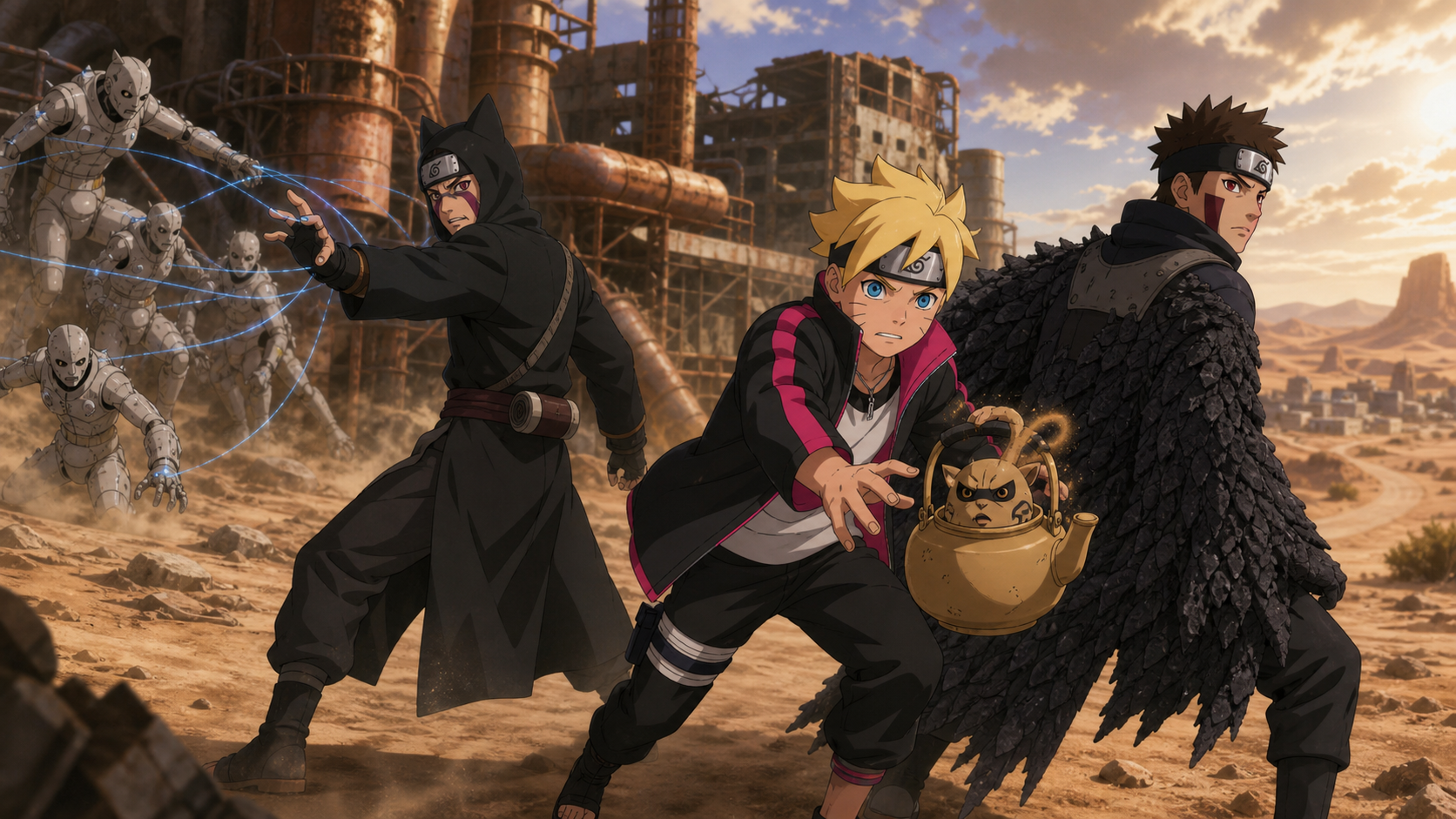
The Entrusted Mission: Protect the One Tails!
Gaara seals Urashiki and entrusts Shukaku to an escort that can only survive if Boruto’s impulse and Shinki’s discipline learn to travel together.
Series: Boruto: Naruto Next Generations
Episode: 121 · The Entrusted Mission: Protect the One Tails!
Arc: One-Tail Escort Arc
Release: 2019-08-25
Previous: Episode 120 · With Sasuke as the Goal
Directory: All 293 Boruto episodes
Bottom line
Boruto Episode 121 gives Boruto the mission he thought he wanted and immediately exposes how little he understands about carrying somebody else's survival. Sasuke has vanished through Urashiki's portal. Gaara traps Urashiki with sealing sand, but the Kazekage knows the prison will not hold forever. Shukaku must reach Naruto in Konoha before Urashiki breaks free, so Gaara entrusts the One-Tail to Shinki, Kankurō, and the uninvited Leaf genin standing in the battlefield. Shukaku squeezes into a tea kettle, Kankurō gets the strangest luggage assignment in the franchise, and Boruto keeps arguing with Shinki because urgency feels different to a child who improvises and a child trained to treat orders as survival. The episode ends when Otsutsuki puppets find the escort and Kankurō stays behind to fight them alone. Boruto finally has a job connected to Sasuke's disappearance. The job requires discipline, not another dramatic sprint toward the person he wants.
Sasuke is gone before Boruto can apologize
Episode 120 ended with Sasuke protecting Boruto, losing chakra to Urashiki, and disappearing through a dimensional portal. Episode 121 does not give Boruto a comforting explanation.
The mentor is simply absent from the battlefield. Boruto has to stand inside the consequence before anybody knows where Sasuke landed or how he will return.
That silence matters because Boruto cannot talk his way around the timing. He arrived, Sasuke looked toward him, and Urashiki exploited the opening.
Gaara keeps fighting while Boruto freezes
Gaara does not have time to comfort the child. Urashiki still wants Shukaku's chakra, and the Kazekage has a village and a Tailed Beast to protect.
The contrast is brutal. Boruto experiences Sasuke's disappearance as a personal emergency. Gaara experiences the same moment while continuing the larger defense.
Leadership does not remove fear. Leadership forces Gaara to act before fear gets a private room.
Urashiki is hunting a living target
Shukaku is not a battery sitting in storage. The One-Tail has memory, personality, grudges, loyalties, and a long history of being treated as a weapon.
Urashiki reduces that life to harvestable chakra. The Otsutsuki threat repeats the ugliest shinobi habit on a cosmic scale: power matters, while the person carrying power becomes packaging.
Gaara understands that violence personally. He spent childhood as a container whose fear and pain mattered less than military usefulness.
Gaara's seal buys time instead of victory
The Kazekage catches Urashiki in a powerful sealing technique. Nobody mistakes the restraint for a permanent solution.
Gaara says the prison will eventually break. That admission prevents the episode from pretending one impressive jutsu solved an Otsutsuki attack.
The mission begins because the strongest adult present knows his limit and plans around that limit. Competence includes knowing when a technique only changes the clock.
Naruto becomes the safest destination
Gaara orders the escort toward the Hidden Leaf because Naruto can protect Shukaku and understands the burden of housing a Tailed Beast.
The choice also shows how much the political world changed after the Fourth War. A Kazekage can trust the Hokage with his village's most dangerous strategic asset without treating the transfer as surrender.
Their friendship has practical weight. Trust becomes a route, a destination, and a decision made while an enemy is trying to steal a living being.
Shinki receives the mission first
Gaara places responsibility on his adopted son. Shinki does not celebrate the honor or turn the order into a speech about proving himself.
He listens, calculates, and prepares to move. His calm can look cold beside Boruto's visible emotion, but the mission needs somebody who can hold the objective steady.
Shinki has spent years learning control because uncontrolled power once frightened everybody around him. Discipline is not decoration for him.
Boruto gets included because the crisis is already here
Boruto did not earn this assignment through the normal mission system. He entered the battlefield without permission and now possesses information nobody can erase from his head.
Gaara uses the available person instead of wasting time on a lecture. That practical choice should not be confused with approval of Boruto's trip.
The mission is a consequence and an opportunity. Boruto can help repair the danger around him, but useful action will not rewrite the original mistake.
Shukaku refuses to travel politely
The One-Tail has no interest in behaving like cargo. Shukaku argues, complains, and makes sure everybody remembers that the escort is carrying a person with opinions.
That attitude keeps the premise from becoming solemn military transport. Shukaku has survived seals, hosts, extraction threats, and human orders. A little cooperation does not require cheerful obedience.
His irritation is funny because the complaint has history underneath the joke.
The tea kettle is ridiculous and practical
Shukaku shrinks into a tea kettle for transport. The visual gag works immediately: one of the world's great Tailed Beasts now looks like luggage somebody forgot beside a stove.
The container also solves a real movement problem. A giant sand creature cannot cross open country without announcing the mission to every watcher between Suna and Konoha.
Naruto has always understood that absurdity and danger can share the same object. The kettle is cute until the audience remembers why concealment became necessary.
Kankurō joins the escort
Gaara sends an experienced jōnin and puppet master with the two genin. Kankurō knows the desert, the route, Shinki, and the kind of enemy likely to pursue them.
His presence prevents the mission from looking like adults handed a Tailed Beast to children and hoped for the best.
Kankurō also becomes the bridge between two boys who can cooperate in combat yet still read responsibility through completely different instincts.
Boruto wants Sasuke to remain the only priority
His mentor's disappearance keeps pulling at every thought. Boruto wants answers, a rescue plan, and a way to undo the moment he witnessed.
Those feelings are real. The danger begins when grief tries to rename itself as mission judgment.
Protecting Shukaku is not a distraction from Sasuke. Urashiki targeted both, and keeping the One-Tail away from him weakens the same enemy who removed Sasuke.
Shinki refuses to let emotion rewrite the order
Shinki hears Gaara's instruction as a complete assignment: reach Konoha with Shukaku. He does not want improvisation, detours, or arguments about what Boruto would rather fix first.
That firmness can feel inflexible. In an escort mission, flexibility without a shared objective becomes wandering with valuable cargo.
Shinki protects the group by insisting that everybody remember the exact reason they are moving.
Their personalities clash before the enemy arrives
Boruto moves through instinct, relationships, and immediate emotional pressure. Shinki moves through probability, control, and ordered priorities.
Neither method is automatically enough. Boruto notices human need quickly, while Shinki prevents urgency from scattering the team.
The episode does not need to declare one boy superior. The escort works only when each child learns what the other method catches.
Kankurō tells Shinki that Boruto has something he lacks
The observation does not mean Boruto is a better shinobi. Kankurō sees a quality in Boruto that Shinki's efficient discipline has not fully developed.
Boruto reaches people. He acts from attachment, sometimes recklessly, but that attachment can create cooperation no command could force.
Shinki's next stage of growth is not becoming louder or less intelligent. He needs room for another person's judgment without treating every difference as disorder.
The old power plant becomes temporary shelter
The escort pauses at an abandoned facility before continuing toward the Leaf. Broken infrastructure gives them cover while reminding viewers that national development leaves ruins as well as progress.
Episode 120 used a proposed power plant as the excuse for stealing Gojō's farm. Episode 121 places the group inside an old plant that no longer serves anybody.
The pairing quietly challenges the claim that construction alone equals public good. Somebody always pays for a project, and somebody lives beside what remains.
Shukaku listens from the kettle
The transport container does not remove him from the conversation. Shukaku hears the disagreements, advice, and assumptions made around him.
That detail matters for a character repeatedly discussed as a village possession. The supposed cargo is still judging the escorts.
Shukaku's eventual cooperation with humans has always depended on recognizing specific people, not accepting every institution that once used him.
Gaara's childhood sits behind every order
Gaara once lived under constant surveillance because adults feared Shukaku and feared the child carrying him. Assassination attempts came from his own father.
The Kazekage now protects the same Tailed Beast without pretending their history was gentle. Gaara's order to move Shukaku toward Naruto grows from experience, not abstract diplomacy.
Two former jinchūriki built the trust that gives this mission a destination.
The escort is also a family assignment
Gaara sends his son with his brother. The military order carries private stakes even when nobody pauses to name them.
Kankurō has watched Gaara move from isolated weapon to Kazekage, husband, and father. Shinki entered that family with his own dangerous power and learned control under Gaara's care.
Protecting Shukaku means protecting part of the history that shaped their household.
Boruto must learn that concern is not command
He cares about Sasuke deeply, but concern does not give him authority over every decision connected to Sasuke.
The previous episode showed the cost of chasing access without permission. This episode begins teaching the next lesson: helping means doing the needed job, even when the job does not soothe the helper's fear.
Boruto cannot rescue Sasuke by abandoning the asset Urashiki is still hunting.
The puppets turn the road into a trap
Otsutsuki puppets intercept the group as they prepare to continue. Their arrival proves Gaara's warning correct and removes any illusion that the seal created a leisurely head start.
These enemies do not need sleep, sympathy, or a personal grudge. They exist to recover the target.
The escort has to preserve distance instead of winning every fight in one place.
Kankurō recognizes his kind of battlefield
Puppets are his specialty. He understands their movement, construction, blind spots, and likely control patterns better than either genin.
Staying behind is not empty adult sacrifice. Kankurō assigns the specialist to the obstacle while the couriers continue with the mission.
Good teamwork does not keep every fighter together. Good teamwork places the right person where that person's skill changes the odds.
Shinki is ordered to keep moving
The hardest command for a child is sometimes leaving an adult in danger. Shinki has family loyalty, professional discipline, and no guarantee that Kankurō will catch up.
Turning toward Konoha can look like abandonment if the mission disappears from view. Kankurō refuses that framing because stopping would hand the enemy a second target and waste his decision.
Trust means believing the person who stays behind understood the cost.
Boruto sees a different kind of protection
Sasuke protected Boruto by reacting in the moment and paid with stolen chakra. Kankurō protects Boruto and Shinki by planning separation before the enemy controls the pace.
Both adults accept danger for children. The methods are different because the situations demand different choices.
Boruto needs to notice that protection is not always standing beside somebody. Sometimes protection orders the other person to run.
The mission title belongs to all four travelers
Gaara entrusts the assignment to Shinki, Boruto, and Kankurō. Shukaku also has to trust the people carrying the kettle.
The word “entrusted” travels in several directions. A leader trusts his family and an allied child. A Tailed Beast accepts concealment. An uncle trusts two genin to continue without him.
Responsibility becomes mutual long before friendship becomes easy.
The episode ends before anybody earns relief
Kankurō prepares for the puppet battle while the children carry Shukaku forward. Sasuke remains missing. Urashiki remains sealed only temporarily.
The ending works because the mission has narrowed into clear jobs rather than louder panic.
Kankurō fights. Shinki leads the route. Boruto helps carry the responsibility he entered without understanding. Shukaku survives by trusting people again.
Gaara protects Shukaku as a partner, not a village asset
Gaara knows what happens when a village calls a living being a strategic resource. Adults sealed Shukaku inside him, feared the result, and treated the child carrying the One-Tail as both weapon and threat. The escort plan matters because Gaara refuses to repeat that logic while facing a real military danger.
He listens to Shukaku, explains the temporary seal, chooses Naruto as the destination, and assigns family members whose loyalty extends beyond institutional orders. Those choices do not erase the power imbalance created by putting Shukaku in a kettle. They show an attempt to use concealment through trust rather than captivity through force.
Naruto becomes the safest destination because Kurama's former host understands personhood and extraction risk. Konoha also has stronger defenses and allies who recognize Otsutsuki tactics. The decision rests on relationships built after Gaara and Naruto survived the same system from different villages.
Protecting Shukaku therefore means protecting a person and the proof that jinchūriki history can produce something other than another prison.
The kettle is practical because every better option has a cost
Shukaku's full chakra signature would make the escort easy to track. A visible giant Beast would also turn every settlement along the route into a potential battlefield. Compact concealment reduces detection, allows ordinary travel, and lets the team move without announcing the target to civilians.
The disadvantages remain obvious. Shukaku loses mobility, depends on carriers, and risks being treated like baggage. The container can be dropped, stolen, damaged, or separated from the people who understand the mission. A ridiculous disguise becomes a serious security choice because no option offers freedom, speed, secrecy, and combat readiness together.
The group should treat Shukaku as an active member even while his body remains compact. He can warn, advise, consent, and challenge decisions. The episode does this through conversation, which keeps the kettle joke from erasing agency.
Good protection does not require pretending the arrangement feels dignified. Shukaku can cooperate and complain with equal legitimacy.
Boruto enters the mission through consequence, not reward
Boruto chased Sasuke, ignored warnings, entered an Otsutsuki fight, and contributed to the moment Sasuke lost chakra. Episode 121 does not reward that recklessness with exclusive training or heroic praise. Gaara includes him because the crisis has already placed him near the target and because Boruto can help move Shukaku.
The assignment forces Boruto to serve a need that does not center his guilt. He wants to find Sasuke, apologize, and confirm his mentor survived. Those desires are understandable. Following them immediately would expose Shukaku and abandon the responsibility created by the same crisis.
Consequences become useful when they teach without reducing a child to shame. Carrying the mission gives Boruto a way to repair harm through judgment and work rather than dramatic self-punishment. He cannot undo Sasuke's stolen chakra. He can stop Urashiki from taking another living source.
Love matters. Responsibility decides what love does next.
Shinki's discipline is valuable until discipline becomes emotional armor
Shinki reads the order correctly. Shukaku must reach Konoha, Urashiki's seal will fail, and every delay reduces the advantage Gaara bought. His focus protects the group from Boruto's urge to chase every person in danger.
The same focus can hide fear. Kankurō is family. Gaara is injured. Shukaku carries the history of their household. Shinki cannot control those outcomes, so strict mission language offers something measurable. Continue moving. Preserve the target. Do not reopen the decision.
Kankurō sees that armor because he knows Gaara and helped raise Shinki. Telling Shinki that Boruto possesses something he lacks does not mean replacing discipline with impulsiveness. Kankurō wants him to recognize emotional information as part of battlefield judgment.
Shinki will need that capacity when rules no longer cover every responsibility. A perfect route can still leave a person behind. A disciplined shinobi must notice the cost without allowing the cost to destroy the objective.
Kankurō's separation order creates a duty to reconnect
Staying behind makes tactical sense because Kankurō understands puppet combat and the escort must maintain distance. The order should not make him disposable. Shinki and Boruto need a rendezvous point, a time threshold, and a method for reporting whether Kankurō escaped.
The episode emphasizes trust but leaves recovery logistics vague. Trusting Kankurō's decision means continuing now. Trusting the relationship also means planning to find him after the target reaches a safer boundary.
Children often inherit adult sacrifice as a command to keep walking. Without later debriefing, that pattern teaches them that love proves itself through disappearance. Gaara's family has already suffered enough from adults turning danger into silence.
Kankurō's stand should buy time, not remove him from the mission ledger. Episode 122 will test whether the children can distinguish honoring his choice from assuming his loss.
The entrusted mission distributes trust in every direction
Gaara trusts Shinki and Kankurō with Shukaku. Naruto and Gaara trust their alliance. Shukaku trusts humans who belong to institutions that once imprisoned his kind. Kankurō trusts two genin to continue after he separates. Boruto must trust that helping elsewhere can still support Sasuke.
None of these bonds feels effortless. Trust works because people accept specific responsibilities and remain answerable for the result. Shukaku's suspicion does not invalidate cooperation. Boruto's fear does not invalidate the escort. Shinki's restraint does not invalidate his attachment.
The title uses “entrusted” rather than “ordered,” and that word carries the episode. Orders move downward. Trust moves across relationships and can be broken in several directions.
The kettle reaches Konoha only if every person treats the others as more than equipment inside a plan.
Final reaction
“The Entrusted Mission: Protect the One Tails!” is a setup episode with actual moral weight. The plot has to move Shukaku from the Land of Wind toward Konoha, introduce the escort conflict, and place Kankurō in position for the next fight. The writing could have treated those requirements like travel paperwork. Instead, the episode makes every logistical choice reveal somebody's history.
Gaara's sealing jutsu is impressive because he knows the seal will fail. He does not pose beside a temporary victory. He uses the time, chooses the safest destination, and sends people whose skills fit the route. Naruto becomes the destination because two former jinchūriki built trust after villages spent generations treating Tailed Beasts and their hosts as military property.
Shukaku inside the tea kettle gives the episode its funniest image, but the joke never erases the person. He complains because he has earned suspicion. Every village has called his power useful while making decisions over his head. Cooperation now comes from relationships with Gaara and Naruto, not sudden faith in shinobi institutions.
Boruto and Shinki carry the character argument. Boruto's heart moves faster than his judgment. Shinki's judgment moves faster than his trust. Boruto needs to learn that fear for Sasuke cannot replace the assignment in front of him. Shinki needs to learn that another person's emotional knowledge may catch something a perfect plan misses. Kankurō sees both truths and refuses to flatten either child into a lesson.
Then the puppets arrive, and Kankurō demonstrates the difference between dramatic sacrifice and useful risk. He stays because puppet combat is his field and the couriers must preserve distance. The decision hurts Shinki precisely because Kankurō is family. Continuing toward Konoha does not mean caring less. Continuing means respecting what Kankurō chose to protect.
Boruto wanted Sasuke's attention in Episode 120. Episode 121 gives him responsibility instead. That exchange is healthier and much harder. A hero does not always get to chase the person he loves. Sometimes the hero carries the kettle, follows the route, and leaves the specialist behind because one living target has to reach safety.
Sources and lawful viewing
Official episode reference: Naruto Official episode guide
Licensed episode route: Crunchyroll licensed series page