
X Cards Proxy War!
Shino and Rock Lee already earned their place in history, but apparently a card company needs a popularity war and one public rescue to notice.
Series: Boruto: Naruto Next Generations
Episode: 114 · X Cards Proxy War!
Arc: Extreme Ninja Cards
Release: 2019-07-07
Previous: Episode 113 · The Qualities of a Captain
Directory: All 293 Boruto episodes
Bottom line
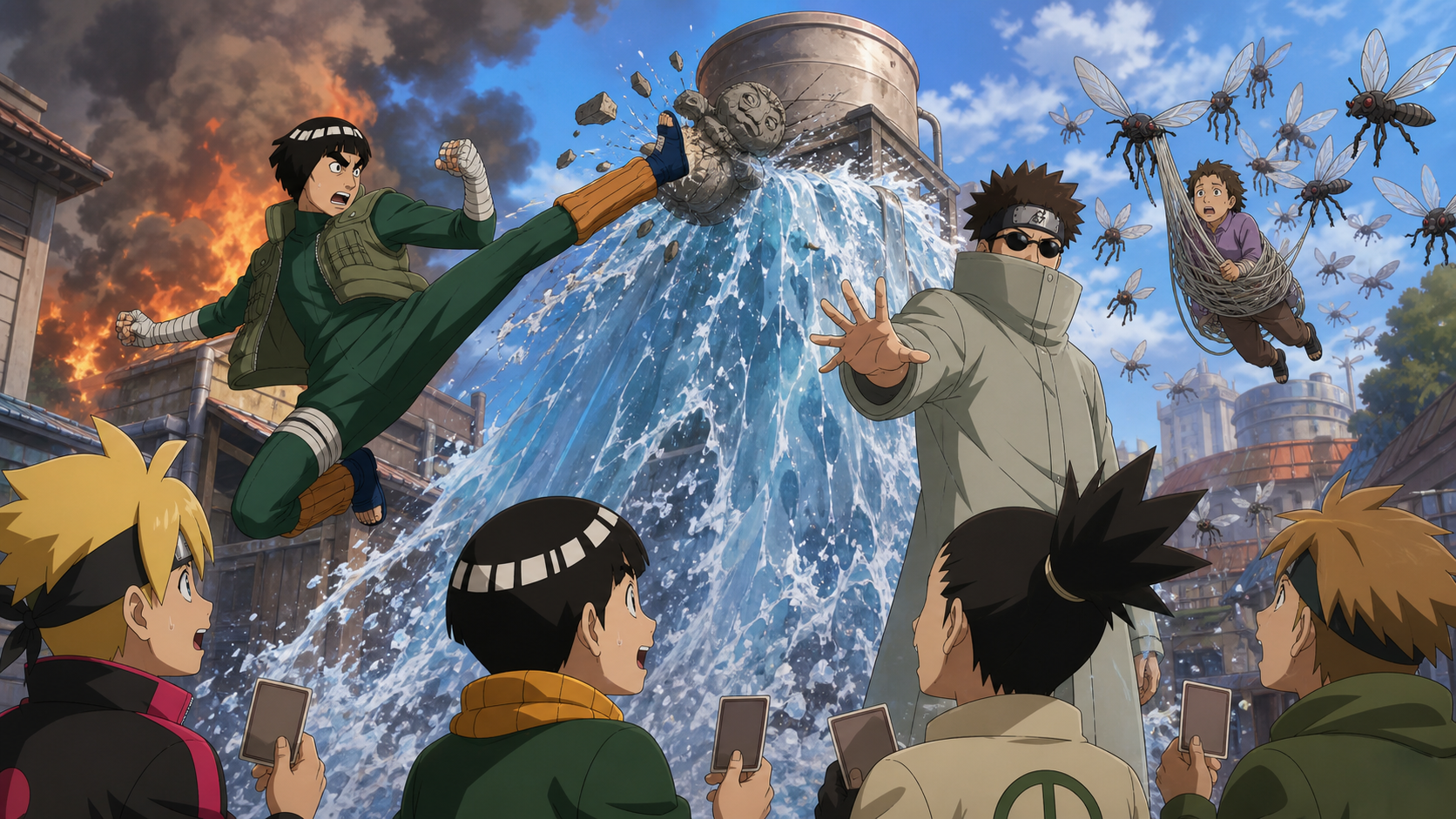
Boruto Episode 114 disguises a sharp little argument about public memory as twenty minutes of children fighting over trading cards. “X Cards Proxy War!” introduces Extreme: Shinobi Picture Scrolls, the collectible game turning Konoha history into rarity tiers, duplicate pulls, and playground status. Boruto can pull his father's card repeatedly while Shino does not have one. Metal discovers Rock Lee is missing too. Kaminarimon Company has one open slot in the next set, so Boruto and Shikadai campaign for Shino while Metal and Denki campaign for Lee. Leaflets become train advertisements. Advertising becomes unauthorized stone monuments. The promotion war grows ridiculous until a real fire breaks out. Lee kicks the stone statue into a water tank, and Shino's insects rescue the trapped person. Demand rises enough that both men receive cards. That solution is neat, but the episode's real joke is crueler: two shinobi who already saved lives for years need a visible rescue at the exact moment a company is measuring popularity before their service becomes collectible. Shino and Lee never needed cardboard proof. Their students needed the world to acknowledge teachers whose work happens outside the kind of legend merchandising remembers easily.
Boruto has too many Naruto cards
The Seventh Hokage is so heavily represented that another duplicate feels disappointing rather than rare. Boruto reacts as a collector, not as a son receiving an image of his father.
That distance is funny and believable. Public culture treats Naruto as a historic icon while Boruto sees the man who misses dinner, snores, and occupies too many slots in a card pack.
Fame creates abundance for the person already impossible to ignore.
Sarada calls the hobby immature and then leaves for dessert
She watches Boruto, Metal, and Shikadai tear into packs and decides the obsession is childish. Chōchō calls her toward a new sweet, and Boruto notices that chasing limited desserts is not morally superior to chasing limited cards.
Everybody has a collectible system. Some arrive in foil wrappers. Some arrive with whipped cream and a queue.
The exchange keeps the episode from pretending fandom belongs only to boys or only to merchandise.
Extreme Ninja Cards turn history into a market
The game selects famous shinobi, assigns images and perceived rarity, and circulates those reputations through children who did not witness the events.
That process can teach history. The cards can also flatten people into one technique, one pose, and one popularity score.
Konoha's peace era remembers war heroes through consumer products because direct experience is fading.
Shino learns Kiba and Akamaru made the set
He tries to hide the discomfort, but the omission hurts. Kiba and Akamaru deserve recognition. Shino does too.
The comparison stings because they came from the same generation and shared many of the same conflicts. One partnership has an immediately marketable hook: loud dog shinobi and beloved companion. Shino offers insects, quiet competence, and a personality built around being overlooked.
Merchandising prefers the pitch that fits in one breath.
Shino's students know exactly how strong he is
Boruto, Shikadai, and Metal do not need a company profile to validate their former teacher. They saw his abilities and experienced the care behind his awkward classroom presence.
Their campaign starts from loyalty rather than abstract fandom. Shino deserves a card because the set claims to represent important shinobi and has missed somebody important to them.
The children are trying to make public memory match lived experience.
Kaminarimon Company has one open slot
Denki's father shows them the planned second series and admits one place remains undecided. His respect for shinobi makes selection difficult.
The supposed scarcity creates the conflict. Shino and Lee do not become less worthy because the print plan has one empty box.
Commercial limits masquerade as historical judgment.
Metal nominates Rock Lee because of course he does
Metal sees Shino's case and immediately realizes his own father is absent. Lee survived impossible fights, devoted his life to taijutsu, trained younger shinobi, and turned lack of ninjutsu talent into a philosophy of effort.
Metal's nomination is not sabotage. He recognizes the same omission through a more personal relationship.
The episode creates two valid campaigns and lets artificial scarcity turn allies into opponents.
Denki suggests profit as the deciding metric
If Kaminarimon Company cannot choose the most deserving shinobi, the market can choose the card likely to sell.
That proposal is honest about what the product is. The company admires shinobi, but admiration does not pay printing costs by itself.
The uncomfortable part is how quickly popularity becomes a substitute for worth.
The customer survey turns respect into a vote count
Children and citizens can support one candidate. The system looks democratic while rewarding whoever receives the strongest campaign exposure.
A person unknown because his work was quiet begins behind the person whose style is visually famous. Voting cannot correct invisibility without information.
Boruto and Metal therefore stop advocating and start marketing.
Boruto and Shikadai build the Shino campaign
Shadow clones distribute leaflets and multiply Boruto's reach. Shikadai helps organize without sharing Boruto's appetite for escalation.
Their message has substance. Shino taught them, fought powerful enemies, and can use insects for surveillance, restraint, tracking, and rescue.
The campaign becomes a way for students to articulate what their teacher contributed.
Metal and Denki put Lee on the trains
Denki has access to modern infrastructure and advertising surfaces. Metal has personal testimony and absolute conviction.
Lee's story sells easily because effort overcoming limitation already has the shape of an inspirational campaign.
The trains carry his image through the village while Shino's supporters still hand out paper.
Rock Lee takes the early lead
The result is not an insult to Shino. Lee has a public fighting style, visible enthusiasm, and a personal story Konoha knows how to repeat.
Shino's best work often looks like a problem quietly stopped before anybody sees the scale.
Popularity measures visibility, not usefulness.
Boruto bribes Iwabee with a rare Naruto duplicate
The extra Seventh Hokage card Boruto did not want becomes valuable currency to somebody else. He offers the duplicate in exchange for Iwabee using Earth Release.
That trade captures collectible economics perfectly. Rarity and desire depend on who holds the object.
Boruto then uses the exchange to fund an unauthorized Shino monument near the Hokage Rock, which is where the campaign loses the plot.
The stone face is affection with no permission
Iwabee creates a large Shino likeness because visibility seems like the missing ingredient. The act mirrors Konoha's official monument while bypassing every decision about public land and consent.
Shino does not want that kind of attention. His students are celebrating the version of recognition they imagine he needs.
Good intentions become embarrassing when the person being honored has no voice in the tribute.
Metal answers by trying to carve Lee into the monument
Competition turns the landscape into an argument. Metal uses taijutsu to reshape the stone, and Boruto responds with clones and Gale Palm to restore Shino.
Both sides destroy the image they claim to defend.
The campaign stops being about two teachers and becomes about winning on their behalf.
Shikadai leaves before the vandalism finishes
He recognizes where the escalation is headed and wants no part of the consequence. Walking away is sensible self-preservation and questionable friendship.
Shikadai could have used his new Chūnin authority to stop the plan. Instead, he lets Boruto and Metal learn through the wreckage.
Captain rank does not automatically make him everybody's off-duty babysitter, but the timing is still wonderfully convenient.
The giant monument becomes a tiny statue
Competing alterations reduce the grand face to a small figure. The physical result exposes the campaign's logic.
Every attempt to control the image removes something until neither side has the heroic monument envisioned.
Public memory suffers when supporters care more about defeating another story than preserving the person they claim to represent.
Shino and Lee stop the proxy war themselves
Both men say they do not want excessive attention, though they appreciate the students' effort. Their response is gentler than the vandalism deserves.
Shino and Lee do not resent each other. The one-slot system manufactured hostility between the campaigns while the candidates remained friends and peers.
Adults often discover that fans are fighting a war nobody asked them to fight.
A nearby fire ends the popularity performance
Someone is trapped, and the question changes immediately. No survey matters. No monument matters. Rescue ability matters.
The transition is almost too tidy, but the episode understands that heroism becomes clearest when attention is pointed elsewhere.
Shino and Lee respond without asking which action will produce the better card art.
Lee turns the failed statue into water
He kicks the stone into the building's water tank, breaking the container and releasing what firefighters need.
The campaign's embarrassing artifact becomes rescue equipment. Lee's strength converts a bad idea into a useful result.
That is more representative of his character than any advertisement. He applies everything available with total commitment.
Shino's insects reach the trapped person
His kikaichū move where ordinary rescuers cannot reach quickly enough and carry the victim out.
The scene demonstrates why Shino's abilities resist flashy marketing. The insects look unsettling to some people. In a fire, their distributed movement becomes exactly the safe access route required.
Quiet specialization saves a life in public view.
Both men receive cards because demand changes
The rescue raises their profiles enough for Kaminarimon Company to add another space. The impossible one-slot limit disappears once projected sales support two products.
That ending is happy and revealing. Scarcity was never sacred. The print plan could change when the market incentive changed.
History receives room after profit discovers an audience.
The fire should not have been necessary
Shino and Lee were already worthy before the rescue. Years of service, teaching, sacrifice, and skill existed without a current spectacle.
The company does not become evil for responding to demand. The episode still shows how recognition systems reward visible crisis over sustained work.
Some heroes are famous because everybody watched. Others prevented the event people would have watched.
Duplicates return after the moral victory
Boruto and friends finally open packs containing both teachers, then continue pulling repeats. The collectible system absorbs the victory and resumes being annoying.
That joke keeps the episode from becoming a sermon about merchandise. The children wanted the cards because collecting is fun, and fun includes complaining about duplicates.
Shino can enter history and still become somebody's fifth copy.
Sarada and Chōchō choose another dessert round
Their parallel hobby closes the episode. New sweets create their own limited releases, social rituals, and reasons to spend money.
Nobody escapes consumer fandom by changing the product category.
The difference is that dessert does not pretend to determine which shinobi deserves historical recognition.
Extreme Ninja Cards turn public service into collectible scarcity
The cards preserve shinobi history, give children access to famous techniques and careers, and create shared fandom language. The product also converts living people and wartime service into rarity tiers, duplicates, market value, and company-controlled visibility.
Boruto owning several Naruto cards shows how family pride becomes consumer behavior. A child may need to buy repeated packs to find one preferred person while the company decides which shinobi deserves another print slot.
That system does not make the hobby evil. Collecting can be joyful, social, and educational. The business model deserves scrutiny because artificial scarcity turns affection into repeated spending and makes popularity look measurable through sales.
Shino and Lee served Konoha whether a foil card exists or not. Recognition should not depend on whether children can be convinced to chase another packet.
A customer survey measures campaign energy more than worth
The open slot becomes a vote between candidates whose students build campaigns of unequal visibility. Rock Lee receives train advertising through Denki's family company. Shino receives Boruto and Shikadai's grassroots effort. The result measures organization, access, and novelty as much as genuine public opinion.
Popularity surveys can answer what customers say they want from a product. The survey cannot determine which shinobi contributed more, taught better, or deserves respect. Those questions have no clean sales metric.
Denki's profit argument makes sense inside the company. A card producer wants demand. Calling demand the same thing as merit would let marketing budgets rewrite history.
The episode eventually gives both men cards because the campaign itself creates demand. That outcome exposes the market mechanism more honestly than pretending one vote revealed objective value.
Boruto and Metal turn affection into campaigns nobody requested
Boruto admires Shino and wants classmates to recognize the teacher's strength. Metal loves Lee and wants the village to see his father as clearly as he does. Both motives begin with genuine affection.
Neither student asks whether Shino or Lee wants public campaigning, exaggerated slogans, or physical monuments. The men become symbols inside a contest organized around them without their consent.
Proxy fandom behaves this way constantly. Supporters claim to defend an artist, character, or team while spending most of their energy attacking a rival or inflating a metric the person never requested.
Shino and Lee stop the fight because admiration has stopped serving either man. Support should reflect the values of the person supported, not use that person's name as permission for escalation.
The stone face crosses from tribute into vandalism
Boruto and Shikadai carve Shino's likeness into rock without permission. Metal answers by attempting a Lee carving on the Hokage Monument. The jokes escalate because everybody understands that altering public land is not a normal campaign tactic.
Affection does not grant ownership of shared space. A tribute needs consent from the person represented and from the community responsible for the site. The Hokage Monument carries historical and civic meaning beyond available rock surface.
Shikadai leaving before the escalation finishes is funny because he recognizes the consequences and decides he has contributed enough stupidity for one day. Recognizing a bad plan earlier would have been better.
The final tiny statue cannot erase the damage through cuteness. Repair, accountability, and permission still matter after the contest ends.
Shino's students understand strength that spectacle overlooks
Shino rarely performs charisma in the way Lee does. His insects, observation, classroom discipline, and quiet protection make him easy for casual audiences to underestimate. Students who work with him know that reserved presence does not equal weakness.
Boruto's campaign begins from that frustration. He wants public recognition to correct a shallow impression. The impulse is relatable and unnecessary for proving Shino's actual value.
Teaching success often remains invisible because good instruction appears through students rather than dramatic personal victories. Shino's influence can be seen when young shinobi analyze, cooperate, and survive.
A collectible card offers one form of recognition. Respect from students who know the work offers stronger evidence.
Lee's visibility does not make his support less sincere
Rock Lee has a memorable look, loud personality, famous taijutsu, and a story built for inspirational marketing. Those traits give his campaign an advantage without making him undeserving.
Metal's support comes from a son who sees discipline, effort, and care behind the public energy. Reducing Lee to the flashy candidate would dismiss the work that made the flash possible.
The proxy war becomes unfair when supporters treat one man's visibility as proof that the other man lacks value. Shino and Lee represent different kinds of contribution. A card set has room for both because history is not a single winner slot.
Their friendship also survives the campaign because neither adult accepts the rivalry students constructed in their names.
The fire rescue proves capability and exposes a lazy validation device
A nearby emergency interrupts the campaign and lets Lee and Shino demonstrate complementary strengths. Lee converts the failed statue into water. Shino's insects locate and reach the trapped person. Action replaces slogans.
The rescue works as character evidence, but neither man needed a civilian danger to earn a card. Their service records already existed. The company and students simply ignored those records until a crisis made value cinematic.
Fandom narratives often demand fresh suffering or spectacle before granting recognition to characters whose steady work has been visible for years. Episode 114 repeats that pattern and partially critiques the popularity contest around the pattern.
The strongest conclusion is not that the fire proves a tie. The stronger conclusion is that one commercial slot was always too narrow for the history the set claimed to represent.
Final reaction
“X Cards Proxy War!” is silly enough to include a Shino face carved near the Hokage monument and smart enough to understand why the joke hurts. Shino has spent years being the forgotten member of his generation. Rock Lee has one of the franchise's clearest stories of effort, yet the card list skips him too. Their students notice because lived relationships reveal omissions official products normalize.
Boruto and Metal begin with love. Artificial scarcity turns that love into rivalry, advertising, bribery, and vandalism. Neither teacher wants the spectacle. Both teachers respond instantly when a real person needs help.
The rescue proves their value to the market, but their value did not begin in the fire. That distinction is the episode's best argument.
Konoha can print both cards because history was never limited to one deserving person. A company chose one slot until demand justified two. The students win, Shino and Lee receive recognition, and the set becomes more accurate. I only wish the village had remembered them before somebody needed saving in front of a crowd.
The cards need context, not only rarity labels
A historical card set should identify team, era, technique, service, and source context rather than reducing a shinobi to one attack statistic. Shino's teaching and tracking work belongs beside his insects. Lee's recovery, taijutsu discipline, and wartime service belongs beside a dramatic pose.
Accurate metadata also limits the market's power to rewrite memory. A rare card can remain fun while the archive explains why the person matters. Children should not need a popularity campaign to discover that someone served the village for years.
Kaminarimon Company can sell collectibles and still maintain a complete public index. Commercial design becomes more responsible when scarcity affects the object, not access to basic history.
Sources and lawful viewing
Official episode reference: Naruto Official episode guide
Licensed episode route: Crunchyroll licensed series page