
The Steam Ninja Scrolls: The Resurrection Hot Springs!
Tatsumi wants one last apology, Mirai wants one first conversation, and Ryūki has built a trap for every daughter carrying unfinished grief.
Series: Boruto: Naruto Next Generations
Episode: 110 · The Steam Ninja Scrolls: The Resurrection Hot Springs!
Arc: Steam Ninja Scrolls
Release: 2019-06-09
Previous: Episode 109 · The Steam Ninja Scrolls: Potato Chips and the Giant Boulder!
Directory: All 293 Boruto episodes
Bottom line
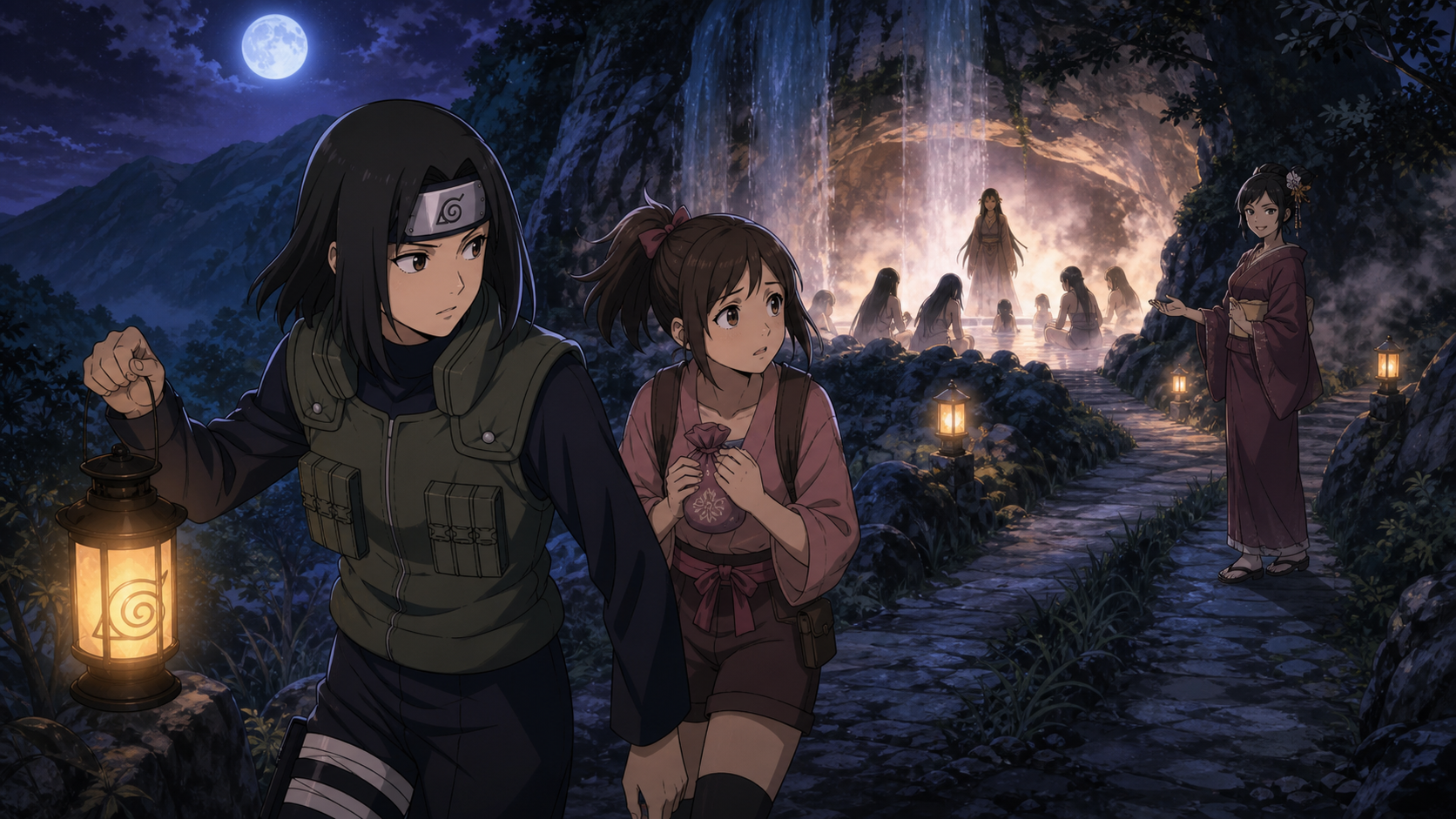
Boruto Episode 110 takes the grief sitting underneath Mirai and Tatsumi's friendship and hands that grief to a man who knows exactly how to weaponize hope. “The Steam Ninja Scrolls: The Resurrection Hot Springs!” begins when Tatsumi admits that her journey was never only a memorial tour. She has been searching for a spring rumored to let the living speak with the dead. She wants to apologize to her mother for a fight they had the day before her mother died. Mirai calls the story impossible until Tatsumi asks the only question capable of cracking that certainty: would Mirai refuse a chance to meet Asuma? The girls leave at night, follow a suspicious guide through a waterfall, and join grieving women gathered by Ryūki for a resurrection ceremony. Mirai recognizes the language of Impure World Reincarnation, detects a drugged initiation drink, and exposes the promise as a trap. The episode ends before the full confrontation, but the point is already sharp. Ryūki does not recruit foolish women. He recruits grieving women who have one sentence left to say. Mirai knows better and still wants the spring to be real. Intelligence does not cancel grief. A person can see every warning sign and still lean toward the door that promises one impossible conversation.
Tatsumi finally tells Mirai the real destination
Tatsumi says a hidden hot spring can bring the dead close enough to speak. Her entire journey has been aimed at that rumor rather than a general tour of places her mother missed.
The confession changes the previous episodes. Sleeping inside the haunted inn, running out of money, and pressing through difficult mountain roads were not random travel mistakes. Tatsumi has been chasing one final meeting with the desperation of somebody who cannot accept the last conversation she actually had.
She hid the goal because saying the dream aloud invites ridicule and interference.
Mirai rejects the claim until Asuma enters the question
Her first response is skepticism. Dead people do not wait in mineral water. Mirai learned enough about forbidden techniques and enough about absence to distrust any easy return.
Then Tatsumi asks whether she wants to see her father. Mirai has never met Asuma. She has inherited his blades, chakra nature, family name, and everybody else's memories. A single conversation could answer questions years of secondhand stories cannot.
The impossible promise becomes emotionally specific, and skepticism loses the clean distance Mirai had in the haunted inn.
Tatsumi wants to apologize for the last fight
She argued with her mother the day before her mother died. Now that ordinary disagreement has become the final record.
Grief gives last conversations unfair authority. Every earlier act of love can shrink beside one sharp sentence because the person left behind cannot create a better ending.
Tatsumi does not need proof that her mother loved her. She needs a chance to say sorry and hear that one bad day did not define their relationship.
Ryūki's promise is built for exactly that wound.
Mirai tells herself she is only providing protection
She decides to go with Tatsumi and frames the choice as guard duty. Tatsumi should not travel alone at night, so Mirai will keep her safe and return before morning.
That explanation contains truth and denial. Mirai is genuinely protecting her friend. She is also curious enough to leave Kakashi and Guy without permission during an active escort mission.
Calling desire “protection” allows her to move before admitting how badly she wants Asuma to be waiting at the destination.
Leaving Kakashi and Guy is still a serious mistake
Mirai's compassion does not erase her assignment. She slips away from the people she is supposed to guard and assumes she can return before anybody notices.
The decision shows how Ryūki's rumor disrupts judgment before Mirai even meets him. She would criticize another shinobi for leaving a post based on a supernatural story.
Her reasons make the mistake understandable. They do not make the choice professionally sound.
The empty night village changes the emotional temperature
Daytime hot-spring towns carry food stalls, travelers, bathhouses, and comedy. At night, the same streets feel abandoned. Familiar buildings become shapes instead of services.
The quiet lets Mirai and Tatsumi speak more honestly. Nobody else can hear the hope they are embarrassed to hold.
The episode uses atmosphere without pretending darkness itself is evil. Night simply removes the witnesses who might have challenged their plan.
Iron in the water gives Mirai a physical clue
The girls stop to refill their water. Mirai tastes a metallic quality, while Tatsumi explains the spring's supposed restorative minerals.
Mirai's senses stay active even while her judgment bends toward hope. She notices taste, terrain, fatigue, and later the smell of sulphur.
That combination makes the trap believable. She does not become stupid. She becomes emotionally compromised while remaining observant.
Mirai's shinobi skills make Tatsumi feel safe
The mountain route demands climbing and difficult crossings. Mirai carries or guides Tatsumi through obstacles that would stop an ordinary traveler.
Tatsumi admires her strength. Mirai experiences the journey as basic responsibility, but the physical support deepens their trust.
That trust becomes dangerous because Tatsumi will later treat Mirai's presence as evidence that the resurrection spring must be safe enough to try.
Somebody watches before the guide appears
The episode lets the audience feel surveillance before the girls fully recognize a threat. A stranger approaches at a fork and claims to know the way.
She says she has visited the spring and spoken with her dead brother. The testimony is tailored perfectly: personal enough to sound sincere, specific enough to validate the rumor, and emotional enough to bypass questions about evidence.
Ryūki's group does not wait for mourners to find the cave. Recruiters intercept people already looking for hope.
The waterfall entrance looks like a secret worth believing
The path leads behind a waterfall into a cave filled with steam. Natural beauty gives the operation borrowed holiness.
A hidden place feels more authentic because access requires effort. The difficult journey becomes proof in the minds of the people who complete the journey: surely nobody would travel this far for a lie.
That is sunk cost wearing spiritual robes.
Twenty grieving women become a ritual requirement
The waiting group celebrates when Mirai and Tatsumi bring the count to twenty. Some women have remained for a month because Ryūki claims the ceremony requires a full number.
The arbitrary threshold controls them. Waiting creates dependency, and every new arrival becomes responsible for everybody else's chance to see the dead.
Leaving no longer feels like an individual decision. Doubt threatens nineteen other people's miracle.
The missing-women reports finally have a location
Episode 109 mentioned that Yugakure was occupied with young women disappearing. Episode 110 reveals a cave full of women separated from their homes and gathered under one leader.
The connection should make every promise collapse immediately. Grief and group pressure keep the room emotionally sealed.
Nobody thinks of herself as missing. Each woman believes she has nearly reached the person she lost.
Ryūki borrows history to make a new lie sound educated
He discusses a shinobi technique that returned the dead during the wars. Mirai recognizes Impure World Reincarnation and knows the actual method requires living sacrifices while violating the dead.
Ryūki condemns those costs, then claims his research produced a cleaner resurrection technique without sacrifice.
That structure is clever manipulation. He acknowledges the known horror, agrees with the audience's moral objection, and presents himself as the ethical innovator who solved the problem.
Mirai asks the questions everybody else resents
She wants mechanics, proof, and an explanation of how Ryūki's technique avoids the rules she knows. Other believers treat her skepticism as disrespect.
The group has invested weeks of travel, waiting, and hope. A good question now threatens more than the ritual. A good question threatens the emotional decision that brought them there.
Ryūki benefits when believers police the doubter for him.
The initiation drink is where hope becomes control
Ryūki offers Mirai a drink as part of joining the group. She suspects the liquid is drugged and pours the serving away.
That small refusal breaks the friendly performance. A real spiritual guide could tolerate one cautious participant. A captor needs compliance.
Mirai's training catches the point where consent becomes chemical control. Her grief brought her into the cave. Her senses keep her from surrendering her body.
Ryūki blames Tatsumi for bringing somebody perceptive
Once Mirai refuses the drink, his kindness disappears. He criticizes Tatsumi for arriving with a shinobi capable of detecting the trap.
The shift reveals how little he cares about the mourners as people. Tatsumi's devotion only mattered while she delivered another usable body.
Predators praise vulnerability until vulnerability stops being convenient.
Mirai fights free without losing sight of the women
Followers restrain her, but she escapes quickly and demands the truth about the ritual. Her goal is not simply to flee.
Twenty women remain inside the cave, many likely drugged or conditioned to trust Ryūki. Tatsumi still believes the promise because abandoning the promise feels like abandoning her mother.
Mirai has to defeat a physical trap and an emotional one at the same time.
Wanting the spring does not make Tatsumi gullible
She traveled alone, survived without money, and kept moving through grief. Tatsumi has determination. Ryūki turns that determination toward his ceremony.
Calling her foolish would let the predator disappear from the analysis. He builds the lie around a need no evidence can satisfy: proof that a dead parent forgives the living child.
The lack of proof keeps the promise alive because every failure can be blamed on timing, faith, numbers, or ritual purity.
Mirai is vulnerable for the same reason
She knows forbidden-jutsu history. She notices the metallic water, sulphur, surveillance, and suspicious drink. Mirai still hopes to meet Asuma.
Knowledge does not vaccinate a person against longing. Smart people do not stop having unfinished conversations.
The episode respects her by allowing both truths. Mirai can be the sharpest investigator in the cave and one of the mourners Ryūki's promise was designed to catch.
The king question becomes bait
Mirai says she would ask Asuma who the king is. On the surface, that sounds like a simple factual question Chōji or Shikamaru could answer.
She wants Asuma's voice more than the information. Hearing the answer from anybody else cannot create the father-daughter moment she missed.
Ryūki offers an imitation of that moment. The next episode will test whether Mirai can recognize emotional counterfeit while standing inside her greatest wish.
The episode stops at the correct point
The full fight belongs to Episode 111. Episode 110 ends after the promise has been exposed but before Mirai has dismantled the cult.
That boundary keeps the focus on recruitment, grief, and the dangerous walk into belief. A battle scene would let viewers dismiss Ryūki as another villain before sitting with how effectively he found his victims.
The trap matters because the invitation worked.
The resurrection promise converts unfinished guilt into compliance
Tatsumi does not seek entertainment. She wants to apologize for the last argument with her mother and fears death made repair impossible. Ryūki's operation turns that unresolved guilt into a reason to follow instructions.
The promise works because no ordinary person can disprove every spiritual claim before entering. Grief asks for one exception, one final conversation, and one chance to replace the last memory with a kinder ending.
Manipulators frame skepticism as the obstacle keeping the deceased away. Every question then feels like betrayal. Mirai protects Tatsumi by asking questions anyway.
The episode should never call Tatsumi stupid for wanting the spring. The cruelty belongs to the person who designed obedience around a wound.
Missing-women reports should have changed the mission sooner
Mirai and Tatsumi encounter an empty village, secret route, gathered women, and a guide controlling access. Local reports already describe women disappearing. Those facts together create a criminal investigation before Ryūki offers the initiation drink.
Kakashi and Guy likely track the broader pattern, but Mirai does not know their full plan. She needs to communicate the location, preserve an exit route, and avoid entering an isolated ritual without backup.
The missing women also deserve names, timelines, and follow-up. Treating them as a crowd of gullible victims would erase individual losses and possible injuries.
Finding the site is only the first task. Konoha and local authorities must identify who recruited each woman, what was taken, and whether more locations exist.
Mirai's private promise to Tatsumi becomes operational risk
Mirai tells herself she is only protecting Tatsumi, which makes separation from Kakashi and Guy feel morally necessary. The same private reasoning removes her from the communication structure that would make protection safer.
Good intentions cannot replace notifying the people responsible for the mission. Mirai could leave a message, signal the route, or request support before following the waterfall entrance.
Her choice remains understandable because Tatsumi may disappear if Mirai delays. Emergency judgment sometimes requires movement before full authorization. Movement should still create a trail for backup.
The episode uses the mistake to test Mirai. The debrief should name the courage and the preventable isolation together.
The iron-rich water gives skepticism a physical foothold
The spring's color and taste suggest minerals rather than blood or supernatural proof. Mirai notices the clue because shinobi training includes observation beyond combat.
Physical explanations do not automatically disprove every spiritual belief. The clue does prove Ryūki uses ordinary material to stage extraordinary authority. Once one element is manufactured, the rest of the ritual deserves stricter verification.
Mirai later turns the same property into part of her counter. Evidence becomes useful because she remembers, tests, and adapts rather than dismissing the setting as superstition.
The sequence respects intelligence work. A small sensory detail can matter more than a dramatic technique when the enemy depends on atmosphere.
Twenty women create social proof and shared vulnerability
The gathered group makes the ritual feel legitimate. Each participant sees other grieving people who appear willing to proceed and may assume somebody else verified the claim.
Ryūki benefits from that diffusion of doubt. A woman who hesitates risks looking like the only person blocking the reunion everyone else wants.
Group vulnerability also means one rescue plan must protect several people whose emotional states, chakra, and physical conditions may differ. Mirai cannot simply attack the leader and assume the crowd will understand.
She needs to expose the mechanism, create a safe exit, and avoid shaming participants whose hope brought them there. Rescue includes making truth survivable after the ritual collapses.
The initiation drink marks the point where consent becomes chemically compromised
Ryūki asks participants to consume a substance before the promised contact. Once the women drink, any altered perception, weakness, or suggestibility can be presented as spiritual experience.
Consent given before ingesting an undisclosed substance does not authorize whatever follows. Participants need ingredients, effects, risks, and the freedom to leave without losing access or being threatened.
Mirai recognizes the danger because the ritual moves from speech into bodily control. Her resistance protects people who may no longer be able to evaluate what they experience.
The drink also creates evidence. Containers, residue, distribution records, and symptoms should be preserved for medical treatment and prosecution.
Ryūki borrows Hidan's history without inheriting Hidan's power
Ryūki uses cult language, ritual staging, blood, and stories connected to Hidan to make imitation look like lineage. He understands that historical specificity makes a lie sound researched.
Copying appearance and vocabulary does not reproduce immortality or divine authority. Ryūki needs victims to believe the association before any power becomes visible.
Mirai has a personal connection to Hidan through Asuma's murder, which gives the performance unusual emotional force. The villain weaponizes her family history while lacking the ability he claims to continue.
Episode 111 will expose the gap through testing. Knowledge of lore becomes defense when Mirai refuses to treat reference-dropping as proof.
Tatsumi and Mirai share the same wound from different distances
Tatsumi remembers her mother and the last argument directly. Mirai knows Asuma through stories, objects, training inherited from others, and the absence that shaped her family.
Both want recognition from someone dead. Tatsumi wants forgiveness. Mirai fears Asuma would not know her. Ryūki's promise can reach each grief through a different doorway.
Mirai's shinobi status does not immunize her. Training gives tools for testing the claim while grief keeps the claim emotionally dangerous.
Their shared vulnerability strengthens the friendship. Mirai protects Tatsumi without standing above her as the rational person rescuing the irrational person.
Final reaction
“The Steam Ninja Scrolls: The Resurrection Hot Springs!” is the moment this vacation arc shows its teeth. The earlier stops taught Mirai about peacetime duty, inherited techniques, family stories, and the value of making room for Tatsumi. Every warm lesson creates the trust and longing that lead both girls into the cave.
Tatsumi wants to apologize. Mirai wants to hear Asuma answer one question. Neither wish is greedy. Ryūki's cruelty lies in recognizing decent grief as a resource.
Mirai should not have left Kakashi and Guy. She should not have followed an unverified guide into an isolated cave. Those mistakes deserve to remain mistakes. The episode also makes each choice emotionally legible, which is far more honest than turning competence into permanent immunity from pain.
The best detail is Mirai pouring out the drink. She has crossed every dangerous threshold, but she does not surrender the part of herself that observes. Hope gets her through the waterfall. Training keeps Ryūki from owning the rest of the night.
Episode 110 leaves Mirai surrounded by women who came to speak one last sentence. The next question is not whether the dead will answer. The real question is whether Mirai can help the living leave without treating their hope like a joke.
The ritual victims need medical follow-up
Healers should examine every participant before anyone travels home. The drink, blood collection, isolation, and emotional shock may leave effects that frightened victims do not recognize immediately. Follow-up also preserves evidence if Ryūki used the same method elsewhere.
Sources and lawful viewing
Official episode reference: Naruto Official episode guide
Licensed episode route: Crunchyroll licensed series page