
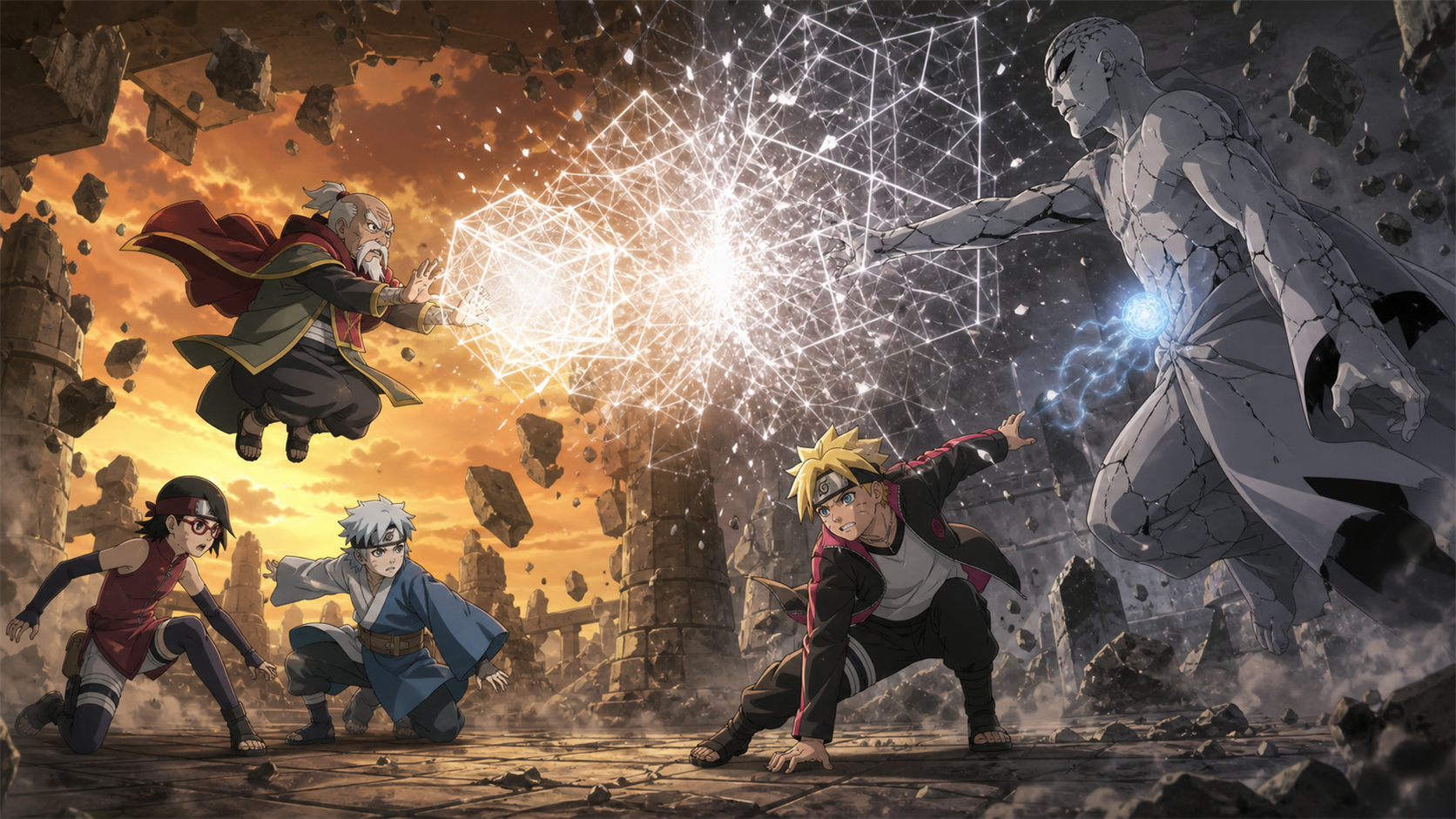
Ohnoki's Will
Ohnoki cannot undo the project that turned grief into occupation. He can stop its final weapon from making Team 7 another set of children sacrificed to an old man's plan.
Series: Boruto: Naruto Next Generations
Episode: 91 · Ohnoki's Will
Arc: Mitsuki Disappearance Arc
Release: 2019-01-27
Previous: Episode 90 · Mitsuki and Sekiei
Directory: All 293 Boruto episodes
Bottom line
Boruto Episode 91 gives Ōnoki a final chance to choose what his will actually protects. Kū has a stolen human heart, fresh power, and every ugly lesson his creator passed down. Team 7 fights him together, but their success only weakens a body still capable of one enormous Particle Style attack. Ōnoki answers with his own Dust Release and accepts the cost. The old man does not die because sacrifice magically cleans every mistake. He dies while stopping the weaponized consequence of those mistakes from killing more children. That difference matters. Before the final clash, Boruto returns Mitsuki's forehead protector and tells him that the person standing in front of them is the real Mitsuki, not a replaceable copy. The statement rejects the logic that produced Kū. A life cannot be reduced to function, origin, or interchangeability. Ōnoki finally understands the same truth from the opposite direction. He created Kū as a vessel, filled him with grief and purpose, then discovered a person capable of choosing domination. His last act does not erase Kozuchi, the prisoners, the dead Fabrications, or the occupied village. The act stops the cycle at the point where only he can stop the technique. Repentance becomes action under pressure, not a speech asking everyone else to forget.
Kū wakes inside a stolen future
Kū revels in the strength supplied by the transplanted heart. The body that was cracking now moves with confidence, and survival convinces him that the method was justified.
The heartbeat is not redemption. A human prisoner paid for Kū's recovery. Every display of fresh power carries the cost of the person reduced to spare parts.
Mitsuki opens in Sage Mode
Mitsuki tries to restrain Kū with snakes while drawing on Sage Mode. The transformation shows how serious the threat has become. He cannot afford the quiet infiltration role anymore.
Kū answers by creating an earth golem capable of wielding his sword and cutting through the snakes. The counter forces Mitsuki out of Sage Mode. A technique associated with Mitsuki's exceptional potential becomes another temporary answer rather than a guaranteed win.
Kū can turn the room into a weapon
Kū controls debris and stone across the chamber. Boruto's clones disappear beneath moving rock. Safe ground becomes temporary because the environment answers Kū.
Team 7 must fight a person whose body has been restored and whose battlefield is everywhere. Their advantage cannot come from standing farther away. They need timing, pressure, and one opening near the heart.
Ōnoki arrives with the question he avoided
Ōnoki reaches the confrontation with Boruto and Sarada and asks Kū when he abandoned the goal of protecting the weak. The question is sincere and painfully late.
Kū does not accept the premise. From his perspective, protecting the plan required controlling the village and harvesting hearts. Ōnoki taught him that the future mattered more than consent. Kū merely extended the lesson toward his own survival.
Kū calls himself a vessel for inherited hatred
Kū says that he carries the hatred Ōnoki passed down. The word vessel lands hard in a story obsessed with created bodies. Ōnoki believed he was filling an empty form with Kozuchi's peaceful will. Kū absorbed grief, fear, secrecy, and control too.
Creators do not choose which parts of themselves become inheritance. A mission statement cannot filter out the methods used to enforce the mission.
Ishikawa's warning returns
Ōnoki remembers the First Tsuchikage warning that the Will of Stone could be replaced by hatred. The memory reaches him after his project has already converted grief into an army.
The Will of Stone was supposed to provide a stable inner commitment. Ōnoki treated stability as never changing his mind. True steadiness sometimes requires admitting that the path no longer serves the original value.
The underground stream creates one honest pause
Team 7 and Ōnoki escape Kū temporarily through an underground stream. The change in setting gives them a short space without performance. No village audience, no creator standing over a project, no enemy demanding immediate reaction.
Mitsuki can finally speak about what he found after leaving Konoha.
Boruto asks whether Mitsuki found his answer
Boruto does not begin with accusation. He asks whether Mitsuki found what he was searching for. The question respects the journey even though the journey frightened everyone.
Mitsuki says he has seen many things and remains unsure whether he is empty. He is certain that he has a will. That answer is more valuable than a perfect declaration of identity. Certainty about choice can exist before certainty about self.
The forehead protector comes back
Boruto returns Mitsuki's Leaf forehead protector. The object does not force Mitsuki back into obedience. The gesture says that his choices did not erase belonging.
Konoha will still have rules and consequences. Friendship can hold a place open while accountability catches up.
Boruto rejects the language of copies
Mitsuki offers to lure Kū away because other versions of him could exist. Boruto refuses the substitution. The Mitsuki standing in front of him is the real Mitsuki.
That sentence cuts directly against the logic behind the Fabrications. Origin does not make a person replaceable. Similar bodies cannot duplicate accumulated relationships, choices, grief, or memory.
Team 7 chooses the fight together
When Kū finds them, Boruto, Sarada, and Mitsuki stand as a team. The reunion is not built on complete agreement. Boruto still has questions. Sarada still sees the danger secrecy created. Mitsuki still carries Sekiei's death.
They share the immediate decision to stop Kū. Sometimes trust begins again through one clear action before language catches up.
Sarada reads the moving stone
Sarada uses the Sharingan to navigate Kū's boulder attacks and protects Boruto by destroying a rock aimed at him. Her role remains active coordination, not background observation.
She sees the battlefield as information. Every moving object reveals the timing behind Kū's control.
Mitsuki and Sarada force the smoke screen
Kū prepares Particle Style. Sarada and Mitsuki strike the attack with their own techniques, turning the explosion into cover. They close distance and hold his arms apart so he cannot form hand seals.
The response transforms a terrifying technique into a route forward. Team 7 cannot overpower Dust Release directly, so they deny the body position needed to shape another one.
Kū throws them away and finds Boruto
Kū breaks the restraint and knocks Sarada and Mitsuki aside. Boruto charges and takes a rock-gauntlet punch.
The hit appears decisive until the body becomes smoke. Boruto used a shadow clone to make Kū commit.
The real Boruto reaches the stolen heart
Boruto attacks from the new angle and drives a Rasengan into the area of Kū's transplanted heart. The target is symbolically precise without needing a speech.
Kū believed the organ completed him. Team 7 attacks the place where stolen survival entered his body. The Rasengan does not end the fight, but the strike weakens him enough to expose the last stage.
Ōnoki watches children pay again
As Team 7 struggles, Ōnoki sees the pattern his experiment was supposed to prevent. Young shinobi stand in mortal danger because of decisions made by elders.
The sight removes the final excuse. Continuing to protect the project would mean choosing the plan over the children the plan claimed to save.
Kū reaches for one final erasure
Kū gathers a giant Particle Style attack meant to finish everyone. His restored body, stolen heart, and inherited technique converge in an act of total removal.
The person created to shield lives now tries to erase the children standing between him and control. Ōnoki cannot delegate the answer.
Ōnoki meets Particle Style with Particle Style
Ōnoki forms his own Dust Release and collides with Kū's attack. Their techniques mirror the creator and creation relationship more honestly than any conversation. Kū uses inherited power to preserve domination. Ōnoki uses the same power to stop what he enabled.
The collision is not a contest over who possesses the purer will. Ōnoki wins by accepting responsibility that Kū refuses.
Repair requires more than regret
Ōnoki admits that his commitment to Kozuchi's will became twisted. The admission matters because he names his own agency. Grief influenced him. Grief did not make the choices by itself.
He follows the admission with an action that costs him everything. Repentance without repair would leave Team 7 under Kū's attack. Repair without honesty would turn the sacrifice into another heroic myth. The episode gives him both.
Kū dies as a person, not a malfunction
Ōnoki's Particle Style overwhelms Kū and destroys a large part of the chamber. Kū's end should not be described as deleting a broken machine.
He was a created person who chose coercion and murder under conditions built by someone else. Recognizing his personhood makes accountability sharper, not softer.
Sekki reaches Ōnoki at the end
Sekki finds the survivors and reaches Ōnoki after the final clash. The young genin who found his heart stone becomes part of Ōnoki's last audience.
That connection returns the story to the future Ōnoki claimed to protect. Sekki did not need an artificial army to possess courage. He needed adults willing to trust, teach, and protect without stealing his choices.
Ōnoki's last words belong to the living
Ōnoki speaks before passing away. The death closes a long Naruto history, but the scene does not belong only to legacy. Boruto, Mitsuki, Sarada, Sekki, Kurotsuchi, and Akatsuchi must live with the consequences.
A final act can redirect a legacy. The living still have to do the work of rebuilding.
Naruto arrives after the children survive
Naruto, Konoha shinobi, Kurotsuchi, and Akatsuchi arrive by sunset. The rescue force is necessary, but Team 7 has already endured the decisive fight.
The timing does not make adult intervention meaningless. Konohamaru's sabotage, Shikamaru's coordination, and Naruto's political clearance helped prevent a wider disaster. The delay still leaves the children carrying experiences adults cannot undo.
Konohamaru hugs Mitsuki before filing the report
Konohamaru says he will report to Naruto and hugs Mitsuki. The order matters. The teacher recognizes the child before processing the violation.
Mitsuki expects rejection because he left without permission and caused a crisis. Accountability remains. Affection does too.
Teams 5 and 15 make belonging visible
Mitsuki assumes he may not be allowed back. Classmates from Teams 5 and 15 arrive glad that he is alive. Their welcome expands belonging beyond Boruto's faith.
Mitsuki is not one person's moon. He has a community of relationships, including people whose concern continued while he was absent.
Kū wakes with a stolen heart and no honest future
The transplant gives Kū more time without giving him a life built through consent. Another person's heart becomes the price of continuing a project Ōnoki should have stopped.
Kū experiences the organ as proof that he can survive, evolve, and become the vessel his creator imagined. The episode refuses to let survival settle the moral question. A functioning body can still be built from theft.
His desire to live is real. The method used to extend that life remains a violation. Personhood does not require pretending every act taken for survival was justified.
Calling Kū a vessel does not remove the person making choices
Kū describes himself through inherited hatred and assigned purpose because those stories give his short life a shape. He was created to protect Iwagakure and then learned that protection meant replacing the people whose consent would complicate the plan.
The word vessel sounds like destiny, but Kū keeps choosing how to interpret the role. He deceives, commands, sacrifices allies, and reaches for greater power. Those choices make him accountable and confirm that he is more than equipment.
A malfunctioning tool can be discarded. A person can be grieved, judged, resisted, and remembered at the same time.
Ōnoki arrives after secrecy has already spent other people's lives
Ōnoki recognizes the disaster, but recognition comes after Akuta, Fabrications, shinobi, civilians, and children have paid for a project they never approved.
His remorse matters because stopping further harm requires him to admit authorship. Remorse cannot rewind the secret decisions or restore the people consumed by those decisions.
The episode earns his final intervention only when the audience keeps the account open. A good death does not produce a zero balance.
Ishikawa's warning was about power without shared judgment
The memory of Ishikawa reminds Ōnoki that will becomes dangerous when one leader treats personal certainty as sufficient authority. Experience can guide a village. Experience can also make a veteran believe disagreement belongs to people who understand less.
Ōnoki hid the project partly because he expected others to reject the risk. That rejection would have been governance working, not cowardice blocking genius.
The warning returns because Ōnoki finally sees secrecy as the mechanism that let grief become policy.
Mitsuki's Sage Mode answers the copy argument through lived choice
Kū wants Mitsuki's body as proof that created life can reach stability and power. Mitsuki uses Sage Mode to protect people Kū treats as obstacles.
Shared origin does not produce shared identity. Mitsuki's abilities emerged inside relationships, repeated decisions, failures, and a growing right to refuse Orochimaru's preferred answers.
Kū cannot copy that history through tissue, research, or transplantation. The body may be reproducible. The person is cumulative.
Boruto returning the forehead protector is trust with consequences still waiting
The forehead protector tells Mitsuki that Team 7 still recognizes him before Konoha decides what punishment follows. Boruto does not have authority to erase the mission violation.
He does have authority over whether friendship survives the violation. Returning the symbol separates institutional rank from personal belonging for one crucial moment.
Mitsuki can face accountability without facing emotional exile. That distinction gives him a reason to return rather than disappear into another test of whether people will chase him.
Sarada makes the final fight possible through observation
Sarada studies Kū's moving stone, identifies patterns, and coordinates the opening rather than waiting for Boruto's Rasengan to become the entire plan.
Mitsuki supplies restraint. Sarada supplies analysis and timing. Boruto supplies deception and impact. The sequence works because Team 7 finally operates with shared information after an arc built from Mitsuki's silence.
Their coordination becomes relational repair in motion. Nobody needs to declare the team restored before the team chooses to function together.
Particle Style against Particle Style is Ōnoki rejecting his own legacy weaponized
Kū reaches for the technique as inherited authority. Ōnoki meets the attack with the same power because he recognizes what his teaching, grief, and secrecy produced.
The clash is not simply master defeating imitation. Ōnoki destroys the final expression of a project he once defended.
That choice protects the children and condemns his earlier belief that artificial soldiers could carry violence so the young would remain clean. The young were standing in the blast zone anyway.
Sekki reaches Ōnoki as the ordinary future he claimed to protect
Sekki is not the legendary successor Ōnoki designed through a laboratory. He is a living child with imperfect skill, affection, and time to become someone nobody can fully predict.
Reaching Ōnoki at the end places the real future beside the failed manufactured shortcut. Protecting the next generation means allowing uncertainty, education, mistakes, and growth.
Ōnoki wanted guaranteed defenders because grief made risk intolerable. Sekki shows why a future worth protecting cannot be guaranteed into existence.
Naruto's late arrival does not reduce what the children survived
Naruto arrives with authority, reinforcements, and the ability to stabilize the aftermath. Team 7 has already carried the immediate fight, the moral decisions, and the loss.
The timing preserves the younger characters' agency without pretending children should routinely solve international crises alone. The adults are still responsible for how three genin reached this battlefield.
Rescue after survival must include investigation, accountability, medical care, and honest recognition of the burden the children carried.
Konohamaru hugs Mitsuki before asking for the report
The embrace establishes that Mitsuki's life matters before his explanation becomes satisfactory. Konohamaru can be angry, frightened, relieved, and responsible for discipline afterward.
Affection first does not erase command. Affection prevents command from becoming the only relationship available when a student fails.
Mitsuki expects to be treated like a dangerous problem returning to custody. Konohamaru treats him like a missing child who came back alive.
Repair must include the people whose bodies became project supplies
Stopping Kū prevents another attack, but Iwagakure still has to account for organs, medical procedures, erased records, and every person transformed into material for the Fabrication project.
Ōnoki's death cannot become the administrative endpoint. Survivors need names, families need truth, and the village needs an investigation capable of reaching beyond one revered leader's final confession.
Memorials matter. Records matter too. Without both, future officials can describe the crisis as one old man's mistake and leave the systems that enabled secrecy untouched.
Kū's death deserves grief without a rewritten innocence
Kū manipulated Mitsuki, ordered violence, treated other Fabrications as expendable, and tried to seize a future through stolen life. Those actions remain his.
He was also created with an expiration date, assigned a purpose before gaining language for desire, and denied the ordinary time needed to build another identity. Grieving that injustice does not require calling every later choice unavoidable.
The episode becomes more honest when Kū can be victim and perpetrator in the same record. Personhood gives him dignity, responsibility, and tragedy together.
Quick reaction
Episode 91 gives Ōnoki a meaningful death without pretending death balances every account. He created Kū, hid the project, ignored Kurotsuchi's authority, allowed Mitsuki to become research material, and endangered the generation Kozuchi's memory was supposed to protect. His final Dust Release cannot reverse those choices. The act does prove that he finally understands which lives must matter now. Team 7 earns the opening through actual coordination: Sarada reads the stone, Mitsuki restrains, Boruto uses the clone feint, and the Rasengan reaches Kū's stolen heart. Ōnoki does not replace their courage. He prevents their courage from becoming another funeral. Boruto returning Mitsuki's forehead protector gives the episode its quieter truth. A person is not interchangeable because someone else can share the same origin or body design. The real Mitsuki is the one who lived these choices. The real Ōnoki is both the man who caused the disaster and the man who chose to stop the final attack. Legacy has to hold both.
Sources and lawful viewing
Official episode reference: Naruto Official episode guide
Licensed episode route: Crunchyroll licensed series page