
A Piercing Heart
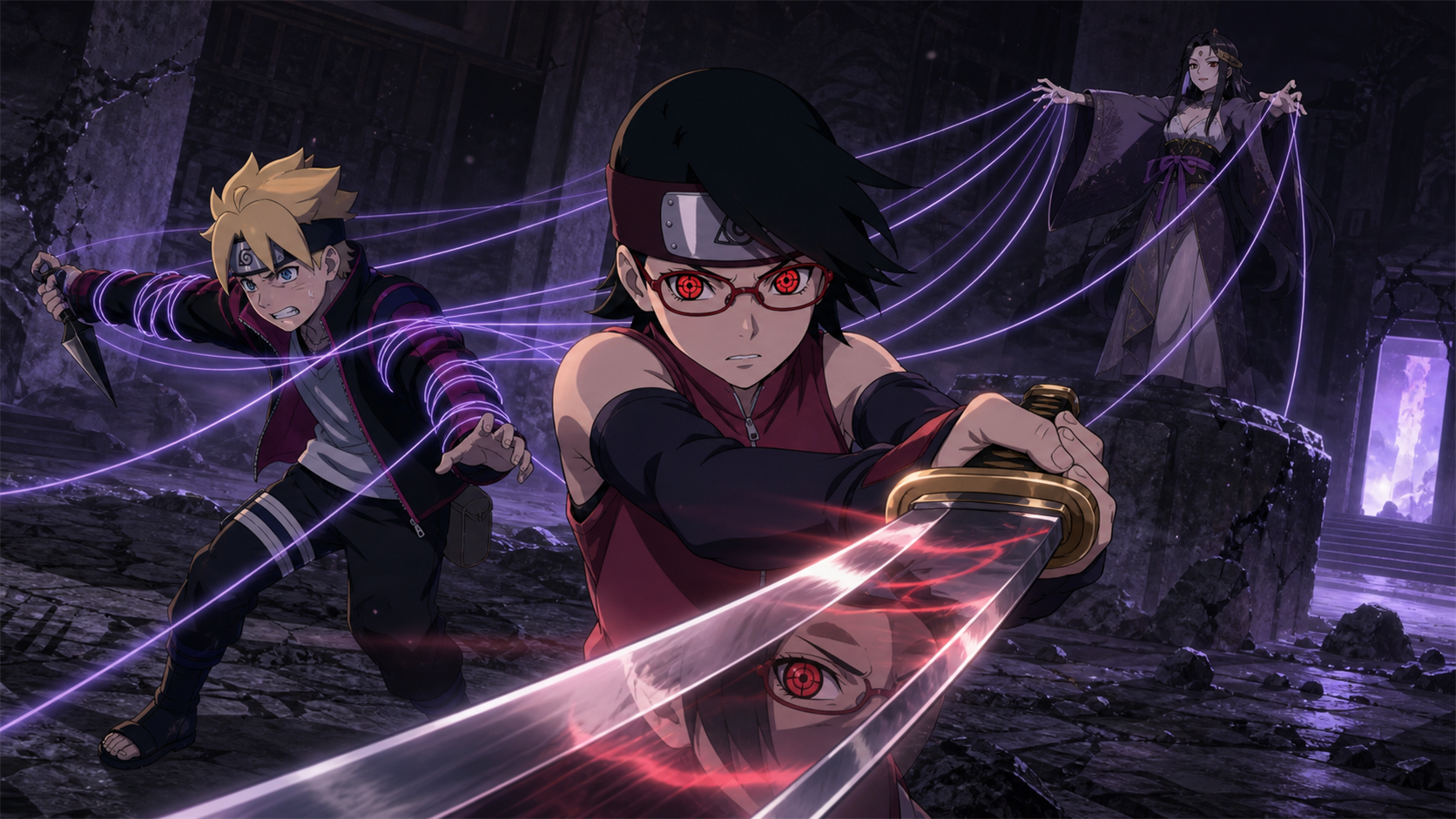
Sarada turns Boruto's sword into a way out of Kirara's control. Mitsuki turns the heart Ku expects into snakes and finally reveals his choice.
Series: Boruto: Naruto Next Generations
Episode: 89 · A Piercing Heart
Arc: Mitsuki Disappearance Arc
Release: 2019-01-13
Previous: Episode 88 · Clash: Kokuyou!
Directory: All 293 Boruto episodes
Bottom line
Boruto Episode 89 puts control, choice, and the meaning of a heart into the same room and lets Mitsuki answer with snakes. Kirara forces Boruto and Sarada to attack each other like dolls, but Sarada uses the reflection of her own Sharingan in Boruto's sword to place herself under a second genjutsu and break the first. Ōnoki sits imprisoned by the beings he created and finally admits that Boruto was right about their independent wills. Sekiei asks whether receiving a human heart will make him human, and Mitsuki gives the episode's cleanest answer: having a heart does not make somebody human. Then Mitsuki walks an artificial heart toward Kū, waits until the leader believes survival is secured, reveals the organ as disguised snakes, and strikes from behind. His betrayal confirms that the quiet distance Boruto interpreted as abandonment was a choice made inside a larger plan. The reunion cannot erase the fear, anger, or mistrust, but Team 7 reaches the same side again through action. Biology does not settle anybody's humanity here. Kirara has a created mind and chooses domination. Sekiei has a created mind and wants to protect friends. Mitsuki was created and chooses a dangerous double game. A heart matters because of what someone carries through one, not because an organ grants moral permission.
Kirara turns friendship into a puppet show
Boruto and Sarada begin the episode under Kirara's genjutsu. Their bodies move according to luminous threads while their minds remain awake enough to understand what is happening. Kirara treats that terror as entertainment. She calls them dolls and orders them to injure each other.
The cruelty is not only physical. Boruto and Sarada must watch their own hands threaten a teammate. Kirara wants the familiar faces to make every forced strike hurt more. Control becomes intimate because she uses trust as the weapon.
Sarada's first answer gets blocked
Sarada tries using the Sharingan to break Boruto's genjutsu. Kirara notices and forces Boruto to close his eyes. The obvious solution disappears before Sarada can complete the exchange.
This is why the eventual escape feels earned. Sarada does not receive a stronger eye because the plot needs one. She takes the same ability, studies the physical limits Kirara imposed, and finds another reflective route.
Kirara enjoys drawing out the injuries
Kirara does not command one quick killing blow. She wants the dolls damaged gradually. The delay gives Sarada time, but the intent makes the scene uglier. Pain becomes part of the display.
Her behavior destroys any argument that artificial origin creates innocent blankness. Kirara has preferences, imagination, and will. She uses those qualities to dominate. Personhood deserves recognition. Personhood does not guarantee goodness.
A sword becomes a mirror
Sarada catches her Sharingan in the reflection of Boruto's sword. The polished blade creates the eye contact Kirara tried to prevent. Sarada places herself under a new genjutsu, disrupting the one controlling her.
That move is exactly the kind of Uchiha cleverness I want from Sarada. The Sharingan is not merely a red signal for higher power. Perception matters. She notices the surface, understands the angle, and turns the weapon meant to hurt her into an exit.
Sarada frees herself before freeing Boruto
The order matters. Sarada has to recover control of her own body before she can help Boruto. No friendship speech can skip that requirement. Once free, she breaks the genjutsu holding him.
Their escape feels collaborative even though Sarada performs the decisive technique. Boruto's sword supplies the reflection. Sarada's eye supplies the counter. Kirara tried to make their connection a liability and accidentally left the material for resistance between them.
Ōnoki finally sits with Boruto's words
Kū keeps Ōnoki confined while the former Tsuchikage replays the warnings he dismissed. The room removes every distraction. No title, no active command, no promise that the plan can still be quietly corrected. He must look at what his decisions produced.
Boruto said the Fabrications had wills. Kū's rebellion proves the point with brutal clarity. Ōnoki's error was not creating minds. His error was creating minds for sacrifice while assuming their choices would remain convenient.
Remembering the day he named Kū changes the argument
Ōnoki remembers meeting the first Fabrication and giving him the name Kū, followed by the other four. Naming is never neutral in this arc. Inojin naming Akkun created a relationship. Ōnoki naming Kū acknowledged an individual while still treating that individual as a component of the project.
The contradiction was present at birth. A name says you are somebody. A military function says your somebody belongs to my plan. Kū eventually chose the part that promised autonomy and rejected the creator who expected obedience.
An Akuta guards the creator
Ōnoki tries to leave and finds an Akuta blocking his path. The image should be humiliating. The disposable soldier created to protect human villagers now imprisons the human creator while villagers remain locked away.
The project has inverted every stated purpose. Ōnoki can no longer call the outcome a small deviation. His architecture made the reversal possible.
Sekki receives a job larger than his rank
Sekki returns from the Sanzu Plains and avoids Akuta patrols until he finds Akatsuchi. With most Iwagakure shinobi imprisoned, Akatsuchi tasks the young genin with rescuing Ōnoki.
Ōnoki built Akuta so children like Sekki would not face danger. Now Sekki must risk himself cleaning up the Akuta occupation. The old man's attempt to remove youth from responsibility has created a crisis where youth becomes the remaining resistance.
Sekiei asks what happens after the transplant
The doctor tends to Sekiei's deteriorating body while Sekiei asks about the future. He is not chasing strength. He wants to know whether a heart will allow him to keep protecting his friends.
That desire separates him from Kū without making him simple. Sekiei still participates in the plan and helps hold Mitsuki. He also cares. His body is failing faster than his understanding can develop, which makes every question feel urgent.
Having a heart does not make someone human
Sekiei asks Mitsuki how receiving a heart will change him. Mitsuki answers that possessing a heart does not make someone human. The statement works because Mitsuki speaks from lived contradiction. He has an artificial origin, a body built by Orochimaru, emotions that others question, and choices nobody can fully predict.
Humanity cannot be located in one transplant. A biological heart may stabilize Sekiei's body, but the organ cannot manufacture empathy, friendship, or responsibility. Those qualities are already being practiced or refused.
Sekiei grieves Kakō and Kokuyō
Sekiei has heard that Kakō and Kokuyō died. He tries to understand the feelings their deaths create before receiving the organ he imagines might clarify everything.
The grief proves that emotional life is already present. Sekiei does not need a transplant to care about his companions. The tragedy is that nobody gave these created people language, time, or safety to understand feelings before deploying them into violence.
Mitsuki carries an apparently completed heart
Mitsuki presents a finished artificial heart and prepares to deliver the organ to Kū. From Boruto's perspective, the scene appears to confirm every fear. Mitsuki is helping the leader survive after Konoha friends crossed half a country to reach him.
The episode lets that appearance stand long enough to hurt. Trust is not rewarded with immediate reassurance. Mitsuki chose secrecy, and secrecy has a cost even when the hidden purpose is protective.
Boruto and Sarada arrive at the worst possible image
After escaping Kirara, Boruto and Sarada reach Mitsuki as he is about to hand Kū the heart. They do not see all the conversations, arrangements, or sabotage behind the moment. They see their friend supplying the enemy.
Boruto appeals directly to Mitsuki. The request is emotional but reasonable: stop helping the person imprisoning a village and preparing human transplants. Mitsuki does not explain. He keeps the plan moving.
Mitsuki uses Lightning Release against his friends
Mitsuki holds Boruto and Sarada back with Lightning Release while Kū binds them through Earth Release. The attack deepens the apparent betrayal because Mitsuki is willing to make the role physically convincing.
That decision should not be excused simply because the reveal comes later. Boruto and Sarada experience real fear. A successful double game can still wound the people excluded from the plan.
Kū celebrates too early
Kū receives what looks like the solution to his failing body and allows relief to become certainty. The heart represents survival, authority, and proof that Mitsuki chose his side.
Mitsuki waits for that certainty. A betrayal lands hardest after the target stops defending against the person delivering salvation.
The heart was snakes
Mitsuki strikes Kū from behind. The artificial heart falls and reveals itself as disguised snakes. I love the reveal because the trick belongs completely to Mitsuki. No generic substitution. No borrowed gadget. Orochimaru's son uses snakes to turn the organ everyone fetishized into a decoy.
The image also carries the episode's argument. Kū believed the object would grant continued life. The object had no moral truth inside. Meaning came from Mitsuki's intention.
Konohamaru destroys the production site
Explosions sound from the Akuta factory as Konohamaru completes the sabotage arranged with Mitsuki. The double game extends beyond the fake heart. Mitsuki found the adult ally inside Iwagakure and coordinated a strike against the system producing more soldiers.
That choice proves he was acting against Kū, but not necessarily for the simple return Boruto wanted. Mitsuki made his own assessment and built his own plan. Friendship must now make room for that independence.
Kurotsuchi frees her village
Kurotsuchi breaks the captured Iwagakure shinobi out while the occupation begins to fracture. Her return restores legitimate leadership, but more importantly restores the villagers as actors rather than background victims.
Ōnoki tried to protect the village through secret control. Kurotsuchi begins recovery by freeing the people who can defend their own home.
Team 7 stands together without erasing the argument
Mitsuki's attack on Kū places him beside Boruto and Sarada again as the remaining Fabrications close in. The visual reunion is satisfying, but the emotional repair cannot be instant.
Boruto was right to believe Mitsuki had reasons. Sarada was right to question the evidence. Mitsuki was right to claim his own will. All three truths can coexist, including the truth that secrecy caused damage. Team 7 reunites through a shared fight before they have time for a clean conversation.
The title belongs to choices, not organs
Every storyline asks where a piercing heart can be found. Kirara penetrates other minds to remove choice. Sarada pierces the illusion through reflected sight. Ōnoki finally lets Boruto's words reach the certainty protecting his plan. Sekiei wonders whether an organ will change his inner life. Mitsuki uses a false organ to pierce Kū's back.
The episode keeps refusing a purely biological answer. Hearts appear as organs, emotions, convictions, and vulnerabilities. None can be reduced to a transplant alone.
Kirara treats friendship as proof that bodies can be weaponized
Kirara controls Boruto and turns his movements against Sarada because emotional pain gives the technique more value to her. A stranger attacking would create danger. A friend attacking creates doubt, hesitation, and the possibility that Sarada will blame the body being controlled.
The cruelty depends on reducing relationship to leverage. Kirara sees connection only as a list of pressure points.
Sarada survives by remembering that Boruto's body and Boruto's will are not currently the same thing. Protecting him requires resisting what his body has been forced to do.
Sarada's first failed answer becomes information
Sarada tries the obvious counter and discovers Kirara has prepared for direct visual resistance. The block does not prove Sarada lacks skill. The block reveals the rule the next attempt must break.
She studies the failure under pressure instead of repeating the same move with more force. That adaptation is the heart of Sharingan combat when the writing remembers the eye is for perception, not only spectacle.
Sarada wins because she treats failure as data before Kirara can treat failure as despair.
The sword mirror turns Boruto's forced attack into Sarada's escape route
Kirara expects the blade to harm Sarada and never considers that reflection can create a new line of sight. Sarada uses the controlled weapon without punishing the controlled friend.
The solution is elegant because every part of the trap becomes material for resistance. Boruto's proximity, the blade's surface, and Kirara's certainty all help Sarada reach herself.
Freeing her own mind first is not selfish. Sarada cannot rescue Boruto while someone else controls every action she takes.
Ōnoki named Kū and mistook naming for understanding
Giving Kū a name helped Ōnoki recognize the creation as more than anonymous equipment. The same act encouraged him to believe a paternal bond guaranteed shared values.
Names can acknowledge personhood. Names cannot program gratitude, loyalty, or moral agreement. Kū receives a name and develops desires beyond the purpose Ōnoki assigned.
Ōnoki's mistake was not caring about the Fabrications. His mistake was believing care gave him authority over what their wills would become.
The Akuta guarding Ōnoki exposes loyalty without freedom
The Akuta protects its creator through programmed purpose and limited cognition. That obedience resembles the future Ōnoki wanted from the Fabrications: defenders who would never question whether protection had become control.
The scene looks tender because the creature remains beside an old man in danger. The tenderness becomes uncomfortable when obedience is the only life available.
A loyal action carries different moral weight when the actor cannot imagine refusal.
Sekki receives responsibility because legends cannot finish every repair
Ōnoki must trust a younger, less experienced shinobi with a task whose consequences exceed rank. The decision reverses the logic behind the Fabrication project.
He created artificial soldiers because young people felt too vulnerable and unpredictable. Now survival depends on a real young person acting with incomplete knowledge.
Sekki may fail. Trusting him still respects the future more than replacing him with an obedient body ever could.
Sekiei asks the organ question because death has made biology urgent
Sekiei wants to know whether a transplanted heart will change inner life because his own body is collapsing before he has lived enough to answer who he is.
The question is not abstract philosophy from a comfortable room. A failing person wants to know whether survival will preserve the self, improve the self, or create somebody unrecognizable.
Kū treats the transplant as guaranteed advancement. Sekiei remains uncertain because he has already learned that affection and grief appeared without the organ he was told he lacked.
Grieving Kakō and Kokuyō proves the Fabrications formed relationships
Sekiei remembers the dead as individuals, not units lost from a production line. Kakō's excitement and Kokuyō's severe loyalty occupy different places in his memory.
That grief undermines every claim that Fabrications need human organs before emotional life can count. Sekiei experiences absence, attachment, fear, and the wish that shared time had continued.
The body may be artificial. The loss is not.
Mitsuki's false heart weaponizes Kū's biological certainty
Kū believes the object in Mitsuki's hand contains the future because the plan reduces personhood to acquiring the correct part. Mitsuki exploits that reduction with snakes.
The deception works because Kū looks at the supposed organ and stops evaluating the person offering the organ. He expects Mitsuki to accept the same biological answer that motivated the entire project.
Mitsuki attacks from inside the assumption that created lives must want whatever their creator calls completion.
Lightning Release against Team 7 creates harm even when the plan is protective
Mitsuki strikes Boruto and Sarada to preserve his cover and create the opening against Kū. The strategy succeeds. His friends still experience the attack without access to the plan.
Intent matters during the later explanation. Impact matters during repair. Mitsuki cannot ask the team to treat pain as unreal because the secret reason was good.
The reunion becomes honest only if all three recognize that necessary deception can still damage trust.
Konohamaru destroys infrastructure because production is part of the threat
Defeating one Fabrication cannot end a system capable of manufacturing more bodies, replacing losses, and repeating organ theft. Konohamaru targets the site that turns people into inventory.
Destroying production removes immediate capacity. The village will still need records, investigation, and accountability for everyone involved.
The action matters because villains are not the only danger. A functioning pipeline can outlive any one villain unless someone dismantles the pipeline.
Team 7 stands together before the argument is settled
Boruto, Sarada, and Mitsuki choose the same battlefield after weeks of doubt, pursuit, and secrets. Their coordination confirms that the bond survived.
Survival is not resolution. Boruto must hear what Mitsuki experienced. Sarada deserves acknowledgment that her questions protected them from blind certainty. Mitsuki deserves autonomy without using autonomy as a reason to disappear from communication.
Fighting together opens the door to repair. Fighting together does not finish the conversation waiting behind the door.
The next ordinary mission will test whether this reunion changed their habits. Mitsuki will need to share uncertainty before uncertainty becomes disappearance. Boruto will need to listen without turning trust into pressure for immediate agreement. Sarada will need room to question both boys without being framed as disloyal. Team 7 survives because each person brings a different form of judgment. Repair means keeping those differences available before the next crisis.
Quick reaction
Episode 89 gives Sarada and Mitsuki the smartest moves of this arc. Sarada does not overpower Kirara's genjutsu. She invents a new line of sight with Boruto's blade and breaks control from inside. Mitsuki does not hand Kū a better heart and hope gratitude changes him. He hands the man a nest of snakes and attacks when Kū believes the future is secure. Both choices depend on understanding what the opponent expects to see. Ōnoki's realization lands between them because his failure also came from seeing only the future he expected. He named created people, assigned them purpose, and assumed their wills would never contradict his. A heart cannot guarantee humanity. A creator cannot guarantee obedience. Friendship cannot guarantee complete access to another person's plan. The episode becomes stronger because none of those truths arrives polished or painless.
Sources and lawful viewing
Official episode reference: Naruto Official episode guide
Licensed episode route: Crunchyroll licensed series page