
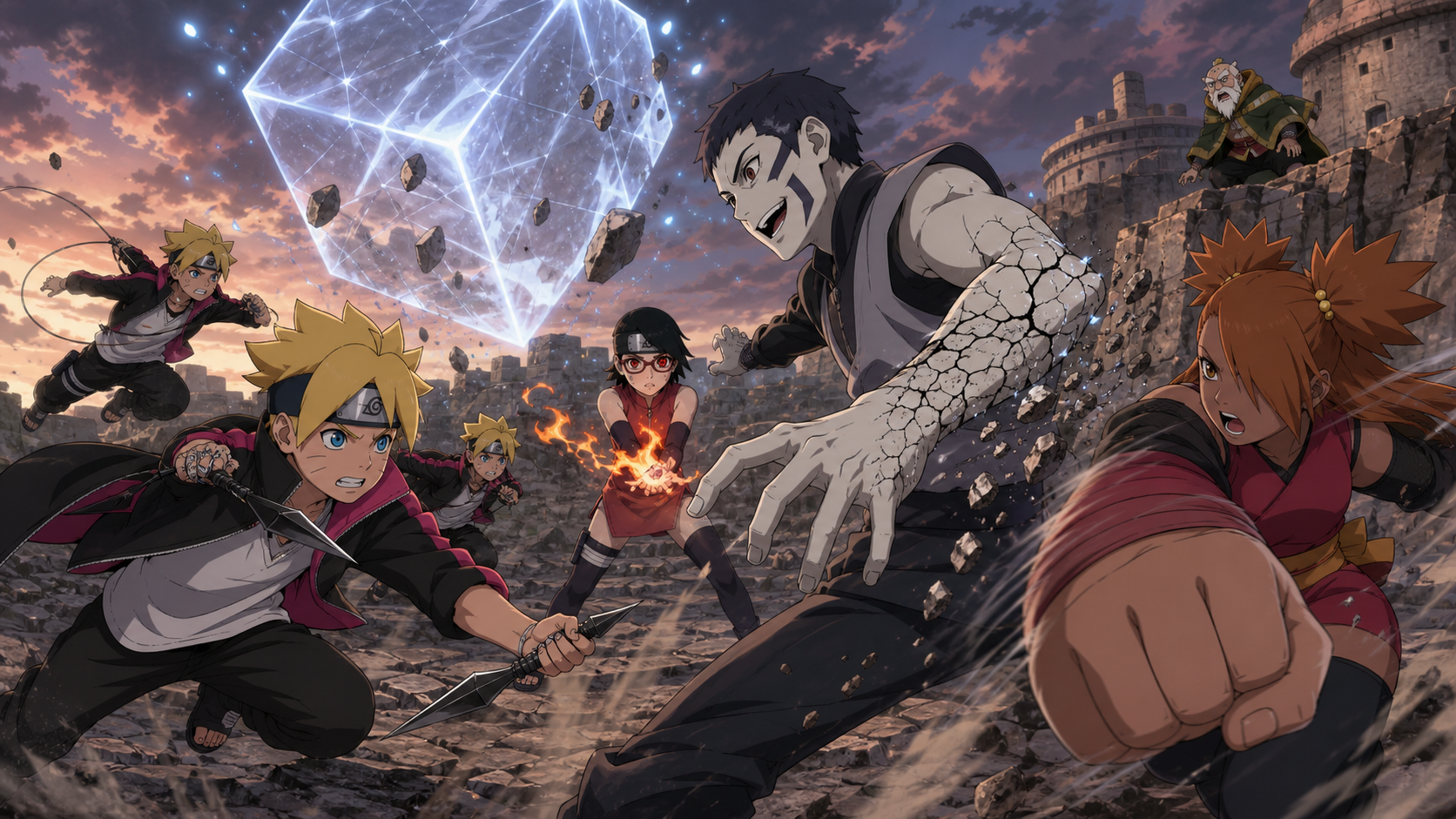
The Sensation of Living
Kakou discovers exhilaration through combat and destroys the body meant to make him disposable. Sarada turns his Particle Style into a twenty-second problem.
Series: Boruto: Naruto Next Generations
Episode: 87 · The Sensation of Living
Arc: Mitsuki Disappearance Arc
Release: 2018-12-23
Previous: Episode 86 · Kozuchi's Will
Directory: All 293 Boruto episodes
Bottom line
Boruto Episode 87 gives Kakō exactly what he says he wants and makes the answer unbearable. He wants the sensation of living, so he chooses a fight that forces his artificial body past every safe boundary. Boruto, Sarada, and Chōchō do not defeat him with a bigger miracle. They survive by studying the twenty-second recovery window after Particle Style, sharing information, and refusing to let his excitement dictate their rhythm. Kakō dies smiling because combat gave him a feeling he could call his own. That does not turn the fight into a beautiful liberation. His death exposes the cruelty inside Ōnoki's project. The Fabrications were created as disposable shields for human shinobi, then given enough awareness to crave experience while their bodies collapse under the effort. Elsewhere, Shikadai reaches Shikamaru with the warning Iwagakure desperately needs, Kirara takes control of Inojin, and Naruto begins the slow political work required before Konoha can intervene. Everybody is trying to move through a closing window. Kakō responds by burning his body for one thrilling moment. The children respond by communicating, adapting, and trying to keep one another alive.
Kakō arrives to retrieve Ōnoki
Kakō finds Boruto and Ōnoki after the conversation at Kozuchi's memorial and reports that the plan has stalled. His manner stays polite, but the request carries a threat. Ōnoki must return. Boruto cannot be allowed to warn Konoha. The former Tsuchikage agrees that Boruto should be taken into custody while insisting that the boy not be injured.
That instruction reveals how little control Ōnoki actually has. He thinks a verbal condition can make an abduction safe. Kakō hears the order, then immediately becomes fascinated by Boruto's resistance. A created soldier with his own desires cannot be managed like an obedient tool, especially when the desire is combat.
Boruto refuses to become quiet cargo
Boruto attacks because capture would remove his last chance to reach Mitsuki or expose Kū's takeover. He uses shuriken, shadow clones, wired kunai, Lightning Style, and constant movement. None of those choices can match Particle Style in raw destructive power, but raw power is not the only question.
He keeps forcing Kakō to react. Each clone gathers information. Each failed approach reveals range, timing, or temperament. Boruto often looks reckless because he begins moving before a perfect plan exists. Here movement becomes the way a plan is built. Standing still would only make him easier to contain.
Particle Style changes the rules immediately
Kakō's Dust Release is not another heavy punch. The geometric field can erase whatever falls inside. Boruto cannot trade blows, test durability, or accept one hit to create an opening. Distance becomes survival, and every attack must account for a technique that removes the normal margin for error.
The visual contrast sells the danger. Boruto fills the field with clones, wires, sparks, and improvised angles. Kakō answers with a clean shape that deletes the mess. One fighter creates possibilities. The other erases them. Boruto needs friends because no single angle remains safe for long.
Kakō is delighted by human fighting instinct
Kakō does not merely want victory. He studies Boruto's aggression with genuine wonder and calls the instinct fascinating. The reaction is almost childlike, which makes the violence sadder. Somebody built him with knowledge and abilities but without ordinary opportunities to discover excitement, fear, pride, or preference.
His first intense personal sensation arrives through a battle where his body can die. Ōnoki wanted Fabrications to spare young shinobi from danger, yet Kakō was designed so narrowly that danger becomes his clearest route toward feeling alive. That failure belongs to the adults who treated experience as unnecessary equipment.
A rock clone proves Kakō can improvise too
Boruto manages to drive a blade into Kakō and receives a brief flash of hope before the body turns to stone. Kakō has used a rock clone. The reveal matters because the Fabrication is not repeating stored attacks like a machine cycling through commands. He deceives, adapts, and enjoys the surprise.
Ōnoki watches more evidence of independent will appear in real time. Every clever choice should force him to revise his assumptions. Instead, he continues trying to preserve a distinction between acceptable programmed behavior and inconvenient personhood. Kakō refuses that neat boundary with every grin.
Sarada and Chōchō arrive on the explosion
Boruto uses an explosive tag partly as an attack and partly as a signal. The blast reaches Sarada, Chōchō, and Inojin while they search for their missing teammates. They have already found an injured Akatsuchi, so the group divides with purpose: Inojin returns Akatsuchi to the cave while Sarada and Chōchō follow the explosion.
That decision feels like competent teamwork rather than convenient plotting. Akatsuchi cannot be abandoned. Boruto cannot be left alone. The children assess both needs and distribute themselves. This arc keeps separating them, but their best moments come from refusing to treat one person's danger as the only danger that counts.
Chōchō belongs in this fight
Chōchō's arrival is not decorative backup. Her physical pressure forces Kakō to track another range and another style. Particle Style punishes predictable approaches, so her willingness to enter close combat becomes valuable when paired with Sarada's timing and Boruto's clones.
She also brings a blunt emotional clarity. Boruto is their friend. An artificial stranger is trying to take him. Chōchō does not need Ōnoki's entire political history before deciding where she stands. Sometimes a situation has enough information already, especially when one side is firing an erasure technique at your classmate.
Sarada turns observation into a countdown
Sarada watches Kakō instead of being hypnotized by the size of his technique. She notices that Particle Style carries a recovery period. After each use, Kakō cannot immediately perform another ninjutsu attack. The window lasts around twenty seconds.
That measurement changes the battle. Twenty seconds is not comfort, but the number converts terror into a problem the team can coordinate around. Sarada does what future Hokage leadership should look like: observe clearly, state the useful truth, and create space for other people's strengths rather than demanding that everybody follow one flashy move.
Twenty seconds becomes the team's real weapon
Once the recovery window is known, Boruto and Chōchō can draw out Particle Style while Sarada prepares the counterattack. Timing replaces desperation. The team still faces an opponent capable of erasing them, but Kakō no longer controls every beat.
I love fights where information becomes visible teamwork. No speech about believing harder can replace the work. Sarada counts. Boruto pressures. Chōchō closes distance. Each person depends on the others to do a specific job correctly. Their victory grows from attention rather than destiny.
Kakō ignores the body telling him to stop
Kakō tries to force another Particle Style attack before his recovery is complete. Cracks spread across his body. The warning is obvious, including to Ōnoki, but Kakō keeps reaching for the sensation that made him feel alive.
Calling this choice freedom would be too easy. Kakō chooses, but his available world was built inside a laboratory, a military plan, and a failing body. His appetite for battle belongs to him. The conditions that made self-destruction feel like the richest possible experience do not.
The title becomes a cruel question
What counts as the sensation of living for somebody created as a weapon? Kakō finds exhilaration in danger, physical strain, surprise, and opponents who refuse to behave predictably. The episode never laughs at that discovery. His joy is real.
The cruelty comes from how little time he gets to understand any other joy. No ordinary meal chosen because he likes the flavor. No annoying hobby. No quiet friendship allowed to develop beyond the plan. He gets battle, obedience, deterioration, and death. Ōnoki's supposedly humane project gave Kakō consciousness without a life broad enough to hold that consciousness.
Kakō dies from the attack he chooses
Kakō corners Boruto and attempts a larger Particle Style despite the damage spreading through his body. The effort becomes fatal. Boruto, Sarada, and Chōchō survive, but the moment does not feel like a clean victory. Kakō reaches the emotional peak he wanted and loses every future sensation in exchange.
His death also proves that the Fabrications cannot simply serve as renewable replacements for human shinobi. Their bodies have limits. Their minds create new motives. Their fear of death may lead to human hearts, and their desire to feel alive may push them beyond repair. Ōnoki has not removed tragedy from combat. He has manufactured another population vulnerable to tragedy.
Boruto tells Ōnoki what Kakō already proved
Ōnoki asks why Kakō disobeyed. Boruto answers that the Fabrications have wills of their own. The point should no longer be debatable. Kakō chose the fight, chose escalation, chose to ignore the body's warning, and chose the sensation he wanted to pursue.
Boruto does not need a philosophical definition of personhood. He watched a person make choices. Ōnoki's resistance comes from consequence. If Kakō possesses a will, then creating him for sacrifice was never morally clean. Admitting personhood means admitting responsibility.
Shikadai turns escape into communication
Shikadai moves through the occupied village while Akuta search for him. He destroys one near the Tsuchikage's office, gets spotted, and still reaches a telephone long enough to contact Konoha. The scene makes communication feel like an action sequence because one completed call can change the entire political situation.
Shikamaru answers. Hearing father and son connect after so much uncertainty gives the episode a quiet emotional release without slowing the urgency. Shikadai communicates the crisis, then gets out before Kū arrives. He does not solve the occupation. He makes sure the truth can no longer be sealed inside Iwagakure.
Naruto cannot simply invade another village
Shikamaru briefs Naruto, Kakashi, and Tsunade. Naruto wants the children recovered and the crisis stopped, but Iwagakure remains another sovereign hidden village. Konoha intervention without permission could create a larger conflict even when the reason is good.
The response divides political labor intelligently. Kakashi and Tsunade can use their authority as former Hokage to explain the situation to other villages. Naruto and Shikamaru work through the daimyō for permission. Rescue depends on relationships and legitimacy, not only speed. The children are fighting minute by minute while the adults must prevent one emergency from becoming an international rupture.
Former Hokage experience becomes useful here
Kakashi and Tsunade are not brought into the room for nostalgia. Both understand alliances, war, and the danger created when Kage authority becomes unstable. Their names can carry information across borders in ways a hurried genin report cannot.
The scene also contrasts with Ōnoki's use of former authority. Kakashi and Tsunade help the current Hokage navigate a crisis. Ōnoki used his legacy to build a secret force around the current Tsuchikage. Experience can support the next leader or quietly replace her. Episode 87 shows both paths.
Kirara finds Akkun and weaponizes Inojin
Back at the cave, Kirara discovers Akkun and confronts Inojin. His attempt to seal her fails when her genjutsu takes hold. By the time Inojin reaches Boruto, he is being used as a hostage and a weapon against his own friends.
The choice targets one of the arc's gentlest relationships. Inojin gave Akkun a name, food, attention, and protection. Kirara responds by stripping Inojin's agency. That violation makes her interest in created life feel especially hollow. She wants control, not recognition.
Inojin's face changes the victory immediately
Boruto has barely survived Kakō when Inojin arrives under Kirara's control. There is no recovery celebration. The person walking toward them looks familiar, but his choices no longer belong to him. Kirara turns friendship into a delivery system for threat.
This cliffhanger lands because the team cannot attack Inojin like an ordinary enemy. They need to protect him while resisting whatever order Kirara gives. The arc moves from Kakō discovering his will to Inojin losing control of his own body. Those scenes belong together. One artificial person dies proving autonomy; one human friend becomes a puppet.
Kakō arrives as retrieval force and discovers personal desire
Kakō begins with an assigned objective: recover Ōnoki and remove resistance. Boruto's refusal turns the task into a fight, and the fight gives Kakō a sensation no creator planned as the mission's purpose.
Excitement changes his relationship to the order. He wants the contest to continue because combat makes the short life feel immediate and distinct.
That desire confirms personhood without making the desire healthy. A person can discover the self through a destructive appetite, especially when the surrounding world offers almost no safer experience.
Particle Style places annihilation inside an unstable body
Particle Style can erase matter rather than merely strike or restrain. Giving that technique to a Fabrication whose body is already deteriorating creates danger for every person nearby and for Kakō himself.
The power is impressive enough to distract from the design failure. Kakō can perform a legendary technique and still lack the physical stability to survive repeated use.
Ōnoki's project chased battlefield capability before building a life capable of carrying the capability.
Boruto improvises because the obvious power contest is unwinnable
Boruto cannot match Particle Style directly. He survives by moving, testing, using clones, and refusing to let fear narrow the fight into one desperate charge.
The improvisation gives Sarada information when she arrives. Boruto's survival work becomes part of the team solution rather than a solo prelude everyone forgets.
His refusal to become quiet cargo matters because Kakō expected an object to retrieve. Boruto keeps forcing the enemy to respond to a person making choices.
Kakō's rock clone proves artificial life can create rather than only repeat
The clone shows adaptation inside a being created to follow purpose. Kakō reads the field, predicts an opponent, and develops a response suited to the moment.
Improvisation weakens the argument that Fabrications are equipment with advanced instructions. A tool executes design. Kakō interprets circumstances and adds something the design did not script in detail.
The same creative capacity that makes him dangerous also proves the inner life Ōnoki failed to plan around.
Chōchō belongs because strength and friendship both matter
Chōchō enters a fight built around legendary techniques without becoming comic relief or an obstacle Sarada must protect. Her power creates space, absorbs risk, and helps keep Kakō occupied during the timing window.
Her presence also carries the reason Team 10 entered the crisis. Inojin, Shikadai, and Chōchō are not borrowed support units for Boruto's story. Their friends and village are endangered too.
Chōchō chooses the battlefield because the relationships behind the mission belong to her.
Sarada converts observation into a twenty-second plan
Sarada notices the interval Kakō's body needs and turns that weakness into a countdown everyone can use. The analysis becomes leadership because she communicates a specific survival condition.
Twenty seconds is not a vague instruction to hold on. The number organizes movement, chakra, attacks, and risk.
Her Sharingan matters through what she sees and how quickly she makes the sight useful to other people.
The body warns Kakō and Kakō interprets the warning as proof of life
Pain, fracture, and instability should tell Kakō to stop. He experiences the danger as intensity and decides the intensity confirms that he is alive.
That conclusion is emotionally understandable and devastating. A person denied ordinary sensation may treat self-destruction as the clearest available evidence of existence.
The episode should never ask us to admire the design that made battle the only moment large enough for Kakō to recognize himself.
Kakō's final attack is chosen inside a world designed to narrow choice
Kakō decides to use the technique again after understanding the physical cost. The decision belongs to him.
Ōnoki and the project still shaped every available option: assigned combat, unstable lifespan, limited relationships, and no ordinary future waiting after mission success.
Agency and structural responsibility coexist. Calling the death chosen cannot excuse the people who built such a small world around the chooser.
Boruto makes Ōnoki hear the contradiction in his protection plan
Ōnoki wanted replaceable soldiers so young shinobi would not die. Kakō dies young, thrilled by combat, because the artificial body was treated as acceptable loss.
Boruto refuses the distinction between children worth protecting and created lives safe to spend. Kakō wanted, feared, improvised, and chose.
The plan did not eliminate grief. The plan tried to decide in advance whose grief would count.
Shikadai's escape creates the communication adults need
Shikadai moves through an occupied village where direct confrontation would waste the information he carries. Reaching a secure route and contacting Konoha becomes a mission equal to any fight.
Communication converts scattered resistance into possible coordination. Naruto, Shikamaru, and the former Hokage can only act responsibly if someone delivers reliable facts.
Shikadai's work proves that survival, observation, and reporting can change a battlefield before reinforcements arrive.
Former Hokage experience matters because power cannot solve jurisdiction
Naruto cannot simply invade another hidden village based on incomplete reports. Military force could escalate the crisis, harm civilians, and give the occupiers another story to weaponize.
Older leaders understand the relationships, protocols, and consequences surrounding intervention. Their knowledge does not replace action. Their knowledge helps action avoid creating another disaster.
The episode keeps the adults useful through judgment while the younger shinobi carry immediate danger.
Kirara's control of Inojin reverses Kakō's entire arc in one image
Kakō begins as a created soldier and dies exercising a will that exceeded his orders. Inojin begins as a free human and arrives with movement separated from his own will.
The contrast makes origin irrelevant to the moral question. Autonomy can emerge inside an artificial body and be stolen from a biological body.
Kirara sees both as available material. The heroes must protect the personhood present in each.
Quick reaction
Episode 87 earns its title through Kakō, but the sensation of living appears everywhere. Boruto feels fear and keeps improvising. Sarada turns attention into leadership. Chōchō risks herself because friendship has weight. Shikadai hears his father's voice after moving alone through an occupied village. Kakō experiences exhilaration so intense that he destroys the only body available to hold the feeling. I cannot romanticize that ending. His smile hurts because the moment is genuine and the design around him is cruel. Ōnoki wanted soldiers who could die instead of children, then created people capable of wanting life without giving them stable bodies or ordinary futures. Kakō's final attack is his choice. The narrow, violent world surrounding that choice was built for him. Boruto sees the difference, and Ōnoki is running out of ways to avoid seeing the same truth.
Sources and lawful viewing
Official episode reference: Naruto Official episode guide
Licensed episode route: Crunchyroll licensed series page