
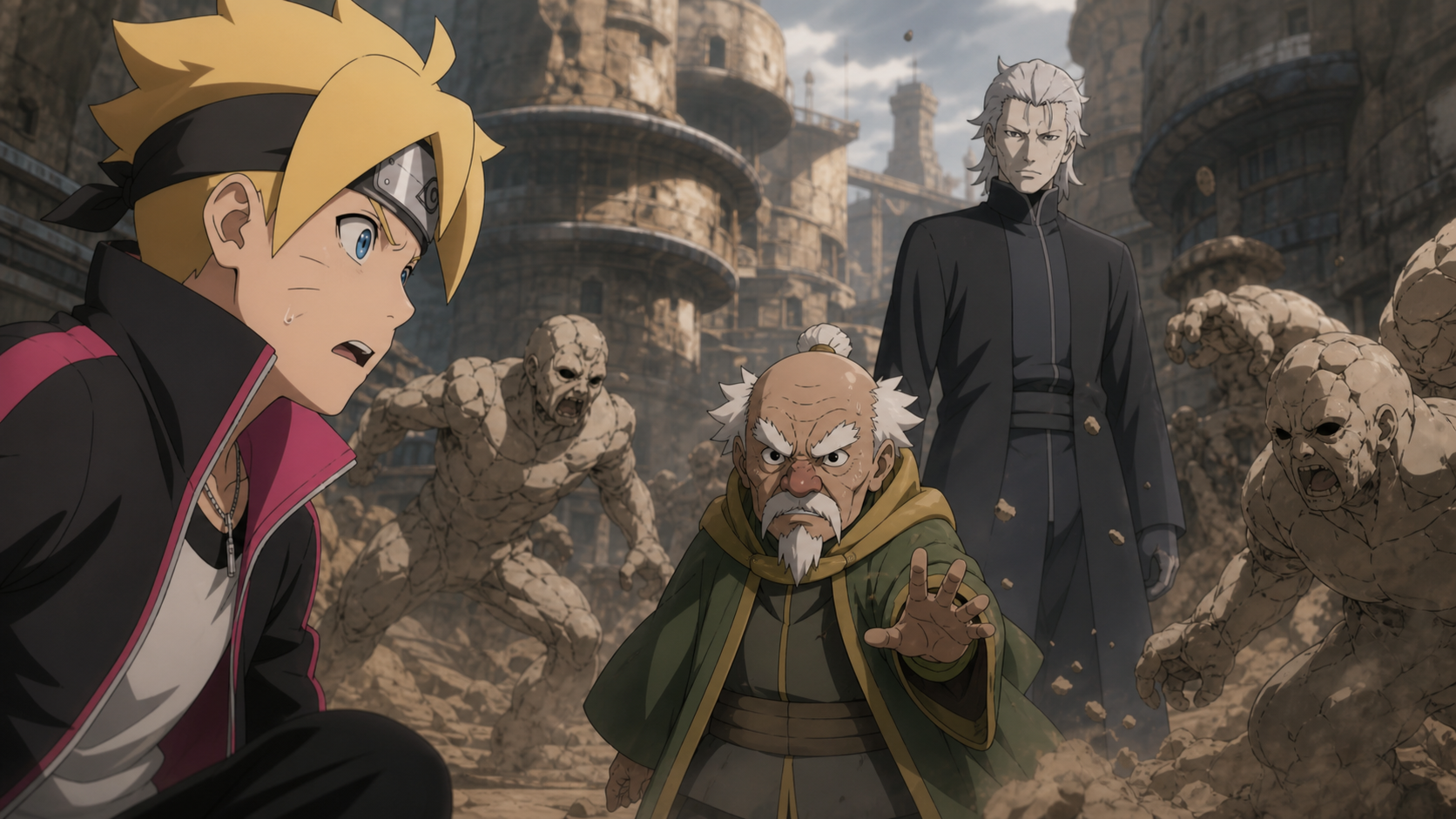
Ohnoki's Justice
Ohnoki wanted artificial soldiers to spare young shinobi. Sekiei’s joy around Mitsuki proves that the bodies expected to absorb every loss are already living their own lives.
Series: Boruto: Naruto Next Generations
Episode: 83 · Ohnoki's Justice
Arc: Mitsuki Disappearance Arc
Release: 2018-11-25
Previous: Episode 82 · Infiltrating the Hidden Stone Village!!
Directory: All 293 Boruto episodes
Bottom line
Boruto Episode 83 finally puts Ōnoki in front of the children who trusted his name, and the old man somehow makes the situation worse before giving them a real answer. Boruto, Sarada, Shikadai, Chōchō, and Akatsuchi reach him expecting the former Tsuchikage to help expose the people controlling the Hidden Stone. Kū arrives, calls Ōnoki his master, and turns the rescue attempt into one ugly reveal. Ōnoki helped create the Fabrications and the Akuta because his grandson Kozuchi died protecting the village. He wanted artificial soldiers to take the danger instead of another generation of young shinobi. I understand the grief. I even understand why that dream could sound merciful inside one devastated grandfather's head. The moment Kū immobilizes Boruto and sends Akuta after children, the entire plan answers for itself. Ōnoki did not remove sacrifice. He created lives expected to absorb sacrifice quietly. Meanwhile, Sekiei shows Mitsuki the Fabrications' home with the open excitement of someone welcoming a friend. That tour matters because Sekiei is curious, affectionate, sick, proud, and painfully alive. A disposable weapon is not supposed to care whether Mitsuki enjoys the visit. Episode 83 exposes the lie before Ōnoki can defend the project.
The children reach the worst possible answer
The group has spent this arc chasing Mitsuki through borders, snake trials, attacks, injuries, and one betrayal after another. Reaching Ōnoki should feel like finding the adult who can finally cut through the mess. He is a former Kage, an ally of Naruto's generation, and a man Boruto remembers from the Five Kage Summit. That history gives his name weight before he says anything.
Then Ōnoki refuses to help.
The refusal lands harder than another enemy ambush because Boruto came to him with trust. Boruto is not asking a stranger to gamble a village on his word. He is asking someone who already knows the shinobi world, knows Naruto, and knows what young people can lose when adults hide the truth. Ōnoki has all the experience required to understand the danger. He chooses silence anyway.
Kū calling Ōnoki “master” changes the whole arc
Kū does not arrive as a distant commander with an unrelated scheme. He approaches Ōnoki as his creator and leader. One word rearranges everything Boruto thought he knew. The Hidden Stone crisis is not happening despite Ōnoki's legacy. The crisis grew inside his attempt to shape that legacy.
Boruto's shock is earned. Naruto's generation taught these children that the Five Kage ended the cycle of isolation and built peace together. Ōnoki stood inside that story as proof that a stubborn old leader could change. Episode 83 does not erase his growth during the Fourth Great Ninja War, but the reveal shows how easily an old fear can return wearing the language of protection.
That is the nasty part. Ōnoki did not wake up wanting to become a villain. He wanted to prevent another funeral.
Kozuchi's death is sitting inside every decision
Ōnoki lost his grandson Kozuchi when the boy protected others during an attack on the village. The death gave Ōnoki a painfully simple wish: young shinobi should not have to die defending the Hidden Stone. No fan who watched the original Naruto series should laugh at that wish. We have watched this world feed children into wars, missions, clan disputes, and adult revenge for hundreds of episodes.
Ōnoki knows the bill better than most. He survived long enough to see friends, enemies, students, and family disappear. His body carries an entire century of shinobi choices. Losing Kozuchi after the war must have felt like proof that peace had failed to protect the one life Ōnoki could not bear to lose.
The grief explains why the Akuta project started. Grief does not turn Kū's army into mercy.
Ōnoki tried to move death somewhere less visible
The Akuta were supposed to fight in place of human shinobi. On paper, that sounds like the same logic behind sending a puppet, clone, drone, or scientific ninja tool into danger. The difference is that the Fabrications are not empty tools. Kū, Sekiei, Kokuyō, Kakō, and Kirara speak, choose, compete, fear deterioration, and form attachments.
Ōnoki wanted bodies that the village could lose without mourning. The project becomes horrifying the moment those bodies want to live.
Naruto has returned to this question since the beginning. Villages keep deciding which children count as people and which children count as weapons. Jinchūriki carried that abuse. Root operatives carried that abuse. Orochimaru's experiments carried that abuse. The labels change faster than the habit.
Boruto refuses to let the legend hide the man
Boruto does not have Naruto's patience with respected elders. Sometimes that impatience creates diplomatic disasters. Here, the bluntness is useful. Ōnoki cannot keep standing behind age, title, and grief while Boruto's friend remains inside the Fabrications' base.
Boruto wants an explanation, but he also wants movement. Mitsuki left Konoha, attacked his friends, and continued toward people whose motives remain unclear. Every delay increases the chance that Mitsuki is sick, trapped, manipulated, or choosing something Boruto does not understand. Ōnoki's refusal feels like another adult deciding that children can wait while important people control the story.
Boruto has never reacted well to that arrangement. Thank goodness.
Kū answers questions with force
Kū immobilizes Boruto instead of allowing the confrontation to continue. That decision tells us how much confidence his movement actually has. A leader who believes the project can survive scrutiny does not need to silence one furious Academy student with a technique.
The Akuta attack immediately after the reveal, turning a moral argument into a survival problem. Boruto's group is scattered through unfamiliar territory, and each child must reach the rendezvous point alone. Kū gains time, controls Ōnoki's access, and prevents the Konoha group from comparing what they see.
That is not protection. Kū is managing witnesses.
The separation strips away the team's best advantage
Shikadai's planning, Sarada's observation, Chōchō's power, Boruto's improvisation, and Akatsuchi's local knowledge work best when the group can communicate. The Akuta do not need to defeat everybody in one clean battle. The creatures only need to break the formation and make each person solve a different route.
The episode uses the Hidden Stone's architecture well here. Narrow paths, rock walls, elevation changes, and unfamiliar streets turn the village into a maze. Konoha's children are already trespassing without official support. Calling for help risks exposing them to the same compromised system they entered to investigate.
Their friendship has carried the chase this far. Episode 83 forces each child to carry the plan alone.
Ōnoki loses control of the thing he created
Ōnoki may still believe he can guide Kū, but the attack makes that belief look ridiculous. Kū chooses the timing, commands the Akuta, blocks Boruto, and decides where everybody goes next. Calling Ōnoki “master” sounds respectful. The actual power in the scene belongs to Kū.
This is where the old man's arrogance deserves real side-eye. Ōnoki has spent a lifetime surviving people who thought they could control military power through rank and intention. He knows better than to confuse being the founder with being the current commander. The Fabrications depend on his original choices, but they have developed goals beyond his permission.
Ōnoki built an answer to grief and assumed the answer would remain obedient.
Mitsuki receives the gentlest part of the episode
While Boruto's group is attacked, Sekiei welcomes Mitsuki as a friend and guides him through the hideout. The tonal difference is deliberate. Kū's operation looks threatening from the outside. Sekiei experiences the same place as home.
Mitsuki is the perfect person to notice that difference. He was created by Orochimaru, raised around experiments, and sent into the world with questions about his own will. He cannot dismiss Sekiei as fake without accepting the same insult against himself.
The tour gives Mitsuki something Boruto cannot offer during the chase: space to look at artificial life without beginning from rescue. Boruto sees danger around his friend. Mitsuki sees people trying to understand why they exist.
Both views contain truth, which is why this arc works when the writing stops rushing toward a simple answer.
Sekiei is delighted to have a friend
Sekiei's excitement around Mitsuki is one of the clearest arguments against Ōnoki's original categories. He wants to explain the base, show Mitsuki how the Akuta are made, and share the world that has shaped him. That behavior is not military efficiency. Sekiei wants recognition.
He also does not approach Mitsuki like a finished expert on being human. Sekiei asks questions, watches reactions, and treats friendship as something he can learn by doing. His failing body makes that curiosity hurt more. A person who may have very little time is spending some of that time trying to connect.
Calling Sekiei disposable after watching him welcome Mitsuki would require the audience to ignore the person directly in front of us.
Kokuyō and Kakō do not share Sekiei's enthusiasm
The other Fabrications are less comfortable with Mitsuki's presence. Their suspicion makes sense. Mitsuki came from Konoha, has connections to Orochimaru, and may be useful to Kū for reasons nobody has fully explained. Sekiei sees a possible friend. Kokuyō and Kakō see an unknown variable inside their home.
That difference proves the Fabrications are not one personality multiplied across several bodies. They disagree about trust, strength, curiosity, and what Mitsuki represents. The group may share an origin and a physical problem, but shared construction does not erase individual temperament.
Ōnoki created soldiers. The soldiers became people who argue with one another.
The Akuta numbers reveal Kū's real ambition
Sekiei explains that the base is producing enough Akuta to outnumber the Hidden Stone's shinobi. The original justification was protection: artificial fighters would absorb danger so young people would not die. An army larger than the village's own force creates a different question. Who protects the village from the army?
Kū controls production, commands the existing creatures, and has already helped remove Kurotsuchi from power. Those facts make the scale impossible to treat as a harmless backup plan. A replacement force can defend a government. A replacement force can also become the government.
Ōnoki's personal grief has supplied Kū with the machinery for a coup.
The episode makes artificial life and artificial obedience different
The Fabrications' origin does not make every choice innocent. Kū uses force. Kokuyō has attacked Konoha shinobi. The Akuta injure people without the reflective behavior Sekiei displays. Accountability still matters.
The important distinction is between created life and automatic obedience. Sekiei's friendship does not excuse Kū's violence. Kū's violence does not erase Sekiei's personhood. The arc becomes shallow whenever every artificial being is pushed into one moral box.
Mitsuki understands that problem better than anyone. Orochimaru created him, but Orochimaru does not own every decision Mitsuki makes. The same principle has to reach beyond the character we already love.
Ōnoki's justice repeats the shinobi world's oldest mistake
The old system told adults that some children had to suffer so the village could survive. Ōnoki believes he has escaped that logic by creating new bodies for the dangerous work. He has only changed the children whose pain becomes acceptable.
The irony is brutal because Ōnoki helped end a war built from this exact thinking. The Allied Shinobi Forces won when villages stopped treating one another as replaceable resources. Naruto changed the battlefield by insisting that bonds mattered across borders. Ōnoki carried that lesson home, lost Kozuchi, and built a secret exception.
Everybody believes their exception is reasonable. That is how the cycle survives.
Boruto and Mitsuki are learning opposite lessons
Boruto learns that a beloved elder can hide a terrible decision behind a noble motive. Mitsuki learns that people tied to a terrible decision can still offer genuine friendship. Those lessons do not cancel each other.
Boruto needs to stop assuming that reaching Mitsuki will automatically restore the relationship they had. Mitsuki needs to stop treating private investigation as though his friends will experience the silence without fear. Episode 83 keeps them physically apart while letting each boy encounter one half of the problem.
Their eventual reunion will mean more if both truths survive the argument.
The title belongs to Ōnoki and judges him
“Ohnoki's Justice” sounds almost respectful until the episode shows what his justice requires. Ōnoki wanted no more Kozuchis. He accepted Fabrications whose bodies fail and Akuta whose existence centers combat. He wanted peace for the children born inside the village and gave Kū control over beings created outside the village's circle of care.
That is not justice. That is grief choosing who receives protection.
The title also leaves room for Ōnoki to confront the gap later. Naruto characters are rarely trapped forever inside their worst decision. Redemption, however, cannot begin while the old man refuses to name what he made and what Kū has become.
Reaching Ōnoki gives Boruto an answer and destroys the easy rescue story
Boruto expected the former Tsuchikage to explain the crisis, expose the villains, and help recover Mitsuki. Instead, the respected elder stands inside the origin of the project.
The discovery hurts because Boruto trusted the legend before knowing the man. A simple enemy could be defeated. Ōnoki must be understood, opposed, and possibly saved from the consequences of choices made through grief.
The rescue changes shape. Finding the authority figure does not restore order when the authority figure helped build the disorder.
“Master” reveals a hierarchy Ōnoki pretends is guidance
Kū calling Ōnoki master places creation, command, and obedience inside one word. Ōnoki may imagine a paternal relationship or a teacher preparing protectors.
The title tells us that the Fabrications were not invited to negotiate purpose. They were made beneath an authority that expected loyalty.
Personhood begins disrupting the hierarchy as soon as Kū interprets protection differently from the creator. A will capable of judgment cannot remain safely inside the role of tool.
Kozuchi's death became the question Ōnoki stopped allowing anyone else to answer
Losing Kozuchi gave Ōnoki a legitimate horror of sending young people into war. The grief narrowed every future debate into one demand: prevent another child from dying in combat.
Other leaders could have proposed training reform, diplomacy, defensive technology, adult staffing, or limits on deployment. Secrecy removed those alternatives before anyone could weigh them.
Ōnoki did not only choose a solution. He decided grief gave him the right to choose alone.
Moving death onto created bodies does not abolish death
The Fabrications fail physically, the Akuta break in battle, and both categories exist to absorb danger naturally born shinobi would otherwise face.
The project calls that protection because the created lives sit outside the circle of expected mourning. A broken Akuta can be replaced. A dying Fabrication can be described as an incomplete product.
The moral trick works only while everyone refuses to see the created beings as lives capable of losing futures.
Kū uses force because explanation would expose the contradiction
Boruto asks questions that place Kozuchi, Mitsuki, the Fabrications, and the occupied village inside the same moral frame. Kū answers by restricting movement and separating the group.
Force prevents the conversation from reaching the people whose consent was never requested. Control becomes necessary because the project cannot survive open examination.
Kū's violence is not a departure from the system. Kū reveals what the system requires when persuasion fails.
Separation removes the children's shared evidence
Boruto, Sarada, Shikadai, Chōchō, and Akatsuchi each hold different observations about Mitsuki, the Akuta, the guards, and Ōnoki. Together, those observations could challenge the official explanation.
Splitting them blocks coordination and makes each person easier to manage. Isolation turns uncertainty into vulnerability.
The tactic echoes Mitsuki's original departure. Secrets become powerful when friends cannot compare what each person knows.
Ōnoki loses control because obedience was never the same as shared values
Ōnoki gave Kū purpose and expected the purpose to remain stable. Kū receives intelligence, self-preservation, and authority over other created beings, then develops a future the creator did not authorize.
That outcome was not an unpredictable glitch. Judgment produces priorities, and priorities can conflict with the creator's plan.
Ōnoki wanted a person capable of protecting the village and a tool incapable of redefining protection. No design could guarantee both.
Sekiei's delight is evidence no laboratory metric can dismiss
Sekiei wants to talk with Mitsuki, compare experiences, and claim friendship. The excitement exceeds mission utility.
Nobody ordered him to value the relationship. The bond gives a failing body a future-shaped desire: more conversation, more shared time, another encounter after the current task.
That desire makes Sekiei vulnerable to loss and confirms that short artificial life still contains real anticipation.
Kokuyō and Kakō prove created people do not share one personality
Kokuyō values strength and discipline. Kakō responds to combat with growing excitement. Sekiei reaches toward companionship. Kū seeks control and survival.
Different reactions undermine the claim that origin determines interior life. The Fabrications share a production system without sharing one moral identity.
Treating them as interchangeable equipment ignores the variation already visible to everyone around them.
Akuta numbers reveal a city becoming dependent on disposable force
More Akuta in streets and strategic positions give Kū the ability to enforce orders without persuading residents or trusting human shinobi.
The system looks efficient because broken units can be replaced and no unit asks whether the command is just. That efficiency is the warning.
A village protected by beings denied meaningful refusal has converted security into occupation infrastructure.
Boruto and Mitsuki learn opposite lessons about respecting will
Boruto discovers that adults can use love and grief to justify controlling another person's future. Mitsuki discovers created lives whose choices do not fit the purposes assigned by creators.
Both lessons challenge the friendship. Boruto must stop treating faith as ownership of Mitsuki's answer. Mitsuki must recognize that independent will includes responsibility for harm caused through secrecy.
Their reunion will matter only if each lesson survives the relief of seeing the other alive.
Quick reaction
Episode 83 made me angry at Ōnoki because the motive is so understandable. A cartoon villain building an artificial army would be easy. A grandfather building one because he cannot survive another child's funeral is harder, especially when the plan still creates children who can suffer. Sekiei steals the episode without needing the loudest scene. His happiness around Mitsuki destroys the fantasy that the Fabrications are equipment. Kū can call Ōnoki master all day; the Akuta move when Kū commands them, Boruto gets silenced when Kū decides, and the Hidden Stone is already living under Kū's choices. Ōnoki wanted to spare young shinobi. He handed one grieving idea enough power to endanger another generation.
Sources and lawful viewing
Official episode reference: Naruto Official episode guide
Licensed episode route: Crunchyroll licensed series page