
One Piece and the Politics of Who Gets to Eat
Bottom line
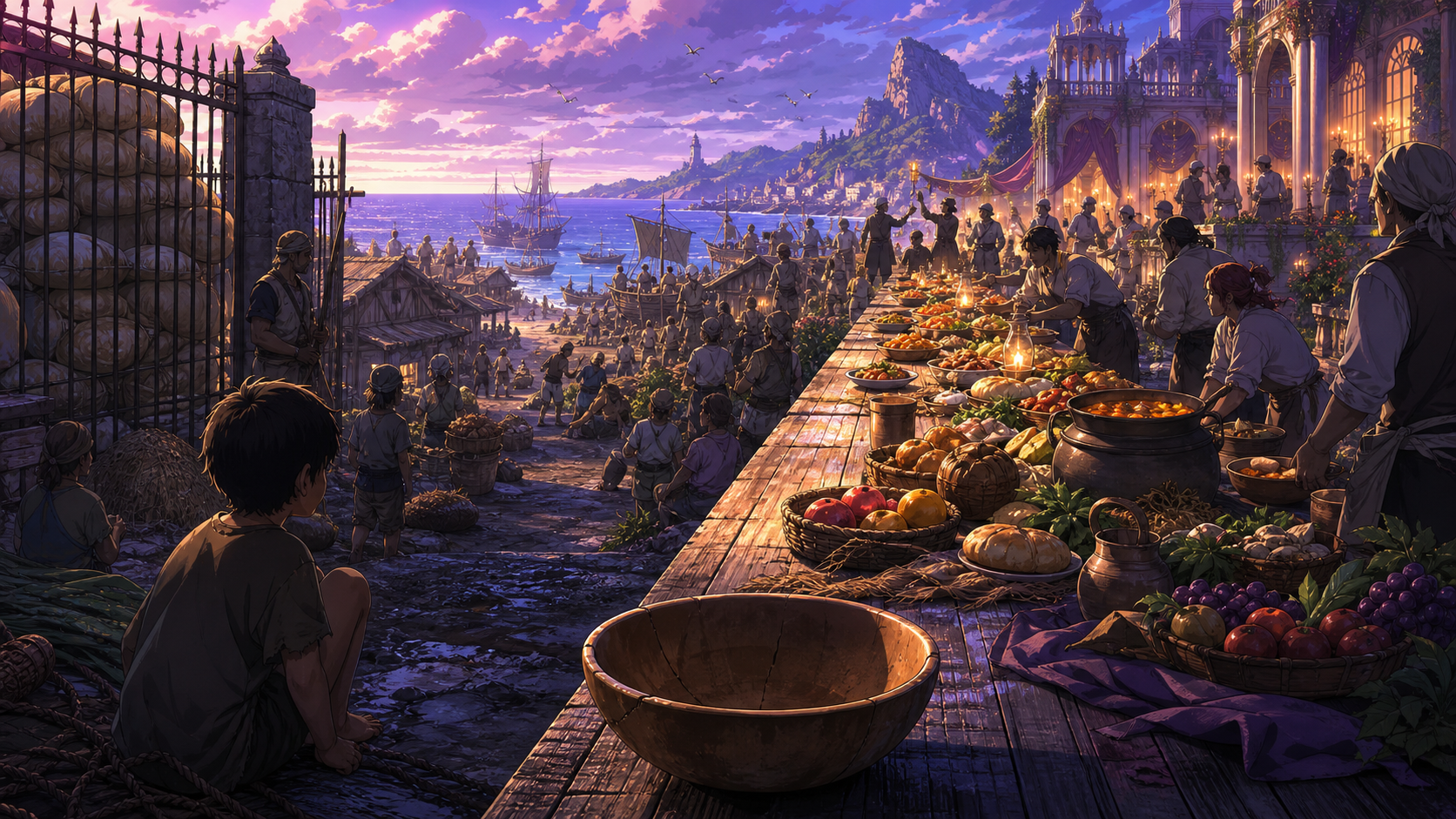
One Piece talks about freedom with flags, ships, dreams, and impossible bodies. The series also talks about freedom with an empty bowl. Again and again, political power becomes visible through who can eat, who grows food, who controls distribution, and who receives praise for a feast while somebody else washes the plates.
I do not think food is a soft theme sitting beside the real plot. Food is one of the real plots. Luffy understands tyranny fastest when a child is hungry. Sanji understands dignity through feeding somebody he has every reason to hate. Nami understands money because money once looked like the only route toward buying a village back. Wano’s liberation means very little if the people outside the Flower Capital still drink poisoned water.
Luffy’s appetite is funny because hunger is serious
Luffy eats with a scale that breaks furniture, budgets, and any cook’s belief in reasonable portions. The gag works because appetite is honest. He wants food, says so, and experiences sharing food as a relationship. A person who feeds him becomes somebody whose material life he notices.
Tama’s bowl of rice in Wano matters more than another speech about justice. She gives away a rare meal on her birthday. Luffy sees a child treating hunger as normal and decides that normal has to change. His promise concerns a country where she can eat every day. That promise is political because daily food requires land, clean water, labor, storage, transport, and power no longer stealing the result.
Sanji makes cooking part of the ship’s infrastructure
Sanji is not the crew member who performs a cute domestic hobby between fights. He plans stores, protects ingredients, balances nutrition, and wakes early enough for everybody else to treat breakfast like weather. The Sunny moves because Franky maintains a ship, Nami finds a route, Jinbe reads the sea, Chopper protects health, and Sanji keeps bodies fueled.
Baratie gives the work an ethic. A starving enemy still receives food. Zeff and Sanji know hunger as bodily terror, so denying a meal becomes a form of power they refuse to practice. The principle is generous and difficult. Feeding somebody does not require surrendering self-defense. Feeding somebody recognizes that survival should not be a prize awarded only to people we approve.
Arlong turns money and food into occupation
Cocoyasi Village pays for the right to remain alive. Every adult and child receives a price. Bellemere’s household becomes impossible under the arithmetic because love produced more family than her money can legally protect. Arlong’s violence is not random. Violence enforces a payment system.
Nami steals, maps, calculates, and saves because one enormous payment appears to offer an exit. Her fixation on money after Arlong Park is not proof that trauma vanished into a character joke. Money was safety, leverage, and a future she could count. I hear that history whenever she screams about wasted supplies while the men on deck treat logistics like an optional ministry.
Alabasta shows how scarcity manufactures political belief
Crocodile does not need citizens to become stupid. Citizens are thirsty. Crops fail. Rain appears near the capital. A manipulated public explanation becomes convincing because the drought already hurts. Dance Powder turns water into evidence against the king.
That is why Vivi cannot solve the crisis by announcing the truth once. Facts need routes, witnesses, public trust, and enough safety for people to stop fighting long enough to hear. Hunger and thirst narrow the time available for careful judgment. Crocodile understands that material desperation can make propaganda feel like common sense.
Whole Cake Island makes abundance coercive
Totto Land is made of food and still governed through deprivation. Big Mom’s cravings redirect workers, ingredients, ministers, and entire communities toward one body. Refusal can cost lifespan. A beautiful table does not prove a just food system when everybody serving the table is afraid.
Sanji’s wedding cake succeeds through collective labor. Chiffon, Pudding, cooks, transport, rare ingredients, and technical knowledge all matter. The sequence gives Sanji credit without pretending one genius produced a miracle alone. The cake saves lives because people work together inside a crisis created by concentrated power.
Wano separates the feast from the workers
The Flower Capital celebrates while other regions absorb pollution, hunger, forced labor, and poisoned water. Prosperity becomes a visual trick created by geography. The people allowed near the palace can call the country orderly because the cost has been moved out of sight.
SMILE fruits make the arrangement even crueler. People lose the public language of grief while powerful men continue reading laughter as proof that suffering is manageable. A feast at the end of the raid matters, but reconstruction has to reach farms, rivers, medical care, housing, and the regions the feast once depended upon exploiting.
Women perform much of the food labor
One Piece loves male cooks and still relies on women feeding households, children, crews, and resistance movements. Bellemere farms tangerines. Makino runs a bar that functions as community space. O-Tsuru feeds people under occupation. Chiffon and Pudding help produce the cake that prevents mass death. Their work can disappear behind the man receiving the formal cook title.
I want the series and fandom to keep naming that labor. Food does not appear because a heroic appetite deserves a reward. Somebody cultivated, purchased, carried, preserved, prepared, served, and cleaned. Adventure depends on hands the camera may never celebrate.
Meat is not the only meal that matters
Luffy’s meat obsession is iconic, but the series uses many foods as local memory. Rice, soup, oden, tangerines, wedding cake, emergency rations, and a shared cup can reveal class, migration, grief, and belonging. A recipe carries history differently from a monument. People reproduce memory by making food again.
That repetition makes cuisine political without turning every dinner into a lecture. The table decides who sits close, who serves, who eats first, and whether there is enough. A crew meal can model abundance as relationship rather than accumulation.
Food relief is not the same as food justice
Luffy can break a warehouse open. Sanji can feed a starving crowd. Chopper can treat bodies damaged by hunger. Those actions matter immediately. None of them replaces systems that keep food available after the Sunny leaves.
Food justice requires clean land and water, safe work, public infrastructure, distribution, knowledge, and the power to challenge whoever controls the stores. One Piece often ends arcs at the feast because the feast proves survival. My question begins the morning after. Who replants? Who repairs irrigation? Who owns the port? Who can afford tomorrow’s meal?
Food reveals who controls the clock
Hunger in One Piece is never only an empty stomach. The person who controls meals also controls rest, movement, attention, and the ability to plan beyond the next hour. Prisoners cannot organize when survival consumes every thought. Workers cannot refuse an order when wages barely reach dinner. Children cannot imagine a future when adults have converted the pantry into a threat.
That is why Sanji feeding somebody matters as much as Luffy breaking a gate. A meal returns time to the person eating. Energy creates choices, and choices create political danger for anyone invested in obedience.
Abundance without access is still manufactured scarcity
The series repeatedly places wealth beside deprivation. Palaces hold banquets while villages ration water. Nobles waste food while laborers calculate portions. The problem is not that the world lacks enough. Power decides whose appetite counts as ordinary and whose hunger becomes background scenery.
Nami, Robin, and Jinbe recognize different versions of that arrangement because each has lived beneath a system that renamed extraction as order. Their memories make food politics part of continuity rather than a repeating visual metaphor with no cumulative lesson.
A liberation feast should show who cooked
One Piece loves the party after a tyrant falls, and those celebrations are earned. The Anime 101 question continues one step further: who found ingredients, rebuilt ovens, carried water, served plates, and cleaned the square after the pirates sailed? Liberation becomes more honest when the frame remembers the labor that makes joy possible.
Food becomes freedom when nobody must earn the right to survive before joining the table.
A shared table also makes room for testimony, planning, laughter, and futures beyond survival.
RaeRae’s verdict
I love that One Piece can make a banquet look like freedom and an empty bowl look like an accusation. The series understands that a dream means more when a person has enough food to imagine tomorrow. The politics becomes strongest when ordinary labor remains visible and weakest when one heroic punch stands in for reconstruction.
Luffy wants the freest life on the sea. Fine. I want the world around him to become free enough that a child’s birthday rice is ordinary, cooks can feed people without serving tyrants, and farmers do not poison their own bodies so a palace can keep glowing.
Official sources and routes
ONE PIECE.com official portal
One Piece Anime Hub
One Piece Sagas and Story Arcs
Sanji Character Profile