
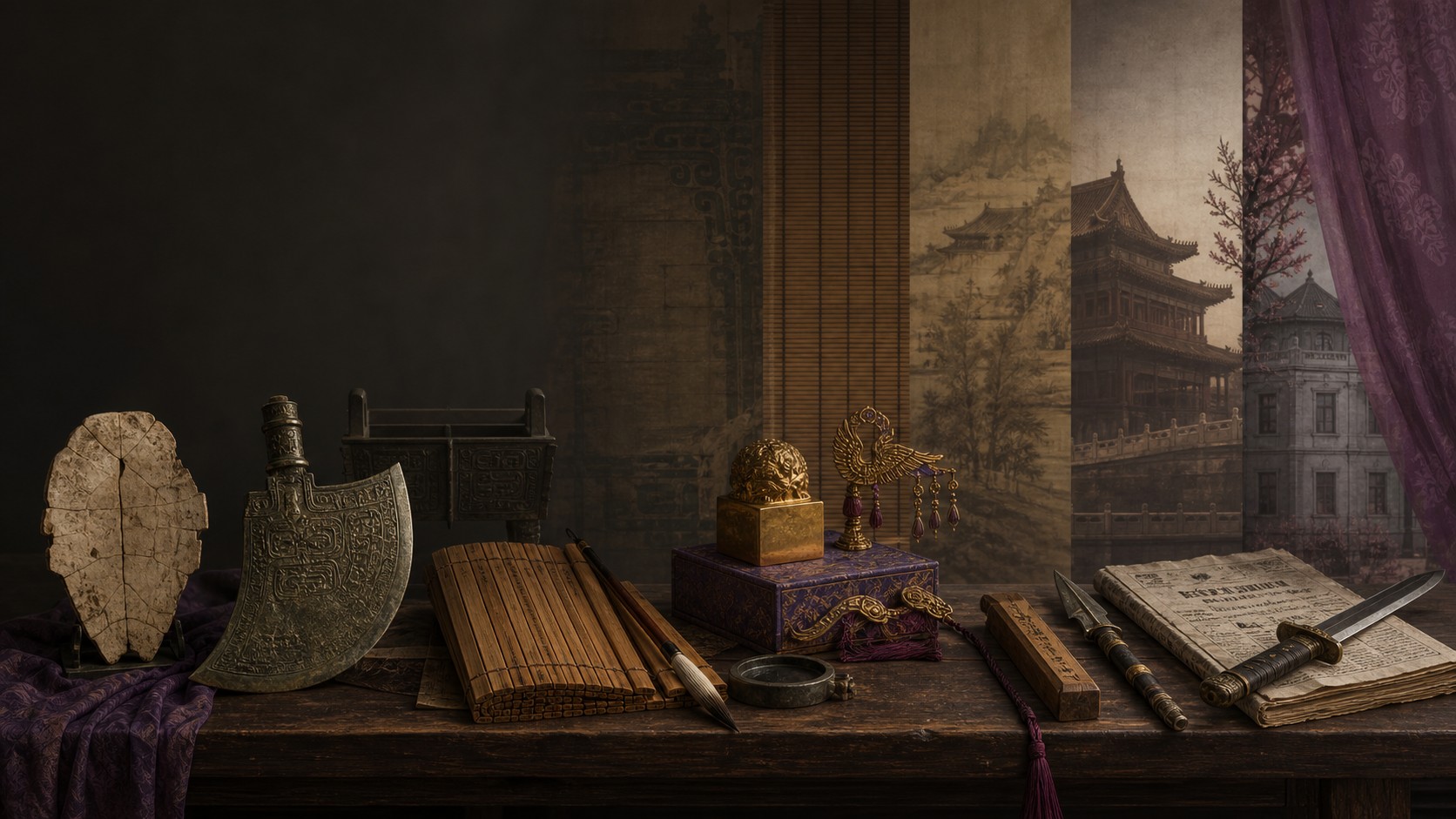
Anime 101 · History beyond the one heroine everybody knows
Mulan Is Not the Only Chinese Woman Worth Knowing
One legendary warrior daughter cannot carry thousands of years of Chinese women’s history on one animated shoulder.
Bottom line first
Mulan is not responsible for introducing the entire history of Chinese women to Western audiences. She is a legendary heroine whose surviving ballad became one of the most adaptable stories in Chinese culture. That cultural reach deserves respect. The problem begins when one familiar warrior daughter becomes the only Chinese woman a global studio expects viewers to recognize. Thousands of years of rulers, historians, poets, generals, rebels, artists, workers, mothers, diplomats, religious figures, and political thinkers disappear behind one marketable silhouette.
This guide is not replacing Mulan with a new approved icon. A Shang queen buried with weapons, a Han historian working inside court power, the only woman to rule China as emperor, a Tang princess raising an army, a Song poet surviving invasion, a Ming commander defending a collapsing dynasty, and a Qing revolutionary confronting gender and state do not tell one empowerment story. Their differences are the point. Chinese women lived inside changing institutions, and their choices cannot be reduced to proving women could behave like heroic men.
Why fandom keeps asking one woman to carry a civilization
Franchise storytelling rewards recognition. A studio can place Mulan beside a sword, magnolia, dragon, phoenix, or red robe and assume audiences already know the emotional category. Historical education becomes harder because every unfamiliar name needs context before merchandising can begin. The market keeps returning to the figure with established global visibility, then visibility gets mistaken for singular importance. Mulan appears everywhere because Mulan is already familiar. Familiarity grows because Mulan appears everywhere.
That loop creates cultural tunnel vision. Western viewers may learn several British queens, French revolutionaries, American first ladies, Greek goddesses, and Roman women before encountering a second Chinese woman by name. China becomes ancient scenery populated by emperors, male philosophers, male warriors, and one exceptional daughter. A fandom site can interrupt the loop by connecting the familiar franchise to a wider reading path without pretending the fictional heroine secretly represents every woman who came before or after her.
Start with evidence, not inspiration
Historical women often survive unevenly in records written, preserved, edited, and interpreted through male institutions. Court histories may reduce a woman to kinship, morality, scandal, or warning. Archaeology can reveal authority that later stories ignored. Poetry can preserve an interior voice while leaving biography uncertain. Revolutionary writing may become patriotic legend after death. A responsible profile distinguishes contemporary evidence, later official history, material remains, folklore, and modern commemoration.
That standard matters especially after Disney’s Mulan marketing. Audiences were encouraged to ask whether Mulan was real, then handed confident biographies assembled from incompatible legends. Real women deserve better than the same treatment. Dates can remain approximate. Motives can remain disputed. Praise can coexist with criticism. “She existed” is only the beginning of historical work, not permission to convert a life into an empowerment quote over a sword graphic.
Fu Hao left a tomb, weapons, and a political record
Fu Hao lived during the Shang dynasty and became one of the most compelling women known through early Chinese archaeology. Oracle-bone inscriptions connect her with King Wu Ding, ritual activity, childbirth, military campaigns, and political authority. Her intact tomb at Yinxu contained an extraordinary collection of bronzes, jades, weapons, and other objects. The Smithsonian catalog describes the excavation legacy through the roles queen, mother, and general, which already tells us one modern label cannot hold the evidence.
Fu Hao matters beside Mulan because her record changes the question. We do not need to ask whether one legendary daughter proves women could fight. Material and inscriptional evidence place a named royal woman inside warfare, ritual, lineage, and wealth in the Shang world. Her authority was not modern equality, and royal status separated her from most women. Still, the tomb refuses the lazy story that Chinese female military presence begins as folklore and becomes imaginable only after Disney animation.
A bronze axe is not a personality test
The heavy ritual axes associated with Fu Hao signify command and status, but modern retellings can fetishize the weapon until every other role disappears. She conducted rituals and appears in divination records concerning health, pregnancy, warfare, and ancestral matters. Queen, consort, mother, ritual actor, landholder, and commander occupied the same political life. Choosing only the most cinematic title reproduces the narrowness this guide is trying to escape.
Fandom loves a clean visual emblem, so a massive axe becomes tempting shorthand. Use the symbol as a door rather than the entire room. Ask who recorded campaigns, how royal households organized power, what the tomb goods reveal, and why archaeology transformed modern understanding. Fu Hao does not need to become “the real Mulan.” That comparison makes a documented Shang woman valuable only when attached to a fictional brand created many centuries later.
Ban Zhao wrote history inside the institution
Ban Zhao lived during the Eastern Han and became a scholar, historian, writer, and court teacher. After her brother Ban Gu died, she helped check, edit, and complete the Han Shu, the History of the Former Han, using access to imperial books and archives. University scholarship also emphasizes the long influence of her Lessons for Women, a text that became central to later discussions of women’s education and conduct. Her intellectual authority existed inside a deeply hierarchical court world.
Ban Zhao frustrates simple celebration because Lessons for Women can sound painfully accommodating to patriarchy. Reading only the most restrictive lines produces another distortion. A woman who counseled court figures, worked on dynastic history, wrote poetry and essays, and taught within imperial institutions cannot be summarized as either feminist heroine or obedient mouthpiece. Her work shows how intellectual agency can operate through structures a modern reader may criticize. That tension deserves analysis, not a rescue mission that makes every notable woman secretly agree with us.
Education can preserve and discipline at the same time
Ban Zhao argued for teaching girls, but education in her framework prepared women to navigate and uphold gendered relationships rather than abandon them. The contradiction feels familiar. Access to literacy can widen thought while curriculum narrows acceptable behavior. A woman may gain authority by mastering the language of an institution that limits women. Her success can create opportunity and reproduce the rules that made such success exceptional.
Mulan stories often resolve the contradiction through disguise: enter the male institution, prove equal ability, receive recognition. Ban Zhao offers another route and another problem. She became authoritative through scholarship without becoming socially ungendered. A fandom ecosystem interested in women needs room for intellectual labor, compromised agency, pedagogy, and institutional negotiation. Otherwise “strong female character” remains code for somebody who wins a fight while every other form of power stays invisible.
Wu Zetian did not borrow the throne
Wu Zetian rose through the Tang imperial court and eventually ruled as emperor, establishing her own Zhou dynasty interlude. She remains the only woman in Chinese history generally recognized as ruling under the emperor title in her own right. Her government, religious patronage, bureaucracy, legitimacy campaigns, violence, family politics, and later reputation have generated centuries of argument. Calling her merely an empress turns an unprecedented claim to sovereignty back into a wife’s title.
Wu Zetian does not provide an uncomplicated empowerment fantasy. Rulers govern through institutions capable of coercion, punishment, propaganda, appointment, and war. Later histories written under restored male dynastic authority had reasons to moralize her ambition and sexuality, while modern admiration can minimize brutality because symbolic victory feels satisfying. Both distortions make gender do the historian’s thinking. Evaluate evidence, policy, patronage, rivals, and statecraft, then examine how accusations changed when the ruler was a woman.
Power changes the scale of the moral question
Mulan asks whether a woman can perform duty inside military and family systems. Wu Zetian asks who can define duty for an empire. The difference is enormous. One heroine enters authority through service. One sovereign organizes authority, appoints officials, builds legitimacy, sponsors religious projects, manages succession, and answers threats. Treating both women as examples of female courage erases the political scale that makes Wu Zetian historically difficult and fascinating.
The National Museum of Asian Art’s work on Chinese empresses also reminds viewers that palace women occupied structured ranks, obligations, kinship strategies, religious lives, pleasures, and severe limits. Court power was not a single glamorous category. Wu Zetian’s rise cannot stand in for every empress or consort, just as one imperial woman cannot stand in for women outside the palace. History expands when power receives precise location instead of generic royal purple.
Princess Pingyang built a rebellion branch
Princess Pingyang was a daughter of Li Yuan, the future founder of the Tang dynasty. Traditional accounts credit her with helping the family uprising against the Sui by organizing forces later remembered as the Army of the Lady. Her role belongs to dynastic rebellion, coalition building, and the military struggle that helped establish a new ruling house. She was not a disguised common soldier hiding for years beside unsuspecting men.
That difference is exactly why she should not be introduced as another real Mulan. Princess Pingyang acted through elite family networks and a rebellion connected to her father’s imperial ambition. Rank created access while war created opportunity. Her story expands the field from individual substitution to political mobilization. The useful comparison asks how gender, kinship, class, and dynastic legitimacy shaped command, not which woman deserves the crown for being most like a Disney heroine.
Li Qingzhao made survival audible
Li Qingzhao, born in 1084, became one of the most celebrated poets associated with the Song dynasty. Her life crossed literary partnership, collecting, displacement, widowhood, invasion, political collapse, and the loss of treasured objects. University and museum resources emphasize both her mastery of ci lyric poetry and the historical rupture that shattered the earlier life she shared with Zhao Mingcheng. Her work makes private feeling inseparable from public disaster.
No battlefield credential is required. Li Qingzhao’s significance lives in voice, form, memory, criticism, grief, wit, sensory detail, and the discipline of language. A fandom culture trained to equate action with importance can miss how poetry preserves an era’s emotional weather. Her losses were personal and political. The surviving poems let absence, aging, desire, and displacement carry historical force without converting suffering into a training montage.
A woman does not need a sword to count as strong
The phrase strong woman becomes useless when strength means only physical dominance, stoic endurance, or access to male institutions. Li Qingzhao could write delicacy without becoming weak and grief without becoming passive. Ban Zhao could teach within court hierarchy. Women managing households, preserving art, making religious lives, negotiating kinship, or writing memory exercised capacities that action cinema rarely knows how to frame.
Mulan herself becomes flatter when every adaptation must prove strength through combat. The ballad includes weaving, shopping, travel, family voices, clothing, and homecoming alongside war. Strength already moves through domestic and military space. Reading other Chinese women helps fans notice what the franchise discards whenever a sword becomes the only proof that a heroine deserves attention.
Qin Liangyu held documented military office
Qin Liangyu lived from 1574 to 1648 and became a military commander during the late Ming. Historical accounts connect her with campaigns, regional leadership, forces known for white-shafted spears, defense amid rebellion and dynastic crisis, and honors granted for service. Her biography is notable within the official History of Ming because she appears among officials and generals rather than being confined to a women’s-biography category.
Qin Liangyu offers a much closer historical comparison to a woman recognized through formal military command, yet even here “real Mulan” does more harm than good. Her life belonged to late-Ming frontier governance, hereditary local authority, marriage, warfare, state service, refugee pressure, and imperial collapse. A woman commanding troops openly across years raises different questions from a legendary daughter concealing gender during conscription. Similarity can invite readers in; specificity must take over immediately.
Loyalty becomes dangerous near a dynasty’s end
Popular profiles praise Qin Liangyu’s loyalty, but loyalty during collapse is not a decorative virtue. Commanders make choices while civilians move, resources fail, rebellions spread, rivals compete, and the state demands service. Her career reaches into conflicts that cannot be reduced to good loyalists facing bad rebels. A complete editorial should ask what imperial defense required from local communities and whose suffering disappeared inside official praise.
That political pressure connects back to Mulan without making the stories identical. Disney often treats defending China as an obvious moral direction represented by one emperor, one army, and one invading villain. Historical dynasties contained faction, regional interest, ethnic complexity, taxation, rebellion, and competing legitimacy. Qin Liangyu becomes more impressive, not less, when the world around command remains complicated enough to require judgment.
Qiu Jin refused the life assigned to her
Qiu Jin lived during the final years of the Qing dynasty and became a poet, writer, feminist, educator, and revolutionary. She left an arranged marriage, studied in Japan, participated in revolutionary networks, advocated women’s education and liberation, and faced execution in 1907 after an anti-Qing uprising failed. Her writing and public image joined national revolution with anger at gendered confinement. Modern commemoration remembers both the political martyr and the woman who wrote herself into struggle.
Qiu Jin’s proximity to photography, print culture, international study, modern nationalism, and feminist organizing gives audiences a radically different archive from Mulan’s ballad. We can read texts, inspect photographs, trace organizations, and debate political commitments. She does not need a mythic fog to become dramatic. The danger lies in polishing her into one fearless quote and skipping the marriage, children, exile, networks, tactical failures, literary work, and revolutionary violence that made the choices costly.
Revolution is not a makeover montage
Modern retellings may frame Qiu Jin through clothing changes, sword practice, and rejection of domestic expectation because those images resemble cinematic transformation. The images matter, but revolution requires organization, printing, education, money, trust, risk, and arguments about the state. A woman cutting hair or wearing masculine clothing can challenge convention without explaining the full political project. Style becomes historical only when attached to action and consequence.
Mulan’s disguise gives access to an existing army. Qiu Jin sought transformation of gender relations and political order while working through revolutionary institutions that carried their own limitations. One story ends with imperial recognition. The other confronts an empire as a structure to overthrow. Placing them side by side makes the difference between inclusion and revolution impossible to ignore.
Do not turn the women into trading cards
A directory needs searchable names, dates, roles, sources, and images, but database structure can quietly recreate the problem. “Warrior,” “scholar,” “emperor,” “poet,” and “revolutionary” help readers navigate while encouraging a single identity to swallow each life. Cards should open doors. Full profiles need chronology, relationships, institutions, work, controversy, material evidence, later representation, and clear limits on what the archive proves.
Images require the same discipline. Fu Hao can be represented through excavated objects and site records. Qiu Jin has historical photographs. Later portraits of earlier women may reveal commemoration rather than physical likeness. Generated faces should never masquerade as documentary evidence. A beautiful invented woman in period clothing can satisfy the eye while teaching nothing about the person named underneath. Metadata must say what an image is, when the image was made, and what the image cannot prove.
A better fandom reading path
Begin with Mulan because affection is a useful entrance. Read the ballad and mark what the poem actually says. Move backward to Fu Hao for archaeology and Shang royal power. Move to Ban Zhao for historiography and education. Read Wu Zetian through sovereignty and contested reputation. Follow Princess Pingyang into dynastic rebellion, Li Qingzhao into poetry and displacement, Qin Liangyu into formal command, and Qiu Jin into feminist revolution.
Then keep going. No eight names can complete Chinese women’s history. Add artists, laborers, scientists, actors, religious leaders, athletes, politicians, translators, filmmakers, diaspora writers, and ordinary women documented through law, letters, objects, oral history, and family archives. A fandom ecosystem becomes culturally useful when every familiar character creates more doors than conclusions.
What Disney could do next
Disney does not need to stuff historical cameos into a Mulan sequel. That move would turn real women into Easter eggs orbiting one corporate heroine. Studios can support distinct stories with different genres, languages, creative leadership, and historical commitments. Fu Hao might invite archaeological political drama. Ban Zhao could anchor court scholarship. Li Qingzhao belongs to intimate literary cinema. Qiu Jin demands revolutionary biography. Their lives should not become assignments for one franchise team.
Audiences also have work to do. We cannot demand cultural depth while refusing every unfamiliar title until a global corporation supplies a princess-shaped entry point. Read translated poetry. Visit museum collections. Watch Chinese productions with their own genre histories. Follow scholars who explain disputed evidence instead of promising one secret true story. Curiosity is not homework imposed after entertainment. Curiosity is how fandom stops consuming a culture as scenery and begins recognizing how much remained outside the frame.
The company can also stop presenting live action as the mature correction of animation. Chinese and Chinese-diaspora creators work across animation, documentary, games, television, theater, comics, and film. Medium does not determine cultural seriousness. Research, authorship, language, specificity, and willingness to let contradiction survive determine whether a work treats history as a world or a costume rack.
On the record
This guide uses Smithsonian catalog and video records connected to Fu Hao’s tomb, the National Museum of Asian Art’s work on Chinese empresses, university scholarship on Ban Zhao, Metropolitan Museum material on Tang women and Wu Zetian’s historical context, University of Liverpool material on Li Qingzhao, archival and museum records concerning Qiu Jin, and historical reference works for military figures. Dates and roles remain tied to those records rather than franchise folklore.
The guide does not claim that every later legend about these women is verified, that elite women represented ordinary women, or that visibility erased patriarchal constraint. The selected names are a starting shelf, not a definitive canon. The editorial conclusion is simpler: Mulan becomes more meaningful when she stops being used as the limit of Western curiosity. Chinese women’s history was never waiting for one animated sword to begin.
Read the sources
Begin with the Smithsonian record on Fu Hao and its library catalog for Queen, Mother and General. Read the University of Illinois-hosted scholarship on Ban Zhao, the National Museum of Asian Art material on Chinese empresses, the University of Liverpool introduction to Li Qingzhao, and archival museum records concerning Qiu Jin.
Keep exploring
Return to the Mulan hub for the Ballad guide, qi guide, films, character profiles, reviews, and rants.