
Incurring Wrath
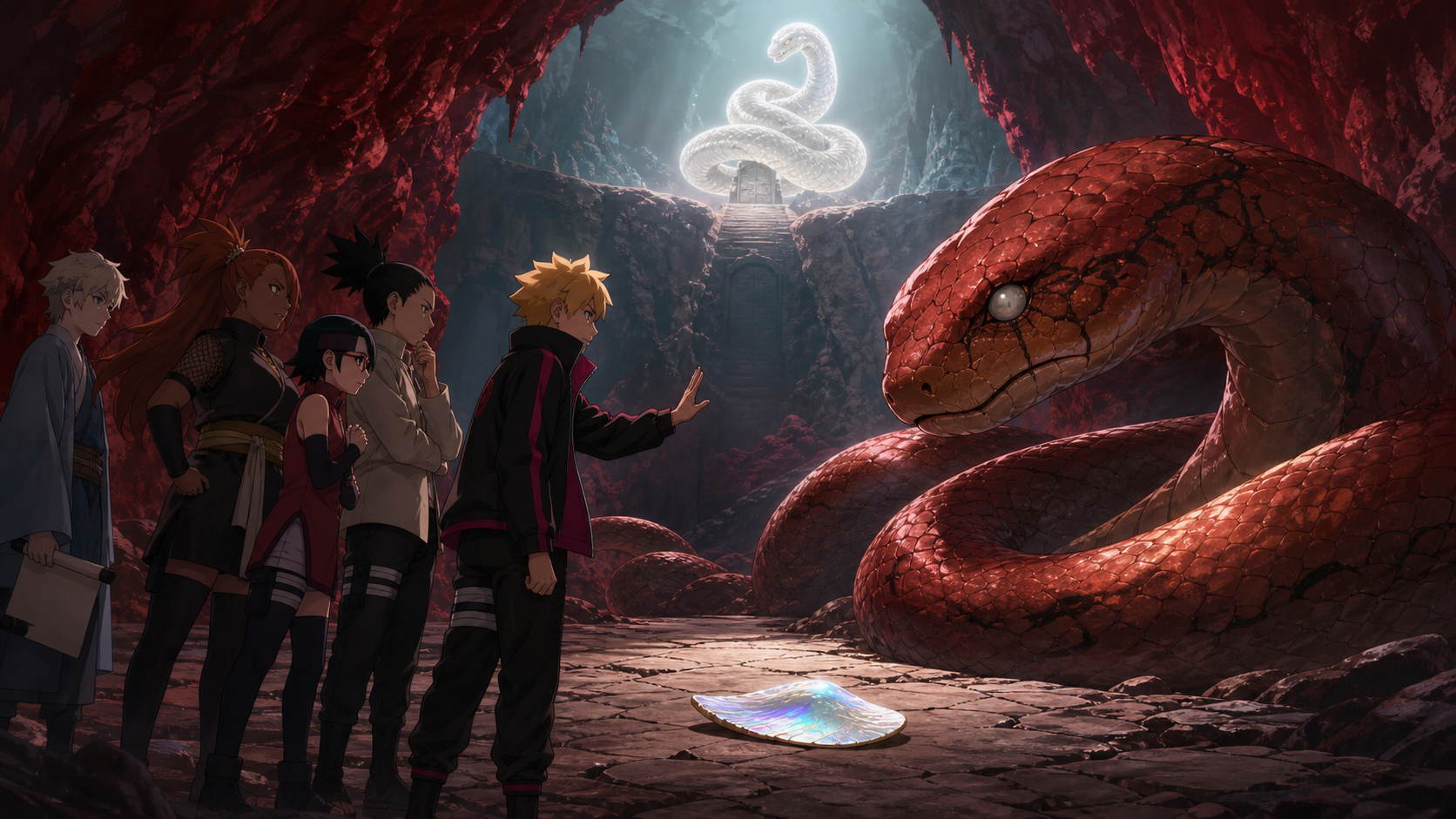
The White Snake Sage sends Boruto’s group after Garaga’s reverse scale, where Aoda protects Sarada and a coordinated attack ends with Chōchō petrified.
Series: Boruto: Naruto Next Generations
Episode: 76 · Incurring Wrath
Arc: Mitsuki Disappearance Arc
Release: 2018-10-07
Previous: Episode 75 · The Trials of Ryūchi Cave
Directory: All 293 Boruto episodes
Bottom line
Boruto Episode 76 turns a simple bargain into a giant-snake disaster. The White Snake Sage has Mitsuki’s message trapped inside a snake, but she will not reveal anything until Boruto brings her Garaga’s reverse scale. That request sends Boruto, Sarada, Shikadai, Inojin, and Chōchō deeper into Ryūchi Cave, where Garaga’s size, bad temper, and petrifying venom make the earlier trials look like orientation.
The episode’s best surprise is Aoda. Sasuke’s enormous blue summon drops into the fight to protect Sarada, then politely tries to escort her home because he knows exactly how dangerous Garaga is. Sarada refuses. Of course she refuses. Sasuke’s daughter has finally met one of her father’s snake summons, and their first shared activity is ignoring the safe option.
Back in Konoha, Moegi delivers Shikadai’s chess piece, confirming that the children are in trouble and that Mitsuki’s disappearance reaches beyond a student running away. Sakura’s patient begins stabilizing. Yurito becomes suspiciously interested in the investigation. Hinata and Sakura share one of the episode’s quietest and most important exchanges about their children making their own choices. Then the cave battle ends with Chōchō turned to stone. “Incurring Wrath” does not resolve much, but the episode raises every stake that matters.
Episode file
- Series: Boruto: Naruto Next Generations
- Episode: 76
- Title: “Incurring Wrath”
- Arc: Mitsuki’s Disappearance Arc
- Japanese airdate: October 7, 2018
- Previous episode: “The Trials of Ryūchi Cave”
- Next episode: “A Fierce Enemy: Garaga’s Ferocious Attack!”
The official episode guide centers the White Snake Sage’s bargain: retrieve Garaga’s reverse scale in exchange for the memory carried by Mitsuki’s snake. The story splits between that dangerous errand and Konoha’s growing realization that somebody with access to village secrets helped arrange Mitsuki’s disappearance.
The White Snake Sage names her price
The White Snake Sage has the information Boruto needs, and she knows nobody else can easily give him the same answer. Her demand sounds like folklore quest logic: go deeper into the cave, find the dangerous beast, bring back one special scale. Boruto hears the urgency and accepts before the group fully understands what a reverse scale means.
That setup tells us plenty about the Sage. She is not a kindly mentor waiting to reward pure intentions. She tests desire by attaching danger to knowledge. Boruto says he will do anything for Mitsuki, so she gives him an “anything” large enough to bite back.
Sarada and Shikadai understand the imbalance. They came seeking a memory, and now they are being asked to attack a creature in his own territory. Nobody has time to debate the ethics like a committee because Mitsuki keeps getting farther away. The discomfort should stay in the scene anyway. Ryūchi Cave runs on power and bargains, not fairness.
What a reverse scale actually means
The group explains the reverse scale while traveling. Violent snakes in Ryūchi Cave may carry one, and removing that scale can make them calmer. The phrase also carries the old image of touching a dragon’s most sensitive place and provoking rage. Garaga has both the physical scale and enough rage to make the metaphor unnecessary.
Boruto initially treats the scale as the price of admission. Chōchō treats the assignment with her usual mix of disbelief and forward motion. Shikadai keeps asking practical questions because the Sage left out almost every useful detail. Sarada remembers the Academy lesson on summoning techniques, connecting this cave to the contracts used by shinobi like her father.
The episode could push harder on the fact that the scale belongs to Garaga’s body. Still, Garaga’s reaction makes the point for the script. He does not regard the group as brave questers. He regards them as intruders hunting the one part of him they have no business touching.
Ryūchi Cave finally feels dangerous
The earlier trials relied on illusion, temptation, and endurance. Garaga replaces all of that with physical threat. The enormous tracks, damaged landscape, and snake statues announce him before his full body enters the frame. Every visual says the genin have walked into territory built for something much larger than them.
Garaga is not elegant. He crashes, lunges, coils, and uses the cavern like an extension of his body. Shikadai’s shadow technique, usually reliable against human opponents, barely slows him. Boruto spots the reverse scale but cannot reach the target before Garaga throws the entire formation apart.
The scale of the fight is the fun. These kids have faced strong shinobi, but fighting a giant summon changes distance, timing, and consequence. A tail movement can break the team’s spacing. A bite can remove somebody from the story. Garaga does not need a complicated jutsu list because being Garaga is already a whole problem.
Sarada nearly becomes lunch
Garaga’s movement throws Sarada away from the group and leaves her in immediate danger. He closes in before she can recover, and another giant snake intercepts him. The rescue works because the new arrival does not feel random once his identity is revealed.
Aoda is Sasuke’s summon, the calm blue snake who fought beside him during the war era. His loyalty extends to Sarada, and the way he addresses her carries a formal gentleness that makes the scene weirdly sweet. Sarada has grown up around the consequences of Sasuke’s absence. Meeting a creature who knows her father through battle gives her a new piece of that history.
She does not have time for a sentimental interview. Aoda just saved her from Garaga, Garaga is furious about Aoda’s interference, and everyone needs to retreat before the cave becomes a graveyard.
Aoda is the exact opposite of Garaga
Aoda speaks carefully, respects Sarada, and honors his contract with Sasuke even when Sasuke is nowhere nearby. Garaga sees humans and expects injury. Aoda sees Sasuke’s daughter and offers protection without hesitation. Putting the snakes together gives the episode a visual argument about what summoning bonds can become.
Aoda explains that Garaga lost an eye in battle and has become more violent. He knows Garaga’s reputation among the snakes and understands why approaching the reverse scale will trigger him. Aoda also lacks the same reverse scale, leading Shikadai to ask whether Garaga’s anatomy and temperament are connected.
The explanation helps the group plan, but Aoda’s first recommendation remains the sensible one: leave. He wants to escort Sarada back to Konoha. Sarada tells him the mission continues because Mitsuki is her teammate. Aoda must look at her and realize Sasuke’s stubbornness did not skip a generation.
Shikadai turns a terrible assignment into a plan
Once retreat is rejected, Shikadai studies what they learned. Garaga has only one working eye. Aoda can contest his size. Chōchō can expand. Inojin can obstruct vision. Boruto and Sarada have the speed and precision needed to reach the reverse scale. The pieces begin fitting together.
This is Shikadai at his best. He does not pretend the group can win through enthusiasm. He gives each person a role based on what they actually do well. Chōchō becomes the visible challenge. Inojin attacks Garaga’s remaining sight with ink. Shikadai holds him with shadow possession while Aoda and Chōchō add physical force. Boruto and Sarada move toward the objective.
Every part depends on timing, and Garaga remains strong enough to break the plan. That balance keeps Shikadai smart without making the opponent stupid.
Chōchō walks directly into the dangerous job
Chōchō’s enlarged form makes her one of the few people in the group capable of demanding Garaga’s attention. She accepts the role knowing Garaga has already shown how quickly he can strike. Her confidence keeps the sequence lively, but her contribution is not comic relief. The plan needs her.
Ino-Shika-Chō teamwork also survives outside the village and without adult supervision. Shikadai calls the timing. Inojin covers the eye. Chōchō supplies the strength. Their inherited formation has been trained into them, and the cave gives us a clear example of why those family techniques remain useful across generations.
The ending punishes the plan at its strongest point. Garaga avoids Boruto and Sarada, then sprays Chōchō with venom that hardens her into stone. The friend who made herself the biggest target pays for everybody else’s opening.
Moegi finds Shikadai’s message
Konoha’s investigation moves forward when Moegi brings Shikamaru the shōgi piece Shikadai left behind. Father and son share a language built around strategy, so the piece tells Shikamaru more than a written note could safely explain. Shikadai knew the group might be followed or searched, and he left a clue his father would recognize.
That detail makes the unauthorized mission feel less careless. The children still broke orders and created a nightmare for their families. Shikadai at least understood that disappearing without a trail would make the situation worse. He trusted Shikamaru to read the board.
Moegi’s report also supports the possibility that Mitsuki’s disappearance involves someone with access to sensitive village information. The attackers knew where to move, which guards mattered, and how to create confusion. Konoha is no longer looking only outside its walls.
Sakura, Tsunade, and the injured gatekeeper
The surviving gatekeeper, Uō, is stabilizing under Sakura’s care. His recovery matters because he may be able to identify the attackers or explain what Mitsuki did during the escape. Sakura sends Yurito to deliver the medical report to Naruto while Tsunade joins the larger discussion.
Seeing Sakura operate as a senior medical authority is always welcome. The original series made her fight for competence one lesson at a time. Boruto can sometimes treat that growth as background furniture. Here the village depends on her work because one recovering witness may change the entire story around Mitsuki.
Tsunade’s presence adds institutional memory. Orochimaru, forbidden research, village security, and medical manipulation are not new problems to her generation. The adults may lack the current answer, but they understand how dangerous the question can become.
Yurito is waving a red flag in a medical vest
Yurito delivers the report, then later takes something from Uō’s room. His interest in the patient feels wrong because the episode frames every movement around access. A medic can enter places most shinobi cannot, handle substances without immediate suspicion, and approach an unconscious witness under the language of care.
The story does not reveal the whole betrayal yet, but viewers are supposed to notice. Mitsuki’s disappearance required more than strength at the gate. Somebody needed knowledge from inside Konoha. Yurito’s behavior gives that threat a face.
Pairing his subplot with the reverse-scale mission creates an interesting contrast. Boruto’s group enters Garaga’s territory openly and receives open hostility. Yurito moves through trusted Konoha spaces quietly, where a familiar uniform provides cover. The obvious monster may be less dangerous than the person everyone has already allowed inside.
Hinata and Sakura refuse the blame game
Hinata apologizes to Sakura because Boruto took Sarada with him. Sakura answers that Sarada made her own choice. The exchange is brief, mature, and badly needed. Neither mother turns fear into an attack on the other child.
Hinata knows Boruto’s stubbornness. Sakura knows Sarada’s. Both women understand that their children are shinobi with agency, even while they remain young enough to need protection. Recognizing agency does not erase parental terror. The scene holds both truths without a speech.
Their response also contrasts with the way the village discusses Mitsuki. People are trying to decide whether his choice was real, programmed, coerced, or treasonous. Hinata and Sakura begin from the assumption that their children can make decisions and still need help with the consequences. Mitsuki deserves the same patience.
Chōchō’s petrification changes the mission
Before the venom lands, the group can still imagine retreating and returning later. After Chōchō becomes stone, the Garaga problem is personal and immediate. They cannot abandon her in the cave. They need the White Snake Sage’s help, which means finding a way through the bargain without losing anyone else.
The visual is effective because Chōchō’s usual movement and expression disappear. Her personality fills every scene she enters. Turning her into a silent statue creates a sharp absence. Inojin and Shikadai now have to keep fighting while looking at their teammate frozen beside them.
The cliffhanger also corrects any idea that Aoda’s arrival solved the danger. Garaga can bypass the group’s best formation and inflict a condition they do not know how to reverse. Episode 77 begins with the team already behind.
What changed for me on replay
The first watch makes Aoda’s arrival the big surprise. On replay, Shikadai’s shōgi piece stands out more. The children are not moving through a sealed adventure separate from Konoha. Shikadai left a line back to his father, and that line begins pulling the adult investigation toward them.
Yurito also becomes harder to ignore. His placement around Uō is too convenient, and his access explains why an internal collaborator would be valuable. The episode gives viewers the clue before the characters can assemble the accusation.
Garaga’s damaged eye reads differently once Episode 77 reveals the betrayal behind the scar. His rage stops looking like generic monster behavior. Every shinobi entering his territory resembles the kind of relationship that already cost him part of his sight.
What works
The episode balances three kinds of tension: the giant-snake fight, Konoha’s internal investigation, and the parents waiting without useful control. Aoda’s introduction rewards longtime Naruto viewers without requiring a nostalgia lecture. Shikadai gets to lead. Ino-Shika-Chō techniques matter. Sakura and Moegi advance the investigation through competence.
Sarada’s meeting with Aoda also deepens her connection to Sasuke’s world. She receives protection from one of his allies but still makes her own decision. The scene belongs to her rather than using her only as a reason to mention Sasuke.
Garaga feels dangerous before his backstory arrives. That matters. Sympathy in the next episode will add a layer instead of replacing the threat established here.
What does not work
The White Snake Sage’s demand receives too little pushback. The story eventually finds a better answer, but Episode 76 mostly accepts that removing a sentient creature’s body part is a normal entry fee for information. Boruto’s unease could have been louder before combat began.
The episode also juggles many locations and characters, which can thin the emotional focus. The cave fight has momentum, then the story cuts to reports, parents, hospital rooms, worried classmates, and suspicious movements. Most pieces matter, though the rhythm occasionally feels like checking boxes before the cliffhanger.
Finally, Chōchō’s petrification works as danger, but the next episode needs to treat her condition as more than motivation for Boruto. Her teammates’ fear deserves room alongside his determination.
The White Snake Sage offers information through a bargain shaped by unequal power
Boruto needs knowledge the Sage controls, and the Sage names a price that can kill the children seeking that knowledge. Agreement under those conditions is not a clean meeting between equals.
The Sage does not force Boruto to continue, but desperation narrows the practical meaning of refusal. Mitsuki's disappearance and the fading trail make leaving feel like abandoning a friend.
The bargain tests resolve while using that resolve as leverage. Wisdom does not make the arrangement ethical.
A reverse scale is tied to identity, rage, and vulnerability
Garaga's scale is not a collectible object waiting for a sufficiently brave hero. Removing the scale means reaching a place connected to the snake's injury and history.
The request treats Garaga's body as the key to somebody else's answer. That framing guarantees conflict before the team learns why the scale matters.
Boruto will need a solution that recognizes Garaga as a participant rather than a monster-shaped lock.
Aoda shows what a summoning relationship can look like after respect
Aoda responds to Sarada because of his bond with Sasuke and because Sarada approaches as a person seeking help, not a conqueror demanding obedience.
The snake remains powerful, distinct, and capable of judgment. Assistance grows from an existing relationship rather than domination.
That contrast prepares the episode's argument about Garaga. Hostility may contain history that force alone cannot resolve.
Chōchō accepts danger with clearer eyes than the adults will later imagine
Chōchō walks into the assignment knowing the role is exposed and necessary. Her choice is not comic confidence accidentally wandering into the serious part of the mission.
She understands the team's need and trusts the others to use the opening. The petrification does not make the earlier judgment foolish.
Risk chosen for a group remains tragic when harm follows. Harm does not retroactively remove agency from the chooser.
Moegi receiving Shikadai's message turns planning into rescue infrastructure
Shikadai cannot solve the entire cave problem or Konoha conspiracy from the field. Leaving usable information creates a path for adults to respond.
The message carries location, concern, and the fact that the children have moved beyond ordinary mission boundaries. Communication lets courage become something other than isolation.
Moegi's role matters because leadership includes building systems where a young strategist does not have to predict every consequence alone.
A suspicious medical worker threatens the meaning of care itself
Yurito's behavior matters beyond one conspiracy clue. Hospitals depend on patients and families believing the people inside will protect vulnerability rather than exploit access.
A compromised worker can manipulate records, movement, medicine, and testimony while wearing the visual language of safety.
The betrayal therefore damages institutional trust. Exposing the person will not automatically repair the fear created around the system.
Hinata and Sakura refuse to turn frightened parents into opposing camps
Both women have children involved, incomplete information, and enough reason to panic. Blaming another family would create emotional motion without producing facts.
They acknowledge fear and preserve solidarity while authorities investigate. That restraint is active work, not passive patience.
The children need adults capable of holding concern together instead of making them return to a conflict between households.
Petrification changes the mission because Chōchō is not acceptable collateral
The team came for information and a scale. Once Chōchō becomes stone, restoration becomes an immediate objective equal to the original search.
Boruto cannot treat her condition as fuel for another dramatic attack and then move on when Garaga falls. Shikadai, Inojin, Sarada, and Chōchō's family all have a claim on what happens next.
The cliffhanger earns danger only if the following action treats her body, fear, and recovery as more than stakes borrowed for Boruto.
Final take
“Incurring Wrath” is a strong setup episode disguised as a monster hunt. Garaga dominates his territory, Aoda gives Sarada a living connection to Sasuke, Shikadai turns a hopeless fight into a coordinated plan, and Chōchō’s petrification proves that good teamwork does not guarantee a clean win.
My verdict: the Ryūchi Cave arc finally gets teeth. The White Snake Sage’s bargain remains shady, Garaga is more than a giant target, and Konoha’s hospital subplot reveals that Mitsuki’s disappearance has help from the inside. Hinata and Sakura bring quiet emotional intelligence while their children do everything possible to make that maturity necessary.
The team came for one reverse scale and ended with one petrified friend. Boruto still wants the truth about Mitsuki. First, he has to survive Garaga’s wrath and find a solution that does not turn the cave’s cruel bargain into somebody else’s permanent wound.
Sources and lawful viewing
Official episode reference: Naruto Official episode guide
Licensed episode route: Crunchyroll licensed series page