
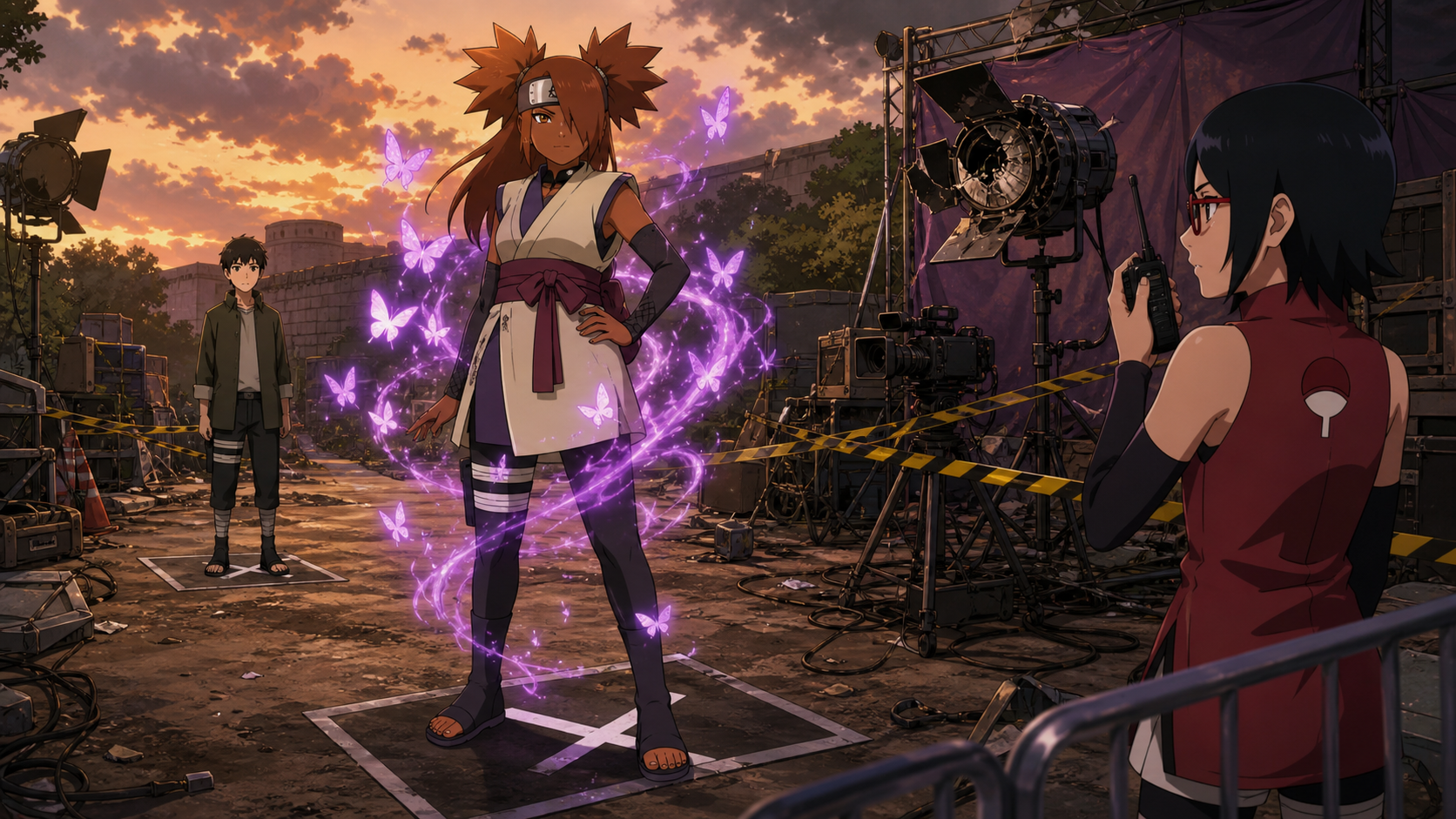
Super Cho-Cho Kiss Mode!
Chōchō lands a television role and a famous costar’s attention while Sarada watches a crush, Butterfly Mode, and an active protection mission collide.
Series: Boruto: Naruto Next Generations
Episode: 68 · Super Cho-Cho Kiss Mode!
Arc: Chōchō Arc
Release: 2018-08-09
Previous: Episode 67 · Super Cho-Cho Butterfly Mode!
Directory: All 293 Boruto episodes
Bottom line
Boruto Episode 68 turns a protection mission into the messiest teen drama Konoha never asked for. Chōchō becomes an emergency actress, Tomaru pours on the flirting, Sarada watches her best friend forget the assignment, and a very real attacker keeps moving around the studio while everybody argues about a fake kiss. “Super Cho-Cho Kiss Mode!” wants to be fluffy romantic comedy. Instead, the episode keeps tripping over the ugly idea that Chōchō becomes desirable only when Butterfly Mode makes her thin.
I will always defend Chōchō's right to enjoy a crush. She does not need to be above romance just because she is loud, confident, and powerful. The problem is Tomaru. He likes a body transformation and a costume before he knows her name. Chōchō starts working to protect that attention, and the girl who normally takes up space without permission begins hiding from her own reflection. Sarada is right to worry. She is also so blunt that every warning sounds like a challenge Chōchō wants to win.
Quick reaction
Chōchō is funny enough to keep this episode moving. Her dramatic posing, her fury at Inojin, and her determination to land the perfect television kiss all feel like the same girl who once launched a parent hunt because her family did not look glamorous enough. Mitsuki walking into romantic scenes at the worst possible second is comedy gold.
The body-image writing is another story. Butterfly Mode should be an Akimichi power, not a magic skinny filter. The episode knows Tomaru's attention is conditional, yet spends most of the runtime presenting that attention like a dream Chōchō would be foolish not to chase. My girl deserves better material than this script inside a script.
The film set is still an active crime scene
The previous attack injured one of the performers. Konohamaru and Moegi inspect the grounds and find footprints along the escape route. Their conclusion is worrying: the attacker either studied the studio closely or received information from somebody inside.
That clue should stop production. Instead, the cameras keep rolling because Ashina insists on finishing her last episode. Boruto loves a village where twelve-year-olds can fight international threats, but even by shinobi standards this set has lost the plot. A masked attacker already crossed security once. Maybe postpone the kissing scene until nobody is bleeding.
The ongoing danger gives every romantic distraction an edge. Chōchō is not simply rehearsing. She is supposed to be guarding people who have received death threats.
Chōchō gets cast because Tomaru chooses her
With the actress injured, Tomaru picks Chōchō as the replacement. He is already attracted to the thin form created by Butterfly Mode. Chōchō hears “you should act opposite me” and immediately floats into her own romance drama.
Can I blame her for being excited? Not completely. Tomaru is handsome, famous, and openly interested. She went from standing near the set as security to wearing a costume beside the leading man. That fantasy would scramble plenty of adults, never mind a genin with a flair for drama.
Still, the choice tells us everything about Tomaru. He does not ask about acting experience or whether she wants the job. He sees a pretty girl and decides she belongs in his scene. Chōchō is cast as an image before anyone treats her like a person.
The kiss scene becomes a personal mission
Chōchō is determined to make the scripted kiss perfect. Her nerves briefly disrupt Butterfly Mode, and her body flickers back. That moment should be a warning that sustaining the transformation is taking effort. Chōchō treats the lapse like a wardrobe malfunction because Tomaru has never seen her usual form.
The cameras roll. Inojin mutters that the performance does not look like real love. The director agrees and cuts the take. Chōchō turns on Inojin with the rage of a woman whose soap-opera debut has been sabotaged by her own cousin.
Inojin is not wrong, but his timing is hilarious. He says the quiet part loudly enough for the professional director to hear, then looks surprised when Chōchō wants to bury him under the soundstage.
Chōchō is acting for Tomaru, not the camera
The scene fails because Chōchō is no longer playing a character. She is chasing proof that Tomaru likes her. Every take becomes a test of whether the fantasy can turn real.
That shift explains why the performance feels false. Chōchō's feelings may be genuine, but she is watching Tomaru instead of listening to the scene. She wants the kiss to deliver an answer no television script can give her.
The director only sees unusable footage. Sarada sees a friend who has tied her mood to a boy's reaction. Both notice the same problem from different angles. Chōchō cannot hear either one yet because the fantasy is louder.
Ashina refuses to pause production
Sarada asks Ashina to postpone filming while the attacker remains loose. Ashina refuses because this episode will be her character's last appearance. That detail changes the emotional temperature around her.
Ashina is not merely a demanding star protecting a schedule. She is being written out while Tomaru keeps the spotlight. Her career is ending on a set where a replacement has already stepped into another injured woman's costume. Of course she is angry. Of course she wants control over the final scene.
Her refusal is still reckless. Pride does not make the threat disappear. The episode plants Ashina's grievance here, but Chōchō's crush pulls so much focus that the warning barely has time to breathe.
Konohamaru and Moegi find the real mystery
While the younger characters spiral around Tomaru, Konohamaru and Moegi investigate the first attack. The footprints suggest planning and inside knowledge. Somebody knew where security was weakest and how to leave the studio.
This subplot is quieter than Chōchō's romantic chaos, but much more important to the arc. The attacker is not a random fan who got lucky. The set itself may be compromised.
Konohamaru and Moegi behave like working shinobi rather than chaperones. Their evidence gives Episode 69 a real foundation and explains why the later ransom demand feels suspicious. I only wish Episode 68 spent more time letting that tension interrupt the comedy.
Tomaru's fans breach the gates
A crowd of fans pushes into the studio. Security collapses fast, and Chōchō grabs Tomaru while Shikadai and Inojin hold people back. The sequence finally remembers that Teams 7 and 10 are on a mission.
Celebrity fandom becomes physical here. Tomaru enjoys attention when admiration stays flattering, but the same attention can erase boundaries and turn dangerous. Chōchō gets him out because she is quick, strong, and decisive. Those qualities matter far more than her costume.
The breach also gives the unknown attacker more noise to hide inside. With fans, crew, actors, and genin running in different directions, the studio becomes exactly the kind of chaos a prepared infiltrator would want.
The locker scene almost gives Tomaru what he wants
Chōchō hides with Tomaru inside a locker. They are squeezed close, breathing the same air, and the staged romance suddenly feels private. Tomaru leans into the moment. Chōchō is ready to believe the scene has followed them off camera.
Then Sarada opens the door.
The interruption is funny because Sarada arrives like the physical embodiment of mission focus. She is not interested in lighting, chemistry, or Tomaru's face. She wants to know why the guard assigned to protect him is hiding in a locker and nearly kissing the client while an attacker remains loose.
Sarada ruins the mood. Sarada also saves the mission from becoming completely unserious.
Sarada sees danger before Chōchō sees conditions
Sarada is worried because Chōchō's priorities have changed. The acting role, Butterfly Mode, and Tomaru's flirtation have become one large project. Every concern sounds to Chōchō like jealousy or disrespect.
Their argument works because both girls are recognizable. Sarada communicates like a future Hokage delivering a corrective briefing. Chōchō hears judgment and pushes harder. Neither one knows how to say, “I am scared you are changing yourself for somebody who has not earned that power.”
Sarada cannot make Chōchō drop the crush. She can keep pointing toward the facts. Tomaru likes the form he met. He does not know what maintaining that form costs. Chōchō is losing focus during a protection mission. Concern is earned even when the delivery is rough.
Tomaru's ring is a prop dressed as intimacy
Tomaru retrieves the ring he gave Chōchō and asks her to read another scene. The gesture feels romantic because he knows exactly how to frame himself. He is an actor. Creating a moment is his whole job.
Chōchō reads the ring as evidence that their connection is special. Tomaru treats flirtation like an extension of performance. He does not have to be plotting anything cruel for the imbalance to matter. He is comfortable moving between scripted affection and personal attention. Chōchō is not.
That ring returns in Episode 69 when he proposes after seeing her strength. The object never represents deep knowledge. The ring represents Tomaru's habit of turning attraction into a dramatic scene before a relationship exists.
Mitsuki has the timing of a small moon-shaped disaster
Just as Chōchō and Tomaru approach another kiss, Mitsuki barges in looking for Ashina's dress. He has no idea that he has detonated a romantic moment. Chōchō attacks him anyway.
Mitsuki's innocence makes the scene. He is still studying ordinary feelings from the outside, and Chōchō's fury provides absolutely no useful data. From his perspective, he asked about clothing and nearly died.
The interruption also exposes how fragile the fantasy is. Every kiss requires Chōchō to isolate Tomaru from the mission, the crew, and her friends. Real life keeps opening the door. Mitsuki just happens to be the funniest version of real life available.
Ashina and Tomaru do not resemble their characters
Ashina discovers Chōchō wearing her costume and demands an explanation. Tomaru pulls Ashina aside. Their argument reveals that neither actor behaves much like the romantic heroes they perform.
Tomaru is careless about Ashina's ending and comfortable replacing people when a prettier option appears. Ashina is furious about losing her role and status. Their resentment has been sitting under polished publicity the entire time.
Chōchō is falling for the version of Tomaru framed by costumes, dialogue, and lighting. The off-camera man is less impressive. Episode 68 knows that distinction, but waits too long to let Chōchō see the full picture.
The episode treats Butterfly Mode like a beauty filter
Here is the part I cannot excuse. Butterfly Mode is one of the Akimichi clan's signature techniques. Chōji's use carried physical danger, family history, and enormous emotional weight. Chōchō's version should say something about inherited power and her own approach to training.
Instead, Episode 68 uses the technique to make her thin enough for a handsome actor's attention. The transformation flickers whenever her emotions or stamina shift, and the comedy treats exposure of her usual body like the nightmare.
That framing does not become empowering simply because Chōchō eventually rejects Tomaru. Her confidence should not require a three-episode detour through “what if a boy only likes me skinny?” The show created the insult before giving her a comeback.
Chōchō is allowed to want the kiss
Criticizing the story does not mean criticizing Chōchō for wanting romance. She likes Tomaru. She enjoys the costume. She wants the kiss scene to become real. None of that makes her silly or weak.
Fandom has a habit of demanding that confident girls prove their strength by never caring what anybody thinks. Human beings do not work that way. Chōchō can love herself and still feel thrilled when someone attractive notices her. She can also get hurt when that attention reveals conditions.
The stronger story lives inside that contradiction. Her desire is real. Tomaru's knowledge of her is shallow. She does not have to deny one fact to learn from the other.
Inojin and Shikadai are terrible romantic support and good teammates
Inojin blurts out the problem with Chōchō's acting. Shikadai tries to manage the fan breach. Neither boy knows how to talk about what is happening without sounding annoyed.
That dynamic fits Team 10. They have known Chōchō long enough to survive her theatrics, but familiarity makes them careless with her feelings. They see the danger before she does and assume bluntness will work because bluntness usually bounces off her.
This time, Tomaru found the soft spot. Chōchō needs her teammates to take the crush seriously even if they do not take Tomaru seriously. Teasing only pushes her deeper into defense.
The attacker benefits from every distraction
Production continues. Fans break through. Chōchō acts, flirts, hides, argues, and chases a kiss. Ashina focuses on her last episode. Tomaru enjoys being the center. The attacker could ask for a better environment, but only if the studio added complimentary snacks.
Konohamaru's footprint clue tells us the threat has planning behind the mask. Every leaked schedule and improvised role creates another opening. Chōchō's distraction matters, but the adults running the set created the conditions long before she fell for anybody.
The episode frames the mission risk as a lesson for Chōchō. The larger failure belongs to a production that refuses to stop after an injury.
Sarada and Chōchō needed a quieter scene
Their arguments happen while the set keeps moving. Sarada warns. Chōchō snaps. Then the next interruption arrives. A quieter scene would let Sarada ask what Chōchō actually likes about Tomaru beyond his face and attention.
Chōchō might not have a good answer. That would be the point. She knows the character he plays, the compliments he gives, and the feeling of being chosen. She does not know what he respects, how he handles disappointment, or whether he would recognize her outside Butterfly Mode.
Friendship is strongest when somebody can ask the embarrassing question without turning the answer into a joke. Episode 69 eventually gives them more room, but Episode 68 needed that honesty sooner.
The episode looks brightest when Chōchō owns the comedy
Chōchō has star power. Her poses are enormous. Her reactions fill the screen. She can turn a basic rehearsal into a personal premiere. The animators understand that her confidence should be visual, not merely stated.
The comedy works when she controls the joke. Chōchō threatening Inojin after his commentary is funny because their relationship has history. Her romantic fantasies are funny because she commits with her whole soul. Mitsuki's interruption works because he walks into her genre without noticing.
The jokes fail when her body becomes the punch line. There is a clear difference between laughing with Chōchō's dramatic personality and waiting for Tomaru to discover what she “really” looks like.
Replay notes
Watch how quickly Tomaru turns casting into flirting. His charm feels effortless because he has probably used the same rhythm with plenty of admirers. Chōchō reads spontaneity where he may simply be very practiced.
Watch Ashina during discussions of her final episode. Her later scheme does not appear from nowhere. She is already measuring how easily the production dismisses her ideas and replaces women around her.
Watch Sarada's face in the locker scene. She is annoyed, but fear sits underneath the annoyance. The attacker is still free. Chōchō is supposed to be watching Tomaru, not getting lost in him.
Finally, watch Mitsuki. His confusion sets up the potato-chip wisdom he delivers in the finale. He spends Episode 68 collecting evidence about Chōchō and romance without realizing he has joined the case.
What worked
Chōchō's personality remains impossible to flatten. She is enthusiastic, stubborn, vulnerable, funny, and fully convinced that the camera belongs to her. Sarada's concern creates real friendship friction, while Inojin and Mitsuki supply comedy that grows from established relationships.
Konohamaru and Moegi's investigation gives the arc forward motion. The footprints and possible inside information matter. Ashina learning that this is her final episode also plants the motive for the finale.
The locker interruption is a good comic set piece. Sarada opening that door has the energy of a mother finding teenagers in the basement, except everybody involved can throw chakra-enhanced punches.
What did not work
Butterfly Mode becomes a thin-body fantasy when the technique deserves far more respect. Tomaru's attraction is so visibly conditional that the episode cannot sell him as a charming possibility. The audience sees the problem long before Chōchō, which makes repeated almost-kisses feel uncomfortable instead of romantic.
The active threat barely affects production decisions. An actress has already been hurt, fans breach the studio, and investigators suspect inside help. Somehow the director's priority remains whether Chōchō's kiss looks convincing.
Ashina's last-episode revelation needs more space. Her career resentment is the mystery's spine, but the episode buries that material beneath romantic comedy that never earns the romance.
Tomaru wants the scene, not the girl
Tomaru’s attraction follows the production schedule. Chōchō enters Butterfly Mode, receives a costume, stands under flattering lights, and suddenly becomes somebody he can imagine kissing. He responds to a finished image while Chōchō mistakes that response for recognition.
The locker scene exposes the gap. Chōchō wants a private moment where the performance can become real. Tomaru wants access without showing any curiosity about the person behind the role. Sarada interrupts because she understands that secrecy, pressure, and celebrity status do not create romance. They create conditions where Chōchō has less room to decide.
Chōchō still has every right to want the kiss. Desire does not become foolish merely because the target has the emotional depth of a promotional poster. The comedy works because Chōchō commits fully, Inojin ruins everything with impeccable timing, and Mitsuki treats romantic tension like a scientific observation nobody requested.
The problem belongs to the framing. Butterfly Mode keeps functioning as visual proof that Chōchō can become worthy of Tomaru’s attention. Her normal body gets treated as a disclosure waiting to happen. A stronger story would make Tomaru’s shallow gaze the joke from the beginning.
Sarada sees her friend shrinking choices around a fantasy and tries to pull her back. Chōchō hears criticism because infatuation converts every warning into interference. Their conflict deserves more quiet space, but the loyalty remains clear. Sarada is not trying to win an argument. She is trying to keep Chōchō from handing a stranger the final vote on her value.
RaeRae verdict
“Super Cho-Cho Kiss Mode!” is entertaining whenever Chōchō gets to be loud, funny, and specific. I laughed at Inojin ruining the take. I laughed harder when Mitsuki destroyed the second almost-kiss by asking for a dress. Sarada barging into the locker deserves its own alarm sound.
I cannot forgive the episode for turning Butterfly Mode into a beauty filter. Chōchō's ordinary body is not a secret Tomaru must be prepared to survive. Tomaru likes the version styled, transformed, and placed across from him. He has not earned the girl underneath the performance because he has barely tried to meet her.
Episode 68 ends with Chōchō still chasing the fantasy and the attacker still close. That frustration is intentional, but the story asks too much patience from anybody who loves her. Let Chōchō flirt. Let her want the kiss. Then give her a romance that can recognize her without waiting for the lighting, the costume, or the chakra to change.
Sources and lawful viewing
Official episode reference: Naruto Official episode guide
Licensed episode route: Crunchyroll licensed series page