
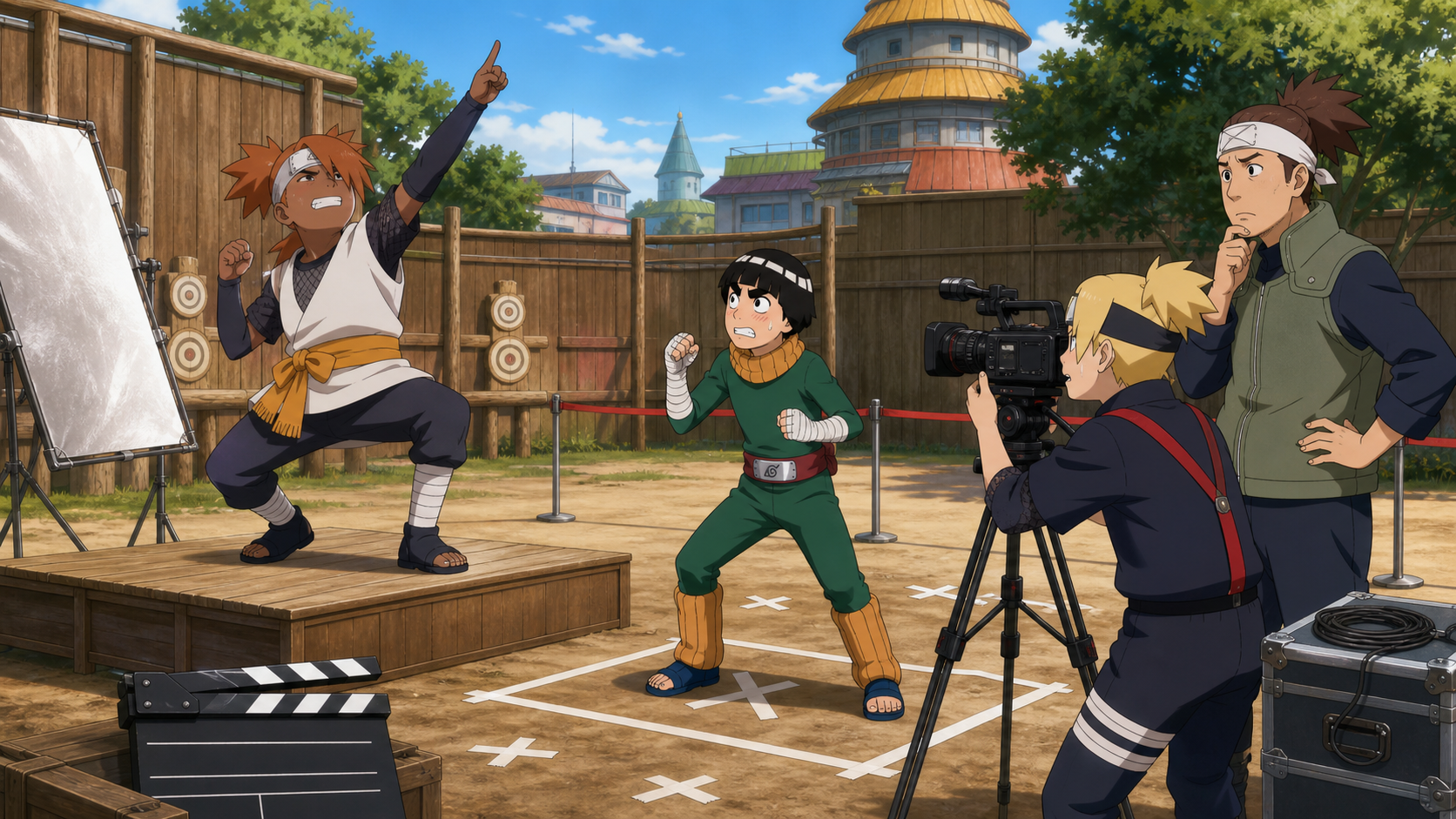
The Genin Documentary!
Team 5 cannot look natural for a camera, but a reckless demolition shoot reveals exactly why Naruto chose Iwabee, Denki, Metal, and Udon.
Series: Boruto: Naruto Next Generations
Episode: 48 · The Genin Documentary!
Arc: Genin Life Arc
Release: 2018-03-07
Previous: Episode 47 · The Figure I Want to Be
Directory: All 293 Boruto episodes
Bottom line
“The Genin Documentary!” puts Team 5 in front of a camera and immediately proves that none of them know how to act once somebody says “be natural.” Iwabee, Denki, and Metal have just finished a suspension that kept them away from the Byakuya Gang crisis. Their classmates earned praise while they watched. Then Naruto personally selects Team 5 for a promotional documentary meant to raise Academy enrollment, and Iwabee sees one clean chance to prove the team belongs beside everybody moving toward the Chunin Exams.
Of course the filming goes badly. Their introductions are stiff, the director wants flashy ninjutsu, Iwabee pushes a staged action sequence until frightened civilians become the real audience, and Udon shuts the production down. The crew later sneaks into a condemned building to create demolition footage, triggers an actual collapse, and Team 5 finally looks like shinobi because nobody has time left to pose. Metal shields the crew. Denki reads the structure. Iwabee holds a falling crane. Udon saves everybody with the most disgusting useful jutsu in Konoha. The documentary finds its story only after the attempt to manufacture heroism nearly buries the filmmakers.
Iwabee starts the episode already angry
Naruto praises the genin who helped resolve the Byakuya Gang conflict. Iwabee hears that interview while remembering that Team 5 was suspended and ordered to stay out of the action. The punishment may have been deserved, but watching classmates receive public credit still hurts.
His frustration grows when news of the Chunin Exams begins circulating. Iwabee repeated Academy years before becoming a genin, so another group advancing ahead of him touches an old fear. He does not want to become the boy left behind again.
Suspension gave Team 5 nothing glamorous
Iwabee, Denki, and Metal could not participate in the biggest village crisis of their early careers. They had to accept an order to remain still while other genin acted. For Iwabee, obedience felt suspiciously like failure because nobody makes documentaries about the children who followed a suspension.
That emotional setup explains why he attacks the publicity mission with too much hunger. He wants footage that can erase the week of helplessness. A camera seems capable of turning one impressive afternoon into proof that Team 5 never fell behind.
Naruto chooses the least camera-ready team imaginable
Udon lifts Team 5’s suspension and announces their new mission: appear in a documentary promoting the Academy’s ninjutsu program. Enrollment is falling, and Konoha wants young viewers to see what genin life looks like.
Naruto personally chose Team 5. That choice becomes important later, but at first everybody looks confused. Team 7 carries famous names and recent victories. Team 10 has recognizable clan techniques. Team 5 has Iwabee’s bluntness, Denki’s nervous technical brain, Metal’s performance anxiety, and Udon’s nose. Honestly, perfect television.
The boys cannot introduce themselves
Once filming starts, all three struggle to sound like normal people. Metal’s anxiety gets worse because a lens is staring at him. Denki understands devices better than performance. Iwabee tries to project strength and looks like somebody trying to project strength.
The awkwardness is fun because shinobi training did not prepare them for public relations. A mission brief has objectives and roles. “Tell the camera who you are” opens an entirely different kind of danger. The boys know how to be Team 5 when they are working. They do not know how to explain Team 5 before anything happens.
The director wants another team
The director pulls Udon aside and asks whether a different group might produce better footage. Udon tells him that Naruto selected Team 5 personally. That answer protects the boys without pretending the early material is good.
The director once wanted to become a shinobi, which shapes what he expects to see. He wants spectacular ninjutsu because the shinobi life in his imagination was built from dramatic moments. Team 5 begins performing for that old fantasy instead of showing the work they actually do.
Iwabee understands spectacle immediately
When the director asks for action, Iwabee raises the ground with Earth Release. Metal strikes the formation, then shuriken fly toward Denki so he can use substitution. The sequence finally gives the camera movement, danger, and techniques worth cutting into a trailer.
The problem is that they stage power in a public space without respecting the people nearby. Civilians become frightened because the boys are throwing weapons and tearing up the ground for a shot. Iwabee sees footage that proves ability. Udon sees shinobi forgetting why ability exists.
Denki is more than the boy standing in the shuriken path
The staged sequence uses Denki as the person who has to substitute away from incoming weapons. His role looks less impressive than Iwabee’s Earth Release or Metal’s physical attack, but timing and awareness make the stunt possible.
Later, during the collapse, Denki’s analysis becomes essential. He reads what the building is doing and helps the team understand the danger. Episode 48 quietly argues that the camera notices large motion first, while survival depends on the teammate who processes information fast enough to direct everyone else.
Metal performs better when the danger is real
Metal’s nerves make the documentary painful. A camera invites self-consciousness, and self-consciousness tangles his body. During the building collapse, he moves to shield the crew from debris without stopping to imagine how he looks.
That contrast fits Metal perfectly. He has trained his body. His anxiety attacks the space between preparation and observation. When somebody needs protection, purpose becomes louder than performance. The documentary crew finally captures his strength after they stop asking him to demonstrate strength.
Udon shuts the shoot down for the right reason
Udon sees civilians reacting to the staged action and stops Team 5. He does not care that the footage looks exciting. Shinobi cannot frighten the people they are meant to protect just because a director wants a dramatic sequence.
This is where Udon proves why he is their captain. He knows the boys feel left behind and understands why Iwabee wants a visible win. He still refuses to let insecurity decide mission standards. Empathy does not require him to approve a bad choice.
Iwabee almost throws away his forehead protector
After Udon ends the filming, Iwabee takes the failure personally. He considers throwing down his forehead protector because the documentary was supposed to prove Team 5 deserved recognition, and the attempt became another correction.
Metal stops him. That matters because Iwabee often acts like the strongest, most certain member of the group. Metal recognizes that the anger is covering shame and intervenes before one dramatic gesture becomes a decision Iwabee cannot take back easily.
Udon tells them how often he failed
Udon admits that he struggled at the Academy and made plenty of mistakes during early missions. The confession changes Iwabee’s understanding of his captain. Udon is not lecturing from a flawless career.
I like this scene because Udon does not transform failure into a slogan. He gives Iwabee evidence that repeating a year, embarrassing himself, or needing correction did not end his path. The adult standing in front of Team 5 survived an unimpressive beginning and became somebody Naruto trusts with students.
Looking cool was never Udon’s advantage
Udon grew up beside Konohamaru and Moegi, usually carrying the least glamorous running gag in the group. Now his nose-based technique becomes the final defense during a building collapse. The episode knows exactly what joke has been waiting for this payoff.
He is the perfect instructor for a documentary obsessed with appearance. Udon never looked like the obvious future jōnin. He learned, persisted, and became effective anyway. Team 5 needs that model more than another legend whose childhood talent was impossible to ignore.
The filmmakers create the danger they wanted
That night, the crew decides not to waste the project. They detonate explosive tags placed on a condemned building to capture dramatic footage. The first shots do not satisfy them, so they go inside.
I need the adults responsible for this decision to sit down and think about every choice that brought them under a collapsing roof. Team 5 was removed because the staged action frightened civilians. The crew responds by staging demolition without the shinobi team. The documentary’s hunger for danger creates actual danger.
The condemned building stops being a set
Once the structure starts collapsing, camera angles and scripted movement disappear. The crew cannot direct falling beams. Team 5 has to respond to weight, timing, blocked exits, and frightened people in a space that may fail faster than any one technique can handle.
This is the real documentary. Not because disaster is more authentic than routine work, but because the boys stop managing their image. Each one notices a different need and acts from training.
Metal becomes the shield
Metal protects the crew from falling debris. The boy who could barely perform naturally for the lens puts his body between civilians and harm as soon as the choice matters.
His action does not cure his anxiety. That is not the point. Metal can feel anxious in one setting and dependable in another. The episode lets competence coexist with a nervous system that does not behave conveniently for television.
Denki reads the collapse
Denki analyzes the structure while debris falls around them. His intelligence becomes field survival rather than a novelty attached to computers. He gives the group information they cannot obtain through strength alone.
This is the Team 5 balance I want more often. Denki should never be written as a weak shinobi waiting for combat power to arrive. He sees systems, notices failure patterns, and turns knowledge into decisions. Leadership can begin with naming what everybody stronger missed.
Iwabee holds the crane
When a crane falls, Iwabee uses his strength to hold the threat back. The image delivers everything the director wanted: danger, power, and a young shinobi performing an impossible-looking rescue.
The difference is purpose. Iwabee is no longer moving earth so a camera can admire him. He is buying time for people to escape. His strength finally looks heroic because the action belongs to somebody else’s safety.
Udon’s Nose Water Tree saves the day
Udon stops the collapsing debris with his nose-based technique. Yes, the jutsu is gross. Yes, the jutsu works. Both facts deserve equal respect.
The moment demolishes the director’s narrow idea of what shinobi power should look like. The least cinematic technique in the group becomes the support holding the rescue together. Konoha has spent years teaching us that usefulness often arrives wearing a form nobody would choose for a poster.
Team 5 loses the forehead protector in the rescue
During the confusion, Iwabee loses his forehead protector. Earlier, he nearly discarded the symbol because shame made him question whether he deserved the role. Now the protector disappears while he is doing the exact work the symbol represents.
Metal and Denki recover the forehead protector and return the symbol later. That choice turns the object into a team statement. Iwabee does not carry the title alone. His teammates saw him protect people and refuse to let one lost piece of metal erase that truth.
The crew finally wants Team 5
After being rescued, the filmmakers ask to keep Team 5 as the documentary subjects. The team no longer needs a manufactured stunt. Their real response produced better evidence than every planned shot.
The irony is satisfying, but the rescue should not be read as proof that every documentary needs a disaster. The useful lesson is simpler. Team 5 becomes interesting when the camera observes who they are under pressure instead of asking them to impersonate somebody else’s fantasy of shinobi.
Naruto knows who Iwabee is
When Team 5 reports to Naruto, he shares his own Academy struggles and reveals that he remembers Iwabee personally. Iwabee cries because the Hokage’s recognition reaches the fear driving the whole episode.
He wanted public footage because he believed visibility could prove he had not been left behind. Naruto naming him does more than the planned documentary ever could. The moment is sentimental, and I am fine with that. Iwabee’s rough exterior has always covered a child who measures himself against every person who advanced sooner.
Naruto’s choice of Team 5 makes sense
Naruto did not select the smoothest team. He selected boys whose paths could reach Academy students who do not see themselves in prodigies. Iwabee struggled academically. Denki entered without the expected physical foundation. Metal has skill complicated by anxiety. Udon’s own history is full of ordinary failure.
That is a better recruitment story than three naturally camera-ready geniuses. The Academy does not need children to believe every shinobi starts impressive. The Academy needs them to know learning can remain messy long after the forehead protector arrives.
Team 7 watches the finished documentary
Boruto, Sarada, and Mitsuki eventually watch Team 5’s documentary. The moment returns the boys to the peer audience Iwabee cared about from the beginning.
Team 5 is no longer the suspended squad watching everybody else receive praise. Their work reaches classmates on its own terms. The documentary does not erase the punishment or give them credit for the Byakuya Gang conflict. The film records a different day when their combination saved people.
My favorite beat is Metal returning the protector
Udon’s jutsu is the unforgettable gag, and Naruto recognizing Iwabee provides the emotional release. Metal and Denki returning the lost forehead protector is my favorite because the gesture stays inside the team.
Iwabee almost threw the protector away when he felt humiliated. His teammates refused to let him. Later, they find the same symbol after watching him risk himself during the collapse. Their quiet return says that one bad shoot never decided whether he belonged.
The part that frustrates me
The film crew creates a preventable collapse and receives a fairly gentle narrative response. They rig explosive tags, enter an unstable structure because the footage was not dramatic enough, and need children to save them.
The episode wants the accident to reveal Team 5’s authentic strengths, and that part works. I still wanted Udon or Naruto to show more anger at the adults who turned a promotional assignment into a rescue. Genin should not have to prove professionalism by surviving somebody else’s reckless production choice.
Team 5 cannot perform a clean identity because their strength is collaborative
The director wants a quick visual definition. One child should look powerful, one should say something memorable, and the footage should explain genin life before the audience changes channels. Team 5 refuses that format without meaning to.
Iwabee’s Earth Release looks impressive, but his real strength depends on judgment about where force belongs. Denki’s intelligence produces no dramatic pose. Metal’s taijutsu becomes less reliable when everybody watches him perform. Their useful traits appear between people rather than inside isolated introductions.
That makes the failed interviews honest. The boys cannot summarize themselves because none has finished becoming the person the documentary expects. Suspension, academic struggle, anxiety, and uneven field experience remain part of the record. A polished script would hide the reasons their teamwork matters.
Iwabee wants spectacle because recognition feels like proof that old failure no longer defines him. He sees teams advancing, classmates earning praise, and Naruto’s generation turned into legend. A documentary could place him inside the same public story. When the director loses interest, Iwabee hears another verdict that he is not enough.
Udon offers the correction nobody else can. His childhood contained poor grades, awkwardness, and a running nose everybody treated as a joke. He did not become a leader by erasing those details. He learned how to turn an embarrassing trait into Water Release and how to recognize value in students whose strengths arrive unevenly.
The condemned building reveals the team because rescue removes the performance demand. Metal shields people before anxiety can turn every eye into judgment. Denki reads the collapse and gives the others usable information. Iwabee holds the crane because raw strength finally has a precise job.
Udon’s Nose Water Tree completes the point. The technique could never sell the glossy image the director wanted. The technique saves lives. Shinobi value and camera-ready cool were never the same measurement.
Metal returning the forehead protector restores Iwabee’s connection to the team before Naruto offers public recognition. That order matters. Iwabee does not remain a shinobi because the Hokage noticed him. He remains because teammates already know who he is during failure, frustration, and rescue.
Naruto’s choice of Team 5 becomes clear afterward. A documentary about genin should show children learning to make incomplete abilities useful together. Team 5 gives the village a better truth than a montage of perfect introductions ever could.
The film crew still owes more than gratitude. Adults rig explosives in an unstable structure because ordinary genin work does not look exciting enough. Team 5 saves them, but rescue should not convert reckless production into a successful creative decision. Udon should file an incident report, the village should review the crew’s access, and somebody should reimburse the children for becoming unpaid emergency responders inside their own promotional assignment.
Good footage does not erase a preventable emergency.
Accountability still belongs behind the camera.
RaeRae’s verdict
“The Genin Documentary!” is one of those Boruto side stories that sounds disposable until the character work starts landing. Iwabee wants recognition because suspension and old academic failure have convinced him that everybody advances while he remains the same boy. Denki and Metal want to support him, but none of them can perform an identity for a director who only recognizes flashy ninjutsu.
The collapse gives Team 5 no time to pose. Metal shields, Denki analyzes, Iwabee holds the crane, and Udon turns a lifelong gross joke into a life-saving defense. Naruto’s later recognition reaches Iwabee because Team 5 finally has evidence that belongs to them. The documentary succeeds when the camera stops asking these boys to look like shinobi and records the moment they choose to protect people instead.
Sources and lawful viewing
Official episode reference: Naruto Official episode guide
Licensed episode route: Crunchyroll licensed series page