
Go! The Crest of Night Strategy
Shikadai reads Ryōgi’s protest strategy as a shōgi decoy, Team 10 trusts his hunch, and Boruto joins the race to stop Gekkō from escaping with Katasuke’s data.
Series: Boruto: Naruto Next Generations
Episode: 46 · Go! The Crest of Night Strategy
Arc: Byakuya Gang Arc
Release: 2018-02-21
Previous: Episode 45 · Memories from the Day of Snow
Directory: All 293 Boruto episodes
Bottom line
Boruto Episode 46 finally lets Shikadai stop circling the truth and make a choice. The Byakuya Gang turns Konoha’s anger into a shōgi board, sending protesters toward Kaminarimon Company while Gekkō raids Katasuke’s laboratory for ninjutsu data. Shikadai recognizes Ryōgi’s favorite decoy because the boy taught him how to see that move. That realization hurts more than any clever reveal should. Their games were real to Shikadai, even if Gekkō planned to use every lesson against him. I love that Team 10 follows before Shikadai can build a tidy argument. Chōchō and Inojin know their friend well enough to hear conviction underneath uncertainty. Boruto follows for the same reason. The episode belongs to Shikadai because he has to chase a thief, confront a friend, disobey an assignment, and trust his own read of the board all at once. For a kid whose favorite defense is pretending everything sounds too troublesome to matter, that is enormous.
We open on the goodbye Shikadai did not accept
Ryōgi walks away from Shikadai before the operation begins, and the quietness of that exit makes the coming betrayal feel worse. Shikadai is not standing there as a shinobi who lost a suspect. He is a lonely kid watching his shōgi friend choose somebody else. Chōchō and Inojin arrive with orders about the protest, so Shikadai has no time to sit inside the rejection. That is very Naruto as a franchise. Personal heartbreak does not wait for the mission to end, and the mission does not pause because a child needs a minute. Shikadai carries both. His face stays controlled, but his attention keeps returning to Ryōgi because the friendship has already changed how he reads everything around him.
Gekkō praises a plan built from somebody else’s trust
Gekkō calls the Crest of Night strategy Ryōgi’s success while they watch the protest swell below them. That praise lands like poison. Ryōgi took a shōgi idea shared with Shikadai and turned the pattern into cover for a robbery. Gekkō does not merely exploit the village. He exploits the part of Ryōgi that wanted to feel smart, useful, and chosen. Every compliment keeps the boy attached to the man who raised him through fear and lies. Ryōgi looks at the crowd, but his mind remains with Shikadai. He knows exactly who might recognize the move. The strategy works because friendship gave him better information, and that knowledge has already started to make victory taste wrong.
The protest is real even when the leadership is rigged
The crowd outside Kaminarimon Company is angry about wealth, power, and a company that represents Konoha’s widening gap between people who benefit from modernization and people who feel discarded by the change. The Byakuya Gang did not invent every frustration on those streets. Gekkō gives existing resentment a target, a slogan, and a shove. That distinction matters because the episode refuses to turn ordinary villagers into disposable villains. Boruto looks uncomfortable when police explain that shinobi cannot use ninjutsu against civilians. Good. He should be uncomfortable. These are neighbors, not enemy soldiers. The ugliness comes from Gekkō using their grievances as camouflage while pretending exploitation is liberation.
That mark on the protest leader changes the whole scene
One of the men steering the crowd carries the same strange mark connected to Gekkō’s control. Later, Sarada uses her Sharingan to catch what everyone else misses. His movements do not fit the emotion around him. Denki notices the crowd behaving in patterns that feel manufactured, and Sarada finds the physical clue. I like this pairing because nobody solves the unrest through a speech. Denki reads systems. Sarada reads bodies. Together they recognize manipulation without declaring every protester fake. The gang planted pressure points inside a legitimate gathering and used genjutsu to make escalation look spontaneous. That is a much nastier plan than simply hiring a mob, because real people will carry the consequences after Gekkō escapes.
Boruto hates standing opposite ordinary villagers
Boruto has rushed into danger plenty of times, but facing upset citizens unsettles him in a different way. There is no clean enemy line. Some people believe they are defending the village from corporate greed. Some are frightened. Some are furious. A controlled leader keeps pushing them toward violence. Boruto cannot solve that with a louder Rasengan, and the police explicitly warn the young shinobi about excessive force. I appreciate the discomfort because Boruto’s instinct is always action. Here, action without judgment could hurt the people he is meant to protect. The episode makes him stand still long enough to see why restraint is also shinobi work.
Team 10 gets a post, but Shikadai gets a puzzle
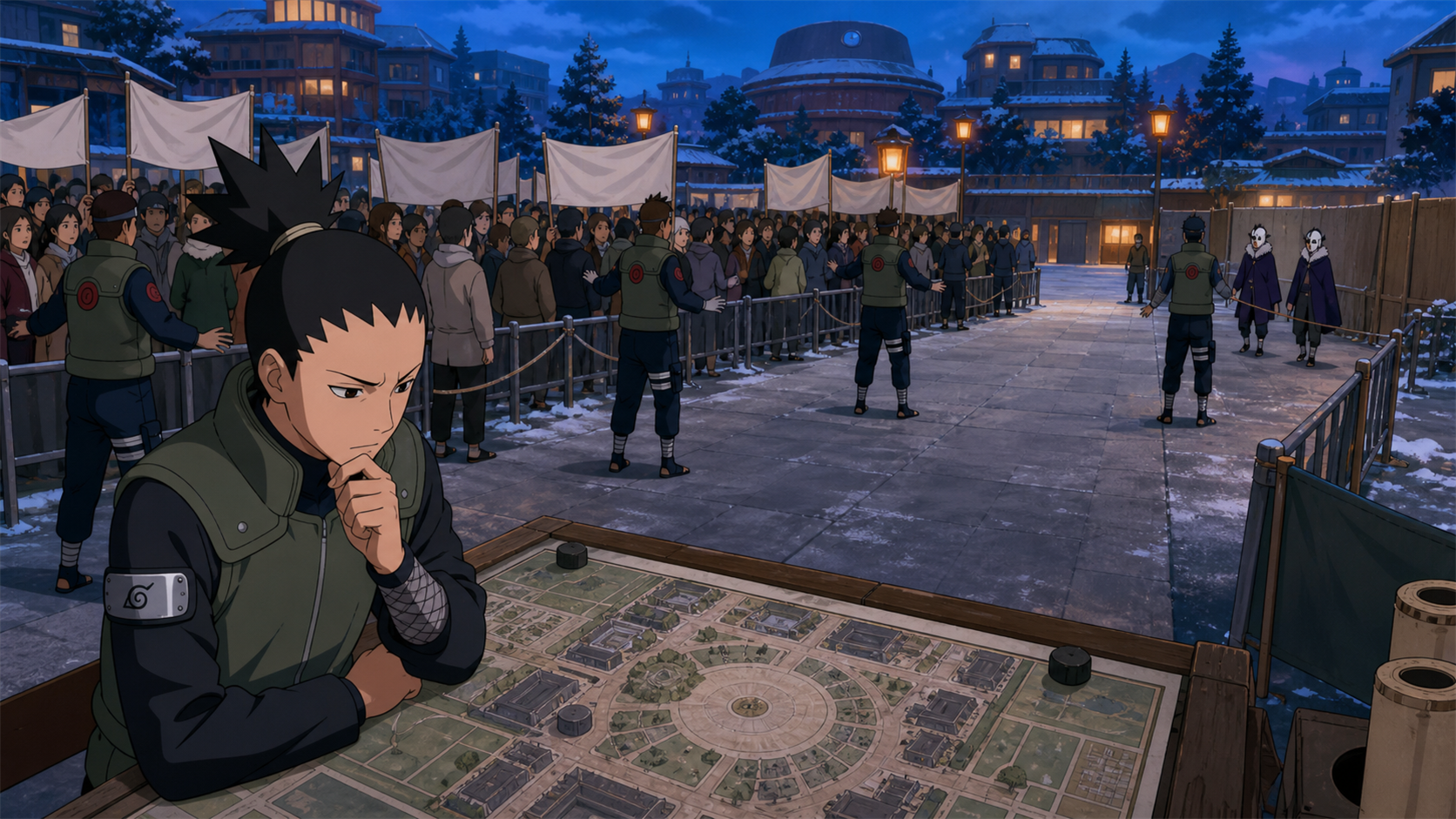
Kōtarō assigns teams across the protest route, placing Team 10 near Kaminarimon headquarters. Shikadai studies the deployment map while everybody else prepares to hold position. The arrangement needles him because the empty space does not look accidental. Chōchō is the one who says the positions resemble shōgi pieces, and suddenly Ryōgi’s decoy strategy snaps into focus. I love that Chōchō supplies the spark. Shikadai may be the strategist, but his teammates are not furniture waiting for his genius. She recognizes the visual language because she has spent enough time beside him to know what he sees. Team 10 works when familiarity becomes shared intelligence.
The empty square points straight at Katasuke
Once Shikadai recognizes the board, he asks Inojin what sits inside the unguarded opening. The answer is Katasuke’s research laboratory, full of ninjutsu data worth far more than anything the gang could grab during another street robbery. Suddenly the protest route stops looking chaotic. Every shinobi pulled toward Kaminarimon leaves the laboratory exposed. The crowd is not the target. Kaminarimon is not even the target. Both are pieces moved so Gekkō can reach the one square nobody is watching. That reveal feels satisfying because the arc has spent several episodes teaching us how Ryōgi thinks. Shikadai solves the operation by taking their friendship seriously.
Shikadai has no proof, only the right answer
The best part of Shikadai’s decision is that he does not have evidence neat enough to hand to a superior. He has a pattern, a memory, and the sick certainty that Ryōgi built the board. Leaving his assigned post could expose civilians if he is wrong. Staying could give the Byakuya Gang every piece of research in Katasuke’s lab. Shikadai hates troublesome choices because they force him to care publicly. This time he cannot hide behind procedure or laziness. He chooses the risk attached to his own judgment. That is not reckless heroism. He studies the map, names the target, and moves because the position demands a player.
Chōchō and Inojin follow before the explanation is finished
Inojin points out that Shikadai usually does not move without proof. Chōchō knows the same thing. Neither teammate uses that uncertainty as an excuse to stay behind. They follow because Shikadai’s unusual urgency is evidence of its own. Their loyalty is not blind. They ask questions while moving, keep thinking, and help test his conclusion. I love Team 10 most in these little moments. The formation inherited famous clan techniques, but the real inheritance is trust built through constant proximity. Shikadai does not need to perform confidence for them. He can admit that he is working from a hunch, and they still make the hunch a team responsibility.
Boruto sees Shikadai moving and chooses him
Team Konohamaru spots Team 10 leaving position, and Boruto immediately breaks away to learn why. Mitsuki tells Sarada to trust him. That tiny exchange shows how much the new generation already understands one another. Boruto does not know the full plan, but he knows Shikadai would not abandon civilians for fun. Sarada does not like losing formation, yet Mitsuki recognizes that Boruto’s refusal to ignore a friend may be useful here. The chase gains another player because relationships travel faster than command. In a weaker episode, Boruto would take over as soon as he arrives. Here, he listens while Shikadai explains the board.
The laboratory robbery proves Shikadai right too late for comfort
While the genin run, the Byakuya Gang enters Katasuke’s laboratory and takes the ninjutsu data. The clean efficiency of the theft makes the protest outside feel even crueler. Civilians are risking injury and arrest while Gekkō walks away with research that can be sold or weaponized. His grand language about justice collapses the second we see the actual prize. He is not redistributing food. He is not exposing corruption. He is stealing power while other people absorb the danger. Ryōgi may still believe pieces of the gang’s mission, but Gekkō’s priorities are sitting in that stolen scroll.
Katasuke’s research is the perfect target for this era
Katasuke represents the village Boruto inherited: shinobi skill translated into technology, information, and portable power. Stealing his data means stealing techniques without enduring the training, relationships, or responsibilities that once carried them. That fits Gekkō perfectly. He wants the appearance of righteous struggle without accountability to the people used along the way. The episode does not pause for a lecture about scientific ninja tools, but placing the robbery here says plenty. Modern Konoha’s most valuable treasure is no longer locked in a feudal vault. Knowledge is the prize, and controlling who can reproduce power will shape the next generation.
Sarada and Denki expose the manufactured escalation
Back at the protest, Denki studies the crowd’s movement and says the behavior does not make sense. Sarada activates her Sharingan and identifies the marked agitator. Their discovery gives the shinobi a way to interrupt Gekkō’s control without attacking everybody around him. This is the smartest crowd scene in the arc because the children protect civilians by being specific. They do not dismiss the anger. They isolate the person unnaturally driving violence. Sarada’s eyes are famous for combat, yet she uses them here to distinguish coercion from choice. That is exactly the kind of leadership skill I want Boruto-era shinobi to learn.
Naruto’s restraint is part of the village he wants to lead
Naruto could overwhelm the crowd physically, but raw strength would prove nothing except that the Hokage can dominate his own citizens. The police and shinobi hold back because protecting Konoha includes people who are angry with its most powerful company. Naruto grew up resenting a village that refused to hear him. Watching his administration make room for dissent feels important, even while Gekkō exploits that restraint. The scene is not perfect political philosophy, and I do not need perfection from a fandom episode. I need Naruto to remember that frightened, furious villagers remain his people. He does.
Iwabee being stuck in the hospital is a small character win
Iwabee wants to leave the hospital and join the response. Metal reminds him that orders are absolute, reversing their usual emotional positions. The boy most likely to charge ahead now has to watch somebody else accept limits. Their brief scene keeps the crisis connected to the wider class. The protest affects more than the four children chasing the gang. Iwabee’s frustration also mirrors Shikadai’s dilemma from the opposite side. One kid obeys because his condition makes intervention dangerous. Another disobeys because his information makes staying dangerous. The episode does not pretend the same rule produces the right answer in every situation.
The train escape turns strategy into pursuit
The Byakuya Gang splits after the robbery so Gekkō can escape with the stolen data. Other shinobi engage the remaining members while Boruto and Shikadai pursue Gekkō and Ryōgi toward the train. The board has become physical now. Routes, timing, and bodies replace pieces on paper. Shikadai’s read got them this far, but solving the decoy does not end the mission. He still has to catch the person who understood his habits well enough to plan around them. Every step toward that train brings him closer to Ryōgi and further from the possibility that their friendship can return to something simple.
Boruto supports the plan without stealing the spotlight
Boruto’s role works because he brings urgency without pushing Shikadai out of his own arc. He believes the lab is the target, runs beside him, and helps force the chase forward. Boruto knows what betrayal by a lonely kid can look like because he has spent the series making friends with people who hide pain behind bad decisions. He does not approach Ryōgi with Shikadai’s tenderness, but he respects why Shikadai cannot treat him as an ordinary thief. That balance matters. Boruto is the title character, yet the episode allows him to become the friend who shows up for somebody else’s confrontation.
Ryōgi keeps looking back because the bond was real
Ryōgi participates in the robbery and escape, but his thoughts keep returning to Shikadai. A purely fake friendship would be easy for him to discard. This one is not. Shikadai gave him warmth without asking for obedience, and that experience now competes with years of Gekkō’s control. The tragedy is not that Ryōgi fooled Shikadai perfectly. The tragedy is that Ryōgi found something genuine and still could not imagine choosing his friend over the man he believes saved him. Gekkō built a cage where gratitude, grief, and fear all point toward the same command. Shikadai is the first person who makes another direction visible.
Gekkō’s revolution ends wherever his profit begins
Gekkō has spent the arc speaking about stealing from the rich, but Episode 46 exposes the distance between his slogans and his conduct. He manipulates workers, controls civilians, raids a laboratory, abandons gang members, and runs with research valuable enough to secure his own future. Everybody else is a screen between him and consequence. That is why the Kaminarimon protest matters beyond spectacle. Gekkō does not care whether the company changes. He cares that anger keeps the police busy. The episode finally strips away the romantic thief pose and leaves a man who monetizes other people’s wounds.
Shikadai is becoming a Nara without becoming Shikamaru
The shōgi reveal naturally echoes Shikamaru, but Shikadai’s choice belongs to him. Shikamaru often treats the board as a way to control distance. Shikadai reads this board because he let Ryōgi close. Friendship supplies the decisive intelligence. His emotional investment is not a distraction from strategy. Emotion is the reason the strategy becomes legible. That feels like the right evolution for the Nara line. Shikadai inherits the patience, pattern recognition, and exhausted sigh, but his own growth depends on admitting that people are not pieces. He can predict Ryōgi precisely because he cares what Ryōgi wanted from their games.
Team 10 proves that orders and judgment have to meet somewhere
I do not want genin freelancing every time a map gives them a feeling. I also do not want a shinobi story where obedience replaces thought. Episode 46 puts that tension inside a credible emergency. Shikadai lacks time to climb a command chain while the robbery is already happening. His teammates reduce the risk by staying together, explaining their movement, and bringing Boruto into the pursuit. The choice remains dangerous, but the episode earns that choice through preparation. Shikadai is not chasing a random instinct. He recognizes a strategy demonstrated directly to him by the person executing the plan.
The title sounds triumphant, but the victory belongs to Gekkō for now
“Go! The Crest of Night Strategy” has the energy of a mission launch, yet most of the plan succeeds. The protest draws the village’s defenders. The laboratory is breached. The data leaves Katasuke’s hands. Gekkō reaches the train. Shikadai’s discovery prevents a clean escape, not the crime itself. I like that the episode ends inside unfinished danger. Recognition does not magically reset the board. The children arrive late and have to fight from a losing position. That pressure is exactly what Episode 47 needs. Shikadai has solved Ryōgi’s move, but he has not solved Ryōgi.
What changed on every replay
My first watch followed the puzzle: the protest map becomes a shōgi formation, the empty square reveals Katasuke’s lab, and Shikadai runs. On replay, Ryōgi’s face became the episode. He already suspects Shikadai will see through the strategy, and Gekkō’s praise only makes that fear heavier. Another pass made Chōchō stand out. Her quick recognition unlocks Shikadai’s thinking, and her decision to follow turns a solitary hunch into Team 10’s move. The last detail I kept returning to was Boruto’s discomfort at the police station. The loudest kid in Konoha understands that protecting people sometimes means refusing the easiest display of power.
The protest works because real frustration gives the disguise weight
Gekkō manufactures leadership, marks key participants, and uses the crowd as cover for theft. The manipulation does not mean every complaint in the square began with him. People recognize the message because the village’s rapid change has created winners, uncertainty, and fear about who controls new power.
Naruto’s restraint matters. Police could clear the square through force, but domination would validate the claim that ordinary citizens receive no voice. Protecting Konoha includes protecting the right to be angry without treating every angry person as an enemy.
Boruto feels the contradiction immediately. He prefers action, yet action against civilians would serve Gekkō’s strategy. Standing still becomes part of the mission while the real target moves elsewhere.
Shikadai reads the empty square because Ryōgi taught him how the plan thinks. Their friendship becomes intelligence without becoming a trick Shikadai intended to use. That knowledge hurts because solving the formation confirms that the person he trusted helped build the attack.
Chōchō and Inojin follow before certainty arrives. They know Shikadai well enough to recognize when a hunch carries structure. Teamwork means trusting judgment while remaining ready to challenge the next move.
Boruto also follows rather than taking command. His choice preserves Shikadai’s relationship to the case and gives the team another capable fighter. Support becomes a form of leadership when the loudest person knows whose voice should guide the pursuit.
Katasuke’s laboratory makes the perfect target because scientific tools concentrate both hope and fear. The research could expand access to techniques and change shinobi work. Stolen data could also place enormous power in hands nobody supervises. Gekkō does not want liberation. He wants ownership of the leverage created by public anxiety.
The train escape proves that recognition alone cannot reverse a completed plan. Shikadai finds the answer after the theft, so the children begin the pursuit from behind. The episode respects consequence: a correct deduction can still arrive late, and late does not mean useless.
RaeRae’s final reaction
This episode gives Shikadai the board and then makes him admit why he can read the pieces. Ryōgi mattered. The games mattered. The friendship mattered, even with stolen data moving toward a train and Gekkō pulling every ugly string. I am angry for the civilians whose real frustrations became cover, angry for Ryōgi because Gekkō trained him to confuse control with love, and proud of Team 10 for following Shikadai without demanding a performance of certainty. The climax still belongs to the next episode, but Episode 46 does the harder setup work. Everybody reaches the final confrontation carrying a choice already made. Shikadai chooses his judgment. Chōchō and Inojin choose their teammate. Boruto chooses to follow. Ryōgi, for now, chooses Gekkō. That last choice is why the train doors feel like a trap closing instead of an escape.
Sources and lawful viewing
Official episode reference: Naruto Official episode guide
Licensed episode route: Crunchyroll licensed series page