
RaeRae Reacts · One Piece Episode 177
Ohm Locks Zoro Inside the White-Barbed Death Match
One Piece Episode 177 traps Zoro and Wyper inside Ohm’s White-Barbed Death Match while Raki confronts Enel and Luffy reunites with Nami inside Nola.
RaeRae’s reaction: Ohm irritates me because he performs sadness while building a cage that makes survival almost impossible. That “mercy” act is control wearing a calm face. Zoro is still trying to reach Chopper and the people trapped inside Nola, Wyper is trying to reach Aisa, and Ohm turns both rescue attempts into pieces of Enel’s game. I wanted somebody to interrupt his sermon long before Zoro found the angle.
The part I kept thinking about was Holy obeying Zoro’s ridiculous command. The joke works, but Holy’s training is also ugly. Ohm has turned a living creature into another extension of the ordeal, then talks as if violence simply happens around him. Zoro recognizes the command system and uses that system against its owner. Petty, efficient, and deserved.
What happens in One Piece Episode 177?
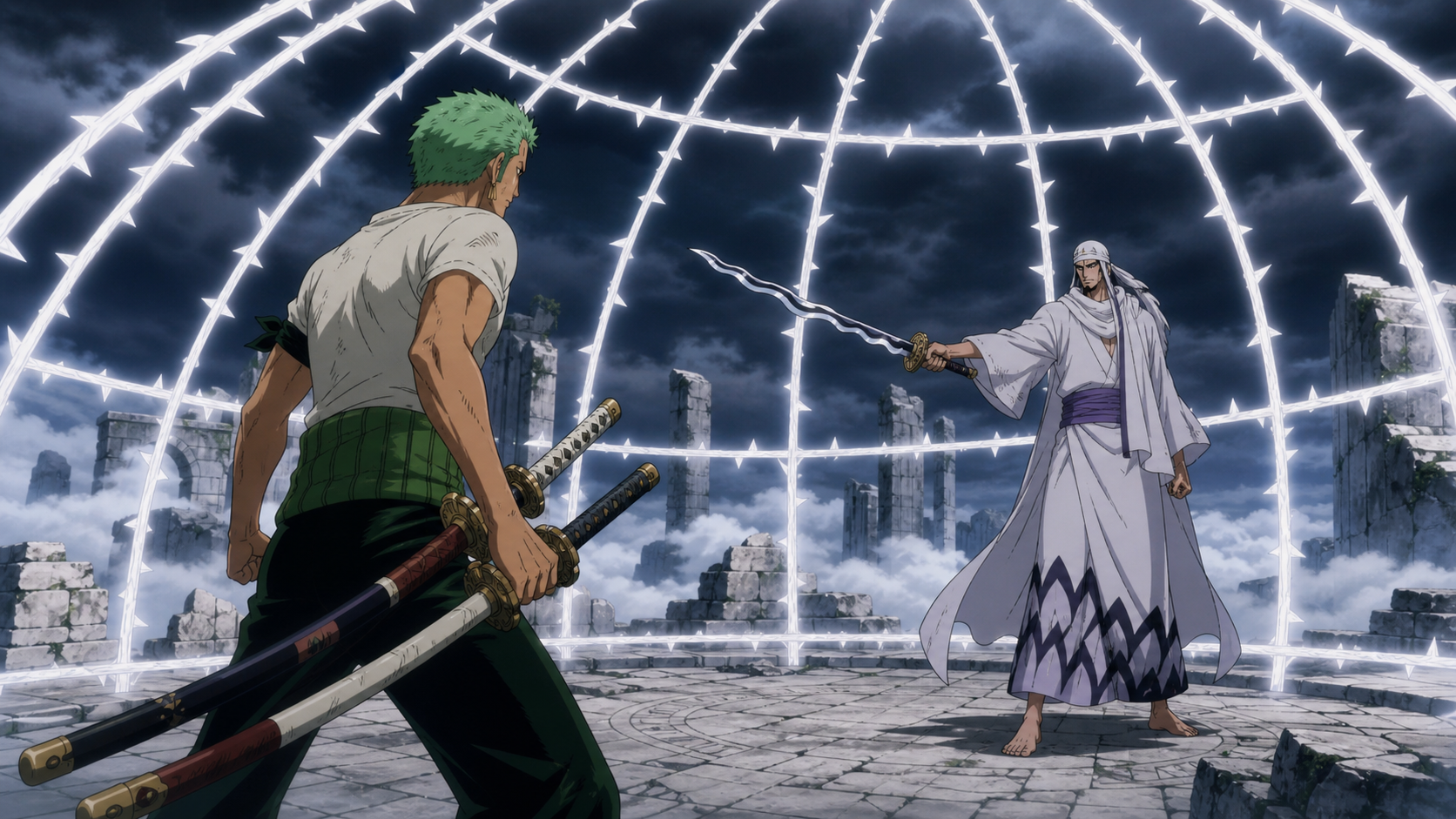
One Piece Episode 177, “The Ordeal of Iron! White Barbed Death Match,” turns the Upper Ruins into a sealed arena. Ohm exploits the confusion around Nola, floors Zoro and Wyper, and announces that ten people and two animals remain in Enel’s survival game. Several Shandia rush the priest. Holy and the Iron Cloud answer before their courage can change the count.
Holy circles the ruins and triggers a dome of white, barbed Iron Cloud. The cage closes around every remaining fighter in the area. Escape now demands movement through cutting cloud or victory over Ohm. Zoro rises with Chopper’s defeat still fresh. Wyper rises while Nola carries Aisa away. Neither man plans to retreat, so Ohm’s trap concentrates two separate rescue missions inside one lethal boundary.
RaeRae Reacts to a cage built from control
Ohm loves language about sorrow, mercy, and inevitability because those words let him pretend cruelty arrives from somewhere above him. Episode 177 strips away that performance. The priest orders a trained dog to activate a weaponized perimeter, counts living bodies like game pieces, and calls forced combat a test. Every part of the design belongs to a person making choices.
The White-Barbed Death Match works because Ohm controls the map before anyone can challenge his argument. Fighters can oppose him, oppose one another, or cut themselves against the boundary. Those are not free choices. Those are options selected by the captor. RaeRae’s patience for authority figures who create the emergency and then judge everybody’s response remains exactly where readers expect: underground.
Ohm turns grief into a sales pitch
Ohm speaks as though awareness of suffering makes him compassionate. His version of compassion always ends with somebody else bleeding. That contradiction matters more than his solemn face. Genuine grief recognizes another person’s pain and changes behavior. Ohm recognizes pain, aestheticizes pain, and uses pain to prove his own spiritual importance.
The priest’s sadness therefore becomes another weapon. A calm voice tells trapped people that resistance is futile while a flexible blade reaches around stone. The performance asks victims to accept his interpretation before the fight ends. Zoro refuses that framing. He does not debate whether Ohm feels sorrow. He measures the sword, the cage, and the man responsible for both.
Holy shows how obedience can become violence
Holy is trained with extraordinary discipline. A command produces immediate action, even when the action builds a death cage. The dog’s precision gives Ohm distance from the mechanism without removing responsibility. Ohm designed the command structure. Holy carries out the movement. The resulting danger reflects the values of the trainer.
Episode 177 places that obedience beside the Shandia’s desperate coordination and the Straw Hats’ messy loyalty. Holy never questions a command. Zoro and Wyper question nearly everything, including one another, yet both men remain oriented toward people swallowed by Nola. Perfect compliance looks efficient. Chosen responsibility looks chaotic. Only one of those systems leaves room for conscience.
Zoro reads the battlefield through Chopper
Zoro entered the Upper Ruins looking for the crew. Finding Chopper unconscious changed the emotional temperature before Ohm ever raised the cage. Episode 177 keeps that injury inside Zoro’s decisions. He wants Nami and Gan Fall out of Nola, but Ohm blocks every useful route. The swordsman recognizes that rescue begins by removing the person controlling the arena.
This is one of Zoro’s strongest leadership habits. He can hold anger without letting anger choose a useless target. Nola looks like the immediate problem because the giant python swallowed his companions. Ohm represents the active strategist who can attack during any rescue attempt. Zoro’s choice to settle the priest first protects the people he cannot yet reach.
Wyper and Zoro share a rescue problem
Wyper wants Aisa back. Zoro wants Nami and Gan Fall back. Their goals overlap without becoming friendship. Both fighters still carry different histories, different loyalties, and very little trust. The cage does not erase those differences. The cage reveals that Ohm benefits whenever the two men treat one another as the nearest threat.
Wyper keeps attacking Nola because the python has Aisa. Zoro initially reaches the same practical concern from the Straw Hat side. Their shared rescue problem could create cooperation, but the survival game has trained every person in the ruins to expect scarcity and betrayal. Enel’s structure makes solidarity harder before lightning ever enters the frame.
Raki carries a warning nobody wants to hear
Raki runs toward Wyper with Kamakiri’s warning about Enel. Her mission has no glory. She carries information that could keep the surviving Shandia from walking into a god’s electrical reach. The journey also gives the episode space to remember why the Shandia entered Upper Yard and why retreat feels unbearable after four hundred years.
Warnings challenge momentum. Wyper has spent years preparing for this day, and the warriors around him have already paid heavily. Raki’s message asks him to revise action under pressure. That request is a form of courage. A movement committed to liberation still needs people who can say the enemy is stronger than expected, the plan has failed, and survival requires new information.
Enel makes Raki’s courage expensive
Enel appears behind Raki before her warning can create safety. Wyper tells her to run and not attack. Raki fires anyway. The bullets pass through Enel’s lightning body, and his answer drops her in front of Wyper. The scene denies any fantasy that bravery guarantees protection.
Raki’s decision comes from fear, duty, anger, and the impossible position Enel creates. Running exposes her back. Firing cannot harm him. Freezing leaves her within reach. Enel controls every path and then treats the outcome as proof of his divinity. The cruelty lies in manufacturing helplessness and presenting helplessness as consent to domination.
Enel’s equality claim is contempt
After attacking Raki, Enel frames indiscriminate violence as fairness. His claim that gender will not change his response sounds like a principle only when the power difference disappears from view. Enel is an untouchable ruler striking a messenger who cannot injure him. Equal contempt from an absolute authority does not become justice.
Justice asks whether force is necessary, proportional, and accountable. Enel asks none of those questions. He uses the vocabulary of equal treatment to hide the absence of restraint. RaeRae has met this trick before: somebody refuses compassion for everyone, calls the refusal consistency, and expects applause for having standards.
Inside Nola, Luffy finally finds the crew
Nami, Aisa, Gan Fall, and Pierre try to understand the living chamber around them. Then Luffy appears, crying over the mysterious cave that trapped him. Nami explains that the cave is a snake’s stomach. Luffy’s confusion lands as comedy, but the reunion also restores a missing connection inside the chaos.
Aisa meets the captain through his least impressive entrance. Nami identifies the bewildered stranger as the person responsible for her crew. That introduction says more than a polished speech could. Luffy can be catastrophically slow about physical context while remaining the person his friends expect to break impossible boundaries.
Nami solves the mystery of Nola’s rampage
Nami has watched Nola thrash across the ruins with unusual violence. Luffy’s arrival provides the missing cause. He has been climbing, striking, and stumbling inside the python while believing the stomach was a cave. Nami connects his behavior to Nola’s pain, then expresses the discovery with her hands.
The joke works because Nami’s analysis is correct and her response makes the problem worse. Hitting Luffy causes another painful reaction from Nola, and the entire group tumbles deeper. Knowledge does not guarantee control. Sometimes the smartest person in the room identifies the system accurately and still chooses one furious action before the lesson settles.
Aisa sees how strange the Straw Hats are
Aisa has survived by reading voices and danger through Mantra. Her first close experience with the Straw Hat captain gives her a different kind of information. Luffy is powerful enough to disrupt a giant python from within and confused enough to miss the obvious explanation. Nami is angry, protective, and completely unsurprised by that combination.
The encounter begins Aisa’s education in chosen family. Straw Hat trust does not require pretending Luffy is sensible. Nami can call him an idiot, pull his face, and still orient toward escape with him included. Their bond leaves room for frustration without making abandonment the price of failure.
Gan Fall cannot escape the history inside the snake
Gan Fall shares the cramped space with Aisa, a child whose people lost Upper Yard under Skypiean rule. The former God cannot treat the situation as a neutral rescue puzzle. Four hundred years of dispossession sit between them even while Nola’s stomach walls close around both.
The episode does not resolve that history through proximity. A shared danger can create contact, but contact alone does not repair land theft or political violence. Gan Fall’s value depends on what he acknowledges and what he changes when survival is no longer immediate. Aisa does not owe him comfort because both happened to be swallowed.
The survival game keeps shrinking human choice
Enel predicted that five people would remain after three hours. Ohm keeps counting bodies to reinforce that prophecy. Each count pressures the survivors to see one another as obstacles rather than as people trapped under the same ruler. The White-Barbed Death Match translates Enel’s abstract number into architecture.
A cage makes the ideology visible. Enel wants the survivors to believe elimination is natural. Ohm physically prevents departure. The priests then call the resulting fight proof. Episode 177 exposes the fraud: the game predicts behavior after designing conditions that reward exactly that behavior.
White Iron Cloud changes the rules of swordplay
Ohm’s Eisen Dial creates a blade that bends, extends, and attacks around cover. Zoro cannot rely on ordinary distance. The cage repeats the same threat at environmental scale. Every white strand looks soft enough to belong in Skypiea and sharp enough to punish one wrong step.
That contrast gives the Ordeal of Iron a distinctive menace. Steel usually announces hardness through weight and shine. Iron Cloud hides lethal structure inside the visual language of softness. Zoro must learn which lines move, which lines define the boundary, and where Ohm’s control begins. Strength without reading would turn the arena against him.
Episode 177 stops before the victory
Zoro does not defeat Ohm here. The episode ends with the cage established, Raki down, the group inside Nola reunited, and Zoro ready to prioritize the priest. Holding that boundary matters. Episode 177 belongs to entrapment and recognition. Episode 178 will carry the decisive sword exchange.
A React should respect where an episode closes. Borrowing the next victory would flatten the pressure built across these scenes. Zoro’s final resolve has force because the solution remains ahead. The audience understands his target and still has to sit inside the cage.
Manga and anime placement
Episode 177 adapts material from Chapters 270 and 271 during the Skypiea arc. The official Japanese episode archive lists the original broadcast date as January 18, 2004, with Michiru Shimada credited for script, Ken Koyama for episode direction, Kazuya Hisada for animation direction, and Miyuki Sato with Kunihiro Chida for art.
The adaptation balances three locations: the Upper Ruins death match, Raki’s warning route, and Nola’s interior. That alternation prevents any single confrontation from becoming the whole survival game. Each cut shows another consequence of Enel’s design, from physical confinement to failed communication to accidental chaos inside the python.
Final reaction to The Ordeal of Iron
Episode 177 is about people who claim violence has become inevitable after working very hard to make violence inevitable. Ohm builds the cage. Enel controls the island. Both men speak as though suffering proves their wisdom. Zoro, Wyper, Raki, Nami, Aisa, and Gan Fall reveal the cost behind that performance.
The strongest beat belongs to the contrast between controlled obedience and unruly care. Holy executes the command perfectly and helps close a death trap. The people inside Nola argue, misunderstand one another, and still search for a shared exit. Zoro and Wyper distrust each other, yet both remain pulled toward rescue. Messy loyalty has more moral intelligence than flawless compliance.
RaeRae’s verdict: Ohm can keep the sermon. A person who installs the barbs does not get to mourn the wounds as though weather caused them. Zoro has identified the correct problem, and the next episode can bring the swords.