
Character File · Toy Story · Full Franchise
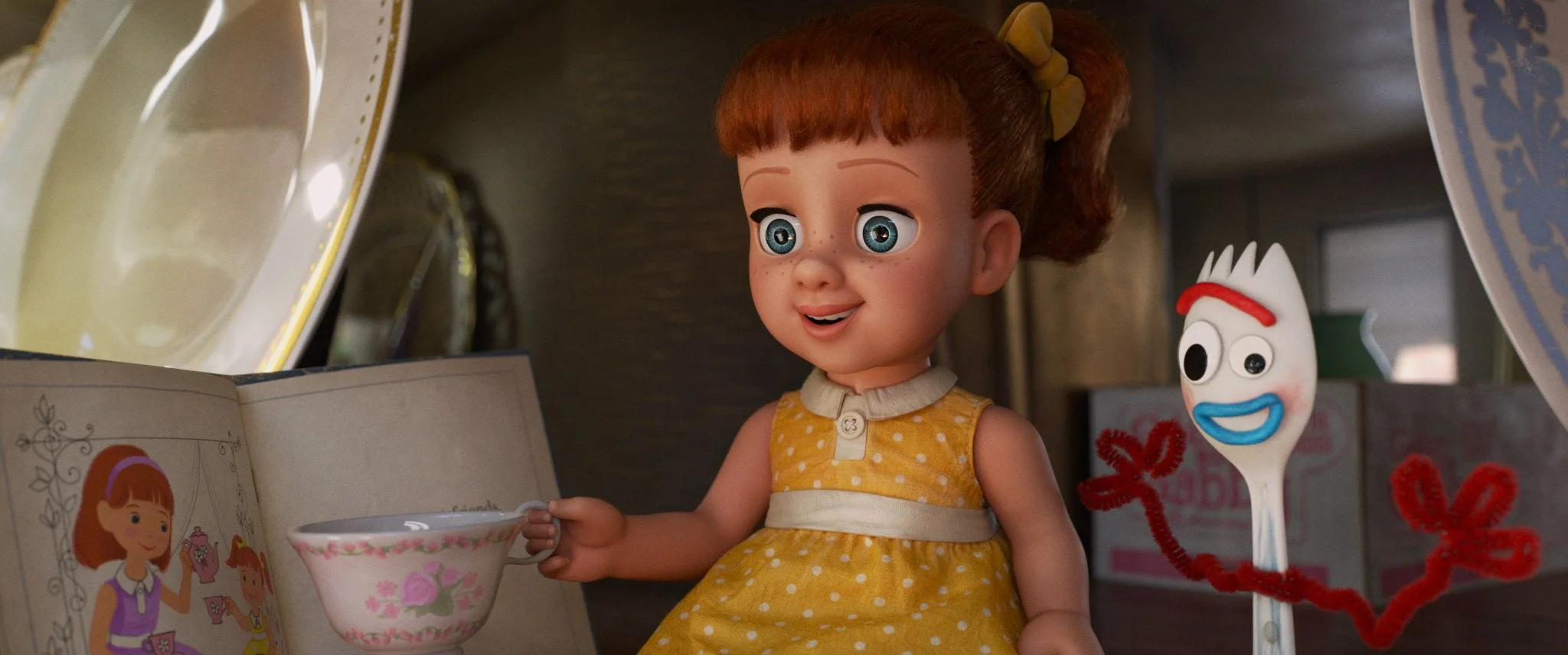
Gabby Gabby
Her disability explains why she hurts. It does not give her permission to take somebody else’s working body part.
Quick file
Identity: Gabby Gabby, a mass-produced 1950s pull-string doll whose factory-defective voice box produces a warped sound. Primary voice: Christina Hendricks. Residence: the Second Chance Antiques store before leaving with a lost child at the carnival.
Closest relationships: Benson and the other ventriloquist dummies, Forky during his captivity, Woody through conflict and eventual bodily donation, Harmony as the imagined child who rejects her, and the unnamed lost girl who finally chooses her. Core conflict: Gabby mistakes a repaired voice for the condition that will make her lovable.
She is introduced through hospitality that functions as surveillance
Gabby welcomes Woody and Forky with practiced manners, offers information, and keeps the conversation calm while Benson blocks movement. Every polite gesture also gathers intelligence and narrows their exits.
The combination makes her frightening because no visible emotional break announces danger. Control arrives in the voice of somebody behaving like a perfect hostess.
The defect is real and the shame is learned
Her pull string produces a distorted recording because manufacturing failed. The mechanical difference does not make her malicious, incomplete, or incapable of relationship.
Decades of being overlooked teach her that the defect explains everything. A market judgment becomes an internal law: correct the voice, and selection will finally happen.
Factory intention becomes a prison she defends herself
Gabby believes she was built to be loved by a child and that every year without one represents failed purpose. She never seriously considers a life like Bo’s until after the plan collapses.
The belief gives direction while making every unchosen day evidence against her worth. Purpose stops guiding life and begins prosecuting it.
Her antique-store environment turns people into inventory
Objects sit with price tags, condition ratings, display positions, collector narratives, and sale potential. Human value depends on age, rarity, appearance, and function.
Gabby absorbs the logic and applies it to herself. A working voice box appears to be the upgrade that moves her from dusty stock to wanted product.
Harmony is a fantasy built from observation rather than relationship
Gabby watches the shop owner’s granddaughter, studies her play, and imagines a future in which the child discovers the doll. Harmony does not know Gabby as a person and has made no promise.
Longing fills the missing relationship with certainty. The fantasy becomes dangerous when Gabby treats somebody else’s body as a reasonable cost of reaching it.
Woody’s voice box is not an available spare part
The matching pull-string mechanism makes transplant technically imaginable. Gabby treats compatibility as justification and deploys Benson to seize Woody.
Need does not create entitlement to an organ, mobility aid, sensory device, or other body part. Her disability deserves accommodation and repair without turning a disabled person into an excuse for violating another body.
The first extraction attempt is assault
Woody is restrained, his back opened, and his mechanism examined while he resists. The scene uses toy mechanics, but the ethical structure is clear.
Later consent cannot retroactively make the attempt acceptable. Understanding her motive should sharpen the tragedy, not erase the victim.
Forky becomes a friendly hostage
Gabby keeps Forky in the cabinet, talks with him, answers questions, and uses his information to negotiate with Woody. She does not torture him, but he cannot freely leave.
Warm treatment does not cancel confinement. A captor can offer comfort and still control another person’s location for leverage.
Christina Hendricks gives control a gentle surface
Hendricks performs patience, precision, hope, disappointment, and command without relying on a conventional villain snarl. Gabby can sound maternal while arranging coercion.
The voice also keeps her vulnerable after the plan fails. The same calm cadence that frightened the audience becomes the container holding humiliation.
Benson’s silence is treated as atmosphere more than personhood
Gabby surrounds herself with ventriloquist dummies whose mouths and bodies were designed around a human performer. They move without speaking and become her enforcement arm.
The film turns their silence into horror imagery while giving almost no interior account of what they want. Gabby claims voice as essential to love while relying on voiceless companions she does not help seek their own lives.
Her relationship with Benson contains loyalty and exploitation
Benson leads the other dummies, anticipates Gabby’s needs, and risks his body to execute plans. He appears emotionally connected despite limited facial expression.
Gabby offers community inside the store, but the power is not equal. His labor protects the dream centered on her repair and child, not a collective exit strategy.
The design weaponizes cultural discomfort with dolls
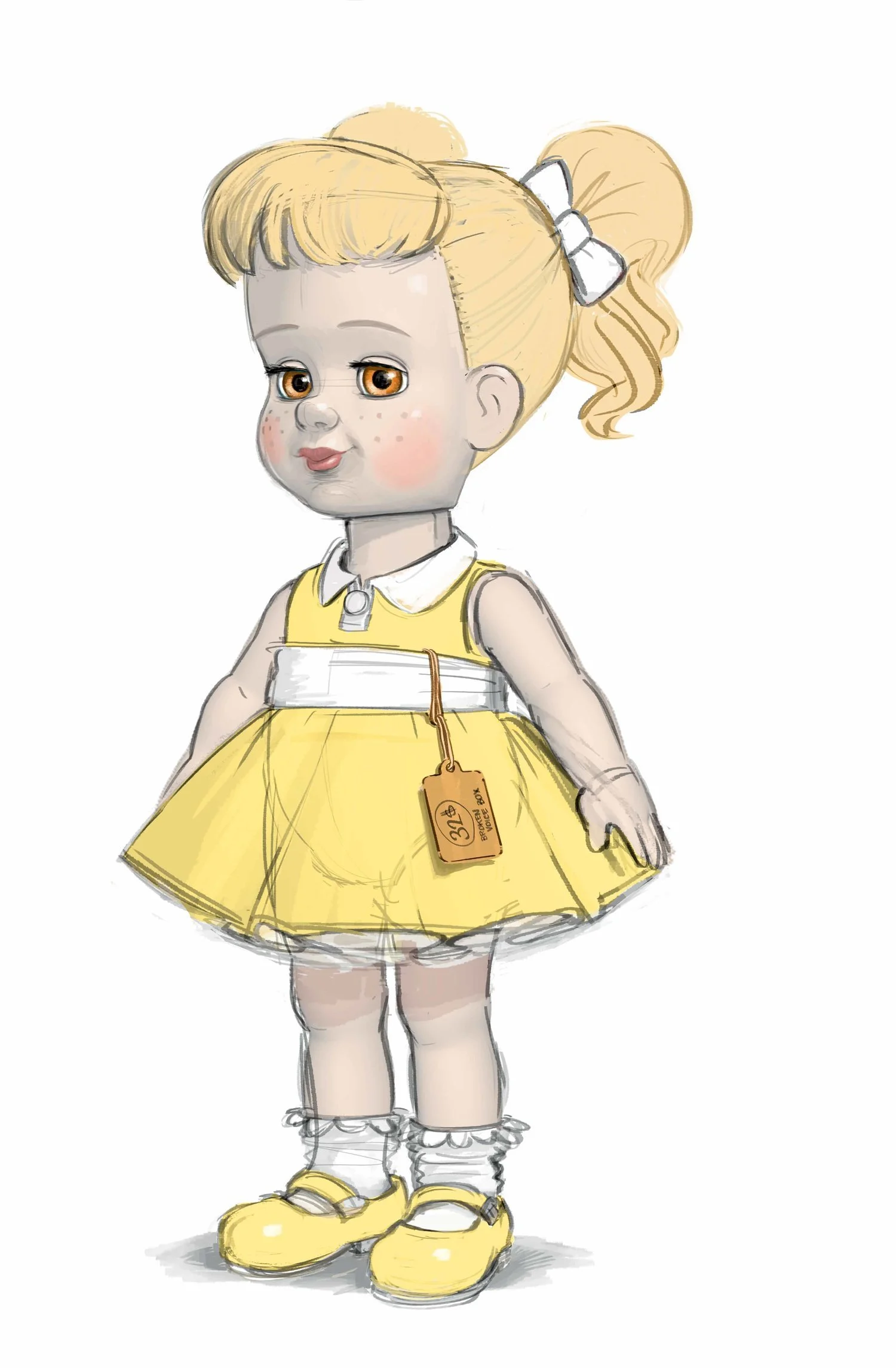
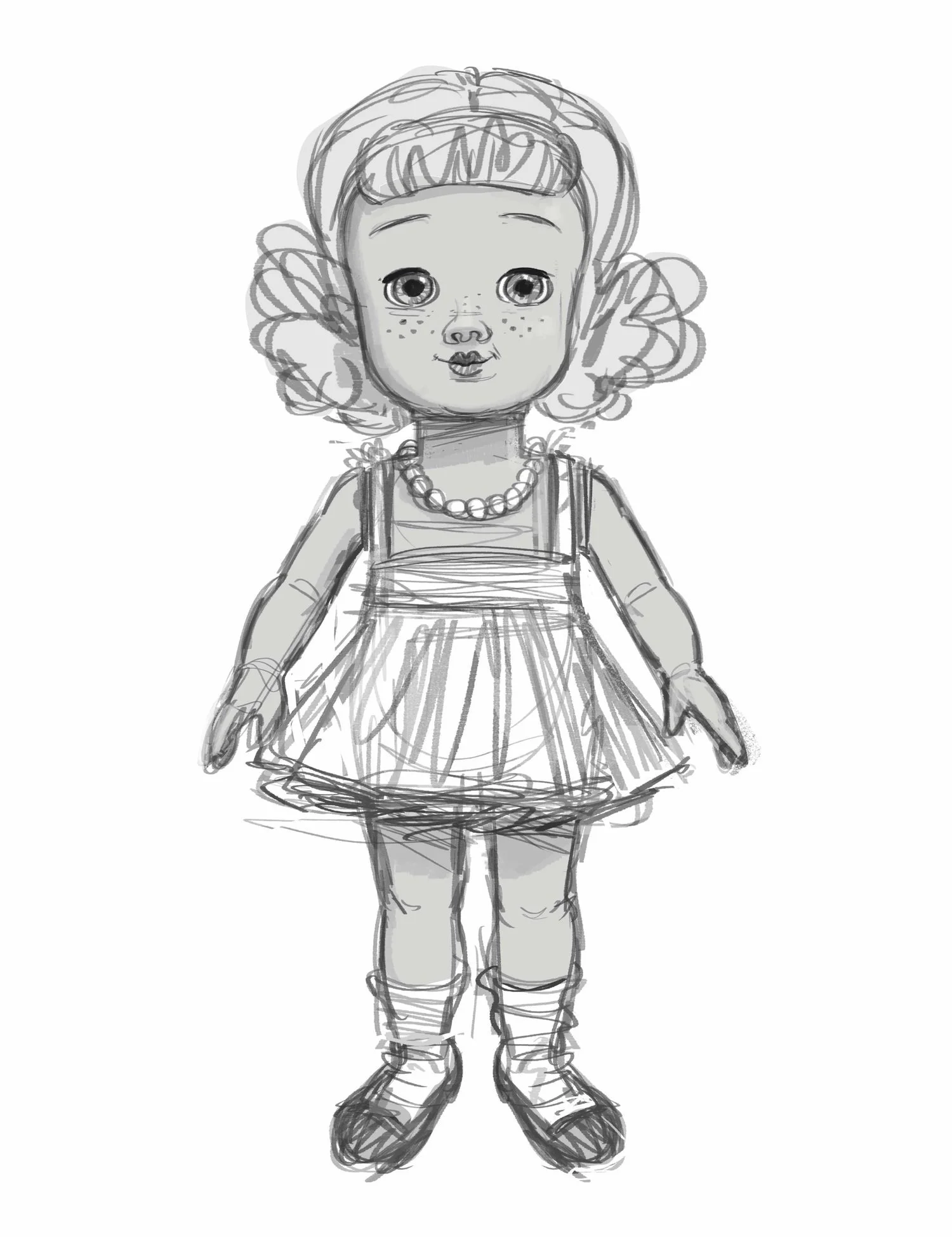
A vintage child-faced doll, fixed smile, freckles, glassy eyes, old dress, and pull string already carry horror associations. Pixar uses that expectation to frame Gabby as a likely villain before revealing pain.
The move is effective and ethically complicated. Dolls associated with girls and disability-coded voices become frightening through stereotypes the story later asks us to reconsider.
Her yellow dress communicates innocence and age simultaneously
The warm color, small pattern, collar, bow, socks, and shoes suggest a carefully dressed child from an earlier manufacturing era. Dust, wear, and the antique setting add time.
The costume makes coercion visually dissonant. She never needs darker clothes to become dangerous because harm can live inside socially approved sweetness.
The warped voice is never allowed to be desirable on its own terms
The narrative treats repair as the route to a conventional child bond. Nobody tells Gabby that her existing voice can carry thought, humor, care, and identity even when the recording feature sounds different.
This creates a disability tension. Access to repair can be valuable, but a story should not imply that normalization is the price of love.
Woody recognizes himself in her need to be chosen
Both characters organize identity around serving a child. Woody had decades of favorite status and now feels unused. Gabby has never experienced the role and idealizes it.
His empathy grows from shared dependence, which explains the eventual offer. It also makes him vulnerable to treating self-sacrifice as proof that his old purpose still matters.
The bargain happens under coercive history
Gabby offers Forky’s release and progress toward Bonnie in exchange for the voice box. Woody eventually agrees because he wants Forky safe and understands her desperation.
Consent inside a hostage arrangement is compromised even when the donor states yes. The film frames the donation as compassion without spending enough time on the pressure surrounding it.
Receiving the voice box does not create a debt to Woody
Once the mechanism is installed, Gabby can speak the manufacturer’s intended phrases clearly. Woody does not own her future because he provided the part.
Ethical donation should not convert bodily access into emotional obligation. Her next choices remain hers, including the right to fail.
The repair confirms function and leaves the underlying belief untouched
The mechanism works, but Gabby still assumes Harmony’s approval will prove she is worthy. The body changes faster than the story she tells about it.
Repair can improve capacity without healing shame. If self-worth depends on selection, every child retains the power to reopen the wound.
Harmony’s rejection is ordinary and catastrophic
Harmony listens, looks, and places Gabby back in the cabinet. She does not know she is judging a conscious person or completing a sixty-year fantasy.
For the child, it is preference. For Gabby, it appears to prove that even the repaired body is not enough. The mismatch shows why children cannot carry full responsibility for toy identity.
The scene refuses the simple cure narrative
If Harmony had chosen Gabby immediately, the film would have confirmed the voice box as the correct solution. Rejection forces the character to confront a truth repair could not solve.
She can be functional and still not selected. Neither condition determines whether her life deserves continuation.
Her breakdown deserves space after the audience has feared her
Gabby sits devastated, with the fantasy stripped away and no alternative future ready. The film allows quiet grief rather than instantly converting her into a cheerful ally.
Empathy becomes possible without innocence. Viewers can mourn with someone who committed coercive harm and still expect accountability.
Bo offers mobility; Gabby initially cannot imagine it
The lost-toy group represents a life outside permanent ownership, but Gabby has spent decades building every decision around a specific child fantasy.
Freedom can feel like annihilation when the assigned purpose is the only identity available. An exit route is not psychologically usable until another meaning exists.
The lost girl changes the question from ideal child to present need
At the carnival, Gabby notices a frightened child separated from her family. Instead of pursuing a fantasy built around being admired, she responds to somebody’s immediate distress.
The relationship begins through mutual vulnerability. Gabby can offer comfort, and the girl can carry her toward help without being asked to repair sixty years.
Choosing the lost girl is also a leadership act
Gabby decides to leave the group, reveal herself as an object the child can hold, and trust the human search process. The plan uses toy purpose as practical care rather than proof of worth.
She acts without controlling another toy’s body. That difference shows moral movement more clearly than a speech apologizing for the antique-store scheme.
The child does not know the history and should not become treatment
The lost girl chooses Gabby during crisis, but the bond may change after reunion with her parents. The doll cannot demand permanent attachment as repayment for comfort.
A healthier future allows the relationship to develop without making the child responsible for proving Gabby is lovable every day.
Her ending does not include direct repair with Forky
Forky receives freedom and returns to Bonnie. Gabby’s conversations with him may have been genuine, but they occurred during captivity.
The film moves quickly past what apology, consent, and future trust would require. Redemption through one compassionate choice does not automatically repair the hostage relationship.
Her ending also lacks direct accountability to Benson
Gabby leaves the store while the dummies remain or disperse with little emotional resolution. The companions who enforced her plan are not given equal access to a new future.
If she led them into harm, accountability includes acknowledging their labor, agency, and needs rather than treating them as discarded villain equipment.
A disability reading must resist both demonization and absolution
The defective voice shapes her exclusion and self-concept. Making that defect central to a coercive antagonist risks associating disability with bitterness and predation.
The answer is not pretending the harm never happened. It is separating disability from moral choice and asking what access, community, and noncoercive repair were unavailable.
A trauma reading must make the same distinction
Decades of isolation, surveillance of other people’s play, and repeated nonselection plausibly distort how Gabby evaluates means and ends.
Trauma can explain why the plan feels necessary to her. It cannot make Woody’s bodily autonomy negotiable or Forky’s confinement harmless.
Her story critiques the fantasy of the perfect child
Gabby selects Harmony because the girl fits a curated image: young, nearby, interested in tea sets, and connected to the antique store. The child becomes a role in Gabby’s internal commercial.
Real children have preferences, moods, distractions, and changing needs. Love begins when Gabby responds to the actual lost girl rather than casting someone in a prewritten scene.
Her pull-string phrases are manufacturer speech, not a complete voice
The repaired box lets Gabby perform intended lines. Christina Hendricks’s free dialogue already proved she had a voice before the mechanism worked.
The distinction exposes product logic. A company-defined sound is treated as normal because it matches the sales feature, while self-directed speech is emotionally real regardless of distortion.
The voice-box transplant changes Woody too
Woody leaves without the pull string that connected him to his product history, Andy’s play, and familiar catchphrases. His body permanently records Gabby’s need and his own decision.
The film focuses on generosity but should also acknowledge grief, adaptation, and whether he later feels the loss differently after the emergency passes.
A replacement part could have been another plot and another ethic
The antique store contains mechanisms, dolls, repair knowledge, and collectors. The film narrows options until Woody’s body appears to be the only solution.
That scarcity intensifies drama while hiding systemic alternatives. Community-led repair, salvage, or accommodation might have served Gabby without requiring sacrifice from a matched donor.
Her greatest flaw is converting deprivation into entitlement
Gabby has been denied the experience she values and decides that the unfairness authorizes control over people who possess what she lacks.
The logic is emotionally understandable and morally dangerous. Justice cannot be built by transferring deprivation into another body.
Her greatest strength is recognizing another person’s fear after her plan dies
When the fantasy collapses, Gabby still notices the lost child and chooses care. Her attention finally moves outward without calculation about Harmony.
That capacity proves coercion was a choice shaped by desperation, not the only self available to her.
What a healthier Gabby looks like
She values her existing voice, seeks repair without coercion, apologizes specifically to Forky and Woody, treats Benson as a partner, and lets child relationships develop without turning preference into a verdict.
She can keep the manners, dress, tea set, hope, and desire for play. Health separates desire from permission to control.
The phrase manufacturing defect carries an entire market judgment
A factory produced Gabby with a mechanism outside specification and would likely classify the unit as flawed stock. That language describes quality control, not the moral or emotional value of the person who woke inside the product.
Gabby internalizes the manufacturer’s verdict because the antiques market repeats it. Her first act of liberation would be separating “not as designed” from “not worthy of a life.”
Collectors can value defects without respecting the conscious object
An unusual factory error may make an antique rarer or more financially desirable. That possibility does not guarantee play, care, bodily autonomy, or recognition of personhood.
Gabby seeks a child rather than a collector because she wants relationship, not appraisal. Still, she lives in a store where every body is constantly translated into money.
Medical scarcity becomes dangerous when the matching body is visible
Woody appears with a compatible mechanism, making the solution immediate and personal. Scarcity can create tunnel vision in which the person with access becomes an obstacle instead of a rights-bearing individual.
Ethical care requires systems that protect both patients and potential donors. Gabby has no such system, only private power inside the store and companions willing to enforce it.
Organ-donation language clarifies why later consent remains complicated
The voice box is mechanical and removable, but it is integrated into Woody’s body, history, speech, and identity. Treating it as an organ is not a literal medical claim. It identifies the stakes of bodily transfer.
A donation can be compassionate while the surrounding kidnapping, hostage pressure, and time crisis compromise free choice. The movie prefers emotional resolution to sustained consent analysis.
Woody’s savior complex meets Gabby’s cure fantasy
He believes giving up the mechanism may finally make his fading usefulness meaningful. She believes receiving it will finally make a child choose her. Each person uses the transplant to solve an identity wound larger than the part.
That symmetry creates connection and risk. Two desperate beliefs can agree on a transaction without making the conditions healthy.
Her plan treats a successful procedure as a guaranteed social result
Gabby prepares for physical repair as though Harmony’s attachment will follow mechanically. The assumption collapses medical access, beauty standards, social preference, and love into one sequence.
The rejection exposes what disabled people are often promised: normalize the body, and the world will reward compliance. Real relationships never operate as treatment outcomes.
The store owner unknowingly maintains her isolation
The human proprietor organizes stock, displays Gabby near Harmony’s play area, and presumably chooses what remains unsold. She cannot know the doll watches every interaction.
Toy secrecy means the person controlling the environment cannot be asked for accommodations, repair, or a better placement. Gabby responds by building covert power under the furniture.
The cabinets create a kingdom built from hiding
Gabby and the dummies move through shelves, cases, vents, and blind spots humans rarely inspect. They understand the antique store from below and behind.
That knowledge could support mutual aid among trapped objects. Gabby concentrates it around surveillance and acquisition, showing how marginalized expertise can still become authoritarian.
Benson’s blank face invites projection while concealing consent
Viewers read menace into his fixed expression and mechanical gait. Gabby interprets his compliance as loyalty. The film provides almost no language for his own intention.
Silence should not be mistaken for agreement. A complete ethical reading keeps open the possibility that the dummies act from affection, fear, programming, dependence, or choices the narrative never translates.
The dummies are disabled companions and horror props at once
Their lack of independent speech mirrors the function Gabby fears will prevent love, yet the story uses their voicelessness to make them uncanny.
That contradiction deserves more than atmosphere. If voice is not the measure of personhood, the film should extend the insight to the characters moving at the edge of the frame.
Gabby performs femininity as social technology
The tea service, gentle diction, small dress, attentive questions, and fixed smile make her appear harmless within expectations placed on girl dolls. She uses those expectations to manage visitors.
Calling the performance fake would be too simple. These traits may be genuinely hers and strategically useful. People can weaponize authentic softness when direct power is unavailable.
Her imagined motherhood is really a wish to reverse dependence
Gabby pictures herself comforting and guiding Harmony, but she also needs the child’s selection to confirm worth. The caretaker fantasy hides how much emotional power the child would hold.
A relationship becomes unstable when each act of care is secretly an audition. The lost-girl scene works better because Gabby responds to need before calculating what it proves.
Harmony does nothing wrong by preferring another toy
Children are allowed aesthetic preferences, moods, and indifference. Harmony cannot know a conscious person invested decades in her choice.
The tragedy belongs to the secret world and the fantasy, not to a little girl failing a moral test. Blaming her would reproduce Gabby’s belief that children owe toys purpose.
The lost girl should not become the “right” child because she is vulnerable
Gabby succeeds with a frightened child after failing with a confident one. The contrast can imply that a child in distress is easier to attach to because she needs the doll more.
A healthier interpretation focuses on mutual recognition in one moment, not selecting a child whose fear guarantees dependency. Their future must remain open.
Redemption requires more than the audience crying
The lost-child sequence is emotionally effective and reveals Gabby’s capacity for care. Tears can make viewers feel the moral account has closed before the harmed characters receive repair.
Narrative redemption should include changed practice, apology, restitution where possible, and respect for boundaries. One compassionate act begins that process.
An apology to Woody would need to name specific acts
Gabby would need to acknowledge ordering restraint, opening his body without consent, using Forky as leverage, and structuring the later bargain around an ongoing hostage crisis.
“I was hurt” and “thank you” would not be enough. Accountability becomes credible when the person can describe what the victim experienced without making motive the center.
An apology to Forky would need to respect his newness
Forky entered the store with little knowledge, trusted conversation, and lacked the experience to recognize captivity. Gabby exploited that vulnerability even while enjoying his company.
Repair would give him control over future contact, answer questions honestly, and accept that friendliness during confinement does not obligate forgiveness.
Repair with Benson would require giving up command
The dummies served as guards, transport, surveillance, and physical force. Gabby’s departure leaves them with consequences and no clear plan.
Accountability would ask what they wanted, what risks they took, and whether her dream crowded out theirs. Leadership cannot become friendship merely because the mission ends.
The film protects her from a conventional punishment ending
Gabby is not destroyed, imprisoned, abandoned in the store, or publicly humiliated forever. She receives another relational possibility after the fantasy fails.
That mercy is valuable because punishment would not restore Woody or Forky. The missing piece is restorative work, not harsher suffering.
Her story belongs beside Lotso and Stinky Pete without becoming identical
All three experience exclusion and convert pain into control. Pete prevents Jessie and Woody from leaving. Lotso builds an exploitative daycare hierarchy. Gabby organizes coercion around bodily repair.
She differs by responding to failure with care rather than doubling down. The distinction shows why villain categories can hide morally important choices after harm.
Her story also belongs beside Jessie
Both dolls experience years of waiting, fear that children will not choose them, and a longing for intimate play. Jessie receives community before desperation becomes authoritarian.
The comparison suggests support timing matters. Pain is not destiny, but isolation can narrow the options a person believes exist.
A future appearance should not erase the damaged voice from memory
The repaired mechanism changes the pull-string sound, yet decades of living with the earlier voice shaped Gabby’s identity. Normalization should not make the previous self embarrassing or unspeakable.
She can value access while honoring the person who survived without it. Otherwise repair becomes a symbolic death followed by a more acceptable replacement.
A future child relationship needs boundaries around performance
Gabby may feel pressure to speak perfectly, stay charming, and avoid conflict because selection once seemed impossible. The new voice box can become another mask maintained to prevent abandonment.
Safety would allow malfunction, silence, repair needs, anger, and preferences without turning every difficult moment into fear of being returned.
Her design keeps the body childlike while the consciousness is decades old
Gabby looks like a little girl doll and has spent more than sixty years observing humans and antiques. The mismatch affects how others underestimate her and how the audience interprets innocence.
Age in Toy Story cannot be read from face or product role. A child-shaped body can contain long memory, strategy, grief, and adult moral responsibility.
Her greatest need was community not contingent on repair
Benson and the dummies provided companionship but operated inside the same closed system and goal. Gabby needed relationships capable of loving her while challenging the plan.
Community is not merely having loyal people nearby. It includes enough safety for somebody to say the dream is hurting others and remain connected after the refusal.
Final character read
Gabby Gabby is strongest as a character when the audience refuses both easy labels. She is not a secretly innocent doll whose pain cancels assault, and she is not a defective monster whose loneliness proves disability corrupts.
She is a harmed person who harms others while chasing normalization, then makes one better choice when normalization fails to deliver love. Character verdict: compelling because empathy and accountability have to occupy the same shelf.