
Character File · Toy Story · Full Franchise
Forky
He wakes up in a body made from cafeteria waste and immediately knows the world has assigned him the wrong category.
Quick file
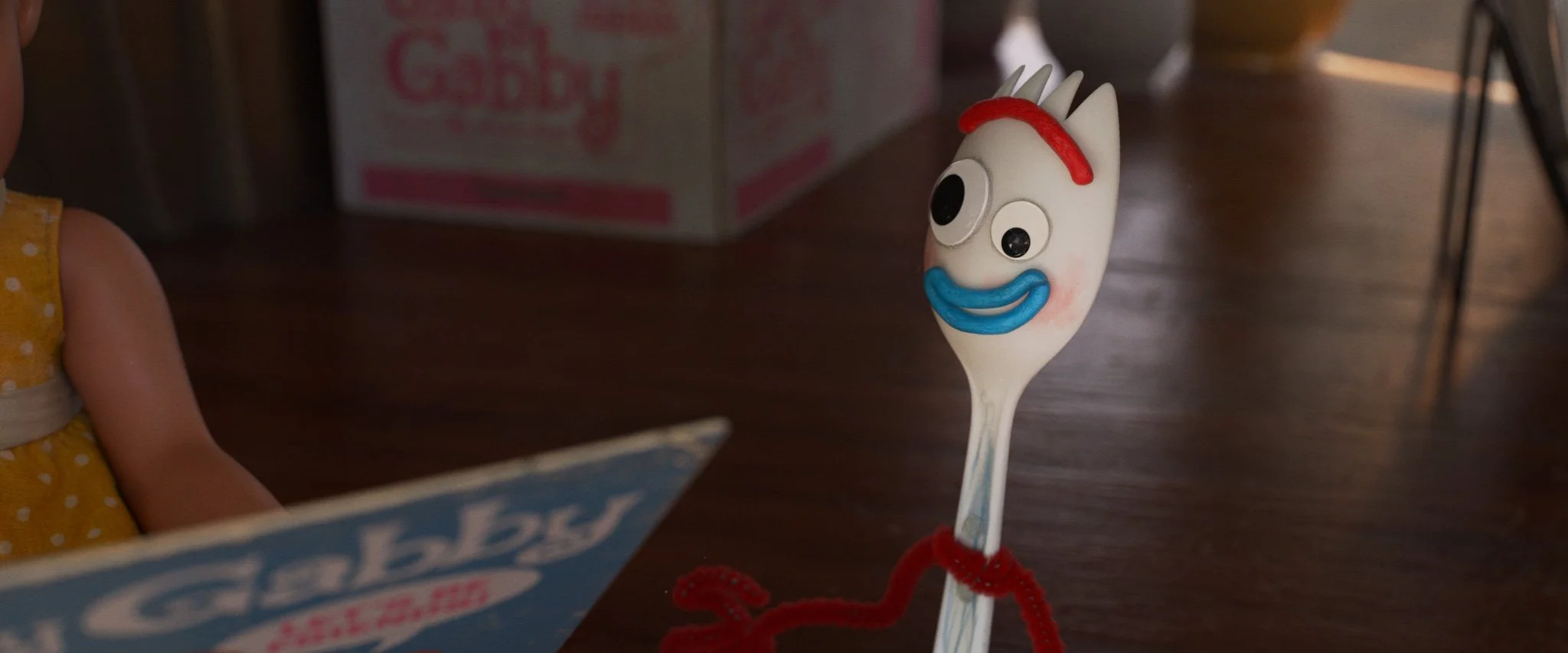
Identity: Forky, a craft figure Bonnie assembles from a discarded plastic spork, pipe cleaners, modeling clay, a wooden stick, mismatched googly eyes, wax or adhesive pieces, and a rainbow sticker. Primary voice: Tony Hale. Creator and child: Bonnie Anderson. First appearance: Toy Story 4.
Closest relationships: Bonnie, Woody, Karen Beverly, and the wider Bonnie-room community. Core conflict: Forky experiences his materials as trash while everyone around him interprets Bonnie’s attachment as proof that he is a toy. His story asks whether identity belongs to origin, function, relationship, self-definition, or all four fighting at once.
His creation begins with Bonnie’s social terror
Bonnie enters kindergarten orientation frightened, isolated, and denied the craft supplies another child takes from her. Woody secretly gathers discarded materials so she can participate without knowing a toy intervened.
Forky is therefore born inside an act of care already hidden from the child. His life begins as Bonnie’s solution to distress and Woody’s solution to her loneliness before Forky can consent to either role.
The trash was not neutral raw material to him
Adults see clean craft components recovered from a bin. Forky remembers being an eating utensil and experiences the trash as warmth, safety, and correct destination. The film treats the pull toward waste as comedy, but it functions like embodied orientation.
Telling him that the bin is disgusting does not answer the deeper claim. He is not seeking filth because he misunderstands hygiene. He is trying to return to the only category that makes his body legible to himself.
Bonnie’s name on his feet establishes relationship before identity
She writes her name across the wooden base, just as Andy marked Woody and Buzz. The inscription records attachment, but Forky lacks the years of play that made those older names emotionally meaningful.
The mark says somebody chose him. It cannot instantly tell him what being chosen requires or whether that requirement matches the person who woke inside the craft.
The googly eyes make perception visibly uneven
Forky’s eyes differ in size and alignment, causing his face to appear permanently startled and slightly unstable. The design gives animators an expressive system without pretending a child constructed symmetrical anatomy.
Difference is not corrected after he becomes important. Bonnie’s making remains visible, and personhood does not depend on achieving factory polish.
His feet turn a label into locomotion
The wooden stick and clay feet were craft decisions, not engineering. Once Forky lives, they become a precarious mobility system. Walking requires balance from materials never designed for repeated movement.
The franchise quietly expands disability logic here. A body can invent function after construction, but the environment and community still determine how difficult that function becomes.
Tony Hale voices panic as a complete worldview
Hale’s strained enthusiasm, abrupt screams, literal questions, and exhausted relief make Forky funny without erasing the sincerity of his distress. The voice sounds like a nervous system learning every sensation at once.
His comedy works because Hale never performs existential fear as intellectual abstraction. Forky feels philosophy in pipe cleaners, trash cans, movement, and Bonnie’s grip.
Woody’s rescue is care mixed with coercion
Woody keeps pulling Forky from the trash, blocks exits, carries him, lectures him, and eventually walks beside him through the night. The sheriff acts because Bonnie needs the craft and because being needed stabilizes Woody’s own identity.
Forky survives because somebody refuses to let him disappear. He is also repeatedly prevented from choosing where his body goes. The film needs both truths.
I Am Not a Toy is an identity claim, not a vocabulary mistake
Everyone treats “toy” as an obviously desirable promotion from trash. Forky experiences it as a category imposed by people who know the community but not his interior state.
The story becomes richer when the audience stops assuming the older toys own the definition. A person can benefit from a community and still resist the name that community considers honorable.
The road conversation is his first real education
Away from constant interception, Woody explains children, purpose, being there for Bonnie, and the emotional logic of toy life. Forky listens because the conversation finally connects new identity to a relationship he already recognizes.
Education works better than capture because it offers meaning rather than merely preventing an outcome. Even so, Woody teaches one doctrine of toy life and presents it as universal.
Bonnie is both a child and the force that makes him socially valuable
Forky becomes indispensable because he helps Bonnie regulate fear during a major transition. The other toys protect him largely because losing him would hurt her.
That arrangement can treat Forky as emotional equipment. Care for Bonnie is necessary, but a living being should not become obligated to perform stability because a child created him during crisis.
His repeated self-disposal is played as slapstick and reads as self-harm
Forky dives into bins whenever opportunity appears. The body is damaged, lost, exposed to vehicles, and placed beyond easy rescue. The action repeats despite Woody’s warnings.
The film can call it returning to trash, but the behavior also expresses a wish to stop inhabiting an unwanted life. Comedy makes the subject approachable without making it emotionally harmless.
The song refuses to let him throw himself away
Randy Newman’s “I Can’t Let You Throw Yourself Away” gives Woody’s compulsion a cheerful surface and a desperate center. The sheriff believes preventing disposal is unquestionable love.
The title captures the ethical tension. One person sees rescue. The other sees forced separation from home. Care must eventually help Forky build reasons to remain rather than relying on permanent surveillance.
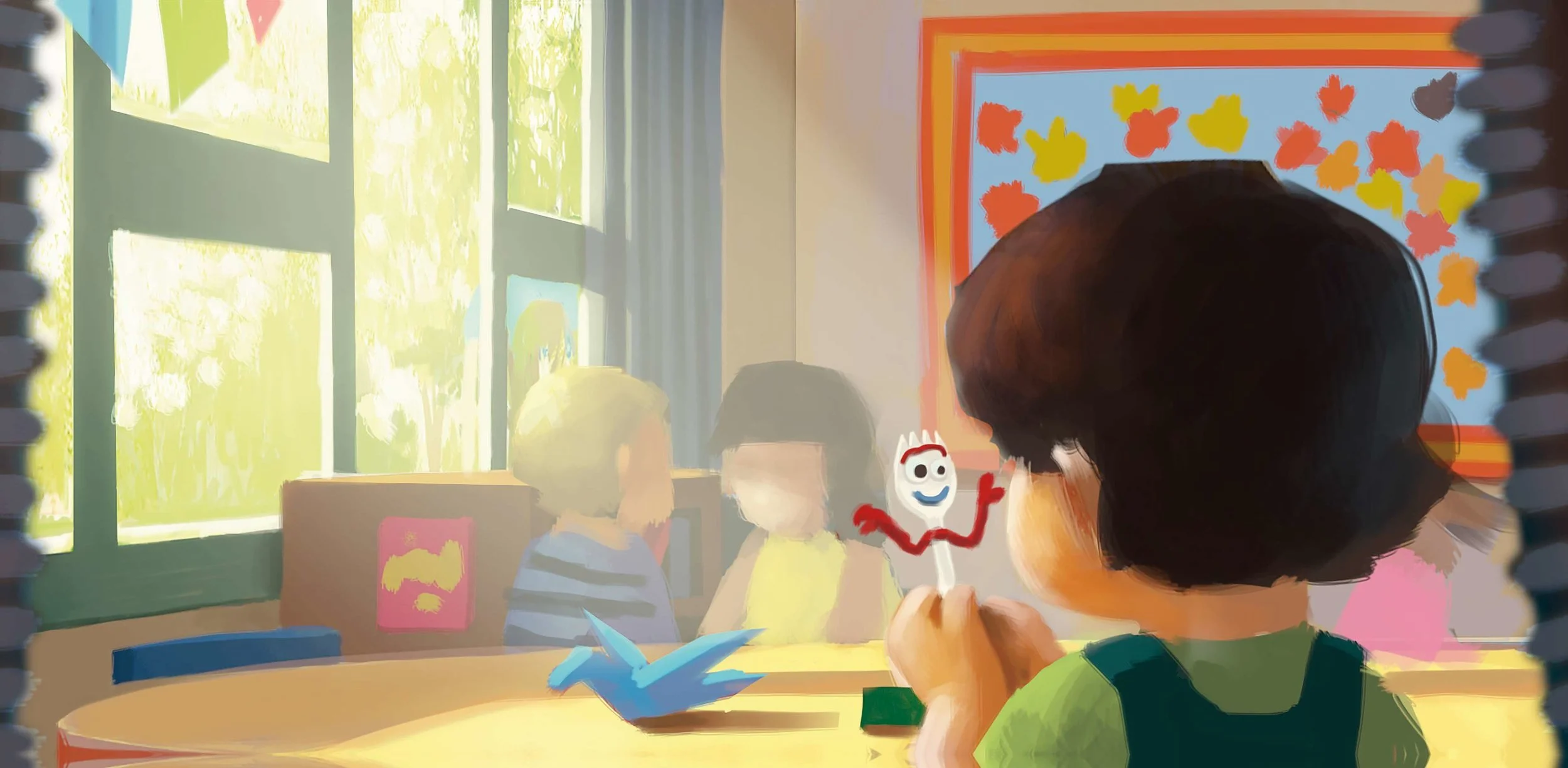
He learns toyhood through Bonnie’s face, not an abstract rule
Forky begins understanding when he sees what his presence does for Bonnie. Her relief, imagination, and affection give the category an embodied meaning unavailable in Woody’s slogans.
Relationship does not erase material identity. It adds a second truth: he came from trash and now participates in a bond that changes what the same materials can do.
Gabby Gabby recognizes his innocence and uses it
Forky talks openly inside the antique store because he does not understand the threat or Woody’s history. Gabby learns about Bonnie and Woody through him.
His curiosity and trust make him vulnerable to adults in the toy world who control information. New consciousness needs safeguarding without treating the new person as incapable forever.
The antique store contains his opposite origin story
Gabby is factory-made for toyhood and believes a defect kept her from fulfilling it. Forky is handmade from discarded materials and rejects the toy status everybody wants him to accept.
Placed together, they destroy the idea that intended function determines desire. The manufactured toy wants the child bond. The unintended toy wants trash. Neither body dictates one emotional future.
Forky waits without becoming the rescue hero
While Woody and others navigate the antique store, Forky remains relatively stationary and observes. His role is information, connection, and presence rather than a sudden action competence the body has not developed.
That restraint respects character design. Importance does not require every person to perform the same kind of rescue.
His return to Bonnie matters because he chooses more than escape
By the end, Forky understands enough about Bonnie and toy life to return voluntarily. The change should not be reduced to Woody winning an argument.
Forky integrates trash identity with relational purpose. He can miss the bin, value warmth, and still decide that being with Bonnie is meaningful.
The question series turns ignorance into a method
Forky Asks a Question gives him ten short lessons on money, friends, art, time, love, computers, leadership, pets, reading, and cheese. He interviews older toys who often reveal their own confusion while trying to educate him.
The format makes Forky less a student receiving canon and more a device exposing how poorly adults explain ordinary concepts they take for granted.
What Is Money reveals value is another invented category
A utensil once considered disposable now has relationships and narrative importance. Money assigns value through a system that does not map cleanly onto emotional worth.
Forky is the perfect person to ask because his body already crossed from waste to treasure without changing materials.
What Is a Friend pushes beyond ownership
Friendship cannot be reduced to who made, owns, or uses a toy. It requires mutual recognition, time, repair, and choice.
Forky’s earliest bond with Woody begins under coercive conditions and grows through conversation. The distinction lets the franchise examine when rescue becomes relationship.
What Is Love prepares him for Karen Beverly
Forky encounters competing explanations of love long before the fifth film’s wedding. The concept resists a single neat definition, especially for someone whose first attachment was creator-to-creation.
Romantic love should not simply reproduce his dependence on Bonnie or Woody. Karen Beverly needs to meet him as another new person with her own material history.
What Is Time fits a body with no childhood memory
Forky wakes during orientation and moves immediately into a road trip. He has no long before, no manufacturer story, and no dormant years to compare with older toys.
Time becomes something learned through waiting, sequence, memory, and anticipation. His short lifespan gives ordinary days extraordinary conceptual weight.
What Is Art turns his whole body into the argument
Forky is a child’s craft project, an expressive object, a living person, and a collection of common materials. Asking what art is cannot stay theoretical when the questioner may be the artwork.
If Bonnie’s intention makes him art, that still does not make her the owner of every meaning his life later produces.
His body requires continuous repair
Pipe cleaners bend, clay deforms, adhesive loosens, wax marks change, and wooden feet can separate. Unlike factory toys with standardized parts, Forky depends on improvised maintenance.
Official Toy Story 5 material acknowledges that Bonnie keeps crafting repairs. Care preserves him, but each replacement raises a Ship of Theseus question about continuity in a handmade body.
Repair by the creator can be loving and controlling
Bonnie knows how Forky was assembled and can restore damaged parts. She is also a child acting on a conscious body without knowing it is conscious.
The franchise’s secrecy rule makes informed consent impossible. Forky must freeze while someone he loves changes his material structure, trusting that the result will still feel like him.
Karen Beverly repeats creation without repeating his exact identity
Bonnie makes Karen from a plastic knife, decorations, and craft materials. Forky becomes the experienced partner who can explain toyhood, trash, and the room.
The sequel has an opportunity to show that shared origin does not produce identical personality. Karen is not female Forky or a reward for his development.
The wedding changes him from student to partner
Official Pixar material places Forky and Karen Beverly at their wedding. Marriage requires more than Forky reciting lessons learned from Woody or the shorts.
He must negotiate shared decisions, bodily repair, independence, attachment to Bonnie, and the difference between teaching somebody and deciding for them.
His name contains the first joke adults make at his expense
Bonnie calls a spork Forky, choosing a child’s understandable category rather than utensil precision. Adults recognize the mismatch and laugh.
The name becomes personal through her affection. Accuracy matters less than whether Forky claims it, and he eventually does.
The spork body breaks clean product categories
A spork already combines two utensils and never fits one function perfectly. Forky begins from hybridity before Bonnie adds personhood, art, toy status, and trash memory.
He is built to make category policing fail. Every attempt to choose one correct noun leaves part of the person outside it.
His masculinity is assembled without a factory script
Forky receives a masculine name and pronouns from Bonnie and the community, but his body lacks conventional male toy coding such as weapons, broad shoulders, uniforms, or heroic branding.
Tony Hale’s anxious performance lets a male character be dependent, frightened, curious, and physically delicate without making those qualities a secret shame he must outgrow.
He reveals how much toy society depends on child authority
The toys accept Forky because Bonnie does. Her imagination appears to confer social legitimacy and perhaps consciousness itself. That raises uncomfortable questions about beings children create, rename, alter, or discard.
A community needs an ethics beyond “our kid chose this.” Otherwise the child’s preference becomes law over persons who cannot disclose themselves.
He also reveals that the toys do not know their own origin rule
Nobody can explain exactly why Forky wakes. They have decades of experience and no tested theory of consciousness. The impossible has become ordinary without becoming understood.
Their confidence about his purpose therefore exceeds their knowledge. Forky’s questions expose a society living inside metaphysics it mostly refuses to investigate.
His greatest flaw is treating origin as destiny
Forky assumes materials once designated as trash must return to trash. The belief gives coherence but blocks evidence that relationships and choices can add meaning.
Growth begins when he understands that respecting origin does not require obeying it forever.
His greatest strength is asking what everybody else stopped asking
Older toys repeat rules about children, purpose, leaders, money, art, love, and value because repetition makes the world manageable. Forky asks for definitions.
The questions reveal contradictions that experience alone did not solve. Ignorance becomes intellectual honesty when the room is willing to answer.
What a healthier Forky looks like
He can identify with trash without seeking bodily danger, choose Bonnie without becoming solely responsible for her regulation, consent to repair as much as the secrecy rule permits, and help Karen without overwriting her answers.
He keeps the screams, literal questions, crooked face, and love of warm waste. Health adds options rather than sanding him into a conventional toy.
Creation does not automatically make Bonnie his god
Bonnie assembles the body and appears to trigger consciousness, but she does not knowingly design a mind, choose his beliefs, or understand that he can observe her. Calling her his creator describes causation without granting absolute authority.
The distinction matters whenever she repairs, carries, names, or plays with him. Love can coexist with a power imbalance the child cannot perceive and the toy cannot safely disclose.
Woody acts like a parent before Forky agrees he needs one
Woody monitors Forky, explains rules, interrupts dangerous behavior, and assumes responsibility for returning him to Bonnie. The labor resembles emergency parenting more than friendship at first.
That care becomes healthier as Forky gains information and choice. A guardian’s job is not to preserve permanent dependence but to help a new person develop enough agency to disagree safely.
The trash bin offers sensory regulation as well as identity
Forky describes trash through warmth, softness, closeness, and comfort. The bins reduce overwhelming novelty and return him to materials and sensations his body recognizes.
A community focused only on the symbolic danger misses the regulatory function. Safer alternatives would recreate comfort without requiring disposal, contamination, separation, or injury.
His design asks what counts as a complete body
Forky has no torso in the conventional humanoid sense, mismatched eyes, flexible arms, clay feet, and a mouth applied to plastic. He is complete because the consciousness inhabiting that arrangement can act and relate.
Factory standards do not get to decide which bodies look finished. The craft aesthetic makes visible how much every definition of normal was designed by somebody.
Bonnie’s craft turns scarcity into invention
Another child takes the available materials, leaving Bonnie distressed and excluded. Woody retrieves discarded items, and she creates with what remains. Forky emerges from a chain of unequal access, improvisation, and hidden help.
His value is connected to the fact that Bonnie made something when the classroom failed to include her. He carries a child’s recovered agency without becoming responsible for the institutional failure that made recovery necessary.
The film’s environmental joke has a waste stream underneath it
Forky comes from single-use plastic designed for a short meal and a long afterlife. His wish to return to trash mirrors the economic system that produced the utensil to be discarded.
Toy consciousness turns disposal into personal stakes, but the human waste problem exists even when no spork wakes. The character can support a deeper conversation about convenience, reuse, and materials that outlive their assigned function.
Upcycling is not automatically liberation when the material can speak
Humans celebrate transforming waste into art or useful objects. Forky experiences the transformation as an unwanted reassignment before learning to value parts of it.
Ethical upcycling usually concerns nonconscious material. His story adds consent to the equation and exposes how easily creators call a new purpose beautiful without asking what continuity the object carries.
He should not have to become grateful for being alive on schedule
The room expects Forky to recognize toyhood as an upgrade. Woody repeatedly frames Bonnie’s need as evidence that life is good. Gratitude becomes another demand placed on a person already overwhelmed by existence.
Forky can eventually value life without retroactively approving every coercive rescue. Survival does not require thanking everybody for ignoring his first answer.
His body invites constant touching from people who find him cute
Children and toys handle Forky because he is small, unstable, and easily moved. His handmade appearance encourages inspection, repair, and laughter.
Personhood requires boundaries even when a body looks like a craft. The franchise rarely asks whether he wants each adjustment, lift, squeeze, or repositioning because the secrecy rule normalizes passive handling.
The RV escape shows how little margin his body has
Forky’s narrow base and flexible limbs make ordinary travel hazardous. Vehicle motion, furniture gaps, windows, and bins can remove him from the group faster than sturdier toys.
Woody’s vigilance is partly controlling and partly a practical response to access needs. The ethical answer is shared planning, not pretending every body can navigate the same environment independently.
He gives Bonnie a transitional object she created herself
Forky helps Bonnie move from home into kindergarten because he combines her labor, imagination, name, and private emotional meaning. Unlike a purchased comfort object, he embodies her ability to make safety when adults did not provide enough.
That role explains the intensity of her attachment without making it permanent. Transitional support can matter completely and still change as the child gains other relationships.
The community never asks what happens when Bonnie outgrows the craft
Older toys know children change, but Forky is taught toy purpose during the moment Bonnie needs him most. Nobody gives equal attention to the likely ending.
Preparing him honestly would not ruin the bond. It would prevent purpose from collapsing when kindergarten anxiety fades or repairs become impractical. Jessie’s history makes that omission especially striking.
Karen Beverly deserves freedom from his expert status
Forky now knows the room and may feel responsible for teaching a newly awakened craft. Experience gives him useful language but not authority over her identity.
If Karen calls herself trash, toy, art, utensil, spouse, or something else, Forky must resist repeating Woody’s mistake of treating his own hard-won answer as the universal one.
Marriage between handmade toys raises material promises
Their bodies can be repaired, altered, partially replaced, or accidentally separated by ordinary play. A wedding promise in this context includes uncertainty about physical continuity and how each person recognizes the other through change.
The fifth film can make the ceremony cute while still letting the relationship address repair care, shared life with Bonnie, and consent around future rebuilding.
His short series proves questions can be relationships
Each episode pairs Forky with another toy whose answer reveals personality, memory, defensiveness, or confusion. The question creates a reason for two people to spend time together.
Learning is social rather than a download of facts. Forky builds community by letting others explain themselves, even when the explanation falls apart.
What Is Leadership should change how he reads Woody
Forky first meets leadership as Woody’s relentless protection and instruction. Later questioning lets him compare authority, competence, care, performance, and responsibility.
That reflection can preserve gratitude without turning Woody into the unquestioned source of meaning. A teacher can save a life and still teach incomplete lessons.
His origin challenges the franchise’s merchandise logic
Most major toys correspond to products children could buy. Forky looks reproducible but is defined by Bonnie’s irregular handwork and the particular discarded pieces she selected.
Mass-produced replicas of Forky create a funny commercial paradox: companies sell factory copies of a character whose meaning comes from not being factory-made. The market turns anti-product design back into product.
A replica Forky would not be Bonnie’s Forky
Identical merchandise can copy the silhouette, colors, and googly-eye mismatch. It cannot copy the specific act of creation, material history, repairs, memories, or relationship that formed this consciousness.
The point echoes Buzz’s duplicates from the opposite direction. Similar bodies do not collapse people into interchangeable units.
His fear deserves language more precise than existential crisis
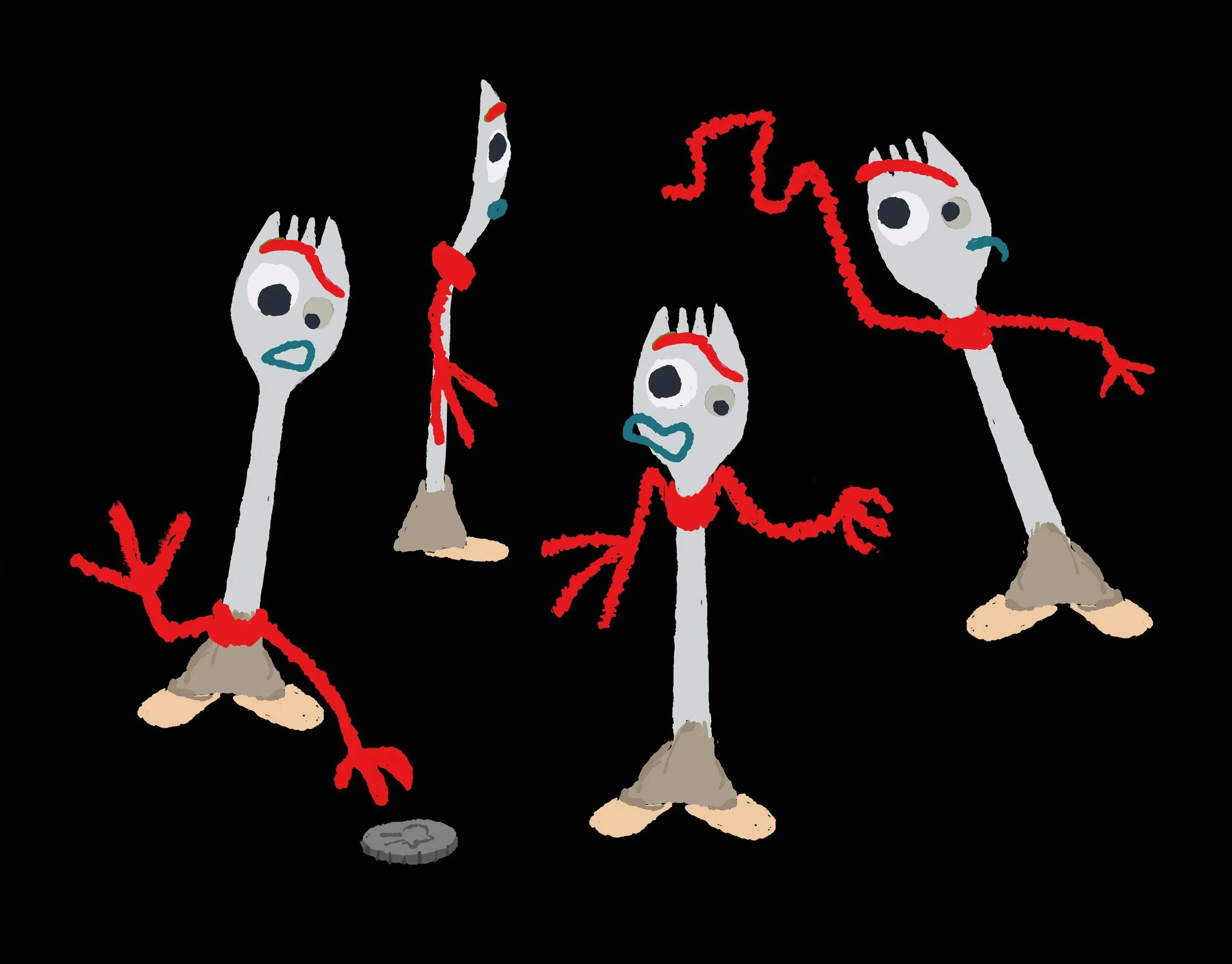
The phrase is accurate but broad. Forky experiences sensory overload, identity dysphoria, unwanted embodiment, separation anxiety, compulsive return behavior, and pressure to regulate a child.
Specific language does not diagnose a fictional spork. It prevents philosophy from making concrete distress sound cleaner and more entertaining than it feels.
He is allowed to be ridiculous and still require ethical seriousness
Forky’s shape, screams, and trash dives are engineered for laughter. Humor opens space for children and adults to approach death wishes, identity conflict, and meaning without an academic lecture.
Ethical reading should not cancel the joke. It should notice why the joke lands and what remains true after the laughter stops.
The community needs a creation protocol after Forky
Once an improvised craft wakes, the toys know similar beings may emerge whenever children assemble materials. They should prepare welcome language, safe observation, repair supplies, and a way to support identity without immediate coercion.
Treating Forky as a one-time miracle wastes what the room learned. Community care becomes real when experience changes future practice.
He changes the definition of a toy from object type to relationship practice
Forky lacks a toy manufacturer, established play function, brand story, or durable construction. He becomes part of toy society through Bonnie’s imagination and the community’s care.
Toyhood therefore behaves less like species and more like a role negotiated among body, child, peers, and self. Forky never lets that negotiation look simple again.
Final character read
Forky is funny because a spork screams about ontology in a family movie. He is lasting because the scream is justified. Everybody assigns him a purpose before asking what waking up felt like.
His life proves material history matters without dictating destiny. Character verdict: Forky is the franchise’s most honest philosopher because he begins with no investment in its sacred rules and keeps asking why a child’s love should change what a body is.