
RaeRae Reacts · One Piece Episode 170
Zoro Cuts Through Braham’s Flash Guns
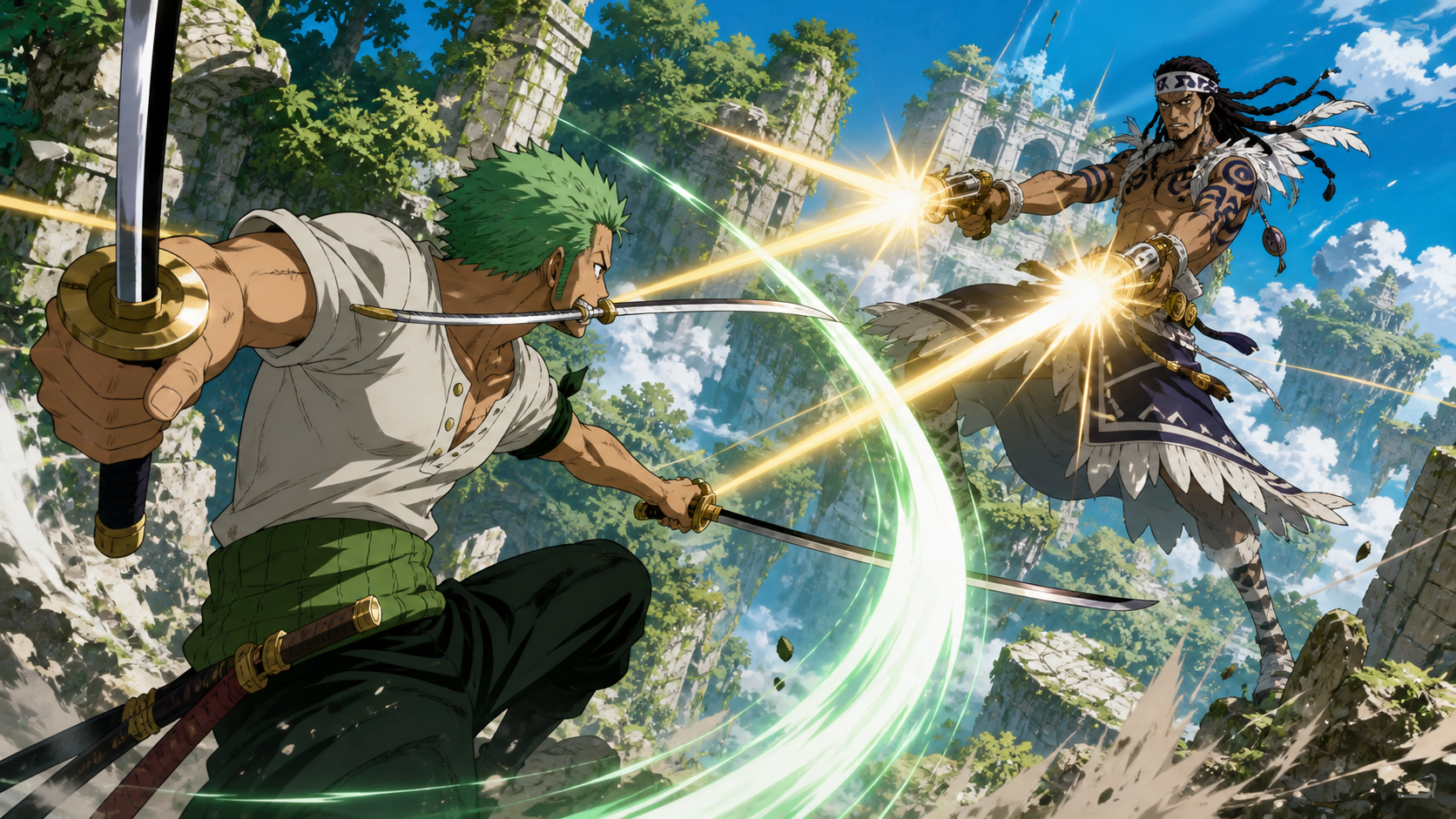
One Piece Episode 170 pushes Zoro through Braham’s Flash Guns to his first 36 Pound Cannon while Enel boards the Going Merry.
Zoro tests a flying slash before Braham gives him a real target
Episode 170 catches Zoro talking through a technique that still exists somewhere between intention and control. A bird gives him one quick trial, and the result tells him the attack is not ready.
That admission matters. Zoro does not mistake force for mastery. He knows a blade leaving visible damage at distance still needs direction, timing, and repeatable form.
Testing around living creatures is still reckless. A safer program would use marked stone, measured distance, a clear backstop, and nobody standing beyond the target.
Upper Yard offers none of those conditions. The unfinished technique follows him into a battlefield where missing can strike a ruin, ally, soldier, or Shandian he never saw.
Chopper runs from Divine Soldiers without a route or a rendezvous
Chopper moves through the forest frightened and alone while Divine Soldiers pursue him. Separation has turned the crew doctor into a mobile casualty risk with no patient list and no destination.
He should stop measuring success by continued movement. A route marker, elevated observation point, or repeated signal would help him locate the others without circling into another patrol.
The soldiers abandon their chase when a Shandian appears, but that change does not make Chopper safe. Competing armed groups can create a temporary opening without creating an ally.
Chopper needs distance from both sides, a defensible hiding place, and enough attention left to remember landmarks. Panic burns the same energy he may soon need for treatment.
Divine Soldiers and Shandians collide while Chopper disappears between objectives
The Divine Soldiers redirect toward a Shandian because Enel’s war has trained them to prioritize organized resistance. Chopper escapes notice only because another target enters their hierarchy.
That pattern gives the Straw Hats useful intelligence. Patrols can be diverted, but any diversion shifts violence onto somebody else. Escape cannot become a plan that spends Shandian lives anonymously.
A cooperative force would identify uniforms, mark active patrol lanes, and share which fighters are hostile to Enel. The battlefield currently punishes everyone for missing introductions.
Chopper should report the encounter when he reconnects. Numbers, direction of travel, weapons, and timing matter more than calling the soldiers scary and moving on.
Robin reaches the ruins and immediately recognizes damage as an emergency
Robin finds ancient structures that may preserve the history she crossed seas to study. A Divine Soldier treats the same stone as disposable scenery and breaks part of the site while directing her onward.
Her anger is not decorative archaeology. Once a carved surface breaks, information may vanish before anyone knows which missing line changed the record.
Robin should photograph or sketch exposed markings, note the location of displaced fragments, and avoid moving debris until she understands the original arrangement.
The crew also needs a rule for combat near the ruins: lure threats into open ground whenever possible. Winning beside irreplaceable evidence can still produce a permanent loss.
Six arms let Robin remove one vandal without turning the ruins into rubble
Robin uses Seis Fleur: Twist to restrain and defeat the soldier who damaged the site. Her precision answers force with controlled leverage rather than an explosion across fragile stone.
The technique suits the location because Robin can place limbs around the opponent and keep the main struggle away from carved surfaces. Control protects both researcher and evidence.
She still needs to check where the soldier falls. A body, weapon, or loose piece of armor can crush a smaller artifact after the fight appears finished.
Robin’s response establishes a boundary Enel’s forces never considered: Upper Yard contains more than territory. The ground holds testimony, and occupation does not grant permission to erase that testimony.
Zoro tries to decline a fight that Braham has already begun
Zoro meets Braham after both men cross the wider battle between Shandians and Divine Soldiers. Zoro initially wants to pass because Braham is not one of Enel’s priests.
The distinction makes tactical sense but ignores Braham’s objective. The Shandian sees another armed outsider on stolen homeland, not a neutral traveler with a tidy target list.
Zoro should identify Enel as the shared threat and state that the crew has already opposed priests. Braham should ask why the pirates entered Upper Yard before spending ammunition.
Neither offers that pause. Braham fires, Zoro answers, and two people resisting Enel begin reducing each other’s capacity for the larger fight.
Braham’s Shooters turn open distance into controlled ground
Braham carries two Shooters fitted for ranged combat. The paired weapons let him attack while changing position, forcing Zoro to defend before closing sword range.
Every clear lane becomes Braham’s territory. Zoro cannot simply charge along the shortest line because both guns can cover different angles and punish a predictable approach.
Zoro should use stone columns as hard cover, change elevation, and make Braham spend shots without seeing a clean target. Closing distance requires shaping the route rather than trusting endurance.
Braham should preserve ammunition and avoid firing toward ruins or other Shandians. Range creates responsibility for everything behind the opponent, especially on a crowded battlefield.
Flash Guns attack Zoro’s vision before their shots reach his body
The Flash Guns add bursts of light that disrupt Zoro’s sight and timing. Braham does not need every shot to land when glare can make the next angle harder to read.
Visual denial is especially dangerous for a swordsman judging muzzle direction, distance, and the small opening needed for a counter. Closing his eyes removes glare but also removes the opponent.
Zoro should track Braham through sound, foot placement, muzzle rhythm, and cover shadows instead of staring into each flash. A lowered gaze can protect vision without surrendering the whole field.
After exposure, he needs to watch for lingering spots, headache, pain, or reduced acuity. Temporary recovery should not be assumed while another shot remains ready.
Braham keeps moving because a stationary gunfighter becomes sword range
Braham uses mobility to preserve the advantage his weapons created. Each reposition forces Zoro to locate him again through light, smoke, stone, and jungle.
The method is disciplined until confidence turns the pattern readable. Repeated lateral movement and repeated firing intervals eventually give Zoro information that glare cannot hide.
Braham should vary timing, keep one weapon ready during movement, and maintain an exit lane. Both guns firing together may increase pressure while leaving the next moment empty.
Zoro’s job is to survive long enough to learn the rhythm. His defense becomes observation, and every blocked shot purchases one more piece of the solution.
Zoro stops chasing the gunman and changes what his sword can reach
The fight turns when Zoro accepts that ordinary pursuit preserves Braham’s preferred distance. Faster feet alone cannot solve a range advantage built around constant repositioning.
His unfinished flying slash becomes necessary rather than ornamental. Instead of carrying the blade to Braham, Zoro must send cutting force across the space between them.
The decision carries risk because the earlier test lacked control. Combat pressure provides urgency, not safety certification, and a wide miss could travel beyond the visible duel.
Zoro chooses a lane, fixes Braham’s position, and commits after reading the firing pattern. The breakthrough comes from changing the geometry of the fight.
Thirty-six Pound Cannon gives Zoro a ranged answer without making him a gunman
Zoro launches his first 36 Pound Cannon with one sword, sending a compressed flying slash toward Braham. The attack defeats the Shandian from outside conventional blade range.
The technique does not imitate Braham’s equipment. Zoro extends swordsmanship through breath, rotation, timing, and force while keeping the discipline centered on a blade.
A successful first combat use does not prove universal reliability. Zoro needs later practice across measured distances, crosswinds, elevations, and target sizes before treating the attack as routine.
He should also establish a clear line behind every future target. A flying slash continues beyond arm’s reach, so sword safety now includes distant people and structures.
Braham falls to innovation but the political misunderstanding remains
Zoro defeats Braham and accepts participation in the Survival Game, yet the victory does not resolve why two enemies of Enel fought each other.
Braham defended a homeland under occupation. Zoro protected himself from an armed attacker while trying to reach his crew. Both facts can remain true without making the collision useful.
If Braham survives conscious enough to speak, Zoro should explain the crew’s purpose and leave basic aid rather than treating a downed Shandian as another game marker.
Enel benefits whenever opposition fragments. Every avoidable duel makes his prediction easier to fulfill while letting him claim that violence proves his worldview.
Chopper reaches the ruins and congratulates himself one danger too early
Chopper arrives at the ruins and celebrates his navigation. Reaching a recognizable site is progress, but a location becomes useful only when he knows who controls the surrounding ground.
Gedatsu stands nearby without Chopper noticing. The former priest’s presence turns the apparent checkpoint into another potential Ordeal before Chopper has assessed exits.
Chopper should listen before calling out, identify cover, and check whether Robin left signs. Medical knowledge does not replace perimeter awareness.
His relief is emotionally fair after running alone. Operationally, relief should follow a security check, not substitute for one.
Luffy and Wyper waste cannon fire proving neither intends to leave
Wyper fires at Luffy, and Luffy rebounds the cannon shots with his rubber body. Their exchange confirms both can survive attacks that would remove ordinary fighters.
That durability encourages escalation. Wyper sees an outsider who refuses to leave, while Luffy sees another obstacle between himself, his friends, and the promised gold.
They need one shared sentence: Enel is the primary target. After that agreement, land ownership and treasure can be argued without cannon fire crossing the forest.
Every rebounded shot also needs a safe destination. Returning force without controlling the landing point can injure people who never joined the duel.
Enel boards Merry because surveillance has already found the crew’s refuge
Enel appears aboard the Going Merry, where Nami, Usopp, Sanji, Gan Fall, and Pierre believed distance offered some protection. His arrival proves the ship is known and reachable.
The vessel holds injured people, navigation supplies, Dials, and the crew’s route home. A hostile visitor on deck threatens far more than the fighters standing nearby.
Nami should secure charts and navigation tools, Usopp should prepare an evacuation signal, and Gan Fall should identify whether Enel can disable escape through lightning or command.
Nobody should cluster around him. One electrical strike could turn a close defensive formation into multiple patients and leave Chopper somewhere else entirely.
Sanji attacks first and Enel answers with power nobody aboard can absorb
Sanji moves to protect the crew and attacks Enel. Enel drops him with the Goro Goro no Mi before the defense can become a coordinated plan.
Sanji’s instinct is loyal, but a direct strike reveals no safe counter and places a core fighter beside vulnerable crewmates. Courage cannot replace reconnaissance against an unknown electrical body.
After the shock, Nami and Usopp should not touch Sanji until they know whether current remains active around him. Gan Fall must keep Enel talking while they assess breathing and immediate danger.
Future contact requires insulation, distance, decoys, and a method for determining whether physical attacks can connect. Repeating Sanji’s charge would create a queue for Chopper.
Gan Fall and Enel’s reunion exposes a history the crew still does not understand
Gan Fall recognizes Enel, and Enel treats their meeting like an old social call after striking Sanji. The casual tone turns domination into theater.
The crew needs Gan Fall to explain the former order of Skypiea, Enel’s takeover, the priests, and any limits he observed. Personal history has become operational intelligence.
Enel claims he did not come to fight, but intent does not erase the attack already delivered. A visitor who disables a defender while entering uninvited remains a threat.
Keeping him in conversation may buy time, yet nobody should confuse conversation with safety. His presence demonstrates that every separated group now faces a different part of the same command system.
RaeRae’s verdict celebrates the flying slash and invoices everyone for communication
Keep this one. Zoro meets the exact opponent who turns an unfinished idea into a necessary answer, Robin protects history with controlled force, and Enel strolls onto Merry like consent was another law he abolished.
The 36 Pound Cannon is the headline because the technique changes Zoro’s future range. The better lesson is his diagnosis: stop running inside somebody else’s fight plan and alter the distance itself.
The invoice remains ugly. Treat Sanji, secure Merry, warn Chopper about Gedatsu, document the ruins, check Braham, and make Luffy and Wyper say Enel’s name before bouncing another cannon through the trees.
RaeRae’s final note: if the swordsman has to invent airborne cutting force because nobody paused for a ten-second alliance briefing, the communication department owes the medical department overtime.