
RaeRae Reacts · One Piece Episode 169
Wyper Takes Shura’s Lance to Land the Reject
One Piece Episode 169 shows Wyper accepting Shura’s heated lance to land a decisive Reject Dial while Enel predicts only five survivors.
Gan Fall turns one harmless shell into a weapons briefing
Episode 169 begins aboard the Going Merry, where Gan Fall explains Sky Warfare to Nami, Sanji, and Usopp. A Dial can store force and release that force later.
Sanji strikes an Impact Dial with a hammer and sees no obvious response until Gan Fall shows the trigger.
The lesson matters because a quiet shell can carry the violence of an earlier blow. Appearance gives no useful warning.
The crew should label every recovered Dial, separate loaded from unloaded devices, protect triggers, and assume unknown shells remain active.
Impact returns stored force without caring who supplied the force
Pressing the Dial releases the captured impact. The device turns past energy into a delayed attack, tool, or accident.
Usopp immediately gains a new engineering category, while Sanji receives a reason not to hit unfamiliar equipment for demonstration purposes.
They need tests using measured force, fixed mounts, protective distance, and a backstop. Human hands should not become the first load-bearing component.
Every operator must know which surface receives force and which surface releases force before carrying a Dial near the body.
Reject multiplies the same principle into damage for both sides
Gan Fall explains that the Reject Dial produces far greater force than an Impact Dial. The release can devastate a target and seriously injure the user.
The weapon treats the wielder’s body as part of the recoil system. Power comes with a medical debt paid immediately.
Chopper would classify repeated use as a predictable trauma event, not heroic mystery.
The crew should avoid Reject unless no safer tool can meet the objective, and nobody should activate one without knowing how the force travels through wrist, arm, chest, and internal organs.
Storage needs the same caution as use. A loaded Reject Dial should remain immobilized inside a marked container with the trigger protected from pressure, impact, and curious hands.
Usopp should never mount the shell into a weapon before Chopper explains the likely injury pattern. Engineering success cannot be defined as the target falling while the operator becomes the next emergency.
Sanji’s legs and hands deliver strong force, but strength does not make recoil harmless. The crew needs a remote trigger or mechanical brace before considering any test.
Gan Fall should identify whether a Dial can leak, degrade, misfire, or retain unknown force from a previous owner. A device found in ruins may carry an attack nobody aboard witnessed.
Every use should be logged with input, output, operator, and observed damage. A technology built on stored force becomes safer only when memory does not remain inside the shell alone.
Mantra sounds mystical until Gan Fall describes a surveillance network
Gan Fall struggles to explain Mantra fully but confirms that priests and Enel can sense presences and actions across distance.
The capability makes isolation dangerous and stealth unreliable. Enel may know people entered Upper Yard even without seeing their routes.
Nami should design plans that remain useful when observed. Usopp can create simultaneous threats and decoys rather than relying on one hidden attack.
Sanji should assume leadership and medical movements can be targeted because Satori already struck the person organizing the team.
Enel counts eighty-one lives as inventory
At the shrine, Enel totals everyone inside his Survival Game at eighty-one. The count reduces distinct people and objectives to one population under his control.
Straw Hats, Shandians, priests, Divine Soldiers, and others become entries in a prediction.
Counting can support rescue when the goal is accounting for every person. Enel counts to enjoy subtraction.
His advisers should recognize that participation in the census does not create consent to the game.
Five survivors in three hours is a forecast designed to become an order
Enel predicts that only five people will remain after three hours. The statement sounds like supernatural certainty while encouraging subordinates to produce the number.
Once priests and soldiers hear the target, every attack helps fulfill their ruler’s forecast. Prediction becomes policy.
The group opposing Enel should preserve more than five lives simply to break the model and protect people.
They also need to distrust any apparent safe group of five. Enel includes himself and may plan to eliminate or recruit the rest after his count stabilizes.
His prediction changes behavior across the battlefield. Priests attack harder to prove value, soldiers pursue approval, and frightened people may abandon injured allies because they believe only a tiny group can remain.
That influence allows Enel to claim supernatural accuracy after creating the conditions that produce the outcome.
A resistance count should move in the opposite direction: record every known person, injury, location, and rescue route. Preserving names prevents Enel’s arithmetic from becoming the only account.
The forecast also deserves a time challenge. If more than five people remain after three hours, announce the failure widely. A ruler who bases legitimacy on infallibility becomes vulnerable when the prediction has witnesses and a deadline.
No one should sacrifice a life merely to disprove a number. The point is cooperative survival, not winning a statistical argument with a lightning dictator.
Shura’s strings catch the Shandian advance before the priest appears
Shandian warriors enter a section filled with nearly invisible lines. Several become trapped before they can identify Shura’s position.
The Ordeal of String converts forward momentum into restraint. Pulling harder can tighten contact or injure a person caught across the throat and limbs.
Untrapped warriors should stop, mark visible lines, lower tension from anchor points, and free breathing first.
Charging toward the priest while teammates hang in the system leaves the trap active behind them.
Wyper stays free because he reads the trap before committing
Wyper avoids the lines and enters Shura’s range with mobility intact. Experience and suspicion keep him from following the most direct path.
He should use that freedom to create a safe lane for the squad, but Shura’s presence pushes the confrontation toward immediate elimination.
Wyper knows the priest will exploit distance through Fuza and the heated lance. A conventional exchange favors Shura.
The Shandian therefore plans around one decisive contact rather than a prolonged aerial fight.
Throwing away the bazooka and shield looks reckless because the recklessness is bait
Wyper discards his gun and shield in front of Shura. The choice appears to remove both offense and protection.
Shura reads the opening as weakness and closes distance. Wyper is controlling the priest’s confidence rather than surrendering.
The tactic works only if Shura commits to a path close enough for the hidden Dial.
Wyper should still consider whether a shield could preserve the same opening without exposing vital areas. A plan that requires injury leaves no margin for error.
Discarding both visible tools also communicates desperation to the Shandians watching. Without a briefing, another warrior may misread the move and rush forward to protect Wyper, entering the strings.
A coordinated version would assign one person to track Fuza, one to free trapped teammates, and one to extract Wyper after the Reject. The episode gives him none of that safety net.
Shura’s arrogance provides the timing, but arrogance remains an unreliable control mechanism. If the priest attacked from farther away or targeted another warrior, Wyper would lose protection without gaining contact.
The plan succeeds because Wyper understands this opponent, accepts extreme personal cost, and hides the decisive tool. Success should not turn the method into standard doctrine.
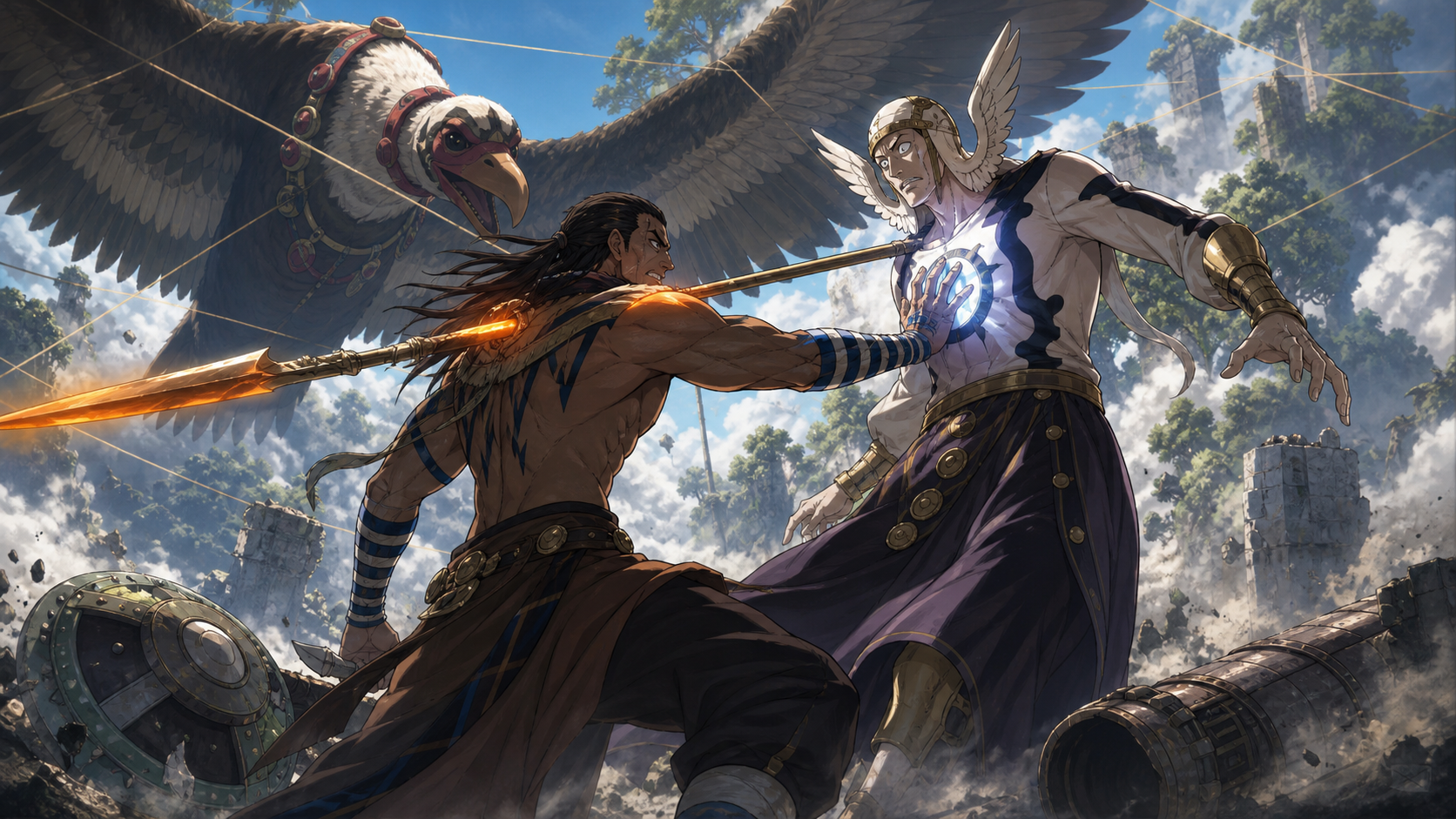
Wyper accepts the heated lance through his left shoulder
Shura drives the lance into Wyper’s left shoulder. Heat and penetration create immediate risk of blood loss, tissue damage, shock, and loss of arm function.
Wyper does not retreat because the attack places Shura inside the range he chose.
The decision is resolve and self-destruction at once. A cause can explain why somebody accepts damage without making the damage free.
After the strike, Wyper will need pressure control, burn care, immobilization, and monitoring for internal injury before any further combat.
The heated lance may seal some surface bleeding while deep tissue remains damaged. A clean-looking wound can still hide burns, contamination, nerve injury, and reduced circulation.
Reject recoil can compound trauma through the opposite arm and torso, leaving Chopper with multiple mechanisms to assess rather than one visible shoulder injury.
Wyper should not carry heavy weapons immediately after treatment. Loss of grip, dizziness, breathing difficulty, or increasing pain should trigger evacuation even if he remains conscious.
The Reject Dial turns Shura’s confidence into contact range
Wyper presses the Reject Dial in his right hand directly against Shura. The priest finally recognizes that the discarded weapons hid the real weapon.
Reject releases force at the point where armor, aerial distance, and lance reach offer little protection.
The blast defeats Shura and removes one priest from the active battlefield.
Wyper also absorbs recoil. Victory therefore creates another injured Shandian at the moment the assault needs leadership.
Shura loses because he underestimates a weapon built from his own sky
Enel observes that Shura underestimated Sky Weapons. The priest knows Dials but assumes only his system can use them effectively.
Wyper’s community understands the same technology and applies that knowledge without priestly ceremony.
Control over official ordeals never meant monopoly over skill. Shura’s status made him careless around an opponent he treated as trapped prey.
The lesson applies to Enel as well: surveillance can reveal presence without revealing every hidden tool or decision.
The Shandians split after victory and lose shared medical support
With Shura down, the warriors continue deeper into Upper Yard. Scattering can cover ground and avoid one trap catching everyone.
The tradeoff is isolation. Wyper is injured, several warriors faced strings, and priests remain mobile.
Each group needs at least one communicator, route marker, and person assigned to basic first aid.
They should report Shura’s position and the Reject use so nobody approaches the blast site without checking survivors and traps.
Yama mobilizes fifty Divine Soldiers into Enel’s arithmetic
Yama sends Divine Soldiers across Upper Yard, adding organized force to the roaming priests and natural hazards.
The soldiers may believe service increases their chance of survival, but Enel’s count does not promise them protection.
Every additional fighter creates more crossfire and mistaken identity around separated Straw Hats and Shandians.
Opponents should bypass soldiers when possible, preserve energy for command threats, and offer surrender routes to people Enel treats as expendable.
Luffy defeats one soldier and keeps walking without learning anything
Luffy encounters a Divine Soldier in the forest and removes the immediate obstacle quickly.
The fight confirms organized troops are active beyond old ordeal zones. Luffy has no way to send that update to the others.
He should search the soldier for signals, maps, or unit markings without taking equipment he cannot identify safely.
Moving onward alone preserves momentum but deepens the communication gap created by Nola.
Wyper meets Luffy and mistakes refusal to leave for opposition
Luffy and Wyper encounter each other after fighting Enel’s forces separately. Both want Enel removed, but their immediate objectives collide.
Wyper orders Luffy to leave Upper Yard. Luffy refuses because he intends to find gold and reunite with his crew.
Neither man explains enough. Luffy does not understand Shandian ownership, while Wyper does not know the crew already defeated a priest and protected civilians.
A ten-second exchange could identify Enel as the shared threat. Pride converts missing context into another battle.
Reject proves that survival cannot be measured only by who stays standing
Wyper remains upright after defeating Shura, but his shoulder and body have absorbed deliberate damage and Reject recoil.
Enel’s game would count him alive and ignore the medical cost. That metric rewards people for hiding injuries until collapse.
Real survival includes function, treatment, community, and the ability to reach the objective after combat.
The Shandians need to protect Wyper from becoming a symbol whose body everyone assumes can pay unlimited debt.
RaeRae’s verdict keeps the Dial lesson and rejects the body-as-ammunition policy
Keep this one. Gan Fall explains that a shell can store violence, Wyper demonstrates the premium model on Shura, and Enel treats eighty-one people like a spreadsheet he wants reduced to five rows.
The operational list remains brutal. Free the trapped warriors, treat Wyper’s shoulder and Reject recoil, report Shura’s defeat, track Divine Soldiers, reconnect Luffy with the crew, and stop Luffy and Wyper from doing Enel’s elimination work for him.
Nami, Sanji, and Usopp must secure every Dial before curiosity creates another patient aboard Merry.
RaeRae’s final note: when the weapon manual says ten times the force and may destroy the user, do not let the most determined man in the forest write the safety policy.