
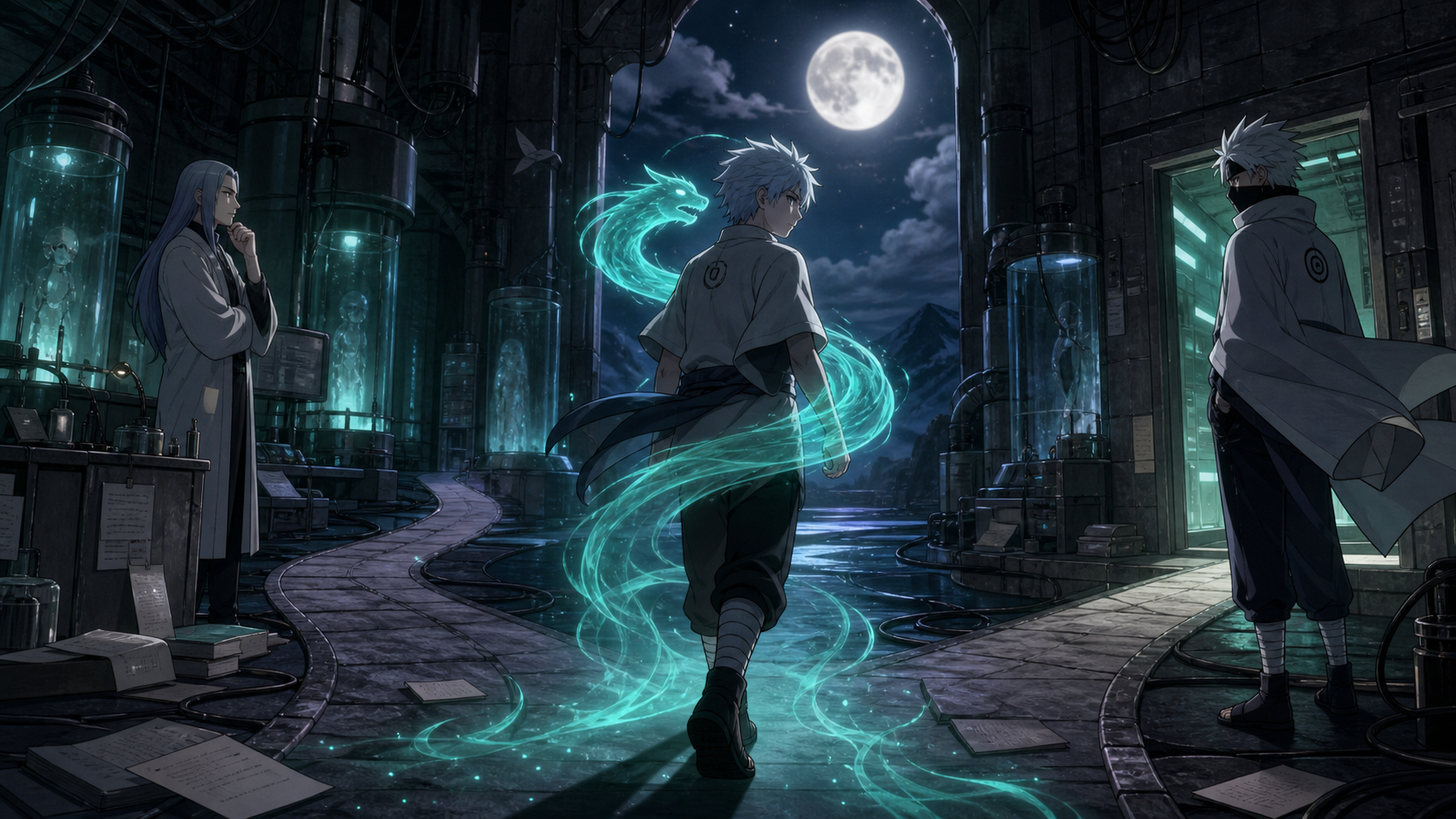
The Path Lit by the Full Moon
Mitsuki wakes without memories, unmasks his older self, rejects Orochimaru and Log, steals back his origin in Sage Transformation, and finds Boruto waiting as a suggested sun.
Series: Boruto: Naruto Next Generations
Episode: 39 · The Path Lit by the Full Moon
Arc: Mitsuki Origin
Release: 2017-12-27
Previous: Episode 38 · Formation of the Three-Man Squad?
Directory: All 293 Boruto episodes
Bottom line
Boruto Episode 39 gives Mitsuki one of the coolest awakenings in the series and one of the messiest definitions of parental love. Sarada asks whether following Boruto is truly Mitsuki’s own choice, and that question takes us back to a laboratory where he wakes without memories. Orochimaru says a masked shinobi named Log stole them. The mission, battle, poison, paralysis, older clone reveal, stolen embryo case, and argument over Mitsuki’s future are all staged. This is the sixth attempt to push him toward an independent decision. Mitsuki finally rejects both adults, enters Sage Transformation, takes the case and key, and leaves before either can stop him. That third choice is real. The room was still built for him. Even the photograph of Boruto waiting inside the case was planted as a possible sun. I am proud of Mitsuki and deeply suspicious of everybody congratulating themselves afterward. Orochimaru wants a child who chooses freely, then controls the memories, crisis, alternatives, and light at the end. That contradiction is not a flaw in the episode. That contradiction is the episode.
Sarada asks the question Mitsuki has already survived
In the present, Sarada complains that Boruto’s lateness could interfere with her goals. She asks Mitsuki what missions he wants, and he says he is happy doing whatever Boruto does. Sarada wonders whether he ever acts from his own will. Mitsuki calmly says following Boruto was his choice. The answer sounds simple because he has already fought for the right to say those words. Sarada cannot know that her casual question opens a door to erased memories, synthetic bodies, and a parent who turned self-determination into an experiment.
Mitsuki wakes with a medicine cup and no past
The flashback begins in Orochimaru’s care. Mitsuki drops a cup of medicine and admits he cannot remember who he is or how he arrived there. Orochimaru explains the missing memories with practiced calm. Everything Mitsuki knows about the crisis comes from the person controlling his treatment. That imbalance immediately makes the room feel wrong, even before we know this has happened more than once. Mitsuki wants identity. Orochimaru gives him a mission.
Orochimaru refuses the father-or-mother box
Mitsuki asks whether Orochimaru is his father or mother. Orochimaru says the distinction does not matter and identifies as his parent. That answer is one of the least troubling parts of the episode, honestly. Orochimaru has always treated bodies and gender as mutable. The problem is not refusing a binary title. The problem is claiming parental love while repeatedly drugging a child’s memories and designing a lethal test around the confusion. Language can be expansive while behavior remains controlling.
The story about stolen memories arrives ready-made
Orochimaru says Log took Mitsuki’s memories and possesses information they need. Mitsuki has no past available to challenge the claim. The mission gives him direction before he has time to ask what the medicine did, whether the memories were ever present, or why this stranger should be trusted. Orochimaru turns uncertainty into momentum. If Mitsuki keeps moving toward the alleged thief, he will encounter only the evidence the adults prepared.
Mitsuki disrupts Log’s barrier because obedience comes first
They approach Log’s hideout, and Orochimaru has Mitsuki break the barrier. Log detects the intrusion, which makes the encounter feel like a genuine operation. Mitsuki contributes before understanding what either side wants from him. The task is small compared with Sage Transformation, but the sequence matters. Orochimaru establishes teamwork and authority first. By the time Log offers a competing story, Mitsuki has already acted beside the parent who framed the mission.
Log’s paralysis makes Mitsuki watch instead of choose
Log confronts them and uses a technique that paralyzes Mitsuki. Orochimaru and Log fight at a speed that impresses him. Mitsuki cannot intervene, so the two adults demonstrate power while he absorbs their roles: Orochimaru as protector, Log as enemy. The paralysis also ensures that the staged battle reaches its intended beats without Mitsuki disrupting the performance too early. Even his helplessness has been designed into the lesson.
Orochimaru’s snakes find the gap in Log’s armor
Log’s armor blocks the obvious snake fangs and even spreads over Orochimaru to hold the Sannin in place. Then a smaller snake slips through a gap and delivers the venom. Orochimaru wins through exactly the kind of patient, invasive detail that defines the character. The fight is staged, but the technique still shows why Orochimaru remains terrifying. There is always another snake small enough to reach the opening you forgot to protect.
Orochimaru tells Mitsuki he can use senjutsu
During the fight, Orochimaru reveals that Mitsuki has access to senjutsu. Imagine learning that fact while paralyzed, memoryless, and watching two strangers battle over a story supposedly centered on you. Mitsuki’s body contains knowledge his mind cannot access. Orochimaru knows the power, Log knows the power, and Mitsuki is the last person informed. That imbalance turns his eventual transformation into more than a new form. He takes ownership of an ability everybody else has been discussing as their result.
Mitsuki is left alone with the villain on purpose
After Log falls to the venom, Orochimaru orders Mitsuki to watch him while searching for the stolen object. This separation creates the exact private conversation the test requires. Log can challenge Orochimaru’s story without interruption, and Mitsuki can believe he is hearing forbidden truth. The setup works because Log’s pain, mask, and accusation all feel immediate. Orochimaru does not simply ask Mitsuki to choose. The adults manufacture emotional credibility for both sides.
Removing the mask reveals a future wearing his face
Log asks Mitsuki to remove his mask so he can breathe, then says the face underneath will prove Orochimaru is lying. Mitsuki reaches forward and discovers an older version of himself. That reveal would break anybody’s sense of identity. He woke asking who he was, and the answer appears as a stranger who looks like the life his body might become. Log is not merely a clone in exposition. He is physical proof that Mitsuki was made, repeated, and observed.
Synthetic does not mean unreal
Log explains that both are synthetic humans created by Orochimaru. The word “synthetic” can sound like an argument against personhood if the story lets Orochimaru’s laboratory define value. Mitsuki’s fear, curiosity, anger, and choice answer that immediately. He was created through a process, as every person was. The process is unusual and ethically chaotic. The person standing inside the result remains real. Log is real too, even while participating in the test.
Log tells the story Orochimaru wants Mitsuki to reject
Log claims he escaped Orochimaru, stole the original embryo source, and wants to destroy both the case and their creator. He frames Orochimaru’s work as narcissism and Mitsuki as a replacement produced after the older version got away. The accusation hits every possible fear at once: replaceability, ownership, and a future where independence only leads to another copy. The story is staged, but the underlying danger is not imaginary. Orochimaru absolutely has a history of treating bodies as projects.
The embryo case turns origin into property
Orochimaru possesses the key. Log possesses the case holding the source from which they were cultured. Both adults argue over whether the material should be preserved or destroyed. Mitsuki stands between them while everybody discusses his origin as an object with a lock. Neither side begins by asking what he wants done with the source. Their disagreement is dramatic, but both still treat Mitsuki as the audience for an adult decision.
Orochimaru calls creation love
Orochimaru returns and says the circumstances of their birth do not matter because both are beloved children. Then Orochimaru suggests creating more siblings for Mitsuki. The offer is supposed to sound warm, but the timing is pure Orochimaru. Log has just described replacement as horror, and Orochimaru responds with more creation. Love may be sincere in the strange emotional architecture of this character. Sincerity does not make repeated memory erasure and engineered fear gentle.
Log wants Mitsuki to choose destruction
Log pressures the younger Mitsuki to oppose Orochimaru and destroy the source. That option appears rebellious, but Log still tells him what a correct independent choice should look like. Mitsuki is offered two scripts: remain the child Orochimaru designed or become the escapee Log wants reflected back at him. Both adults make his identity answer their argument. Mitsuki’s anger finally becomes the healthiest emotion in the room.
Mitsuki says the adults do not get to decide
He rejects both sides because he is a child and has no interest in the adults forcing their conclusions onto him. That line lands. Mitsuki does not need to solve whether preservation or destruction is morally perfect before claiming the right to leave with the case. His third option begins with refusing the false urgency. The adults want a verdict on their terms. Mitsuki chooses distance.
Sage Transformation is gorgeous and terrifying
Mitsuki’s chakra erupts, spectral snakes coil around him, and the laboratory suddenly contains a power even Orochimaru cannot casually control. The form is beautiful in the way dangerous moonlight can be beautiful. This quiet child becomes motion, light, and fury. I understand why fans never forgot the scene. The transformation is not merely a power-up. Mitsuki’s body finally speaks louder than everybody narrating his purpose.
He takes the case and the key from both sides
Mitsuki does not destroy the embryo for Log or return the source to Orochimaru. He takes the locked case and the key, physically removing the object from their divided control. That gesture is the cleanest symbol in the episode. Origin and access belong together in his hands. He leaves too quickly for either adult to stop him, which makes the decision feel gloriously unscripted even after the reveal that they wanted a third choice.
The sixth attempt makes every celebration sour
Once Mitsuki leaves, Orochimaru and Log drop the conflict. They are pleased because the test finally worked on the sixth try. Orochimaru admits that the previous failures required drugging Mitsuki and erasing his memories again. Six times. The episode says this almost casually, which made me angrier on replay. Mitsuki’s awakening is triumphant. The road to that triumph includes five versions of distress he was not allowed to remember.
Orochimaru wanted independence and controlled the conditions
The goal was for Mitsuki to reject both presented options and choose a third path. That sounds almost admirable until we list the variables Orochimaru controlled: memory, medicine, mission, enemy, reveal, case, key, and the information waiting inside. Mitsuki genuinely surprises them through the force and clarity of his response. His agency is real. Orochimaru still treats agency like an outcome to produce in a lab.
Log asks what the scroll contains this time
The phrase “this time” confirms that even the final discovery changes between tests. Orochimaru says the case contains a photograph of the sun, and Mitsuki finds Boruto’s image. Depending on the version and reading, Log helps select or place that image. Either way, an adult points Mitsuki toward Boruto after congratulating the child for choosing independently. The manipulation becomes softer, not absent. Nobody orders him to love Boruto. Somebody places Boruto at the end of the escape route.
Boruto becomes a sun before meeting the moon
Mitsuki sees Boruto in the photograph and travels toward Konoha hoping this boy can illuminate a path. The metaphor is lovely and dangerous. A moon reflects light, but Mitsuki deserves more than a life defined entirely through another person. Boruto can inspire choice, joy, and connection without becoming the owner of Mitsuki’s identity. The later series is strongest when Mitsuki learns that following his sun still requires knowing where his own feet want to go.
The present-day answer is true and incomplete
Mitsuki tells Sarada that staying beside Boruto is his own will. I believe him. He chose to leave the laboratory, chose to seek Boruto, and continues choosing the friendship through experiences Orochimaru did not script. I also remember that the first photograph was planted. Autonomy is not a purity test where outside influence makes every choice fake. Mitsuki turns a suggested direction into a lived relationship. That transformation belongs to him.
This episode adapts Mitsuki’s Chapter 0 origin
The story comes from the one-shot commonly treated as Chapter 0 of the Boruto manga, which gives Episode 39 a different density from many early anime-original episodes. The symbolism, reversals, and compressed history feel deliberate because the chapter had to establish Mitsuki’s entire internal premise at once. Placing the adaptation immediately before Team 7’s first mission is perfect. We learn why Mitsuki chose Boruto just before he begins choosing Boruto and Sarada in the field.
What changed on every replay
My first watch was all Sage Transformation. The animation, snakes, speed, and shock of Mitsuki taking both objects made the episode. On replay, the dropped medicine cup became more frightening because that harmless-looking dose belongs to a cycle of erased failures. Another pass made Log’s role sadder. He helps create the crisis for a younger version of himself, perhaps because he believes this pain will produce a freer child. The final detail I kept returning to was the Boruto photo. Mitsuki escapes two scripts and finds a third suggestion waiting inside the box.
Orochimaru designs independence like an experiment with one acceptable result
The test asks Mitsuki to choose between two adults while both adults perform roles written by Orochimaru. One side offers control disguised as parental purpose. The other offers destruction disguised as liberation. Mitsuki creates a third answer by rejecting both claims.
That choice feels independent because Mitsuki identifies the false frame. He takes the embryo case and the key, activates Sage Transformation, and leaves before either adult can convert his decision into obedience. The action belongs to him.
Orochimaru still arranged the room, memories, conflict, evidence, and possible revelations. Independence becomes the desired experimental outcome. If Mitsuki chooses wrong, the cycle resets. Six attempts mean five earlier children had their memories erased after failing to produce the answer the creator wanted.
Calling the process love cannot clean that record. Orochimaru wants Mitsuki to develop a will strong enough to resist design. The desire may be genuine. The method treats the child’s continuity as disposable whenever development moves in an unsatisfactory direction.
Log complicates the ethics further. He is an older Mitsuki participating in the test of a younger version. Perhaps he believes the pain created his own freedom and therefore justifies repeating the pain. Survivors can inherit the logic of the system that harmed them, especially when the system calls suffering necessary preparation.
The medicine cup makes that danger ordinary. No dramatic machine announces memory removal. Mitsuki wakes, receives a dose, and accepts a ready-made story because no internal record can challenge the explanation. Control enters through routine care.
Mitsuki’s third choice therefore carries two truths. He acts with courage and insight. Orochimaru celebrates because the designed environment finally produced courage and insight in the desired form. A successful escape can still happen inside a cage built to reward escape.
Synthetic origin does not make Mitsuki’s emotions synthetic
Log’s face reveals a body matching Mitsuki’s own and turns identity into a manufacturing question. Multiple versions exist. An embryo case appears to contain another possible life. Orochimaru discusses creation with the vocabulary of ownership and iteration.
Mitsuki responds as a person because personhood does not require unique biological origin. Fear, anger, curiosity, judgment, and desire emerge through his experience even when somebody engineered the body and controlled parts of the experience.
The adults keep trying to make origin decide obligation. Orochimaru created him, so obedience appears natural. Log shares his body and history, so destruction appears like solidarity. Mitsuki rejects the idea that either fact grants final authority.
Taking the embryo case protects the possibility that another version should not become property or collateral. Taking the key ensures neither adult controls access. The choice recognizes a future person before that person can ask for protection.
Sage Transformation makes the internal claim visible. Mitsuki’s body contains power neither adult can safely command once he decides to move. The beauty of the form cannot hide the fear surrounding what Orochimaru built into a child.
The Boruto photograph becomes the next direction. Mitsuki chooses a sun because he wants a point outside the laboratory’s closed system. Yet Orochimaru placed the photograph inside the box, meaning even the escape route arrived through another suggestion.
That does not make Mitsuki’s later bond fake. A recommendation can introduce two people without authoring every conversation, risk, disagreement, and act of loyalty that follows. Boruto becomes meaningful through lived friendship rather than the picture alone.
Episode 39 leaves Mitsuki with a difficult freedom. He cannot prove that every desire emerged untouched by design. Nobody can. He can keep choosing, revising, and testing those desires against relationships where disagreement does not end in a memory reset.
Continuity becomes part of that freedom. Memories of Team 7, ordinary missions, arguments, jokes, and mistakes give Mitsuki a history nobody can replace with a fresh body or another controlled scenario. A self grows through what remains available to remember.
Mitsuki finally gets to keep becoming.
RaeRae’s final reaction
Episode 39 made me love Mitsuki more and trust Orochimaru exactly as much as common sense allows, which is not much. Mitsuki’s third choice is brave, smart, and visually stunning. The fact that Orochimaru hoped for that choice does not erase the moment because Mitsuki supplies the power, anger, and meaning. The fact that this was attempt six does keep me from calling the test good parenting. I am fascinated by Orochimaru’s version of love because love exists there beside control, curiosity, pride, and a terrifying willingness to reset the child when the result disappoints. Mitsuki leaves with his origin in one hand, access in the other, and Boruto’s face waiting inside. The moon chooses a path. The adults still arranged the sky.
Sources and lawful viewing
Official episode reference: Naruto Official episode guide
Licensed episode route: Crunchyroll licensed series page