
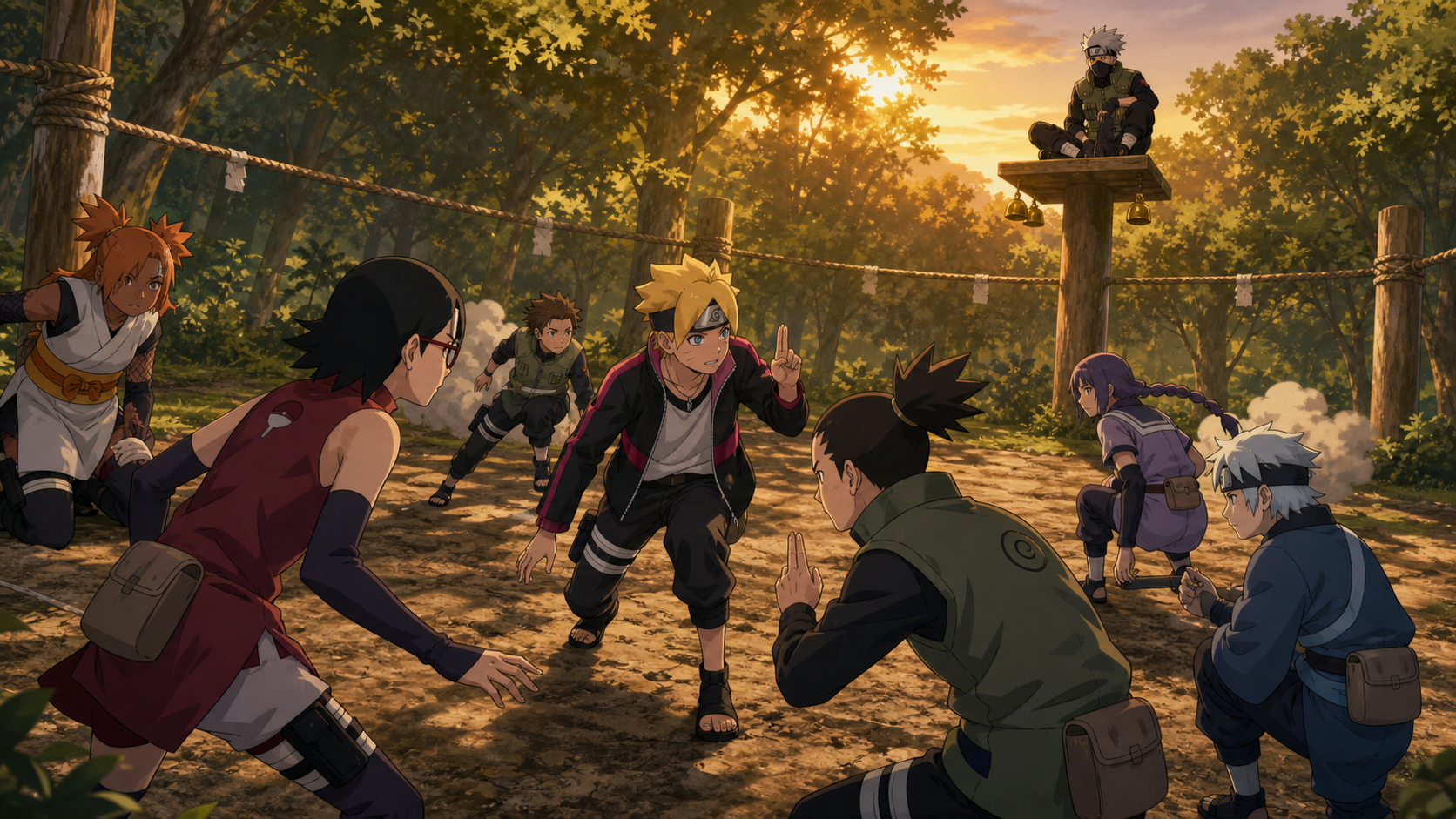
A Shinobi’s Resolve!
Kakashi breaks Boruto’s confidence, the class rescues every captured friend, and a lightning-charged formation proves that nobody will abandon a comrade.
Series: Boruto: Naruto Next Generations
Episode: 37 · A Shinobi’s Resolve!
Arc: Graduation Exams Arc
Release: 2017-12-13
Previous: Episode 36 · The Graduation Exam Begins!
Directory: All 293 Boruto episodes
Boruto Episode 37 finally asks the graduation exam question that matters. The bell is a prop. Kakashi’s deadline is theater. The written scores, the bruises, and every smug little lecture are pressure points designed to expose what these kids do when becoming shinobi stops feeling fun. Boruto begins the episode pinned under Kakashi’s knee, furious enough to fight and frightened enough to hear every cruel word as truth. He ends the episode reaching for a bell while his entire class holds a lightning-charged formation together behind him.
That change is why this finale works. Boruto does not pass because a prodigy finds one more clever shortcut. The class passes because everybody rejects the lonely version of strength Kakashi offers them. They rescue captured friends, gamble on Sarada’s genjutsu, turn Boruto’s signature move into a class-wide disguise, and refuse to release their lines even when lightning starts tearing through the formation. The victory belongs to the whole room.
Bottom line
Boruto Episode 37 succeeds because the bell test is never really about touching metal. The class passes in stages: when Mitsuki and Iwabee rescue Boruto, when Boruto apologizes, when the students recover their captured friends, when Sarada and Denki trust a delicate feint, and when everybody holds the formation through Kakashi’s lightning.
The final bell rings because dozens of choices have already answered Kakashi. These students are messy, overconfident, frightened, clever, and loyal. They are not perfect shinobi. Thank goodness. Perfection would make for a dead fandom story. What they prove is better: when the rule and the relationship collide, they know which one deserves their hands.
Kakashi Opens With a Cruel Choice
Kakashi has Boruto trapped so completely that escape seems to require breaking his own arm. That detail lands harder than another flashy exchange would have. Boruto entered the exam convinced talent and improvisation could carry him through any obstacle. Kakashi answers by making the cost physical. A trick may create an opening, but resolve decides whether somebody can pay for one.
Boruto still searches for a solution because that restless instinct is genuine. The problem is not cowardice. The problem is that he has rarely needed to decide what suffering means before acting. Kakashi can see the gap between quick thinking and settled conviction, and he presses directly into that gap.
Sukea Was Never Just a Funny Disguise
The reveal that Kakashi had been wandering around as Sukea gives the episode a satisfying little snap. Boruto thought he had met a helpful stranger. Kakashi had actually been observing the class up close, gathering evidence while the students relaxed around a face they did not recognize.
More importantly, the disguise makes Kakashi’s judgment feel personal. He is not repeating a reputation from the Hokage’s office. He watched Boruto talk, posture, improvise, and influence everybody around him. When Kakashi says the class is unfit, Boruto cannot dismiss the verdict as an old man misunderstanding the new generation.
Kakashi Knows Where Boruto Is Soft
Kakashi tells Boruto that his lack of resolve has infected the class. That accusation is deliberately vicious. Boruto can shrug off criticism aimed at his grades or manners. Blaming him for his friends’ failure reaches a much more vulnerable place.
The scene also understands Boruto better than the loudest jokes about him do. He wants attention, yes, but he also wants belonging. Graduation is supposed to preserve the daily world he built with these classmates. Kakashi turns that hope inside out and tells Boruto that his presence may be the reason everybody loses that future.
Mitsuki and Iwabee Refuse Kakashi’s Story
Mitsuki and Iwabee attack before Boruto can disappear completely into shame. Their intervention forces Kakashi to release him, and Iwabee helps Boruto escape. Neither boy stops to ask whether helping Boruto will improve an individual score. They see a classmate in trouble and move.
That choice quietly disproves Kakashi’s accusation before Boruto has the courage to challenge the accusation himself. Whatever flaws Boruto brings into the room, his classmates have not become selfish extensions of him. They have become people willing to risk their own exam for one another.
Boruto’s Apology Matters Because He Does Not Perform for Approval
Once Boruto reaches the others, he tells them what Kakashi said and apologizes. The apology is not polished. Boruto does not suddenly deliver a mature speech from some future version of himself. He looks wrecked, admits the fear underneath his bravado, and takes responsibility for the possibility that his behavior hurt everybody.
That messiness sounds honest. Boruto has spent much of the academy era making confidence look effortless. Here he lets his friends see the part that believes graduation could separate them and leave him responsible. RaeRae translation: the baby finally says the quiet part out loud, and nobody makes him beg for a place at the table.
The Class Answers Shame With Loyalty
The others do not accept Kakashi’s definition of Boruto. They know he can be obnoxious. They have survived his schemes, his shortcuts, and his need to turn ordinary afternoons into events. They also know he is the kid who keeps dragging isolated people into the group until the group feels natural.
Their loyalty does not erase his mistakes. Loyalty gives him a reason to grow beyond them. That distinction is important because the episode never asks the audience to believe Boruto was secretly perfect. His friends simply refuse to let one brutal assessment become the only story he tells about himself.
The Captured Students Are the Real Exam
Kakashi, Anko, and Konohamaru watch the students wrestle with the choice in front of them. Some classmates have been captured. The remaining students could protect their own chances by leaving those people behind, or they could spend precious time mounting a rescue.
Kakashi already knows what choice matters. Every formal instruction points toward competition, but the test is waiting for somebody to reject the premise. A shinobi who obeys the surface rule while abandoning comrades has learned the wrong lesson beautifully.
Nobody Gets Treated Like Acceptable Loss
The class rescues the captured students. That sentence sounds simple until the clock is remembered. Every rescue burns time they supposedly need for the bell. Every extra person complicates movement. Every act of solidarity makes individual success less likely under the rules they were given.
They do the rescue anyway. This is the first unmistakable answer to Kakashi’s challenge. The class will not sort members into useful fighters and acceptable losses. Denki matters. Wasabi matters. Namida matters. The strongest students do not earn the right to leave everybody else behind.
Night Gives Them Room to Become a Team
After the rescue, the students use the night to plan. The mood changes because Boruto stops trying to be the only engine in the room. Ideas move between classmates. Strengths become parts of a shared design rather than reasons to rank everybody.
This is leadership Boruto can actually grow into. He remains energetic and central, but central does not mean solitary. He listens, accepts help, and lets other people carry essential pieces of the plan. The episode makes cooperation look like active construction, not a sentimental group hug pasted over the action.
Sarada and Boruto Turn Identity Into a Weapon
Sarada and Boruto transform into each other, using Kakashi’s expectations against him. The switch works because their personalities are distinct enough for Kakashi to believe he has read the battlefield correctly. Sarada gets close while wearing Boruto’s face, and the class turns familiarity into camouflage.
I love that Sarada is trusted with the delicate part. Boruto may be the emotional center of the episode, but the plan does not pretend every solution belongs to him. Sarada’s discipline and timing create the opening everybody needs.
Sarada’s Sharingan Creates the First Crack
Once she is close enough, Sarada uses the Sharingan to catch Kakashi in genjutsu. The illusion does not defeat him. Nobody in this class is going to overpower Kakashi through one clean technique. The point is to steal a fraction of attention from a man who notices almost everything.
That fraction is enough. Kakashi misses Denki’s kunai hidden in his fist. The episode keeps rewarding combinations where one student’s ability makes another student’s small action suddenly dangerous. Power is not only the largest jutsu on screen. Power is also making space for somebody else to matter.
Denki’s Kunai Is a Tiny Triumph
Denki carrying the hidden kunai is exactly the sort of detail this exam needs. He is not recast as a secret combat monster. He participates through nerve, preparation, and the opening his classmates create.
The academy class has always been more interesting when different kinds of competence count. A graduation finale that reduced everything to Boruto, Sarada, and Mitsuki trading attacks with Kakashi would have betrayed that promise. Denki’s contribution says the quieter students are part of the answer, not background decoration for the prodigies.
Tsuru’s Update Changes the Shape of the Fight
Tsuru reports that only Kakashi remains. By then, the students have stopped behaving like scattered exam candidates. They have rescued one another, shared information, and built enough trust to risk a coordinated final move.
The remaining problem is enormous, of course. Kakashi is still Kakashi. Yet the class no longer needs to prove that any single student can beat him. They need to demonstrate that the group can create one impossible opening and hold together long enough to use that opening.
Sunrise Brings a Better Kind of Shadow Clone
At sunrise, Boruto rushes Kakashi with what appears to be more shadow clones than he should be able to produce. The image plays directly into Kakashi’s understanding of Boruto. Excess is believable from this kid. A ridiculous swarm looks like exactly the sort of answer Boruto would attempt.
Then the trick reveals itself. Many of those bodies are classmates transformed as Boruto. His signature has become shared language. Instead of Boruto multiplying himself to dominate the field, everybody borrows his face to hide the class inside his reputation.
The Disguise Is More Than a Clever Gag
This plan repairs the episode’s central wound. Kakashi blamed Boruto’s influence for making the class unfit. The class answers by turning that influence into collective strategy. They do not deny that Boruto has shaped them. They show what that shaping actually produced.
Boruto’s loudness gave the group a recognizable rhythm. His refusal to leave lonely people alone helped create connections across cliques. His tricks taught them to expect sideways solutions. The classmates wearing his face are not losing themselves. They are showing Kakashi that one person’s style can become material everybody reshapes together.
The Multiple String Light Formation Is the Real Bell
The class traps Kakashi with the same kind of fūinjutsu formation used against Konohamaru. Multiple lines bind the target, and every student has to maintain the structure. No single hand can claim ownership of the technique’s success.
This is the episode’s real graduation image. Kakashi stands at the center while classmates anchor one another around him. Their different strengths have become one shape. The bell may still be hanging from his waist, but the formation already shows that the lesson has landed.
Kakashi Answers Their Resolve With Lightning
Kakashi releases Lightning Style as Boruto approaches the bell. The current tears through the formation and gives every student a physical reason to let go. This is no longer a classroom lecture about teamwork. Holding on hurts.
That pain matters because resolve cannot stay abstract forever. Earlier, Boruto faced the possibility of breaking his arm to escape Kakashi. Now the entire class faces a painful choice together. Nobody gets asked to suffer alone, and nobody decides somebody else should carry the cost.
Nobody Lets Go
The students hold their lines. Some scream. Some shake. Every person has an easy excuse available, but the formation remains intact. Their refusal is louder than any speech Boruto could have delivered.
Kakashi wanted evidence that they would value comrades over rules and personal comfort. Here is the evidence. They are not holding on because Boruto ordered them to. They are holding on because each student has chosen the people beside them.
Boruto Rings the Bell Instead of Claiming a Trophy
Boruto reaches the bell before the twenty-four hours expire, but he only rings the little piece of metal. He does not take the bell away from Kakashi. That tiny distinction is beautiful because possession was never the victory.
The sound marks a completed answer. Boruto could not have reached that spot without every line behind him. Claiming the bell as an individual trophy would misunderstand the moment. Ringing the bell lets the achievement belong to everyone who kept the formation alive.
Kakashi Finally Names the Hidden Rule
Kakashi passes the entire class and explains that taking the bell was effectively impossible. The formal challenge existed to make the students reveal their priorities. They succeeded by refusing to sacrifice comrades for a cleaner path to individual victory.
Then Kakashi returns to the lesson that shaped Team 7: people who break rules may be scum, but people who abandon their comrades are worse. The line carries history for longtime Naruto fans, yet Episode 37 does not lean on nostalgia alone. This class has earned the words through its own decisions.
Team Seven’s Lesson Belongs to a Whole Classroom Now
The original bell test bound three lonely children to one another. This version expands the emotional architecture across an entire class. Boruto’s generation is larger, noisier, and more socially connected. Their test has to account for that difference.
Kakashi does not demand that they imitate Naruto, Sasuke, and Sakura. He creates conditions where their own relationships can reveal the same principle. The inheritance is ethical rather than cosmetic. Protecting comrades survives because each generation finds a new way to choose that promise.
Shino Makes Graduation Feel Like Transformation
Shino changes the students’ bandannas into forehead protectors, and the class erupts. The visual is simple, but the timing gives the transformation weight. Those bands have been sitting on their heads throughout the ordeal as unfinished symbols. One movement turns them into proof that the academy era is over.
Their celebration feels earned because the episode spent so much time threatening separation. Boruto feared graduation would scatter the people he loved. Instead, the test confirms the bond before sending everybody into new teams and responsibilities.
Iruka Delivers the Receipt
Iruka scolding Kakashi for being too rough is the perfect final release. Kakashi has spent the episode acting like an untouchable wall of judgment. Iruka arrives with the energy of somebody who knows exactly how dramatic Kakashi can become when teaching a lesson.
The joke does not weaken the exam. The joke restores proportion. Kakashi’s method worked, but the kids were still kids, and somebody needed to say he put them through far too much. Iruka remains the man most qualified to protect a graduating class from legendary shinobi nonsense.
Boruto Earns a Different Kind of Leadership
Boruto does not emerge as the unquestioned strongest person in the room. He emerges as somebody capable of admitting fear, receiving loyalty, and converting personal style into a shared plan. That is a far more useful foundation for leadership.
His growth also remains incomplete, which fits him. One exam cannot cure impatience or erase every shortcut. What changes is his understanding of responsibility. Influence is not merely getting people excited enough to follow. Influence means caring what happens to them when the plan becomes painful.
Kakashi repeats an old lesson without repeating the old class
The original Team 7 bell test hangs over every second of this exam, but the comparison works because Kakashi changes the scale. Naruto, Sasuke, and Sakura once had to understand that three rivals could become a team. This academy class has already spent years beside one another. Their danger is different. Familiarity can become a lazy assumption that everybody will be fine, somebody else will handle the rescue, or the strongest student deserves the only meaningful chance to pass.
Kakashi breaks that assumption by scattering the class and making individual success look scarce. Captured students become burdens under the exam's stated rules. Boruto becomes a liability after Kakashi destroys his confidence. Denki's limited combat experience looks like a reason to keep him away from the decisive exchange. Every apparent weakness invites the students to narrow the group until only the obvious fighters remain.
They refuse. Denki contributes the hidden kunai. Sarada supplies the visual deception. Mitsuki and Iwabee choose Boruto before Boruto can prove he deserves the rescue. The students who hold the strings give the final charge a strength no solo prodigy could manufacture. Kakashi does not recreate his childhood team. He uses the same moral problem to test a generation raised under different conditions, then accepts a much larger answer.
Graduation means the village is trusting children with consequences
Shino's ceremony carries warmth, but the episode never lets graduation feel like a school trophy. These children are moving into a profession built around secrecy, violence, protection, and decisions that can follow families for decades. Naruto's peaceful era gives them better childhoods than their parents had. Peace does not remove the need for judgment. Peace raises the standard because Konoha has enough stability to teach cooperation before a battlefield teaches the lesson through death.
That context makes Kakashi's cruelty easier to understand without making every choice pleasant. He knows what happens when shinobi protect rules at the expense of people. He also knows loyalty without skill can become another route to a grave. The exam demands both. The students need tactics sharp enough to challenge a former Hokage and values strong enough to keep their tactics connected to human lives.
Iruka's presence closes the generational circle. He watched Naruto graduate after years of rejection and chaos. Now he sees Naruto's son stumble toward a different kind of recognition. Boruto has advantages Naruto never had, including friends ready to fight for him and teachers who already know his name. Episode 37 refuses to treat those advantages as proof that Boruto's fear is fake. A child can be loved and still worry that talent is the only reason anybody keeps him around. The class answers that fear through action.
RaeRae’s Take
I came into this episode ready for Kakashi to humble Boruto, and then Kakashi kept twisting the knife until I wanted somebody to humble him back. The man was correct about resolve and still wildly committed to making a room full of children experience emotional collapse before breakfast. Iruka, collect your colleague.
What stays with me is the line of bodies refusing to let go. Boruto gets the motion toward the bell, but everybody else gives that motion meaning. Sarada’s eyes, Denki’s hidden kunai, Mitsuki’s immediate loyalty, Iwabee’s rescue, and every aching hand in the formation belong in the victory. That is the academy class I wanted to see graduate. Not flawless little soldiers. A pack of stubborn kids who have learned that nobody gets left behind just because the clock is loud.
Sources and lawful viewing
“A Shinobi’s Resolve!” is Boruto: Naruto Next Generations Episode 37. The episode completes the graduation exam and establishes the class as genin through Kakashi’s hidden teamwork test. Official episode information is available through the Naruto official site, and the episode is available through Crunchyroll where regional access permits.
Official episode reference: Naruto Official episode guide
Licensed episode route: Crunchyroll licensed series page