
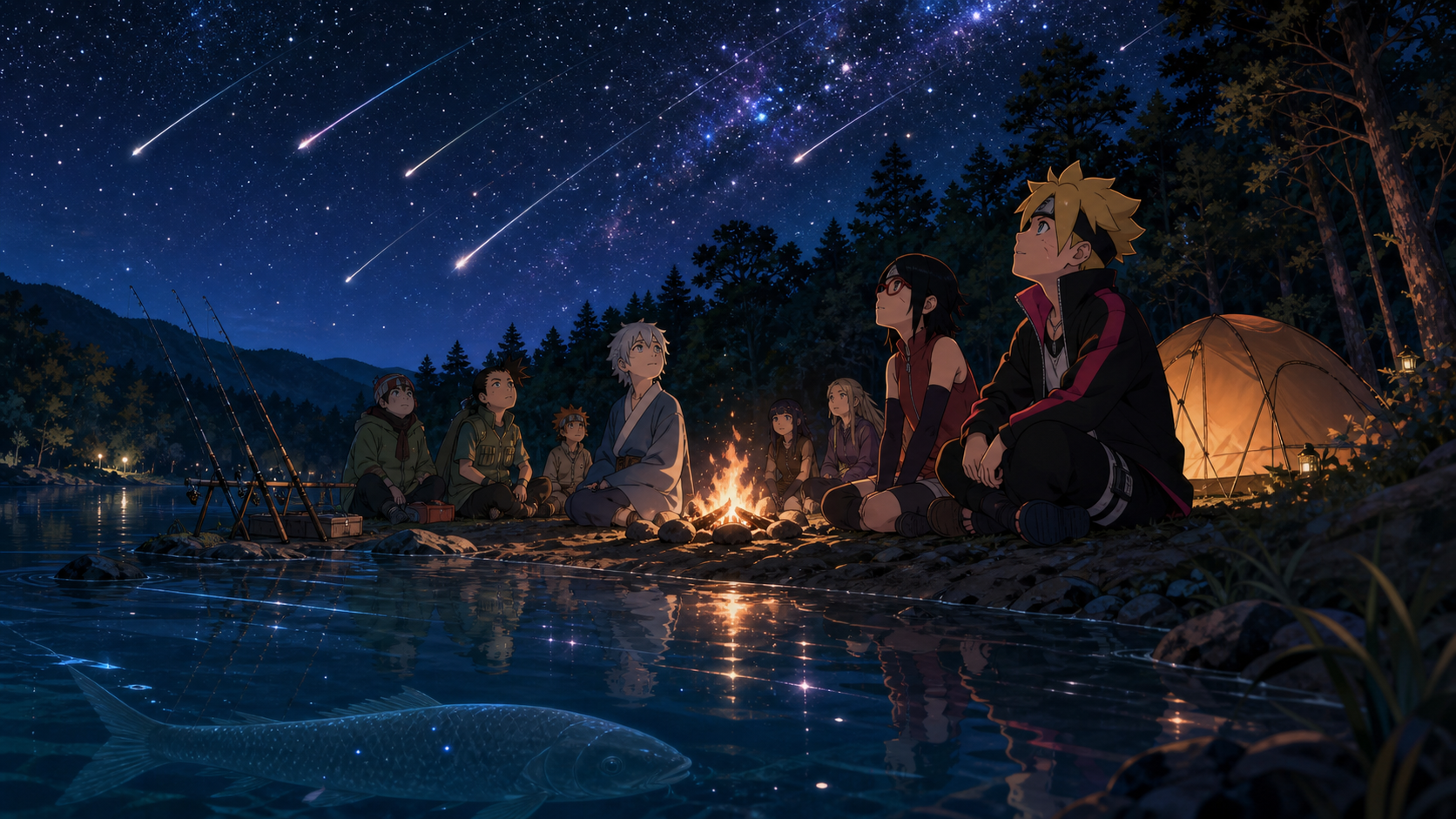
The Night of the Shooting Stars
Boruto turns his fear of graduation into a camping trip, the whole class weaponizes ninjutsu against one legendary fish, and Sumire reminds everyone to look up.
Series: Boruto: Naruto Next Generations
Episode: 34 · The Night of the Shooting Stars
Arc: Academy Graduation Arc
Release: 2017-11-22
Previous: Episode 33 · The Super Beast Scroll Slump!!
Directory: All 293 Boruto episodes
Bottom line
Boruto Episode 34 understands that graduation starts changing a friendship before anybody leaves. The class has exams to study for, future teams to imagine, and less time for Boruto’s spontaneous plans. He responds exactly like Boruto would: find a legendary fish, organize a camping trip, feed everybody one unforgettable meal, and force the universe to certify that this class mattered.
The Eternal Carp turns his feelings into a ridiculous action sequence where every classmate contributes a different technique to one fishing line. Sarada holds Boruto, Sumire sends Nue’s chakra through the line, Shikadai locks bodies in place, Mitsuki shocks the water, Iwabee builds support, Chōchō reaches, Inojin provides the aerial platform, Metal blocks escape, Denki cheers, and Boruto finishes with clones. They do catch the fish. They do eat the fish. Yet the episode’s real memory arrives after the struggle, when Sumire points toward the meteor-filled sky and everybody looks up together. Boruto wanted proof that friendship could survive change. The proof was never the carp alone. The proof was how quickly the whole class grabbed the same problem.
Graduation has already stolen their free time
Boruto wants to hang out, but his classmates are worried about the upcoming graduation exams. Studying, planning, and family conversations are beginning to replace the casual rhythm that made Academy life feel permanent.
Nobody has rejected him. Nobody has announced the end of the friendship. That makes the shift harder for Boruto to fight because the loss arrives through schedules rather than betrayal. He feels everybody moving before he knows where they are going.
Sarada says friendship is not automatically eternal
Sarada gives Boruto the answer he least wants. School friends do not remain close simply because a class once shared a room. People change, teams separate, and daily access disappears.
She is not dismissing the class. Sarada is protecting herself with realism. Boruto hears a challenge. If friendship will not preserve itself, then he is going to create something nobody can forget.
A television chef hands Boruto a mission
The Eternal Carp appears through a cooking program, presented as a rare fish with a taste nobody ever forgets. Mitsuki knows the legend, and Boruto immediately turns flavor into destiny.
Of course he does. Boruto does not need a subtle symbol when a giant legendary fish is available. One unforgettable meal sounds like a perfect answer to his fear that the class might drift apart after graduation.
The camping trip is Boruto trying to freeze time
Boruto convinces the class to visit the Kaminarimon Camping Grounds. The plan includes fishing, curry, supplies, and an overnight stay. Shikadai notices that Boruto is unusually committed to tedious preparation and asks what he is really doing.
Boruto admits he wants a memorable experience before graduation changes everything. That confession makes the whole scheme tender. He is not chasing the carp only because the fish sounds delicious. He is trying to hold the class in one frame before teams rearrange the picture.
Shikadai sees through him because that is his job
Shikadai can detect emotional labor from across a village, mostly because emotional labor sounds troublesome. He knows Boruto rarely volunteers to coordinate shopping lists and camping logistics without a larger obsession hiding underneath.
Their exchange keeps Boruto honest. The episode does not let him disguise sentimentality as pure adventure forever. Shikadai names the unusual effort, and Boruto has to admit that the class matters enough for him to plan ahead.
Sarada brings the question home to Sakura
Sarada talks with Sakura about whether school friendships last. Sakura explains that people who were not especially close during Academy days can become dear friends closer than family. She cannot guarantee forever, but the friends she made then remain part of her life.
That answer respects uncertainty without surrendering to cynicism. Friendship does not stay alive through a childhood promise. Friendship survives because people keep making room across years, distance, missions, marriages, and grief.
The girls shop while Boruto attacks the gear list
The class divides preparations. The girls collect curry ingredients while Boruto handles fishing supplies with suspicious enthusiasm. Ordinary errands become part of the memory before anyone reaches the campsite.
I love episodes that let shinobi children be children with grocery lists. The Naruto generation rarely received enough calm time for this texture. Boruto’s era can build tension from graduation and friendship because the village has enough peace for camping to matter.
Mitsuki appearing too close remains comedy gold
Mitsuki’s relationship with personal space continues to be theoretical. He materializes near Boruto with the serene confidence of somebody who has never once wondered whether a face should be that close to another face.
The joke works because Mitsuki genuinely wants to participate. Social rules remain strange to him, but belonging does not. When Boruto builds a group memory, Mitsuki arrives without hesitation.
Kaminarimon Camping Grounds looks like freedom
The class reaches the campsite and settles into an environment far from desks, conference schedules, and exam rumors. For a little while, they can pretend graduation is not waiting.
Boruto cannot fully relax because he has attached success to the Eternal Carp. Everyone else begins enjoying the trip as a trip. He keeps checking whether the planned memory has appeared yet.
The rain has made a rare fish even harder to find
A caretaker explains that recent rain increased the current and drove the carp into rocky hiding places. The legendary catch was already unlikely. The weather has made Boruto’s timeline almost insulting.
Nature refusing his schedule is exactly the obstacle this child deserves. Boruto is brilliant at forcing human opponents to react. A fish does not care about his emotional deadline.
The first fishing attempt gives them absolutely nothing
The class casts lines and waits. Shinobi skills do not automatically translate into fish cooperation. The lack of action becomes part of the comedy because these children are used to solving problems through movement.
Fishing demands patience from a group trained to throw weapons. Boruto looks personally offended that enthusiasm cannot speed up the lake.
Boruto almost has the carp and loses the line
Boruto finally hooks something powerful, reels too hard, and snaps the line. The near-catch intensifies his obsession because the fish is no longer an abstract legend. He felt the weight. Success seemed one adjustment away.
His classmates are hungry and ready to move on. Boruto reads their willingness to stop as a threat to the meaning he assigned the trip. If nobody catches the fish, he fears the night will become forgettable.
Iwabee’s curry wins the first round
The class returns to camp and eats curry. Iwabee handling the meal is a lovely choice because the tough, confrontational boy also knows how to feed a group. The dish gives everyone the warm communal moment Boruto was trying to create through the carp.
He cannot recognize the victory yet. People are laughing, eating, and sharing a night away from school, but Boruto’s attention remains at the water. The memory is already happening without obeying his script.
Chōchō understands that food is an event
Chōchō never treats eating as background activity, and the episode is wiser for that choice. Her enjoyment gives the campsite a celebratory rhythm even while Boruto sulks over the missing legendary course.
A meal does not need mythical ingredients to become memorable when the company is right. Chōchō lives that truth without making a speech because Chōchō rarely needs philosophical permission to enjoy dinner.
Boruto returns to the water after dark
Boruto refuses to let the trip end with ordinary curry. He goes fishing again at night, carrying the pressure he created for himself. Sarada and Sumire follow.
Their decision matters because they do not share his exact obsession. They see a friend who cannot release the fear underneath the plan. Following him is their way of staying with the real problem.
Sarada and Boruto argue like people who know each other
Sarada challenges Boruto because she recognizes how hard he is pushing. Boruto resists because her realism sounds too much like acceptance that the class will scatter.
Their arguments work when neither person is entirely wrong. Sarada knows memories cannot guarantee permanence. Boruto knows relationships sometimes need somebody stubborn enough to create another gathering. Their future partnership is already present inside the friction.
Sumire laughs because their rhythm feels safe
Sumire watches Boruto and Sarada bicker and finds the exchange amusing. After everything connected to the Ghost incidents, ordinary disagreement inside a circle of friends is a kind of peace she once could not imagine.
She thanks Boruto for helping her change. The gratitude lands softly because Boruto did not save Sumire through one perfect speech alone. He insisted she still belonged to the class after seeing the part of her designed to destroy Konoha.
Baby Nue turns the fishing line into a promise
The Eternal Carp catches Boruto’s line and begins dragging him toward the water. Sarada grabs him and helps pull. Sumire summons a smaller Nue, whose chakra strengthens the line so the fish cannot snap free the same way again.
Baby Nue is adorable, yes, but the moment also shows Sumire reclaiming a power once built for revenge. Nue now helps friends catch dinner during a camping trip. That transformation says more about healing than a sterile declaration ever could.
Sarada becomes Boruto’s anchor
Sarada holds Boruto while he fights the fish. Her role is physical and emotional. Boruto keeps lunging toward impossible goals, and Sarada keeps making sure his momentum has somewhere solid to return.
She complained about his fixation, then stayed beside him when the fixation became dangerous. Sarada’s care rarely arrives wrapped in softness. Care arrives as a grip that refuses to let him fall.
Shikadai locks the struggle in place
Shikadai uses Shadow Imitation to stabilize Boruto and Sarada as the fish pulls them toward the edge. The boy who called the entire plan troublesome becomes an essential support the second his friends need him.
That contradiction is one of Shikadai’s most lovable traits. He will explain why the problem is annoying while already solving the problem.
Mitsuki puts lightning into the lake
Mitsuki extends his arms and uses Lightning Release to weaken the carp. The technique is wildly excessive for normal fishing and completely appropriate for Academy-class fishing.
Mitsuki never asks whether Boruto’s goal makes sense before helping. His loyalty is immediate. Episode 35 will reveal how much Boruto shapes Mitsuki’s chosen future, but Episode 34 shows the bond through action first.
Iwabee gives their feet somewhere to stand
Iwabee creates an earth wall to brace Boruto and Sarada. His technique changes the terrain so their effort can hold. The class does not need every person pulling the line in the same way.
Iwabee contributes structure, which is fitting for a boy whose growth involved learning that strength can support rather than dominate. The wall turns raw force into a stable team position.
Inojin and Metal close the escape route
Inojin creates a Super Beast Scroll bird and carries classmates above the water. Metal throws projectiles to limit where the carp can flee. The aerial angle expands the operation beyond one line on one bank.
Their contribution makes the sequence feel like a mission assembled from personalities. Inojin supplies imagination and mobility. Metal supplies precise physical action while somebody else carries him through the sky.
Chōchō reaches because subtlety has left the campsite
Chōchō uses Partial Expansion to extend her arm toward the carp. By this point, the class has turned fishing into a multi-jutsu boss battle, and Chōchō’s giant reach is exactly the correct escalation.
She also connects the catch back to the meal. Everybody else may be fighting for Boruto’s memory, but Chōchō has never forgotten that the legendary fish is supposed to taste incredible.
Denki contributes the voice that keeps Boruto moving
Denki does not produce a spectacular combat technique during the final pull. He encourages Boruto. In a lesser episode, that contribution could feel like consolation. Here, the class victory depends on people filling different needs.
Denki knows what Boruto’s encouragement did for him when he could not imagine standing up to his father. Returning that energy has value. Not every friend needs a giant jutsu to matter inside a difficult moment.
Boruto’s shadow clones finish a class-wide catch
Once the carp breaks above the water, Boruto uses shadow clones to secure the fish. The final move belongs to him visually, but nobody can pretend the catch was individual.
The line held because Sumire and Nue strengthened the line. Boruto remained on land because Sarada, Shikadai, and Iwabee anchored him. The carp weakened because Mitsuki acted. The escape routes closed because Inojin, Metal, and Chōchō joined. Boruto finishes what the class made possible.
They eat the Eternal Carp together
The class cooks and eats the legendary fish. After all that buildup, the taste becomes part victory, part relief, and part proof that they completed the ridiculous mission Boruto invented.
The meal matters because everyone owns the story equally. Nobody will remember Boruto catching a fish alone. They will remember the night an entire future generation of Konoha weaponized ninjutsu against dinner.
Sumire is the one who tells everybody to look up
While the class celebrates, Sumire notices the sky. Shooting stars streak above them, giving the episode its title and changing the scale of the memory.
Boruto spent the night staring at the water, demanding one specific miracle. Sumire lifts everybody’s attention toward a miracle already happening. Her voice turns separate conversations into shared awe.
The meteor shower becomes the memory Boruto wanted
The carp is unforgettable because the class fought together. The stars are unforgettable because nobody planned them. Both experiences belong to the night, and the contrast is what makes the ending work.
Boruto can create opportunities for connection. He cannot control every meaningful detail. Sometimes friendship survives through effort. Sometimes friendship deepens because everybody happens to look up at the same second.
Toneri reminds us the sky is not only beautiful
The post-credits movement shifts to Toneri on the moon, struggling with distortions in spacetime. The stars above the class carry wonder, but the larger universe is already pressing toward Boruto.
That contrast is quietly cruel. Boruto is afraid graduation will change his friendships while cosmic forces are preparing changes far beyond team assignments. The peaceful camping episode becomes precious because the audience knows innocence has an expiration date.
RaeRae’s take
This episode gave me everything I want from Academy-era Boruto: low-stakes panic, class chemistry, one completely unnecessary use of military-grade training, Baby Nue being precious, and a soft ending with danger waiting beyond the frame. Boruto could have accepted Iwabee’s curry and enjoyed himself, but then we would not have watched ten children combine techniques to defeat seafood.
What gets me is Boruto planning the trip because he is scared. He does not say “I am afraid we will stop being close.” He buys fishing gear and declares war on a rare carp. That is such a believable child translation of grief. The class answers in the language he understands best. They show up, grab the line, and make the impossible memory with him.
Boruto turns fear into logistics because feelings are harder to organize
Boruto can arrange transportation, camping supplies, fishing equipment, and an absurd menu faster than he can admit that graduation scares him. The planning spree is funny because his solution grows more elaborate every time the real problem gets closer. A simple afternoon together would never feel secure enough. Boruto needs a legendary carp, a group achievement, and a story everybody will repeat after the class separates.
That instinct fits the child we have watched since the first episode. Boruto responds to emotional distance by creating motion. When Naruto misses family time, Boruto stages confrontations. When classmates withdraw, he inserts himself into their problems. When graduation threatens the daily routine, he builds an event too large to ignore. His methods can become intrusive, but the motive remains painfully clear. Boruto wants visible proof that relationships still exist when people stop sharing the same room.
Shikadai recognizes the fear without embarrassing him. He understands that the fishing trip is not really about television food or bragging rights. A direct confrontation would make Boruto deny everything and double the shopping budget. Shikadai lets the plan happen, then helps keep the class connected when the plan becomes difficult. That quiet accommodation is one reason Boruto expected Shikadai beside him after graduation.
Sarada refuses a childish promise and still helps create a lasting memory
Sarada's warning that friendships do not automatically last sounds harsh beside Boruto's enthusiasm, but she is naming a truth the episode needs. Teams change. Missions create distance. Family obligations pull people in different directions. Promising eternal closeness cannot stop any of those forces. Sarada has lived with absence long enough to distrust comfort built from words alone.
Her actions at the lake show that realism has not made her cold. When Boruto loses control of the line, Sarada becomes the first physical anchor behind him. She does not promise that the entire class will remain unchanged. She chooses to hold on during the moment they actually share. That choice is more valuable than a sentimental guarantee because Sarada understands the risk of change and participates anyway.
The episode lets both children be right. Boruto is right that friendships deserve effort before circumstances scatter people. Sarada is right that one beautiful night cannot freeze a relationship forever. Their argument becomes useful rather than divisive because the fishing crisis gives them something honest to do together. Boruto creates the occasion. Sarada keeps the occasion from becoming fantasy.
The Eternal Carp sequence previews how this class will survive graduation
The catch works as more than a group-technique showcase. Every student contributes according to an existing strength instead of copying Boruto's approach. Shikadai provides restraint. Iwabee creates stable ground. Mitsuki adds power. Inojin takes the problem into the air. Metal and Chōchō use their bodies where leverage matters. Sumire connects Nue to the line. Denki contributes encouragement when physical force is not his best tool.
Nobody becomes unnecessary because somebody else is stronger. That principle will matter after teams divide the class. Graduation assigns smaller units, but the wider peer network does not disappear. These children already know how to call across specializations and trust a classmate's unusual answer. The carp sequence looks ridiculous because a small army of genin candidates attacks dinner. The underlying coordination is exactly what Kakashi will demand during the graduation exam.
Boruto receives the final visual flourish through his shadow clones, but the clones cannot finish without everybody holding the chain. The moment corrects his fear in a language he understands. Friendship will not survive because Boruto creates a perfect memory and owns the ending. Friendship survives when other people decide the shared problem belongs to them too.
Toneri's warning keeps the episode from sealing the children inside nostalgia
The meteor shower gives the class a peaceful image to carry forward, then Toneri reminds the audience that larger forces are already moving. The sky can hold beauty and danger at the same time. Boruto watches one meaning from the campsite while Toneri reads another from the moon.
That final contrast protects the episode from becoming a farewell special detached from the series. The children deserve their night. Their joy is not foolish because threats exist beyond Konoha. Their ability to build trust during ordinary days may become the reason they survive extraordinary danger later. Peaceful memories are part of shinobi preparation too, even when no instructor can grade them.
Sources and lawful viewing
“The Night of the Shooting Stars” is Boruto: Naruto Next Generations Episode 34, bridging Academy daily life and the Graduation Exams arc. The class camps at Kaminarimon, combines ninjutsu to catch the Eternal Carp, shares the meal, and watches a meteor shower before Toneri’s warning on the moon.
Official episode reference: Naruto Official episode guide
Licensed episode route: Crunchyroll licensed series page