
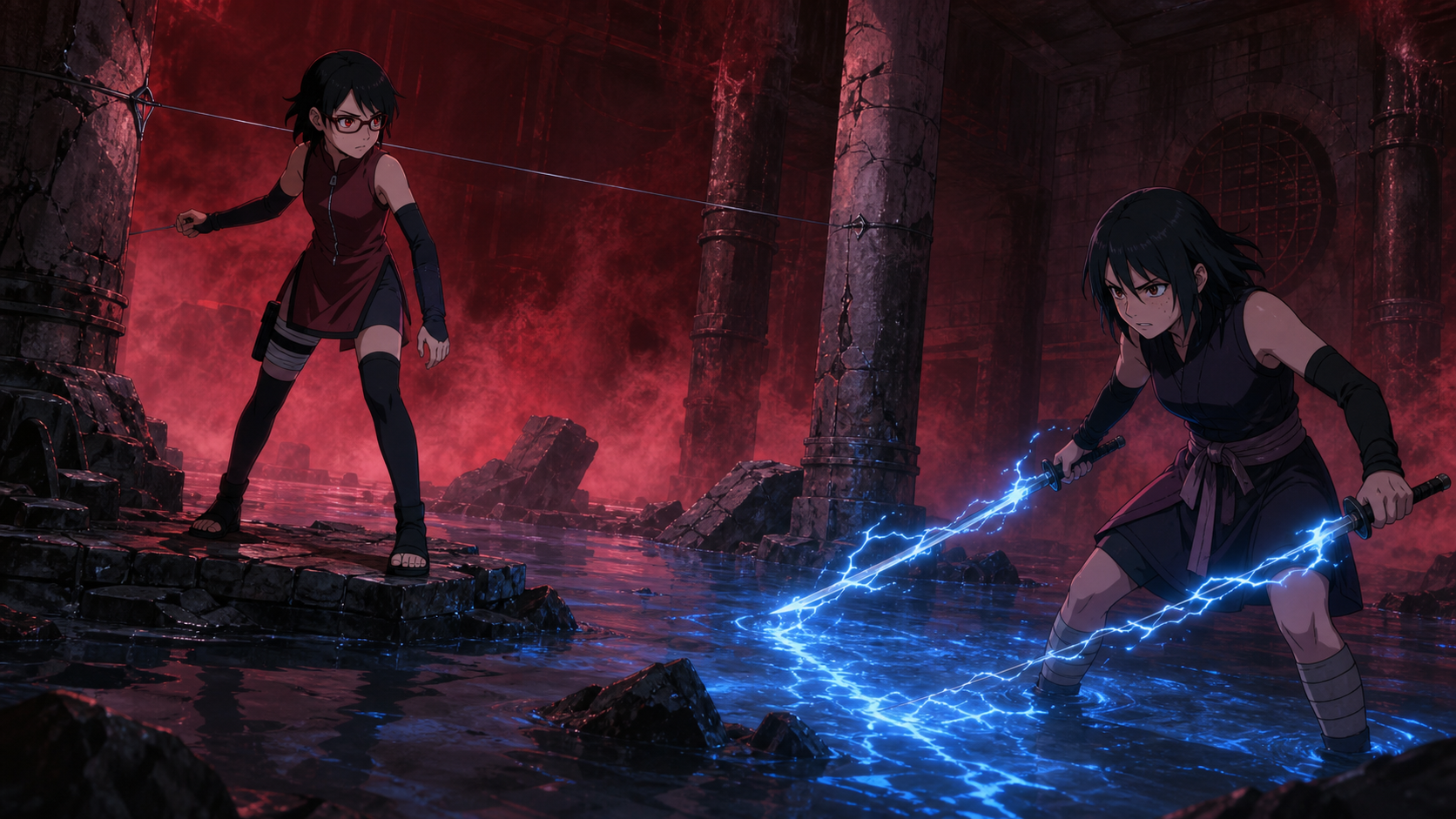
The Sharingan vs. The Lightning Blade, Kiba the Fang!
Buntan turns Kiba and the flooded cavern into a lightning cage, while Sarada copies the seals, plants a genjutsu, reads the bubbles, and lights the whole trap.
Series: Boruto: Naruto Next Generations
Episode: 30 · The Sharingan vs. The Lightning Blade, Kiba the Fang!
Arc: School Trip Arc
Release: 2017-10-25
Previous: Episode 29 · The New Seven Ninja Swordsmen!!
Directory: All 293 Boruto episodes
Bottom line
Boruto Episode 30 gives Sarada a battlefield where almost every obvious advantage belongs to Buntan. Kiba can throw lightning across the mist, attack without remaining in Buntan’s hands, turn the flooded cavern into a cage, and summon a Lightning Fish that patrols the water beneath Sarada’s feet. Buntan has the legendary weapon, greater range, and a lifetime of anger connected to Raiga Kurosuki. Sarada has one tomoe, a limited chakra reserve, and the irritating Uchiha habit of learning while somebody tries to kill her.
She wins because she treats the entire fight as information. Sarada notices Buntan retreating from eye contact, copies Lightning Release once she gets close enough to read the seals, lets Buntan believe she has been decapitated, and recognizes bubbles from the Lightning Fish as evidence that the water is filling the cavern with hydrogen gas. One explosive tag turns Buntan’s strongest environmental advantage into the final trap. The victory is tactical, physical, and deeply Sarada. She does not overpower inherited rage. She watches inherited rage repeat itself until the pattern becomes combustible.
Kagura walks toward Boruto with Hiramekarei
The episode opens by splitting its emotional and tactical fights. Boruto sees Kagura approaching with Hiramekarei, while Sarada faces Buntan and Kiba inside Shizuma’s red mist.
The separation matters because neither child can rely on the group. Boruto has to reach a friend through shame. Sarada has to survive a stranger whose grief has already accepted violence.
Buntan welcomes the Sharingan as a trophy fight
Buntan is excited to face an Uchiha. The Sharingan gives Sarada status before she speaks, turning the battle into a chance for Buntan to prove that Kiba and the Kurosuki name can defeat another legendary bloodline.
Sarada does not carry the Uchiha name lightly, but she refuses to perform the grand family rivalry Buntan wants. Survival comes before reputation.
Kiba fills the fog with lightning
Buntan attacks through the twin blades and sends Lightning Balls across the limited space. The mist hides depth while electrical light reveals Sarada in flashes.
Kiba lets Buntan threaten multiple angles without closing distance. Sarada activates the Sharingan, not as a magic win button, but as the only way to gather enough movement data before the next strike arrives.
Sarada reads movement while Buntan controls range
Sarada dodges and blocks, learning the rhythm of Kiba’s attacks. Buntan knows that prolonged eye contact risks genjutsu, so she retreats whenever Sarada gets the correct angle.
That caution becomes a clue. The Sharingan is already shaping Buntan’s decisions even when Sarada has not cast an illusion. Fear of the eye creates predictable movement.
Buntan lures Sarada into a prepared trap
Buntan is not simply angry with a sword. She understands how to use Sarada’s confidence against her. Lightning attacks direct Sarada toward spaces where Kiba’s next angle becomes harder to escape.
Sarada learns quickly, but learning during combat still costs position. Buntan keeps making the lesson expensive.
Chōjūrō turns restraint into bait
Elsewhere, Chōjūrō faces Hassaku, Kyohō, and Hebiichigo while bound by wires. Hassaku mistakes the Mizukage’s restraint for helplessness and attacks.
Chōjūrō uses the strike to cut part of the restraint, reaches his own blade, and frees himself. Peace did not make him weak. Peace taught him how little effort a leader should waste proving strength to insecure children.
The Mizukage fights three stolen identities at once
The so-called New Seven Swordsmen wear famous weapons like costumes for a past they never lived. Chōjūrō survived the actual Bloody Mist and understands the price behind those names.
His calm humiliates their fantasy. They wanted a glorious generational showdown. Chōjūrō treats the fight like dangerous cleanup.
Buntan sends Kiba to fight without her hands
Buntan remotely controls the blades, forcing Sarada to track weapons that move independently of the wielder. Eye contact becomes harder because the immediate threat has no eyes.
The technique attacks a limitation in Sarada’s Sharingan use. Reading Buntan’s body cannot fully predict a sword guided from another angle through lightning.
Water becomes Buntan’s second weapon
Sarada notices the flooded ground and scattered stones. Buntan creates a Lightning Fish that moves beneath the surface, turning the water into lethal territory.
Sarada is confined to small rocks while Kiba attacks from the air and Buntan maintains distance. The cavern becomes a three-layer trap: weapon above, electricity below, mist everywhere.
Distance denies Sarada the hand seals
Buntan attacks from far enough away that Sarada cannot clearly read and copy the seals. The Sharingan can reproduce movement only after receiving usable information.
That limitation keeps the eye interesting. Sarada has a powerful tool, but Buntan can alter the conditions around the tool rather than pretending the Sharingan does not exist.
The first Lightning Fish catches a clone
Buntan finally drives Sarada into the water and the fish strikes, only for the body to reveal itself as a shadow clone. Sarada has been studying Buntan while supplying false conclusions in return.
The clone buys time and tells Buntan that Sarada can create uncertainty beyond genjutsu. Every apparent victory now needs verification.
Buntan tells Sarada about Raiga
Buntan says her father died because of Naruto without ever knowing she existed. Raiga Kurosuki’s name reaches across the original Naruto anime and into his daughter’s resentment.
She inherited absence, notoriety, and a weapon associated with the man she never got to confront. Shizuma offers her a version of Kiri where Raiga’s violence becomes honor rather than abandonment.
Sarada hears the wound without surrendering the fight
Sarada does not mock Buntan’s grief. She also does not accept grief as permission to help launch a rebellion and kill a classmate.
That balance is one of Sarada’s strengths. She can recognize why somebody hurts while continuing to defend herself. Empathy does not require stepping into the Lightning Fish.
The Uchiha name gives Sarada no simple moral high ground
Sarada comes from a clan marked by love, persecution, rebellion, massacre, and secrecy. She has already fought through confusion about Sasuke’s absence and learned that inherited stories arrive incomplete.
She cannot honestly tell Buntan that one family legacy is clean while the other is cursed. What Sarada can demonstrate is that ancestry does not choose the next move.
Sarada closes the distance on purpose
Once Buntan is visible, Sarada charges forward and begins countering Lightning Release with techniques copied from her opponent. The decision changes the fight from survival on isolated stones to information theft at close range.
Closing distance increases danger, but Sarada needs the hand seals and eye contact available there. She gambles health for data.
Copying lightning is the most Uchiha answer available
Sarada reproduces Buntan’s Lightning Release quickly enough to shock her. The moment recalls the classic Sharingan promise: watch a technique, understand its sequence, and return the lesson before the opponent finishes celebrating.
Sarada’s version is not Sasuke nostalgia pasted onto a child. Her limited stamina means every copied action must serve a plan rather than become a display reel.
Buntan wraps herself in lightning armor
Kiba covers Buntan in electrical power, raising the cost of close combat. Sarada can read the attack and still suffer if no safe route exists.
Buntan throws her into the water directly along the Lightning Fish’s path. The layered trap finally places Sarada where every previous warning said she could not survive.
Buntan’s childhood turns anger into armor
During their clash, Buntan remembers an unhappy childhood shaped by Raiga’s absence and the violent legacy around his name. She has spent years building identity from somebody who never knew her.
Kiba offers physical proof that the connection exists. Holding the blades may feel like holding the father she could not reach, which makes surrendering the weapon feel like another abandonment.
Chōjūrō ends the imitation swordsmen’s fantasy
Chōjūrō defeats Hebiichigo and Hassaku. Kyohō surrenders. The gap between stolen legend and lived experience becomes undeniable.
He does not need cruelty to prove the Bloody Mist is over. His control demonstrates that strength can exist without celebrating suffering.
Iwabee catches Ichirōta before the ambush lands
Ichirōta prepares an attack from a distance while Chōjūrō is occupied. Iwabee intervenes and cuts him down before the strike can reach the Mizukage.
Iwabee came to Kiri carrying contempt for the village’s history. Protecting Chōjūrō shows that he can update his judgment when evidence changes.
Shibuki turns defeat into an explosion
Ichirōta detonates Shibuki in an attempt to take Iwabee with him. The weapon extends the old swordsmen mythology through destruction that ignores survival.
The blast underscores what Shizuma recruited: young people encouraged to treat death as proof of commitment. Chōjūrō’s reform threatens that culture because living with consequences is harder than becoming a legend in one explosion.
Sarada notices the bubbles
Inside her own fight, Sarada studies the Lightning Fish moving through the water and notices bubbles rising. Buntan sees a successful containment technique. Sarada sees a chemical process continuing every second.
Electricity is splitting water and building hydrogen gas in the enclosed space. The fish has been preparing Sarada’s counterattack while Buntan believed the environment belonged to her.
Buntan believes she decapitates Sarada
Buntan closes in and cuts off Sarada’s head. The image is shocking because the episode commits long enough for the strike to feel real.
Then the scene breaks. Buntan has been inside genjutsu since Sarada reached the range needed to copy her technique and catch her eyes.
Genjutsu buys the final second
Sarada does not use illusion merely to frighten Buntan. The false decapitation keeps her opponent committed to one conclusion while the real Sarada completes the environmental trap.
The tactic joins every part of her kit: Sharingan observation, copied lightning, clone misdirection, close-range risk, and genjutsu control.
The cavern has become a hydrogen bomb waiting for a spark
Sarada explains that Buntan’s Lightning Fish electrolyzed the water throughout the battle. Hydrogen gas has collected in the enclosed area.
Buntan’s most oppressive technique created the fuel. Sarada’s genius lies in noticing the side effect and surviving long enough to use the consequence.
One explosive tag ends the duel
Sarada detonates an explosive tag and ignites the gas. The cavern erupts, defeating Buntan through the battlefield she controlled.
The finish does not claim Sarada has more raw lightning power than Kiba. She wins by understanding what Buntan’s power has been doing beyond the intended attack.
Sarada collapses after the victory
Sarada passes out from exhaustion. The cost keeps the win honest. One-tomoe Sharingan use, copied techniques, clones, genjutsu, and constant evasive movement drain a child even when the strategy succeeds.
She did not dominate Buntan. She solved the fight with almost nothing left.
Boruto’s confrontation waits beyond Sarada’s explosion
While Sarada defeats Buntan, Kagura continues attacking Boruto and insists their lives are too different for understanding. The two fights share a question about inheritance but require different answers.
Sarada defeats the opponent trying to kill her. Boruto keeps trying to recover the friend whose blade remains divided against itself.
Buntan’s grief matters after custody, not instead of custody
Buntan joined an armed rebellion and attempted to kill Sarada. Her childhood pain explains the opening Shizuma used, but does not erase what happened in the cavern.
The episode leaves room for future change by refusing to turn her into a faceless monster. Sarada’s victory stops the danger. Kiri still has to decide whether reform can reach the child underneath Kiba.
Sarada proves what observation means in her hands
The Sharingan carries enormous inherited expectations. Sarada uses the eye less like a badge of supremacy and more like a research instrument under fire.
She collects movement, seals, fear responses, terrain, bubbles, and timing. Her intelligence is not separate from the dōjutsu. Her intelligence determines whether the eye becomes useful.
RaeRae’s take
Sarada letting Buntan enjoy a whole imaginary decapitation before revealing the genjutsu was ruthless in the most elegant way. Baby Uchiha said, “You wanted the Sharingan experience? Here is the premium package.” Then she gave a chemistry explanation and blew up the cavern. I support girls in STEM and girls who weaponize the lab result.
Buntan still got to me. Her Raiga story is messy, angry, and unfair, which is exactly why Shizuma could recruit her. She wanted the blades to prove her father left something that belonged to her. Sarada understood the pain and still refused to die for that proof. That is the balance this fight needed.
Buntan mistakes inheritance for the recognition Raiga never gave her
Buntan does not want Kiba only because the blades are powerful. She wants the weapon to certify a relationship her father never properly gave her. Raiga's absence left a vacuum filled by stories, reputation, and the ugly prestige attached to one of the Seven Ninja Swordsmen. Holding Kiba lets Buntan convert abandonment into an inheritance nobody can dispute.
That emotional logic explains her fury without excusing what she does with the blades. Buntan chooses Shizuma's revolt, attacks students, and tries to kill Sarada. Her childhood gives the choices context. Her childhood does not make Sarada responsible for absorbing the consequences. The episode allows Sarada to hear the wound while continuing to fight for her own life.
Shizuma recruited Buntan by promising a world where violent lineage counts as authority. The Bloody Mist fantasy tells her that Raiga's name, Kiba's power, and her anger should place her above ordinary rules. Sarada represents a more difficult relationship to inheritance. The Uchiha name carries enormous power and catastrophic history. Sarada cannot use either side as a complete identity. She has to decide what the Sharingan will do in her hands.
Sarada's Sharingan wins through attention rather than automatic superiority
The duel never treats one tomoe as a magic answer. Sarada can read movement and copy hand seals, but Buntan controls range, terrain, and the pace of the attack. Lightning moves through the flooded cavern before Sarada can close the distance. Kiba can continue attacking after leaving Buntan's hands. Every advantage forces Sarada to gather information under pressure.
Her victory grows from a sequence of observations. Buntan avoids sustained eye contact. The Lightning Fish produces bubbles. Kiba's electricity changes the water from scenery into a connected system. Buntan expects the environment to trap Sarada and stops questioning whether the same environment can trap her. Sarada waits until the pattern becomes usable.
Copying Lightning Release matters because Sarada does more than imitate a technique. She shows Buntan that inherited talent can remain flexible. The Sharingan lets her learn from the opponent trying to define her as prey. Sarada's limited chakra keeps the exchange dangerous, so every copied movement needs a purpose. She cannot win through endless replication. She needs one route toward the decisive trap.
The hydrogen-gas finish rewards evidence the audience watched Sarada collect
The cavern explosion works because the episode plants the physical clues during the battle. The Lightning Fish interacts with water. Bubbles appear. Electrical discharge keeps changing the enclosed space. Sarada recognizes that the environment is no longer merely wet ground carrying Buntan's attacks. The cavern has accumulated a combustible answer.
Her genjutsu creates the final opening by letting Buntan believe the decapitation succeeded. Buntan sees the image she wants most: the Uchiha opponent defeated by Raiga's daughter and Raiga's blades. That desire makes the illusion persuasive. Sarada does not need to maintain a long mental prison. She needs one second for the explosive tag.
The finish also reverses the meaning of control. Buntan spends the fight treating water and lightning as extensions of Kiba. Sarada treats every extension as evidence. When the explosion comes, Buntan loses because she stopped observing the system she created. The Sharingan's greatest contribution is not visual spectacle. The eye keeps Sarada asking what each detail means.
Chōjūrō dismantles the counterfeit swordsmen without protecting the legend
The self-proclaimed New Seven Ninja Swordsmen rely on stolen weapons and inherited reputation to make the revolt look larger than a group of angry young people. Chōjūrō knows the actual history behind the title. He does not respond with reverence. He exposes how little discipline sits beneath the costumes.
His restraint becomes part of the humiliation. Chōjūrō allows opponents to believe they have surrounded a passive Mizukage, then takes their weapons and formations apart with professional efficiency. The difference is not only power. He understands responsibility attached to a legendary blade. They understand the photograph.
Iwabee catching the ambush and Sarada surviving Buntan keep the episode from making Chōjūrō the sole adult solution. The students contribute because they read danger and act. Chōjūrō protects them without erasing their agency. That balance will matter when Kagura needs space to choose his response in the next confrontation.
Sarada's collapse gives the victory an honest cost
Sarada does not walk away from the explosion looking invincible. The duel drains her chakra, forces repeated adaptation, and ends with her body reaching the limit. Her collapse protects the episode from turning tactical intelligence into another form of effortless superiority.
The cost also clarifies what she accomplished. Sarada fought an armed opponent carrying a legendary blade inside terrain designed for Lightning Release. She survived long enough to understand the system, manipulated Buntan's expectations, and converted the cavern into a final weapon. Exhaustion is not evidence that the victory was lucky. Exhaustion is the receipt.
Sarada's condition after the blast also preserves the danger waiting beyond her duel. Boruto still faces Kagura, Shizuma still controls the mist, and the students remain inside an attempted coup. Winning one fight does not restore the field. Sarada has done everything her body can provide, so somebody else must carry the next decision. The limitation makes the wider group necessary.
I also appreciate that nobody arrives to explain the victory back to her. Sarada already knows why the plan worked. The audience watched her collect the clues, and Buntan experienced the consequence. The episode allows physical exhaustion to close the argument instead of adding a speech about intelligence. Sarada earned the silence.
Sources and lawful viewing
“The Sharingan vs. The Lightning Blade, Kiba the Fang!” is Boruto: Naruto Next Generations Episode 30 and part of the School Trip arc. Sarada faces Buntan and Kiba inside Shizuma’s mist while Chōjūrō and Iwabee dismantle the remaining self-proclaimed swordsmen.
Official episode reference: Naruto Official episode guide
Licensed episode route: Crunchyroll licensed series page