
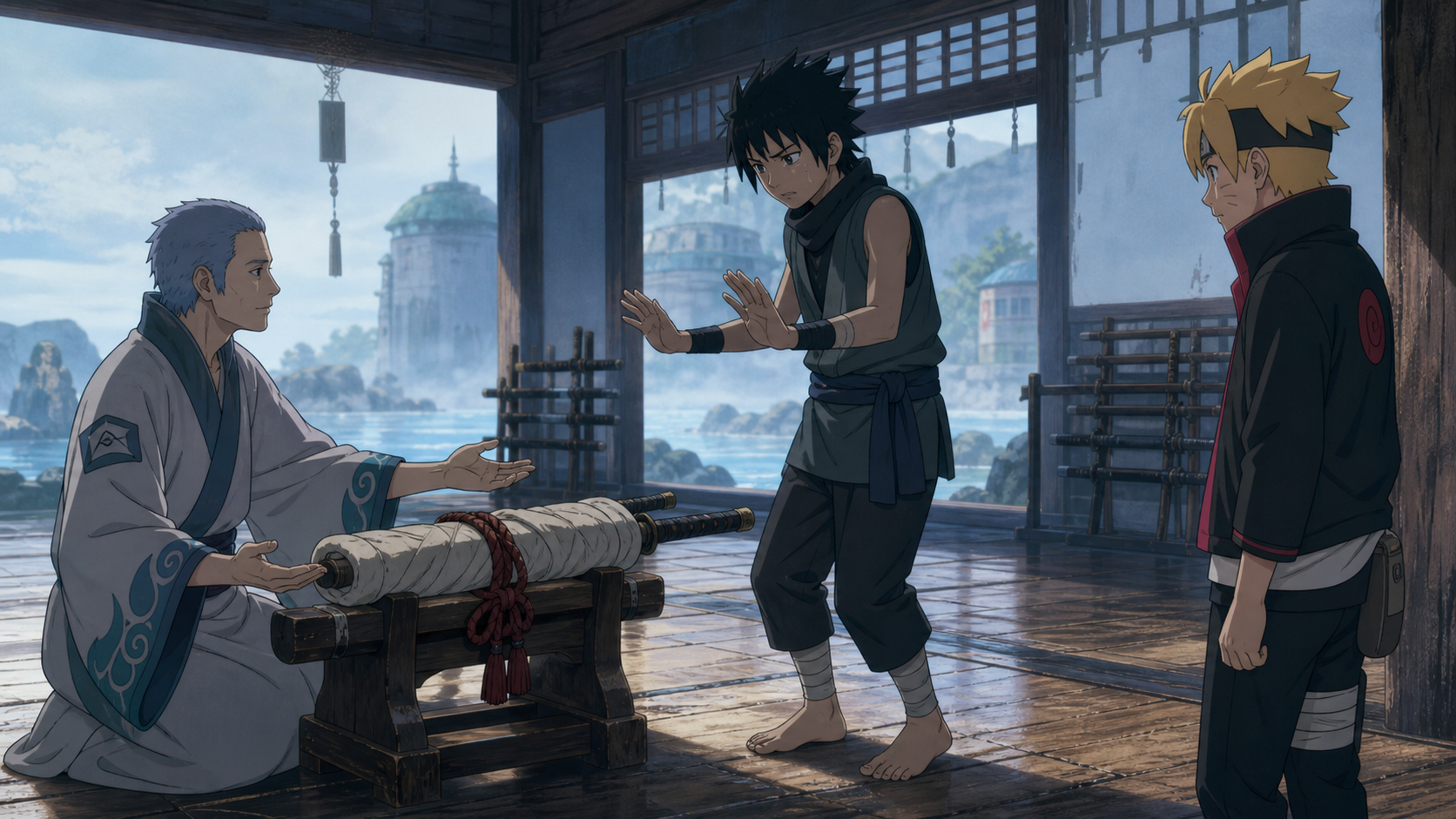
The Mizukage's Successor
Boruto discovers Kiri has an Academy built around swords, Kagura reveals why Chōjūrō chose him for Hiramekarei, and one stopped wooden blade says more than every succession speech.
Series: Boruto: Naruto Next Generations
Episode: 26 · The Mizukage's Successor
Arc: School Trip Arc
Release: 2017-09-27
Previous: Episode 25 · The Turbulent Field Trip!!
Directory: All 293 Boruto episodes
Bottom line
Boruto Episode 26 invites the Konoha class into the Hidden Mist Academy and lets Boruto discover the obvious truth that a school built around swordsmanship is the coolest possible field-trip stop. He watches Kiri students train, forgets every speech about international cooperation, and lights up the second Chōjūrō offers him a sparring match with Kagura. Boruto came for cultural exchange. Apparently culture means getting hit with a wooden sword in front of his classmates.
Kagura wins quickly because Kagura is not merely the polite tour guide holding everyone’s itinerary. Chōjūrō has chosen him as a possible heir to Hiramekarei and even imagines him as a future Mizukage. The praise sounds enormous to everyone except Kagura. He refuses both possibilities because a blade in his hand feels too close to a version of himself he never wants to meet again. During the bout, Kagura’s skill sharpens into something frightening. He reaches the winning strike, stops, and looks more terrified than Boruto does.
That moment is the episode. Boruto sees power and control. Kagura sees how close the strike came. Chōjūrō sees a gifted student who keeps choosing restraint. Shizuma, waiting just outside the polite tour, sees the exact fear he can turn into a recruitment tool. The title asks who might follow Chōjūrō. Episode 26 answers that Kagura has the talent. Whether Kagura can believe talent belongs to him without belonging to the Bloody Mist is the harder story.
Kagura starts the day managing Iwabee
Kagura escorts the class while Boruto warns Iwabee not to wander off and start another fight. The warning is necessary because Iwabee has been in Kiri for one day and already treats every rude local boy like a personal invitation.
Kagura points out that some villagers dislike outsiders. Modern buildings did not modernize every opinion at the same speed.
Mei enters as living Kiri history
The students meet Mei Terumī, the Fifth Mizukage, and Kagura explains her role in the war and the village’s rebuilding. Mei is elegant, experienced, and carrying several eras of Kiri history without needing to announce how dangerous she once was.
For Naruto viewers, her presence connects the shiny city tour to the generation that actually dragged Kiri away from the Bloody Mist.
Chōjūrō gives the cooperation speech
The class reaches the Mizukage’s office, where Chōjūrō welcomes them with a formal speech about exchange and cooperation. Boruto gets bored because Boruto’s diplomacy settings only activate when food, games, or combat appear.
Sarada quietly calls him out. Chōjūrō then admits long speeches are boring, which may be the strongest evidence that he deserves public office.
The Mizukage is softer without being weak
Chōjūrō does not perform the terrifying authority Iwabee expects from Kiri. His mild manner is part of the village’s transformation, not proof that the office lost power.
Peaceful leadership looks unimpressive to boys trained on Bloody Mist legends. That gap between appearance and ability will become Shizuma’s favorite lie.
Chōjūrō asks Kagura about the future again
After the class leaves, Chōjūrō asks Kagura to reconsider the path he offered. Kagura politely refuses and returns to escort duty before the conversation can deepen.
The exchange is warm, but Kagura’s speed says the subject hurts. Chōjūrō hears humility. Kagura hears a blade, a title, and every person who might compare his blood to Yagura’s rule.
Mitsuki knows the guide has a résumé
While Kagura handles the hotel check-in, Mitsuki shares what he knows. Kagura is already a capable shinobi, serves close to Chōjūrō, and has been considered for an important future.
Mitsuki collects personal intelligence with the same calm energy other children use to read a menu. Nobody asks where the file came from because the answer would probably create more questions.
Boruto needs the Seven Swordsmen explained
Boruto does not recognize the full importance of the Seven Ninja Swordsmen, so Shikadai supplies the history. Seven legendary blades, selected wielders, terrifying reputations, and generations of blood-soaked Kiri branding somehow missed Boruto’s study schedule.
Naruto’s son knowing less Naruto lore than the audience remains a dependable source of comedy.
Hiramekarei is not a ceremonial souvenir
Chōjūrō carries Hiramekarei, one of Kiri’s legendary blades. The weapon can shift shape through chakra and belongs to a lineage built through actual war.
Being named a possible successor is not equivalent to receiving a nice family heirloom. Kagura would inherit a weapon people recognize before they recognize the person holding the handle.
The Hidden Mist Academy teaches with blades
The class tours Kiri’s Academy and watches students train in kenjutsu. Konoha’s curriculum includes tools and sparring, but the Mist gives swordsmanship the center of the room.
Boruto is delighted. His classmates see an impressive cultural difference. Boruto sees a chance to volunteer for impact damage.
Chōjūrō notices Boruto staring
Chōjūrō catches Boruto’s excitement and proposes a bout with Kagura. The suggestion is generous, educational, and absolutely calculated to show the visitors what Kiri training produces.
Kagura does not share Boruto’s enthusiasm. A friendly match still requires him to hold the object he associates with losing control.
Kagura accepts despite the hesitation
Kagura steps into the practice area because refusing in front of the class would expose more than accepting. He is the guide, Chōjūrō’s aide, and the student everyone has just praised.
Boruto sees a strong opponent. Kagura sees an audience waiting to discover why he avoids his own talent.
Boruto enters with maximum confidence
Boruto has already decided the bout will be fun. He is fast, creative, and allergic to entering any competition with a realistic estimate of the opponent.
That confidence helps Kagura because Boruto shows no fear before the first strike. Kagura gets to be a peer instead of a dangerous rumor.
Kagura’s footwork ends the argument quickly
Once the bout begins, Kagura controls distance and timing with practiced ease. Boruto pushes forward, but Kagura reads the movement and keeps the wooden blade exactly where Boruto does not want the blade.
The gap is not embarrassing. The gap is informative. Kagura has trained at a level Boruto did not expect from the soft-spoken tour guide.
The wooden sword reveals a legendary swordsman
Kagura does not need Hiramekarei to show why Chōjūrō chose him. His balance, precision, and acceleration make the succession discussion feel practical rather than sentimental.
Chōjūrō is not trying to manufacture an heir from a favorite student. He has seen rare ability paired with a conscience strong enough to fear misuse.
Kagura reaches the finishing strike
The match builds toward a decisive hit. Kagura has Boruto beaten and the blade moving. For a moment, the friendly Academy floor disappears from Kagura’s expression.
That is the moment Kagura fears most. Skill stops feeling like technique and starts feeling like appetite.
Kagura stops before hurting Boruto
Kagura pulls the strike. Boruto remains safe. Everyone else sees control, but Kagura feels the distance between intention and impact shrinking too fast.
The stopped blade proves something Kagura cannot yet accept: fear did not make the decision. Kagura did.
Winning leaves Kagura anxious
Boruto loses the bout and gets up interested in Kagura. Kagura wins and looks shaken. Their reactions invert the usual competition logic.
Boruto judges the match by what happened. Kagura judges the match by what almost happened inside him.
Boruto sees somebody worth challenging again
Boruto is not offended by defeat. He likes Kagura more because the quiet guide just revealed enough skill to flatten his assumptions.
This is one of Boruto’s better traits. A strong peer usually becomes a reason to return, not a reason to sulk.
Chōjūrō sees control where Kagura sees danger
Chōjūrō has watched Kagura train, serve, and stop. He understands why the boy fears the blade, but he also sees repeated evidence that Kagura can choose restraint.
The mentorship works when Chōjūrō offers faith without forcing the weapon into Kagura’s hands. Episode 28 will show Kagura making the request himself.
The shore gives everybody room to breathe
Kagura takes the class to the water after the Academy visit. The open shore contrasts with the close practice room and lets the field trip feel briefly ordinary again.
Boruto has gained a rival-friend. Kagura has survived another bout without repeating the disaster he remembers.
Memorial Park brings the Bloody Mist back
The group pays respects at the memorial, where Kiri’s modernization cannot hide the dead beneath the city’s story. The park turns abstract history into names and family loss.
Iwabee’s anger stops being general suspicion here. His grandfather died under the Fourth Mizukage.
Iwabee carries a family wound into Kiri
Iwabee reveals why the village’s old reputation feels personal. Yagura’s rule reached beyond Kiri and left damage inside Iwabee’s family.
His anger is not simply prejudice learned from a textbook. A peaceful skyline cannot return the person his family lost.
Kagura apologizes for Yagura
Kagura apologizes when Iwabee names his grandfather’s death. The apology lands strangely because Kagura did not commit Yagura’s violence.
He has spent so long carrying the Karatachi name as guilt that another family’s pain immediately feels like his debt. The audience does not yet receive the full bloodline reveal, but Kagura’s reaction tells the truth early.
Iwabee begins seeing the person beside the history
The apology and the day’s tour complicate Iwabee’s image of Kiri. Kagura represents the same village and family history that anger him, yet Kagura has been patient, honest, and visibly burdened by the past.
The episode refuses a cheap resolution. Understanding starts because the contradiction remains in the room.
Hachiya attacks Boruto near the memorial
Tsurushi Hachiya approaches the group and targets Boruto. The attack tests the visitors and signals that local hostility is organized rather than limited to rude comments.
Boruto counters, and Hachiya retreats. The exchange is short, but Shizuma will receive the report.
Hachiya wants Kagura to react
Hachiya’s interest is not limited to embarrassing Konoha. He watches Kagura because Shizuma wants to know how Kagura responds when outsiders and Bloody Mist loyalists collide.
Kagura is being evaluated without consent by people who already decided which version of him they want.
Shizuma waits behind the school-trip conflict
Hachiya and his group report to Shizuma, who orders another confrontation. Shizuma has not entered Boruto’s view yet, but his influence organizes the hostility.
The field trip has moved from awkward cultural exchange into a recruitment operation built around Kagura’s fear.
The title is both sincere and bait
“The Mizukage’s Successor” accurately describes Chōjūrō’s hope. Kagura has the skill, discipline, knowledge, and closeness to leadership that make the future plausible.
The same title also becomes bait for Shizuma. A frightened heir to Yagura gives Bloody Mist loyalists a symbol they can claim before Kagura defines himself.
Chōjūrō's leadership rejects the idea that gentleness weakens a Mizukage
Chōjūrō does not perform authority through intimidation. He welcomes the visiting students, explains Kiri's cooperation with Konoha, and speaks to Kagura with patient confidence. Anybody measuring leadership by the Bloody Mist standard could mistake that softness for weakness. The episode keeps showing why the standard is wrong.
He carries Hiramekarei, survived the old village, served beside Mei, and became Mizukage without needing every room to fear him. His gentleness comes from knowing what institutional violence costs. Chōjūrō can use force. He chooses when force serves protection rather than letting the ability define every interaction.
That distinction makes him the mentor Kagura needs. Kagura already believes power may turn him into Yagura. A leader who treats violence as proof of worth would confirm the fear. Chōjūrō models a different equation: skill creates responsibility, restraint proves judgment, and leadership can remain warm without becoming passive.
Mei's presence reminds the class that reform came from people who survived the old village
Mei enters with humor and political ease, but her presence carries the Hidden Mist's transition. She did not inherit a peaceful institution and simply maintain the brand. Her generation had to move Kiri away from a system associated with purges, secrecy, and children killing children.
The field trip therefore means more than tourism. Konoha students can enter Kiri's academy openly, train beside local students, and hear leaders speak about cooperation because earlier adults changed the conditions. The buildings still hold memories of the old system. The current relationships prove history did not become destiny.
Iwabee's anger prevents the reform story from becoming self-congratulation. His family suffered under Yagura, and a peaceful tour cannot demand that he treat the loss as ancient trivia. Mei and Chōjūrō's work matters partly because wounds remain. Reconciliation needs room for gratitude, suspicion, grief, and accountability at the same time.
The wooden-sword bout gives Boruto the answer Kagura cannot yet accept
Boruto sees the match as a challenge and enters with the exact confidence Kagura lacks. He expects a fun exchange against a skilled guide. Kagura expects every strong movement to expose something monstrous. Their different expectations make the same strike carry two meanings.
Kagura's footwork, timing, and control overwhelm Boruto quickly. The skill is not accidental rage. He has trained with discipline. When the finishing motion arrives, Kagura stops the blade before causing serious harm. The restraint occurs inside speed and adrenaline, which makes the choice more valuable than a calm promise made outside combat.
Boruto reads the observed evidence. Kagura won and controlled the ending. Kagura reads the feared possibility. He came close enough to remember every earlier loss of control. Chōjūrō sides with Boruto's interpretation without dismissing Kagura's fear. The mentor sees that stopping under pressure is precisely the behavior a future leader needs.
Kagura's apology to Iwabee shows how inherited guilt can become another cage
Kagura apologizes for Yagura because his name has taught him to absorb responsibility for history before anybody asks. Iwabee's grandfather died under the Fourth Mizukage, so Kagura assumes his existence reopens the wound. The apology comes from empathy and shame tangled together.
Iwabee has every right to carry anger. His family loss is not less real because Kagura was not alive when the policy caused harm. The episode becomes interesting when Iwabee begins separating the person beside him from the office and ancestor connected to the grief. That separation does not forgive Yagura. The separation gives Kagura a chance to be judged by Kagura's actions.
Inherited guilt can look morally responsible while quietly preventing repair. If Kagura believes he must forever embody Yagura's crimes, no amount of restraint or service can matter. He becomes trapped in the same bloodline logic Shizuma will later exploit. Accountability needs accurate ownership. Kagura can acknowledge history without claiming authorship of every injury.
Memorial Park refuses the easy version of peace
The park gives the field trip a physical place where Kiri's current calm meets the cost of the old village. Memorials can become ceremonial background when everybody agrees to admire them and move on. Iwabee's reaction interrupts that comfort. A name or historical period on stone still connects to somebody's family dinner table.
Kagura's discomfort also shows that public memory affects descendants differently. He sees a warning about the violence inside his blood. Iwabee sees proof that leadership decisions reach people far from the office. Boruto sees friends caught inside history they did not choose. None of those readings cancels the others.
Hachiya attacking near the memorial reveals how easily unresolved history can become recruitment material. He wants Kagura provoked, Boruto humiliated, and the old village's reputation restored as spectacle. The location lets him borrow gravity without accepting the responsibility the memorial demands.
Shizuma needs Kagura frightened of his own competence
Kagura's stopped strike is dangerous to Shizuma because the moment proves talent and restraint can coexist. If Kagura begins trusting that evidence, Shizuma loses the easiest route into his identity. A confident Kagura might choose Chōjūrō's mentorship, wield Hiramekarei responsibly, and help lead the peaceful Kiri Shizuma wants to destroy.
The manipulation therefore does not begin by telling Kagura he is weak. Shizuma tells him he is powerful in one predetermined way. Violence becomes the authentic self, while restraint becomes denial. That framing makes every success frightening. The better Kagura fights, the more he fears Shizuma may be right.
Boruto provides the competing interpretation before he understands the larger conspiracy. Boruto likes the strength and trusts the stop. His reaction is uncomplicated enough to reach Kagura for a moment. Somebody can admire the swordsmanship without demanding blood.
The episode makes succession a question of values rather than a family tree
Kagura's connection to Yagura gives the title political weight, but Chōjūrō's interest in him is not a hereditary coronation. The Mizukage sees discipline, care for visitors, knowledge of Kiri, and the possibility of a leader who understands the village's wounds personally. Succession concerns what Kagura might build, not merely whose grandson he is.
Shizuma offers the counterfeit version. He wants Kagura as a symbol who can make a violent restoration look legitimate. Under that plan, blood matters more than judgment and the title becomes another weapon stolen from a vault. Kagura would appear to lead while serving somebody else's design.
The difference between those futures rests on agency. Chōjūrō repeatedly asks what Kagura wants. Shizuma repeatedly explains what Kagura is. Episode 26 lets the audience hear both arguments before Kagura fully recognizes the choice.
Boruto Episode 26 lets a stopped blade say everything
“The Mizukage’s Successor” spends most of its runtime touring institutions, but the episode lives inside one wooden-sword strike. Kagura beats Boruto, reaches the finish, and stops. Boruto sees an amazing swordsman. Kagura sees a monster barely contained. Chōjūrō sees the exact control that makes Kagura worthy of more trust.
The surrounding scenes keep that moment from becoming a simple confidence lesson. Iwabee’s grandfather died because of the Fourth Mizukage. Memorial Park holds real grief. Kiri’s peace has not erased Bloody Mist casualties or the local boys who romanticize the old system. Kagura’s fear comes from more than insecurity. His name and talent sit inside history that hurt people.
Boruto offers a different way to read the evidence. Kagura could have struck him and did not. Kagura could have treated the field trip like a burden and instead guided the class with care. A person is not only the worst possibility inside a moment. Episode 26 gives Kagura proof through action, even if he cannot accept the proof yet. Shizuma is already preparing to argue the opposite.
Sources and lawful viewing
Official episode reference: Naruto Official episode guide
Licensed episode route: Crunchyroll licensed series page