
RaeRae Reacts · One Piece Episode 157
Enel Repossesses the Going Merry
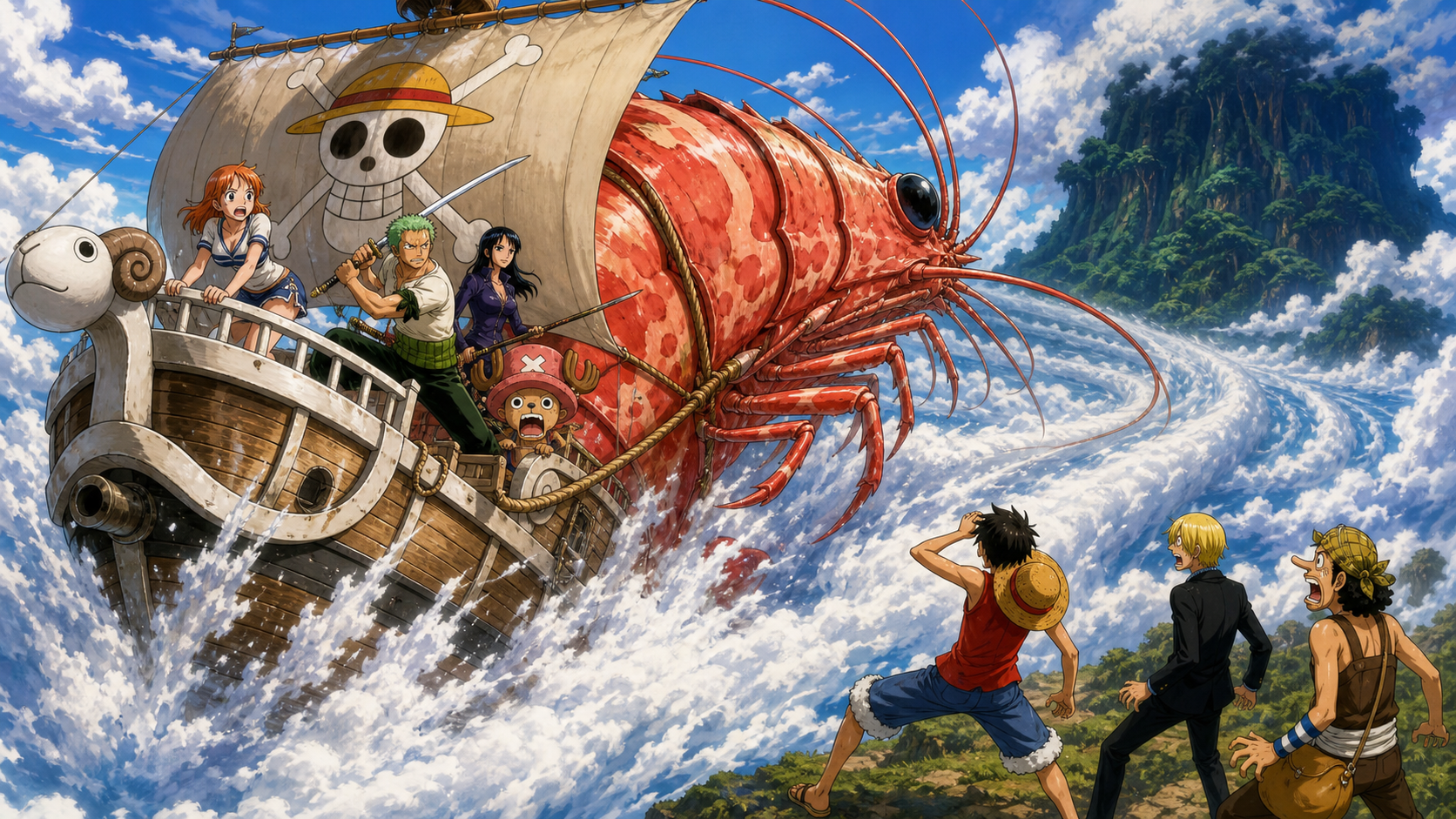
One Piece Episode 157 turns the Straw Hats’ attempted escape into a forced trip to Upper Yard when Enel’s Speedy Shrimp seizes the Going Merry.
Nami wants one clean exit before Luffy finds another adventure
Episode 157 opens with the Straw Hats carrying a Class Two criminal label and exactly zero interest in respecting Skypiea’s crooked paperwork. Nami makes the sensible call: leave before Captain McKinley returns with a larger squad or Upper Yard sends something worse.
Luffy refuses because he has not explored the sacred island yet. Of course he refuses. The man crossed a vertical ocean to reach a legendary sky country, and Nami expects one badly managed border dispute to cancel the trip.
Her urgency still wins on basic risk assessment. The crew has attacked officers, endangered Conis and Pagaya, lost any lawful tourist status, and learned that priests execute heavenly judgment. Curiosity now carries consequences for their hosts.
A proper departure needs a headcount, supplies, a route to Cloud End, and one final check that nobody left evidence or equipment behind. The crew begins that process but never controls the timeline.
Luffy turns evacuation into a lunch order
Luffy asks Pagaya for the remaining food and pulls Sanji toward the house to pack lunches. The request sounds unserious until survival enters the equation. Nobody should flee an unfamiliar sky ocean without water and food.
Sanji can ration meals, protect ingredients, and identify what local foods travel safely. Pagaya knows which supplies tolerate altitude, cloud moisture, and the route toward the Blue Sea.
The crew should also pack medical basics, warm clothing, water containers, and emergency signaling equipment. Chopper’s kit matters more than another pile of meat, no matter what Luffy believes.
Pagaya agrees without hesitation after authorities threatened his household. His kindness remains extraordinary, but the Straw Hats should not leave the family poorer or more exposed because the government targeted their guests.
Usopp remembers that a pirate ship cannot survive on vibes
Usopp asks Pagaya for spare materials to repair the Going Merry. That request may be the smartest decision in the opening sequence. The Merry has crossed impossible currents, suffered repeated damage, and now sits in an environment built from unfamiliar cloud materials.
Usopp needs wood, fasteners, rope, sealant, dial-compatible parts, and instructions for using local substitutes. Taking random supplies without understanding their properties could create a repair that fails under load.
He should document what Pagaya gives him and leave compensation whenever possible. Salvage and hospitality do not erase ownership.
The choice also separates Usopp from Nami, Zoro, Robin, and Chopper at the exact moment the ship becomes vulnerable. A sensible supply run accidentally creates the episode’s two teams.
Robin hears the convenient escape story and starts doing math
Conis explains that a special current can carry the Merry quickly toward Cloud End. Nami embraces the route because speed matters, while Robin questions why Skypieans would remain above if departure were that easy.
That question cuts through panic. A route can exist without being safe, public, voluntary, or reversible. Robin asks about incentives and patterns rather than accepting a useful answer because everyone wants the answer to be true.
Conis may not be lying, but she lives under a government that punishes speech and contact. Every direction deserves confirmation from maps, visible currents, Gan Fall, or another independent local source.
Nami should slow long enough to ask where the current begins, where the route ends, who controls access, and what happens if the ship misses the exit.
Chopper raises anchor while the crew skips the launch checklist
Chopper uses Heavy Point to raise the anchor, proud to help with departure. Nami orders the move fast enough that the crew never verifies helm control, sail position, tow lines, nearby creatures, or the missing trio’s return.
A four-person ship team can launch the Merry, but Nami is the only navigator aboard and Zoro is the least reliable direction source in any sea. Robin understands risk, while Chopper can handle emergencies.
The absent team has food and repair supplies, which means the ship carries neither complete provisions nor the person who requested repair materials. That alone should delay departure.
Nami wants distance from McKinley, not abandonment. Panic compresses her decision window until escape starts to resemble a split evacuation with no rendezvous plan.
The Going Merry moves backward because something already owns the route
The Merry suddenly lurches and begins traveling backward. Luffy watches from shore and laughs at the visual while Usopp notices the shadow beneath the hull.
The ship has not found a current. A huge creature has attached itself below and started towing the vessel. Pagaya identifies the animal as the Super-Express Speedy Shrimp, a servant of God.
That distinction changes the incident from navigation failure to forced transport. The crew aboard becomes a captive group, and the stranded trio loses access to the ship.
The speed also prevents ordinary rescue. A Waver may follow briefly, but an untrained rider cannot match a creature designed to move vessels through the White Sea.
The giant shrimp is hilarious until the destination becomes clear
A colossal shrimp hauling a pirate ship through clouds should be pure One Piece comedy. The oversized claws, frantic crew, and Luffy’s delighted reaction sell the absurdity.
Then Pagaya names the animal’s employer. Enel’s system has turned wildlife into enforcement infrastructure. The shrimp does not merely roam; the creature retrieves accused people and delivers them to punishment.
The same society that treats rare fish as protected property deploys another species as a prisoner-transport vehicle. Skypiea’s rules protect power, not nature.
Chopper may be able to communicate with the creature if the noise and speed allow contact. Hurting the shrimp should remain a last resort because the animal may act under training, coercion, instinct, or stored commands.
Zoro reaches for a blade before anyone understands the tow
Zoro proposes cutting the creature and saving the Merry. His instinct targets the immediate mechanism, which makes tactical sense. Removing the tow could stop forced movement.
Robin warns that attacking one servant may bring more and that Heaven’s Judgment has only begun. She recognizes a system response where Zoro sees a single opponent.
Cutting blindly beneath the hull also risks the Merry, tow rigging, cloud-sea stability, and everyone standing on deck. A severed creature could collide with the ship or leave the vessel drifting without propulsion.
The better response starts with identifying attachment points, speed, direction, and whether the shrimp reacts to sound or commands. Zoro needs precision, not anger.
Robin names the trap while everybody else watches the scenery blur
Robin connects McKinley’s declaration to the sudden capture. The patrol was never the final authority. Class Two status automatically routes the accused toward a higher tier of judgment.
Her analysis explains McKinley’s laughter at the end of Episode 156. Losing the beach fight did not defeat his government. The loss simply activated a process designed for stronger violence.
Robin should record the shrimp’s markings, harness, route, and behavior. Any evidence that links the animal to Upper Yard can help the crew predict later transport systems.
She also needs to keep Chopper calm and Nami focused. Zoro can defend the deck, but Robin is the person most likely to understand why the capture happened and what comes next.
The crew split gives each side the wrong half of what they need
The Merry carries Nami, Zoro, Robin, and Chopper. Angel Island keeps Luffy, Sanji, and Usopp. Both groups remain capable, but the distribution creates ugly gaps.
The ship group has navigation, medical care, scholarship, and sword power. The land group has the captain, food management, ranged improvisation, and the person gathering repair supplies.
Nobody established a meeting point, schedule, or communication method. Gan Fall’s whistle may summon outside help, but only one use remains free and ownership of the whistle matters.
A crew entering hostile territory should assign fallback locations before separating. One Piece keeps teaching that lesson by separating the Straw Hats anyway.
Pagaya finally explains the Sacrificial Altar
Pagaya tells Luffy, Sanji, and Usopp that the Speedy Shrimp will probably take the Merry to the Sacrificial Altar in Upper Yard. The name removes any remaining ambiguity about official intent.
The captives are not headed to a hearing, detention center, or neutral checkpoint. Enel’s servants are delivering them as sacrifices.
Pagaya should provide a map with landmarks, current directions, distances, hazards, and known patrol areas. Verbal directions spoken during a crisis can disappear under adrenaline.
Usopp needs to copy every detail. Sanji should ask about food, water, shelter, and injuries associated with Upper Yard. Luffy needs the destination repeated until even he cannot misplace the objective.
Heaven offers sacrifice or ordeal and calls both outcomes justice
Pagaya explains the two heavenly judgments. One group becomes the sacrifice at the altar, while the remaining accused must face an ordeal administered by priests.
Neither path includes evidence, representation, appeal, proportionality, or consent. Skypiea disguises execution and combat as sacred procedure.
The split also forces friends to divide attention. Rescuers must choose between reaching captives and surviving the ordeals blocking the route.
That design punishes solidarity. A person who cares about the sacrifice becomes easier to manipulate, while anyone who abandons the captive accepts Enel’s power as final.
Sanji hears that Nami and Robin are sacrifices and changes temperature
Sanji’s anger spikes when Pagaya describes the altar. His protective instinct is immediate, especially where Nami and Robin are concerned.
That urgency can drive a rescue, but rage can also make him ignore Chopper and Zoro or underestimate threats. Every captive deserves equal priority.
Sanji should lead practical preparation: pack food, secure water, carry medical supplies, and make sure Usopp has repair tools that can double as survival gear.
He can hate Enel while still listening to Pagaya. The fastest rescue depends on local knowledge, not louder threats against a ruler who has not entered the scene.
Usopp gets the briefing nobody wanted
Usopp reacts like a man who correctly understands that priests, sacrifices, sacred land, and divine punishment form a terrible itinerary. His fear is not cowardice. His fear accurately measures the situation.
He also carries skills the rescue party needs. Usopp can build, repair, scout, fire across distance, read mechanical traps, and turn ordinary materials into options.
The challenge is converting fear into a checklist before panic controls his body. He should inventory tools, ammunition, dials, rope, food, and signaling equipment.
Usopp’s questions may expose gaps in Pagaya’s explanation that Luffy and Sanji would charge past. Somebody needs to ask what each ordeal actually does.
Luffy hears death trial and translates the phrase into adventure
Luffy reduces Pagaya’s warning to one conclusion: beat the priests and reach the crew. The situation becomes interesting rather than terrifying.
That confidence cuts through paralysis. Sanji has anger, Usopp has fear, and Pagaya has lived under divine control. Luffy supplies forward motion.
His simplification also risks everyone around him. Priests may use terrain, dials, creatures, traps, and powers that ordinary punches cannot solve.
A captain can inspire action without pretending the threat is small. Luffy needs Pagaya’s route, Sanji’s preparation, Usopp’s tools, and a clear rule that rescuing the ship group outranks sightseeing.
Enel remains offscreen and still controls every movement
Episode 157 barely needs Enel’s face. His patrol labels the crew, his servant takes the Merry, his priests guard Upper Yard, and his legal language shapes Pagaya’s explanation.
Power feels larger when ordinary people repeat the ruler’s categories before the ruler appears. Sacrifice, ordeal, servant of God, and Heaven’s Judgment all arrive as accepted facts.
Conis and Pagaya do not endorse cruelty, but fear has trained them to explain the system as weather. The punishment simply happens unless somebody refuses.
The Straw Hats specialize in refusing systems that demand obedience without moral legitimacy. That trait now places them on a direct route toward Skypiea’s god.
FAITH arrives as the episode changes the meaning of belief
Episode 157 introduces the ending theme “FAITH,” a sharp title for a story about divine authority and coercion. Skypiea asks residents to treat fear as belief.
The Straw Hats practice another kind of faith. Nami, Zoro, Robin, and Chopper trust that the stranded trio will come. Luffy, Sanji, and Usopp move because abandoning their friends never enters the decision.
That trust does not erase planning failures. Real loyalty needs routes, supplies, communication, and accountability alongside dramatic promises.
The new ending lands exactly when the arc turns from tourist wonder toward a fight over who deserves belief and why.
Episode 157 turns an escape route into a forced march
The episode begins with Nami trying to leave Skypiea and ends with both crew groups moving deeper into Enel’s territory. Every exit becomes another controlled path.
The immediate checklist is clear. Nami must keep the Merry stable and record the route. Robin must study the transport system and altar. Zoro must defend without damaging the ship. Chopper must prepare for injuries and attempt communication with the shrimp when safe. Luffy must make rescue the primary objective. Sanji must carry provisions. Usopp must bring tools, map Pagaya’s directions, and plan signals.
Conis and Pagaya need protection from retaliation after the pirates depart. The crew should leave a truthful statement that the family did not order resistance, assault officers, or control the Speedy Shrimp. Enel may ignore that record, but silence guarantees that McKinley’s version stands alone.
RaeRae’s verdict: keep this one. The giant shrimp kidnapping a whole pirate ship is exactly the kind of ridiculous threat One Piece makes credible in seconds. Comedy delivers the hook, then the Sacrificial Altar gives the joke teeth.
Nami wanted a clean exit. Enel answered by repossessing the Merry and scheduling two kinds of execution.