
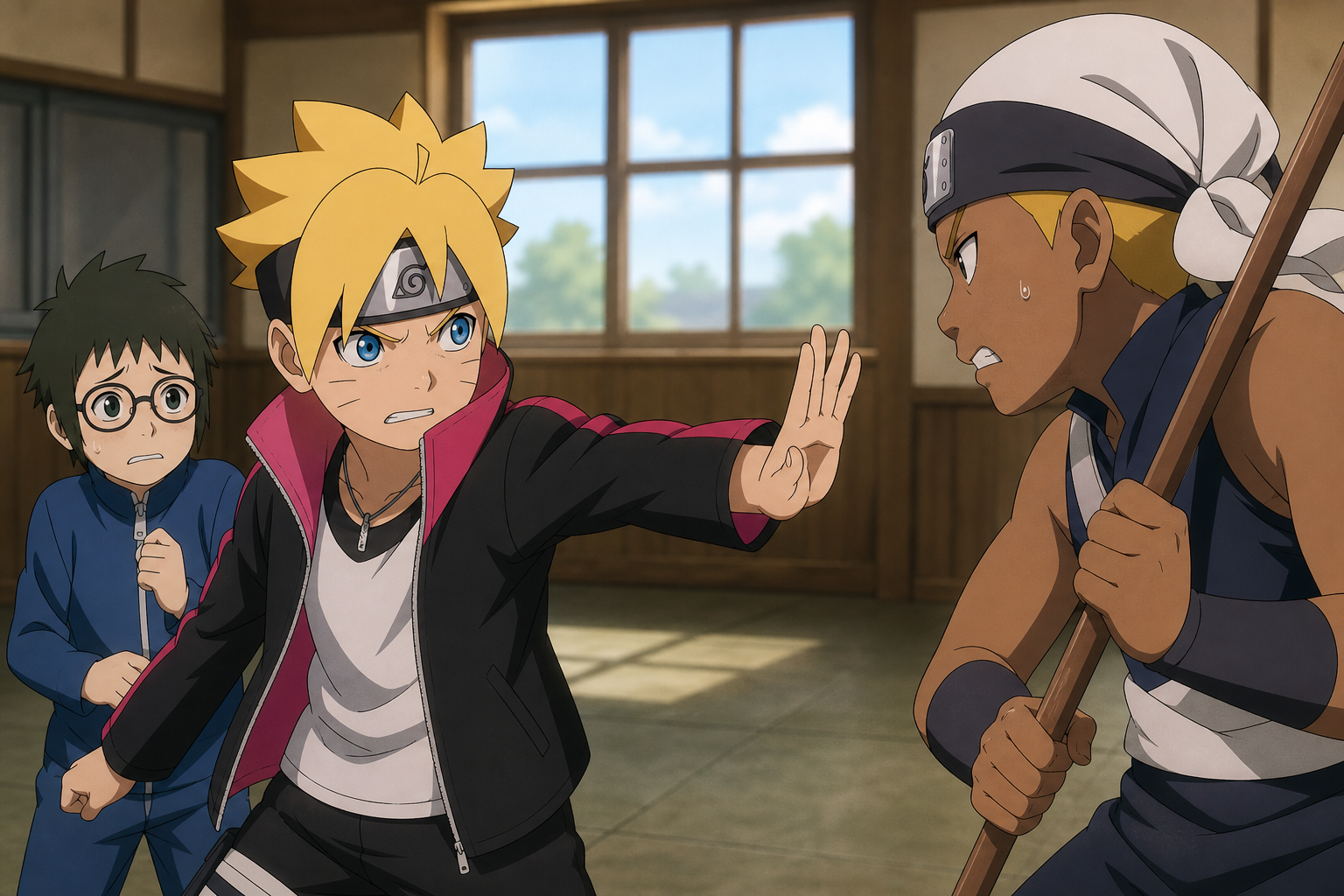
The Hokage's Son!
Iwabee can flatten most Academy students in a fight. Denki and a collapsing practice hall force him to decide what all that strength is actually for.
Series: Boruto: Naruto Next Generations
Episode: 2 · The Hokage's Son!
Arc: Academy Entrance
Release: 2017-04-12
Previous: Episode 1 · Boruto Uzumaki!
Directory: All 293 Boruto episodes
Bottom line
Boruto Episode 2 gives the Academy class its first real collision, and Iwabee Yuino is exactly the loud, stubborn problem Boruto needed. Boruto walks into school two weeks late with a wrecked train attached to his name. Iwabee has repeated a year despite being able to flatten most students in a fight. Denki wants to survive class without becoming somebody's target. All three boys know the Academy is measuring them, but each boy thinks the measurement is unfair in a different way. The episode could have settled for a basic bully fight. Instead, the practice-hall ceiling forces Iwabee to answer the question underneath all his talk about strength. A strong shinobi can win a spar. A useful shinobi notices when Denki is about to be crushed and holds the building up long enough for everybody to escape. Iwabee does exactly that, even with the next exam hanging over him. Boruto does not magically fix his new classmate, and one rescue does not erase the bullying. The rescue gives Iwabee somewhere better to put the ability he has spent using as armor.
Two weeks late is one hell of a first day
Boruto finally enters the Academy after serving a two-week suspension for the train disaster. That timing is funny because the rest of the class has already had time to build a version of him without meeting him. Boruto is not simply a new student. He is Naruto Uzumaki's son, the kid who drove a train into the Hokage Monument ceremony, and the classmate whose name arrives before his face.
Boruto hates that kind of entrance even while behaving like a child who knows everybody will look. He wants attention on his terms. The problem is that family fame and public chaos have already chosen the terms for him. Walking into class late only makes the spotlight brighter.
The suspension also shows how protected Boruto remains. He faced a consequence, but nobody believes one reckless stunt has ended his future. His desk is waiting. His family is intact. His teachers expect him to catch up. Boruto can resent being judged through Naruto while still benefiting from the safety attached to that same name. Both feelings can live in one spoiled, talented, genuinely good-hearted twelve-year-old.
Shino has inherited a classroom full of unfinished business
Shino Aburame stands at the front of a class containing children from famous clans, civilian homes, struggling families, and the village's new money. Some students already know basic shinobi skills. Others are beginning from nearly nothing. Iwabee is older because he has failed the academic requirements. Boruto has received elite training at home but would rather die than admit how much his family has given him. Denki understands technology better than combat. Metal Lee can move beautifully until nerves get involved.
That mixture is wonderful for a series and miserable for one teacher. Shino cannot teach a single lesson to a single level. Every rule touches a different insecurity, and every comparison risks becoming a clan ranking before lunch. His quiet introduction does not advertise how much emotional cleanup this class will require.
Iwabee has been waiting for somebody to blame
Iwabee enters as the boy everyone already knows to avoid. He is physically capable, comfortable with a staff, and angry about repeating a year. Instead of admitting that the written portion of school has him cornered, he turns the entire problem into a speech about the old shinobi era. Strong ninja mattered before. Strength should still decide who advances. Students who succeed under the current rules must be soft.
That belief protects Iwabee from saying the humiliating sentence: I am good at the part everybody respects in stories, and I am still failing.
The old-era obsession is also painfully childish. Iwabee romanticizes danger because danger would grade the skill he already has. He does not have to wonder whether the old world would have chewed him up, assigned him to a deadly mission, or punished his inability to read crucial information. He only imagines the version where everybody finally sees that he is powerful.
Denki refuses to purchase safety with silence
Denki knows what happens when stronger boys decide fear is entertainment. Episode 1 gave him every reason to keep his head down, yet he speaks when Iwabee starts dismissing Boruto as a privileged joke. Denki is not pretending Boruto never caused trouble. He knows why Boruto wrecked the train and remembers who stepped between him and danger.
The refusal matters because Denki cannot win the physical argument. He has no clan technique ready, no staff, and no confidence that his body will cooperate under pressure. He speaks anyway. Courage in Naruto has never belonged only to the person with the largest chakra reserve, and Denki proves that point before Boruto throws a punch.
Iwabee targets Denki because Denki exposes the weakness in his philosophy. If raw force decides whose opinion counts, Denki should stay quiet. When Denki does not, Iwabee has to intimidate him or admit that nerve cannot be measured by combat skill.
Boruto steps in because Denki is already his person
Boruto's loyalty forms fast. Denki defended him in conversation, and Boruto immediately treats that defense like a bond. He does not stand aside while Iwabee uses Denki as a target. This is one of Boruto's most likable qualities during the Academy period. The boy can be vain, reckless, and loud, but he does not enjoy watching somebody weaker get humiliated.
Boruto also recognizes the performance because he has one of his own. Iwabee uses anger to hide academic shame. Boruto uses swagger to hide how badly Naruto's absence hurts. Neither boy wants strangers touching the tender part, so both choose a fight where skill feels safer than honesty.
The practice hall turns an argument into shinobi language
The boys move to the practice hall, and the episode lets their bodies continue the disagreement. Iwabee fights with reach, weight, and experience. Boruto answers with speed, shadow clones, and a willingness to improvise. Neither approach is fake. Iwabee really is talented. Boruto really does deserve respect beyond his surname.
The spar works because Boruto does not win by becoming a smaller Naruto. He moves like himself: impatient, clever, slightly showy, and always ready to make the room part of the plan. Iwabee cannot dismiss that ability as family privilege once Boruto is in front of him. A famous father may create access, but Naruto is not controlling Boruto's feet or making decisions inside the exchange.
Boruto also sees why classmates fear Iwabee. The older boy is not bluffing. A trained body gives his bitterness real force, which makes his choices more dangerous and his eventual change more meaningful.
Iwabee's Earth Style is the real introduction
Iwabee can use Earth Style well enough to reshape the practice space and control the fight. For a student repeating an Academy year, that level of practical ability is impressive. The episode wants the audience to feel the mismatch between what Iwabee can do and where the school has placed him.
That mismatch does not prove books are pointless. A shinobi needs to read mission information, understand maps, calculate risk, recognize codes, follow medical guidance, and communicate with teammates. Iwabee's frustration comes from having one obvious form of competence treated as though the rest of him does not exist. His answer has been to treat every other form of competence with the same contempt.
The cycle is ugly and believable. A child feels reduced by one standard, then reduces everybody else by another.
Boruto's shadow clones expose the old-era fantasy
Boruto's shadow clones keep Iwabee from dictating the rhythm. The technique forces the older boy to respond to several threats and proves that modern Konoha has not produced children who cannot fight. Peace changed the village's priorities. Peace did not erase shinobi talent.
Iwabee's argument depends on pretending school success and combat ability cannot exist in the same student. Boruto ruins that neat division. He is academically capable, tactically sharp, and physically gifted. His worst problem is not softness. His worst problem is believing talent can cover every reckless choice.
That flaw makes Boruto a better opponent for Iwabee than a perfectly obedient student would have been. Boruto cannot lecture from a pedestal. He knows what trouble looks like from inside the principal's office.
The fight ends before either boy gets a clean victory
The practice-hall sequence does not need a tournament result. Boruto earns Iwabee's attention, and Iwabee proves that his confidence has a foundation. Their real decision arrives after the spar, when Denki comes looking for them and the damaged structure begins to collapse.
That interruption is smarter than handing Boruto a simple win. A victory would confirm whose technique worked better for one afternoon. The falling debris asks what either boy will do when strength stops being a performance.
Denki under the falling wall changes everything
Denki is suddenly in danger because the room has absorbed the boys' conflict. The image is blunt. The least combat-ready student may pay for a contest between two children who wanted to prove who deserved respect.
Boruto moves to help, and Iwabee uses Earth Style to hold the collapse back. Iwabee does not calculate whether Denki defended him, whether rescue will improve his grades, or whether arriving late will damage his record again. He sees somebody in danger and acts.
That choice is the first time his strength looks like the shinobi ideal he has been bragging about. The rescue does not make him weaker, softer, or less angry about school. Iwabee finally uses power for another person instead of using another person to display power.
Iwabee risks the exam he cannot afford to miss
The timing gives the rescue teeth. Iwabee already fears another academic failure, and the students are racing toward an exam. Staying behind to stabilize the building may create the exact consequence he dreads. He still stays.
The episode does not announce this choice with a grand speech because the action is enough. Iwabee has spent the episode saying the old days respected strength. Here is the respect-worthy version. A shinobi accepts a personal cost to keep a teammate alive.
Denki cannot repay him with a better grade or a powerful jutsu. The lack of exchange is the point. Protection only means something when the vulnerable person is not required to earn rescue first.
The whole class accepts the consequence
The students arrive late together rather than sacrificing Iwabee to protect their own records. That group choice is small, but the class starts becoming a class in this moment. Boruto and Iwabee have caused the mess. Denki was caught in the danger. Everybody still carries the explanation into the room.
Academy teamwork often begins through spectacular exercises later in the franchise. This version feels more human. Children get into trouble, somebody makes a better choice, and the group decides not to leave one person holding the blame alone.
Shino receives more useful information from their lateness than any written answer could provide. He now knows who challenges cruelty, who protects under pressure, who can improvise, and which student needs help before frustration becomes another fight.
Iwabee does not become a different child overnight
The episode gives Iwabee movement without turning him into a motivational poster. He still has academic work ahead. His pride has not vanished. Denki may forgive quickly because anime friendship moves at anime speed, but viewers should remember that intimidation leaves a mark.
What changes is Iwabee's direction. He has seen Boruto's ability, Denki's courage, and his own better instinct. The strongest-boy rule no longer explains the whole class. Once a belief fails in public, holding onto the same belief requires a more deliberate kind of cruelty. Iwabee is not interested in becoming that person.
Boruto earns a rival instead of a follower
Boruto does not need every classmate to admire him. The series works better when peers challenge his blind spots. Iwabee understands resentment, reputation, and the pressure to prove a specific kind of worth. He can recognize Boruto's gifts without worshipping the Hokage's family.
Their early rivalry also gives Boruto a taste of how his name sounds to children outside the Uzumaki home. He hears assumptions about favoritism and inherited comfort. Some assumptions are unfair. Some are close enough to sting. Boruto's growth depends on learning the difference instead of rejecting every criticism as jealousy.
Naruto is present even when Naruto barely appears
The title makes Naruto the invisible fourth participant in the conflict. Boruto wants classmates to see him as Boruto. Iwabee initially sees a protected heir. Teachers see a gifted student attached to a public family. Every opinion circles the Hokage before Boruto gets to speak for himself.
Naruto's absence at home has taught Boruto to treat the title as a thief. The village receives the heroic Hokage while the family waits for a tired father. School adds another layer: Boruto receives opportunities through the same title he resents. That contradiction should remain uncomfortable. The story loses something whenever Boruto becomes either a pure victim of Naruto's job or a spoiled child with no legitimate hurt.
Himawari catches the truth before Boruto says anything
Back at home, the family notices the shift. Boruto may complain, posture, or pretend school is no big deal, but his energy has changed. The Academy has given him people who answer back. Denki trusts him. Iwabee can challenge him. The class refuses to arrange itself around his family drama.
Himawari's presence keeps these scenes from becoming a father-son courtroom. She watches both of them with the clarity of a younger sibling who knows the household mood before the adults admit anything. Naruto also gets a glimpse of something he cannot manufacture through rank: Boruto may actually enjoy the life opening outside their conflict.
The episode understands why school rivalry works
“The Hokage's Son!” does not depend on a villain. Iwabee is a child trapped inside shame and bad conclusions. Boruto is a child with real pain and real advantages. Denki is learning that fear does not get the final vote. Shino is trying to turn a volatile collection of students into people who can trust one another on missions.
That setup gives the Academy arc room to breathe. The children are not placeholders waiting for adult greatness. They are messy fans of shinobi history, clan heirs, frightened beginners, show-offs, repeat students, and future teammates. Their conflicts begin with homework and pride, then reveal the values they will carry into dangerous work.
Denki refuses to let fear choose his friends
Denki enters the Academy with almost no combat confidence and every reason to stay away from Iwabee. He still returns to the practice hall because Boruto has treated him like a person rather than a project. Friendship gives him somewhere to stand before technique gives him any protection.
His courage does not suddenly make him physically strong. When the ceiling collapses, Denki remains the child who needs help. The episode refuses the cheap lesson that bravery always removes vulnerability. He can make a courageous choice and still depend on classmates with different abilities.
That dependence becomes the test Iwabee needs. Denki cannot threaten, impress, or reward him. Saving Denki means admitting that strength carries responsibility toward somebody who cannot win the same fight.
Denki's continued presence also tells Boruto that the train rescue created a relationship rather than one heroic memory. The quieter boy chooses the messy classroom because somebody inside finally made him feel less alone.
Iwabee's grievance contains truth and poison
Iwabee is correct that written performance does not measure every skill a shinobi needs. He is physically capable, knows history, and can respond under pressure. Repeating a year while weaker fighters advance would make any child furious.
The poison enters when he decides academic frustration gives him authority over classmates. He turns a valid criticism of the system into a hierarchy where force settles who deserves respect. Denki becomes an easy target because Iwabee can make another student's fear feel like evidence of his own strength.
Boruto challenges both parts of the argument. He recognizes Iwabee's ability and refuses the conclusion built from that ability. Winning a spar cannot repair missing coursework, and passing an exam cannot substitute for protecting people.
The ceiling collapse forces the values into one moment. Iwabee can chase the clock that controls his future or hold the structure for Denki. He chooses the person, proving that his best instinct already contradicts the cruel rule he announced.
Boruto's privilege does not make every wound imaginary
Iwabee sees a famous surname, a secured Academy place, and a family connected to every important room in Konoha. From outside, Boruto looks protected by the system Iwabee believes has failed him. Some of that reading is accurate.
Boruto also experiences the Hokage title as repeated absence. The village celebrates Naruto's availability while his children learn that work can interrupt dinner, promises, and ordinary attention. Privilege and neglect can occupy the same household.
The episode works because Boruto does not win by proving he has suffered more. He answers Iwabee through action and accepts that his classmate's resentment has a source. Iwabee, in turn, sees that the Hokage's son will enter danger for Denki and challenge a stronger opponent without hiding behind family status.
Neither boy fully understands the other after one fight. They have enough evidence to stop treating the other as a symbol.
Quick reaction
Episode 2 sold me on the Academy class because Iwabee was allowed to be impressive and wrong at the same time. Boruto needed somebody who would not bow to his name, and Denki needed a moment where courage did not require suddenly becoming good at fighting. The practice-hall collapse pulls every thread together without pretending one heroic choice finishes Iwabee's story. My favorite detail is still the exam clock. Iwabee saves Denki while risking the academic future he has spent the whole episode defending. That is the first honest answer he gives about strength.
Sources and lawful viewing
Official episode reference: Naruto Official episode guide
Licensed episode route: Crunchyroll licensed series page