
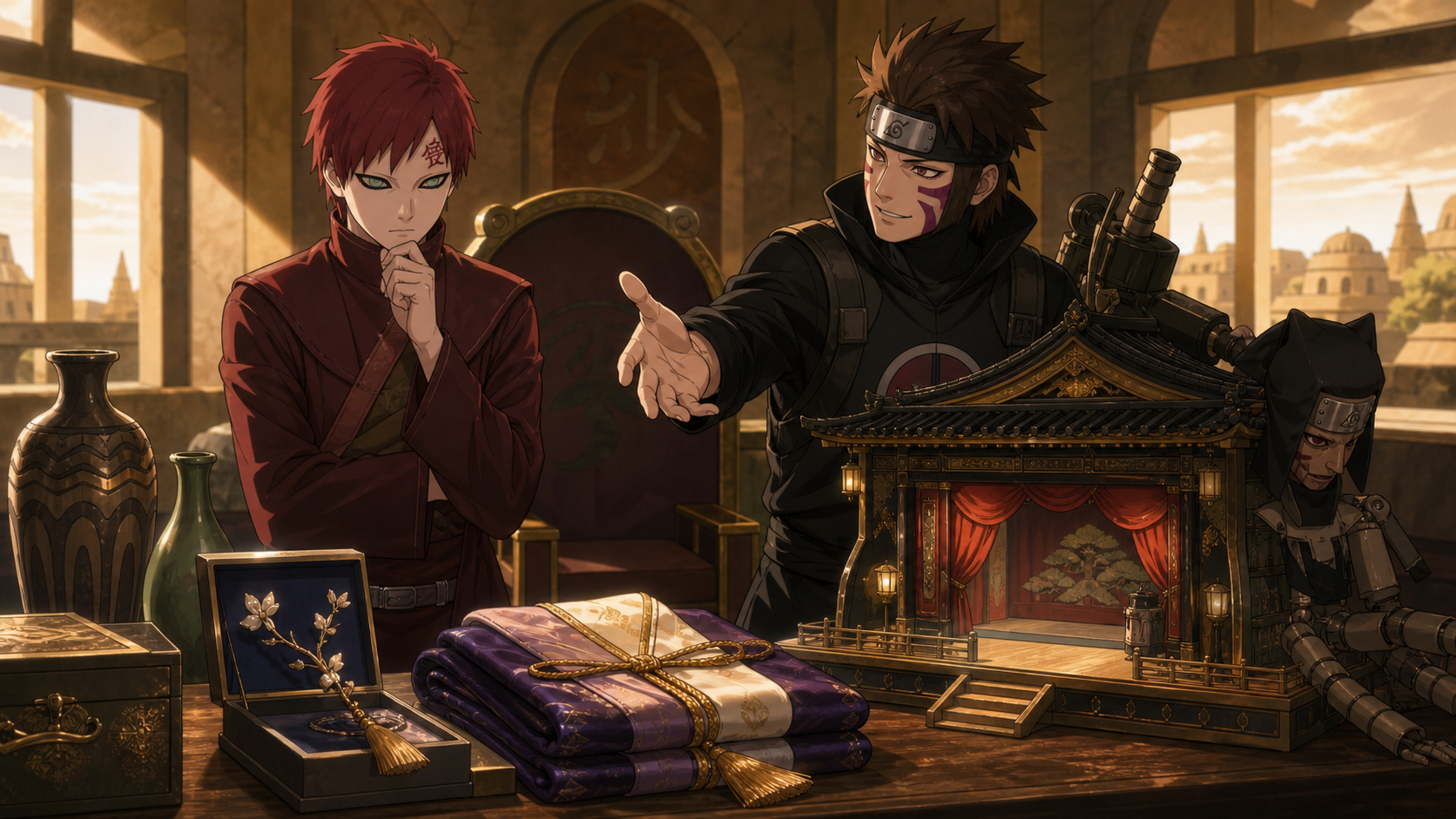
The Kazekage's Wedding Gift
Gaara must decide whether Naruto’s wedding needs the wealth of a Kazekage or the gratitude of the lonely child Naruto once recognized.
Episode at a glance
- Series
- Naruto Shippuden
- Episode
- 497
- Arc
- Konoha Hiden: The Perfect Day for a Wedding
- Japanese airdate
- March 9, 2017
- What matters
- Iruka’s quiet gratitude helps Gaara separate the friend Naruto saved from the Kazekage expected to perform international prestige.
Bottom line
“The Kazekage's Wedding Gift” asks Gaara to choose which relationship will speak when he celebrates Naruto: one Kage addressing another village's hero, or one friend honoring the person who changed his life. A Five Kage Summit brings Gaara, Kankuro, and Temari to Konoha just as wedding preparations have consumed Naruto's friends. Onoki and A discuss official gifts from their villages, so Gaara initially assumes his present must display the wealth and authority of the Sand. Kankuro encourages spectacle. Killer B escalates the mood further by imagining a dance performance involving the Kage. Every institutional voice makes the wedding larger, louder, and less personal. Lee and Tenten take Gaara through Naruto's favorite places, eventually reaching Ichiraku Ramen. There, Iruka thanks Gaara for being Naruto's friend. The sentence releases him from diplomatic performance. Naruto never reached Gaara through rank, money, or ceremony. He recognized another lonely child, fought him, refused to discard him, and opened a path toward community. Gaara therefore decides to give a present as Gaara rather than as Kazekage. The distinction does not erase his office; the friendship helped make his humane leadership possible. The episode also lets Iruka recognize a part of Naruto's life he did not witness. Two men shaped by Naruto meet over ramen, and gratitude moves in both directions without becoming a contest.
Episode 497 continues Konoha Hiden
Episode 497 is titled “The Kazekage's Wedding Gift.” The episode aired in Japan on March 2, 2017, during the anime adaptation of *Konoha Hiden: The Perfect Day for a Wedding*.
Gaara's friendship with Naruto leads the story.
The Five Kage gather in Konoha
The summit places former rivals inside a village preparing for a wedding. Diplomacy and private celebration occupy the same streets.
Peace appears through overlapping obligations.
Gaara arrives with his siblings
Temari and Kankuro accompany him as both advisers and family. Their presence keeps the Kazekage from becoming only an office.
Leadership travels with personal history.
Kakashi welcomes the delegation
The Sixth Hokage receives fellow leaders while managing the staffing crisis surrounding Naruto's ceremony. His formal duties continue alongside the secret gift mission.
Public authority rarely pauses for private care.
Shizune supports the summit
Administrative work makes the gathering possible without drawing attention to itself. The episode's celebration depends on planning beyond the visible guests.
Peace requires infrastructure.
Bad weather delays the Mizukage
Mei's late arrival reminds everyone that travel still answers to conditions no Kage can command. Political importance does not eliminate ordinary uncertainty.
Nature ignores rank.
Onoki mentions an official present
Iwagakure intends to honor Naruto through a gift sent on behalf of the village. The choice recognizes his role in ending the war and reshaping relations among nations.
Gratitude becomes diplomatic policy.
A has prepared a Kumo gift
The Raikage also treats the wedding as an occasion with international meaning. Naruto's private milestone now belongs partly to the alliance he helped create.
Heroism complicates privacy.
Gaara learns the wedding date late
He knew Naruto's relationship mattered but had not received the current details. Surprise leaves him behind leaders who appear better prepared.
Friendship can feel exposed by missing information.
Kankuro questions Temari
She recently visited Konoha and should have heard about the ceremony. His reasonable question collides with her embarrassment over Shikamaru.
One misunderstanding shadows another episode.
Temari says she forgot
Her sharp response discourages further inquiry. Forgetting protects a vulnerable story she does not want her brothers to inspect.
Anger becomes a privacy screen.
Kankuro recognizes danger
He stops pressing when her mood changes. Sibling knowledge allows him to read a boundary even without understanding the cause.
Survival can look like tact.
Gaara feels pressure to compete
Hearing that other villages have gifts turns affection into comparison. As Kazekage, he worries that a modest present could reflect poorly on Suna.
Protocol converts care into display.
Kankuro recommends extravagance
He imagines a gift large enough to announce the Sand's status. The instinct makes political sense while missing Naruto's personal values.
Spectacle can communicate the wrong relationship.
Wealth offers an easy answer
Gaara could authorize resources beyond anything most of Naruto's friends can afford. Access creates possibility but not emotional accuracy.
Price does not measure closeness.
The Kazekage title creates distance
Office requires Gaara to consider symbolism, precedent, and village reputation. Friendship asks him to remember one person without an audience.
Both responsibilities are real.
Lee and Tenten receive escort duty
They guide the Sand delegation through Konoha. Their recent gift struggle makes them appropriate companions for Gaara's uncertainty.
Experience turns into informal counsel.
Gaara asks to see Naruto's favorite places
Rather than choose from an abstract list of expensive objects, he seeks the daily world Naruto enjoys. Observation becomes research grounded in the recipient.
Attention improves generosity.
Konoha looks different through Gaara
The village once represented an enemy target during the Chunin Exams. Now Gaara walks its streets as an allied leader and wedding guest.
Geography records political change.
Naruto's preferences are unpretentious
His favorite places do not point toward luxury. Food, friends, training, and familiar routines define comfort more clearly than ceremony.
Status has not rewritten his appetite.
Temari stays behind
She wants to avoid Shikamaru after their hot-spring misunderstanding. The decision protects her from immediate embarrassment while narrowing her visit.
Avoidance buys time, not resolution.
Her absence has emotional context
Temari is not uninterested in the wedding or Naruto. A recent vulnerable mistake makes public contact harder.
Withdrawal should not be mistaken for indifference.
Ichiraku becomes the essential stop
Lee and Tenten bring Gaara to the ramen shop most closely connected with Naruto's childhood and adult comfort. The small counter holds more meaning than an official monument.
Belonging lives in repeated welcome.
Teuchi has watched Naruto grow
He fed a lonely child before the village celebrated that child as a hero. Hospitality offered dignity when public recognition was absent.
Ordinary kindness can outlast grand honors.
Ayame notices Iruka's visits
Iruka has been coming to Ichiraku often while struggling with Konohamaru's congratulatory recording. Familiar food provides space around feelings he cannot yet phrase.
Routine supports emotional work.
Iruka remains unable to finish his message
No brief camera statement can contain his relationship with Naruto. The wedding asks him to name a family role that teaching alone cannot explain.
Language trails behind attachment.
Teuchi understands the gift search
He sees shinobi moving through the village with unusual concern and recognizes the shared cause. Community knowledge does not require an official briefing.
Care becomes publicly legible.
Teuchi plans a free ramen pass
The gift comes directly from what he has always offered Naruto: food without judgment and a seat at the counter. Monetary value matters less than continuity.
The present extends an existing welcome.
Gaara meets Iruka
Two people from different parts of Naruto's life encounter one another in the place that links childhood hunger with adult belonging. Neither arrives as a rival for importance.
Shared care creates immediate kinship.
Iruka knows Gaara's significance
He understands that Naruto found a peer whose loneliness resembled his own. Their bond proved that recognition could cross villages and histories of violence.
Friendship became evidence of change.
Iruka thanks Gaara
He does not thank the Kazekage for an alliance or military support. He thanks Gaara for being Naruto's friend.
The plain sentence reaches the correct identity.
Gaara receives unexpected permission
Until that moment, every conversation has emphasized office, village reputation, or competitive scale. Iruka names the relationship underneath those obligations.
Recognition can simplify a difficult choice.
Naruto met Gaara before either role settled
Their decisive battle joined two jinchuriki shaped by fear and isolation. Naruto challenged the belief that pain granted permission to harm others.
Friendship began through moral confrontation.
Gaara's transformation was not passive
Naruto opened a possibility, but Gaara chose to rebuild trust, protect Suna, and accept responsibility. Gratitude does not erase his agency.
Change requires participation.
The Kazekage office still matters
Gaara became a leader partly because Naruto showed him another way to seek acknowledgment. His friendship and public duty are connected rather than opposed.
Personal healing can reshape institutions.
The gift should come from Gaara
He decides against using the present primarily as a display from the Kazekage. The choice restores emotional proportion to a ceremony increasingly crowded by politics.
One friend can speak without a government behind him.
A modest gift can carry enormous history
Naruto does not need Gaara to prove the Sand's wealth. He needs no proof of friendship at all, which frees Gaara to offer something sincere.
Security reduces the need for spectacle.
Killer B proposes a dance performance
The Eight-Tails' jinchuriki imagines celebrating through music and movement. His idea turns political guests into possible entertainers.
Creative enthusiasm ignores protocol.
A resists becoming a performer
The Raikage's discomfort reflects the distance between official dignity and public play. B treats that distance as an invitation rather than a restriction.
Sibling dynamics survive high office.
Mei receives the same comic pressure
The Mizukage's arrival does not protect her from inclusion in B's imagined routine. The proposed performance collapses hierarchy through shared embarrassment.
Celebration can temporarily flatten rank.
Gaara imagines the Kage dancing
The fantasy is absurd precisely because these leaders usually gather under threat. Naruto's wedding makes a different form of international coordination imaginable.
Peace permits ridiculous possibilities.
The dance would center the performers
Although memorable, a Kage spectacle could overwhelm Naruto and Hinata's ceremony. B's generosity shares the same danger as Kankuro's extravagance.
Attention is not always a gift.
Hinata remains part of the decision
Gaara's bond is primarily with Naruto, but the present celebrates a couple. Friendship with one partner does not authorize erasing the other.
Wedding care must include both recipients.
Naruto's fame changes the guest list
Leaders who once evaluated him as a weapon now want to honor his marriage. Public esteem creates warmth while threatening to turn a private bond into a state event.
Recognition always carries new pressure.
Iruka and Gaara represent chosen family
Neither shares Naruto's blood. Both relationships were built through recognition, conflict, care, and repeated choice.
Family grows through sustained presence.
Their meeting expands Iruka's view
He cannot witness every life Naruto touched after leaving the Academy. Gaara offers living proof that the lonely student became a source of belonging for others.
A teacher's influence travels beyond the classroom.
Their meeting expands Gaara's view
Iruka represents the adult who first broke Naruto's isolation. Thanking Gaara places him inside a longer chain of people who chose the boy others feared.
Friendship inherits earlier acts of care.
The ramen pass offers the episode's standard
Teuchi does not ask whether his present can compete with a village treasury. He gives more of the welcome Naruto has always valued.
Consistency becomes luxury.
Gaara leaves with a personal answer
The solution does not require abandoning ceremony or disrespecting Suna. He simply refuses to let office replace the person doing the giving.
Rank returns to its proper scale.
Episode 497 separates honor from display
Onoki, A, Kankuro, and B imagine increasingly public forms of celebration. Iruka's quiet thanks reminds Gaara that Naruto changed him before either friend needed an audience.
That contrast gives the comedy a serious purpose. A lavish delegation gift can honor a diplomatic relationship, but Gaara's private debt cannot be measured through price, scale, or applause. Naruto met his violence with recognition and then trusted him to choose another future. Gaara's later authority grew from that choice, which means his friendship and his office are connected without becoming interchangeable. The episode lets him celebrate both truths by putting intention before spectacle. His best answer is not the largest object in the room. His best answer proves that he remembers why Naruto matters to him.
The strongest gift remembers who first received the friendship.
Gaara is being asked which version of himself gets to give
I love Gaara in this episode because his uncertainty is not really about shopping. It is about identity. The Kazekage can mobilize money, artisans, diplomatic staff, and the symbolic weight of an entire village. Naruto’s friend remembers two lonely children meeting through violence and recognizing the pain underneath it. Both identities are real, and Naruto helped make the humane leader possible. The problem begins when protocol tells Gaara that public office must speak louder than the person who actually loves the groom.
Onoki and A are not wrong to prepare official gifts. Naruto helped end a war, build an alliance, and change what cooperation among villages could look like. Their governments have reasons to mark his marriage. Yet an official offering and Gaara’s personal gift answer different relationships. Combining them into one enormous display would make it difficult to tell whether Naruto is being celebrated as a friend, a military asset, a diplomatic symbol, or the hero around whom every institution now wants to arrange itself.
Kankuro chooses legible spectacle, but Gaara’s unusual access makes restraint part of responsible generosity toward a couple who requested no display. A giant present could consume the ceremony, redirect attention toward the giver, and leave Naruto and Hinata responsible for managing somebody else’s expensive idea after the guests go home.
The same caution applies to Killer B’s Kage dance. I would absolutely watch it. I would also ask Naruto and Hinata whether they want international leaders turning their reception into a performance. B understands celebration through music, movement, and collective joy, which is sincere. The trouble is assuming that a memorable idea automatically belongs in somebody else’s wedding. Attention can be generous, or it can make the performers the center. Consent tells us which one we are looking at.
Iruka thanks the person underneath the title
The Ichiraku scene is the emotional center because Iruka gives Gaara the sentence nobody else knew he needed: thank you for being Naruto’s friend. Not thank you for military support. Not thank you for representing the Sand. Not thank you for arriving as Kazekage. Iruka identifies the private relationship beneath the public alliance, and Gaara’s whole body seems allowed to exhale. Someone who loved Naruto before the monuments and medals recognizes someone who loved him across a national border.
That recognition matters for Iruka too. He could not follow Naruto through every mission or witness every bond formed after the Academy. Gaara is living evidence that the child Iruka protected became capable of interrupting another child’s isolation. Naruto did not reproduce Iruka’s care perfectly. He transformed it through his own stubborn language, meeting Gaara in battle and refusing the conclusion that pain granted either of them permission to destroy everyone else. Care traveled, changed form, and reached farther than its first giver could see.
Gaara’s gratitude must not erase his agency. Naruto opened a door, but Gaara walked through it repeatedly. He repaired relationships in Suna, earned trust after terrorizing people, accepted leadership, protected citizens, and chose collaboration when old systems rewarded suspicion. Friendship was not magic performed on him. It made another future imaginable, and Gaara did the difficult work of becoming accountable to that future. His gift can honor Naruto’s influence without turning Gaara’s entire life into Naruto’s achievement.
Chosen family meets at a ramen counter
Ichiraku is the correct place for this recognition because it carries a form of welcome no treasury can reproduce. Teuchi fed Naruto before public opinion made kindness fashionable. Iruka sat beside him when acknowledgment was still fragile. Gaara enters that small space with a title powerful enough to change international policy, yet the thing that connects all of them is ordinary repeated care. A bowl, a seat, a conversation, and the refusal to treat a lonely child as contamination built more belonging than any official ceremony.
Teuchi’s ramen pass extends a practiced welcome Naruto already understands as home, making continuity more meaningful than generosity designed for applause.
Hinata must remain visible in all of this. Gaara’s history is with Naruto, and Iruka’s gratitude concerns Naruto, but the ceremony belongs to two people. A personal gift should welcome Hinata rather than treat her as the surface on which men display their bond with the groom. The best answer can honor Gaara’s history while respecting the life Naruto and Hinata are choosing together. Friendship grants closeness, not ownership of the event.
Final verdict
“The Kazekage’s Wedding Gift” separates honor from display with unusual tenderness. Official villages may recognize the hero who changed international history, but Gaara does not need to prove friendship through the Sand’s treasury. Iruka’s thanks brings him back to the relationship that existed before rank could mediate it: Naruto recognized Gaara’s loneliness, challenged his violence, and trusted him to choose another way. Gaara then performed the long work of becoming a friend and leader worthy of that trust. The episode’s wild proposals are funny because everyone wants love to be visible, yet visibility can swallow the people being celebrated. The right gift is not automatically small or private. It is one chosen with the couple’s consent, the giver’s actual history, and enough restraint to keep Naruto and Hinata at the center of their own day.
Sources and watch notes
What I am carrying forward
Episode 497 lets Gaara give as a friend instead of using Naruto’s wedding as a stage for Suna. Episode 498 will test Shino, Kiba, and the village’s animals as another “last mission” turns gift anxiety into a search for the rarest possible answer.