
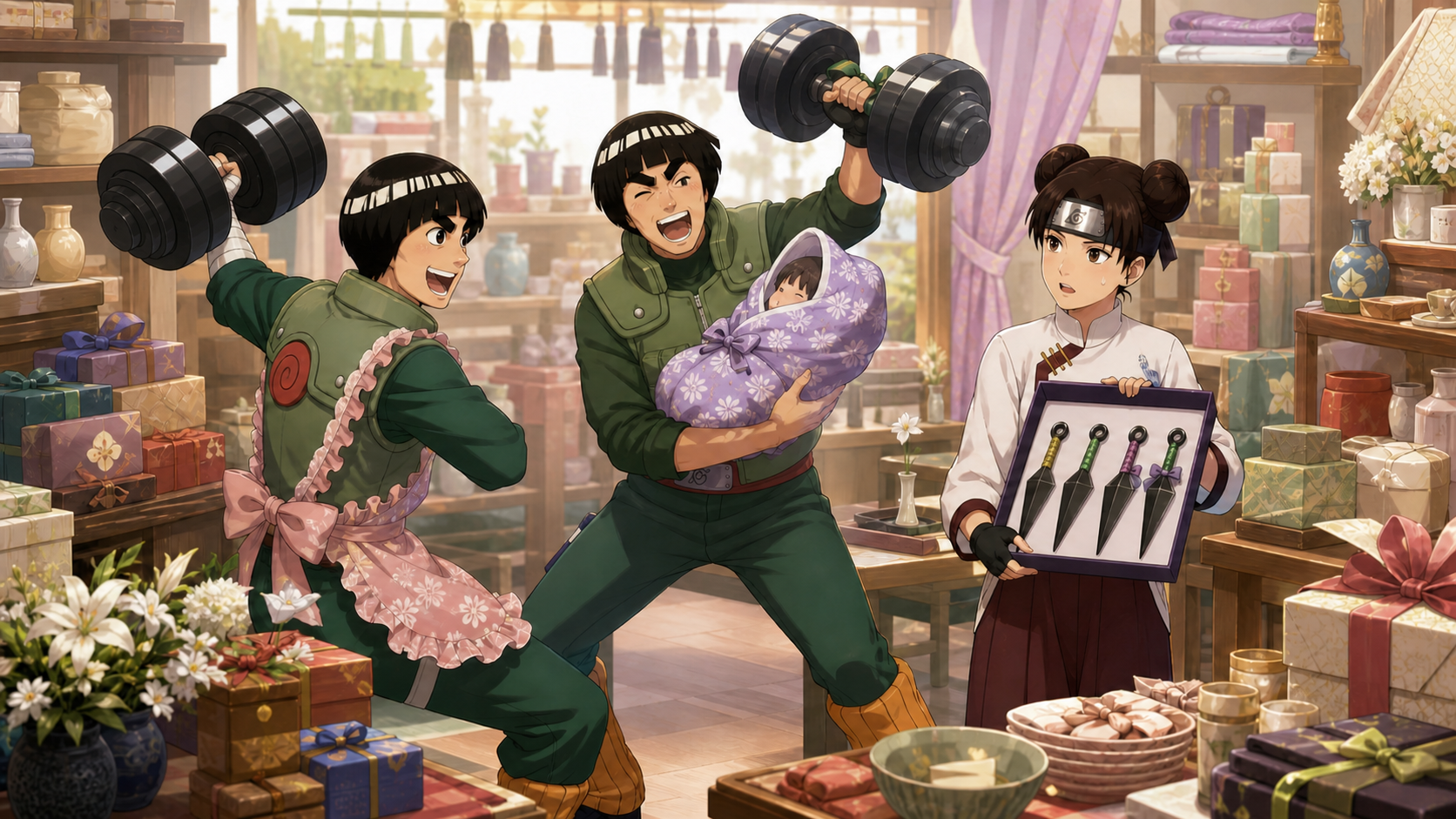
A Full-Powered Wedding Gift
Team Guy stops imitating what a wedding gift should look like and chooses objects that honestly carry persistence, practicality and the shape of their friendship.
Episode at a glance
- Series
- Naruto Shippuden
- Episode
- 495
- Arc
- Konoha Hiden: The Perfect Day for a Wedding
- Japanese airdate
- February 23, 2017
- What matters
- Lee and Tenten stop performing an imagined version of marriage and choose gifts that speak honestly from their own relationships with Naruto and Hinata.
Bottom line
“A Full-Powered Wedding Gift” gives Rock Lee and Tenten a problem that cannot be solved through greater force: choosing something meaningful for Naruto and Hinata. Kakashi's secret leave policy turns shopping into competition, so both friends begin by treating a wedding present like evidence they deserve to attend. Lee searches for an answer powerful enough to represent his bond with Naruto. Tenten rejects the tools she understands because she fears a kunai set will look inappropriate beside conventional household gifts. Might Guy responds with total confidence and almost no practical clarity, leading Lee through an absurd role-play in which empathy becomes another form of extreme training. Beneath the comedy, both students confront the same anxiety. They believe affection needs translation into somebody else's language before affection can count. Lee eventually chooses dumbbells because shared discipline honestly reflects how he knows Naruto. Tenten chooses a custom kunai set because craft, protection, and shinobi identity honestly reflect how she knows the couple. Neither gift becomes correct through price or social approval. Each becomes right when the giver stops performing an imagined version of marriage. The episode lets Team Guy remain gloriously ridiculous while preserving a gentle point: intimacy does not require people to abandon their own vocabulary.
Episode 495 continues Konoha Hiden
Episode 495 is titled “A Full-Powered Wedding Gift.” The episode continues the anime adaptation of *Konoha Hiden: The Perfect Day for a Wedding* as Naruto and Hinata's friends search for presents.
Rock Lee, Tenten, and Might Guy receive the central story.
Kakashi's policy shapes the search
Konoha cannot release every prominent shinobi from duty on the wedding day. Kakashi therefore asks friends to submit gifts and plans to use their value when deciding who receives leave.
Affection has been placed inside an institutional contest.
The assignment remains secret
Naruto and Hinata do not know that their friends are being evaluated. A private staffing problem now influences personal decisions without the couple's consent.
Good intentions do not erase poor process.
Lee approaches shopping as a mission
He wants a gift worthy of Naruto and treats uncertainty like a training obstacle. More effort normally improves Lee's performance, but effort alone cannot identify another person's needs.
The familiar method meets an unfamiliar problem.
Tenten begins with practical judgment
She understands weapons, craftsmanship, and field equipment. A wedding shop offers conventions that feel distant from her expertise.
Competence in one setting can become insecurity in another.
Team Guy enters a bridal shop
The polished merchandise creates an immediate contrast with two career shinobi accustomed to tools and training grounds. Lee studies objects as though one might reveal a tactical answer.
Retail etiquette becomes foreign terrain.
Conventional gifts do not settle the question
Household items may be useful, but usefulness cannot guarantee personal meaning. Lee wants an object that communicates history rather than filling space.
A registry cannot manufacture emotional specificity.
Lee considers exercise equipment
Dumbbells make sense to him because training expresses commitment, endurance, and mutual encouragement. He rejects the thought at first because the gift seems centered on his own interests.
Self-awareness interrupts enthusiasm.
Tenten considers a kunai set
A matched set would draw from her knowledge and could serve two shinobi well. She worries that weapons appear cold or inappropriate for newlyweds.
Social expectation makes expertise look inadequate.
Both friends fear choosing themselves
Their concern has merit. A present should consider the recipient rather than merely flatter the giver.
The error lies in assuming every personal connection is selfish.
Lee asks Guy for guidance
Guy has trained him, protected him, and modeled absolute conviction. Seeking his mentor feels natural when ordinary comparison has failed.
Lee expects wisdom in a familiar voice.
Guy treats the question seriously
He does not dismiss wedding planning as trivial. His intensity affirms that celebration deserves effort equal to any mission.
Care can appear through comic excess.
Advice becomes a flood of enthusiasm
Guy speaks about youth, feeling, and full power without naming a useful object. Emotional certainty replaces concrete instruction.
Inspiration needs interpretation.
Tenten becomes the practical witness
She watches mentor and student amplify one another while the shopping question remains unanswered. Her frustration grounds a sequence designed to abandon restraint.
Somebody must notice reality.
Lee tries to understand Naruto's feelings
Rather than guessing from a distance, he attempts to imagine the couple's domestic life. The impulse resembles empathy even when execution becomes bizarre.
Perspective-taking begins with a worthy aim.
Guy proposes role-play
He and Lee act as Naruto and Hinata so they can discover what a married couple might want. The exercise confuses identity, romance, and training almost immediately.
Method overwhelms purpose.
Lee takes the role with total commitment
He does not perform halfway. Every imagined response becomes a physical and emotional challenge worthy of maximum effort.
Earnestness fuels the comedy.
Guy matches Lee's intensity
Their bond works through escalation. Each validates the other's most dramatic instinct until a small shopping problem feels capable of shaking the village.
Mentorship can reinforce blind spots along with strengths.
Tenten is assigned the baby role
The choice makes no practical sense and reduces her from adviser to prop. Her expression supplies the episode's clearest critique of the exercise.
Participation is not the same as consent.
The imagined family never becomes ordinary
Lee and Guy cannot picture domestic life without translating domestic tasks into trials of stamina. Their fantasy reveals themselves more clearly than Naruto or Hinata.
Projection wears an empathetic costume.
Physical comedy distorts the frame
Faces, motion, and scale stretch beyond the series' usual action grammar. The rough exaggeration resembles Team Guy's emotional reality rather than literal events.
Style follows comic pressure.
Lee pushes beyond sensible limits
His search for the perfect answer becomes another test of whether sufficient passion can break through uncertainty. The body responds before reflection catches up.
Intensity cannot substitute for knowledge.
Guy recognizes Lee's sincerity
Although his guidance creates chaos, Guy never doubts the care behind Lee's struggle. Their relationship allows absurd behavior without ridicule from the mentor.
Respect survives the joke.
Tenten sees the pattern clearly
She understands that both men are circling the gifts they already wanted to choose. Their elaborate experiment has not created new information.
Complex procedure can hide a simple answer.
Neji remains present through absence
Team Guy's wedding preparation carries the empty place left by Neji. Tenten imagines how he might respond to their behavior, while Lee remembers the teammate who balanced rivalry with recognition.
Celebration can hold grief without surrendering joy.
Lee imagines Neji's encouragement
The remembered voice does not hand him a shopping list. Neji's presence instead gives Lee permission to trust the strength and sincerity already guiding him.
Memory supports choice rather than replacing choice.
The dumbbells return as an honest answer
Training equipment represents Lee's relationship with Naruto: rivalry without contempt, persistence after failure, and respect earned through labor. The gift speaks from lived history.
Personal meaning can make an unconventional object appropriate.
Lee does not need to imitate Hinata
His role-play fails because nobody else can define what Hinata wants through caricature. A friend can still offer something sincere without claiming complete access to the couple's private life.
Respect leaves room for difference.
Tenten returns to the kunai idea
She stops measuring her choice against decorative expectations. Naruto and Hinata are shinobi, and Tenten's craft belongs to the world they share.
Practicality can carry affection.
A matched set recognizes both partners
The gift is not only for Naruto, the famous friend at the center of Kakashi's policy. Pairing the weapons acknowledges Hinata as an equal recipient with her own training and history.
Marriage does not erase individual capability.
Custom work adds intention
A selected or specially prepared set differs from grabbing spare equipment. Knowledge of balance, quality, and use becomes part of the gift.
Expertise can be intimate.
Tenten's choice resists gendered expectation
She does not need to become interested in domestic ornament merely because the occasion is a wedding. Her contribution can remain recognizably hers.
Care does not require self-erasure.
Lee's choice also resists embarrassment
He accepts that another person might find dumbbells strange. The possibility of laughter no longer outweighs the honest connection behind them.
Vulnerability includes visible taste.
The episode does not prove either gift perfect
Naruto and Hinata never provide a detailed wish list during the search. Lee and Tenten make thoughtful choices under incomplete knowledge.
Love often works without certainty.
Kakashi's ranking remains ethically awkward
Meaning cannot be compared cleanly across friends with different income, skills, and access. A handmade tool, expensive appliance, and sentimental object answer different questions.
Administrative convenience creates false equivalence.
Team Guy does not know the full stakes
Lee and Tenten believe they are completing an official mission, but they cannot challenge a leave system whose purpose remains hidden. Secrecy limits informed participation.
Trust requires access to relevant truth.
Comedy protects the episode from cynicism
The story laughs at shopping panic without mocking the wedding or the friendships. Lee's sincerity remains emotionally credible even at maximum visual absurdity.
Warmth sets the joke's boundary.
Guy's mentorship remains imperfect and loving
He cannot answer every adult question for Lee. He can offer attention, confidence, and wholehearted company while Lee reaches his own conclusion.
Support need not equal expertise.
Tenten performs invisible emotional labor
She monitors the conversation, translates excess, and keeps the original task from disappearing. The men receive the loudest comedy while her judgment preserves direction.
Grounding work deserves recognition.
The trio still functions through difference
Lee supplies drive, Guy supplies affirmation, and Tenten supplies proportion. Neji's absence changes the balance, yet shared history continues to shape how they move together.
Team identity can survive changed membership.
The wedding creates a civilian challenge
No enemy needs defeating and no technique guarantees success. Peace asks shinobi to practice attention, taste, compromise, and celebration.
Ordinary life requires learned skills.
Naruto inspires Lee through persistence
Their bond was never based on identical abilities. Both boys refused the limits other people assigned them and treated discipline as a form of hope.
Weights carry that shared language.
Hinata deserves more than symbolic inclusion
Friends closest to Naruto can easily treat the ceremony as his reward. Tenten's paired gift and the episode's repeated reference to both names resist that imbalance.
The bride is not an accessory to the hero's ending.
Objects cannot contain an entire friendship
No present can summarize years of rivalry, grief, recovery, and shared war. A gift only needs to offer one truthful expression within that history.
Limits do not make the gesture empty.
The title describes emotional effort
“Full-powered” sounds like a promise of combat, yet the episode applies maximum energy to care. Lee uses the only setting he knows while learning where force stops helping.
Power becomes comic tenderness.
The episode keeps the finale personal
After battles involving nations and gods, the story spends time on two friends wandering through shops. Scale contracts so the ending can return to people rather than spectacle.
Peace becomes visible through errands.
Orochimaru's background presence stays unsettling
The former enemy appears around the village under Yamato's surveillance, turning ordinary scenes into reminders of unresolved accountability. The gag depends on everybody noticing danger without allowing danger to take over the wedding story.
Peace includes uncomfortable unfinished business.
Yamato's assignment has no festive pause
While friends shop for presents, he continues monitoring Orochimaru. Kakashi's attendance problem exists because village labor never disappears completely.
Celebration rests on somebody's shift.
Lee reaches confidence through recognition
His answer does not arrive because an authority certifies the dumbbells as ideal. He recognizes that honest connection matters more than appearing conventionally sophisticated.
Confidence follows self-knowledge.
Tenten reaches the same lesson differently
She does not imitate Lee's enthusiasm or Guy's rhetoric. She trusts her professional eye and chooses a gift suited to her own relationship with the couple.
Shared conclusions need not share a route.
Their gifts become portraits of the givers
That quality is not a flaw when recipients are genuinely considered. A meaningful present connects two sides: what the giver knows how to offer and what the recipient can receive.
Relationship lives in the overlap.
Nobody wins the friendship contest here
The episode refuses to compare Lee's care with Tenten's care. Both choices gain value through specificity, not superiority.
Kakashi's ranking system remains the problem, not the solution.
The next search belongs to other friends
Wedding preparation continues across Konoha as each group brings different histories and anxieties to the same assignment. The structure builds a communal portrait through separate errands.
One ceremony gathers many forms of love.
Episode 495 turns excess into honesty
Lee and Guy travel through the most excessive possible method before arriving at a modest truth. Tenten reaches that truth by surviving their method and trusting her own expertise.
The right gift sounds like the friendship behind the choice.
The gift mission turns insecurity into a public performance
Kakashi’s secret ranking changes the emotional temperature before Lee or Tenten enters a shop. They are not asking what Naruto and Hinata might enjoy. They believe an authority will judge whether their affection looks valuable enough to earn attendance. That distinction matters. Once care becomes evidence, every choice carries fear: too cheap means you do not care, too strange means you do not understand the couple, too practical means you failed to honor the occasion. The policy does not reveal friendship. It teaches friends to distrust the language in which they already know how to love.
Lee’s panic makes perfect sense inside that pressure. His relationship with Naruto was built through effort, rivalry, injury, recovery, and the stubborn refusal to let other people decide what their bodies made possible. Dumbbells are not a random object Lee wants to unload on somebody else. They are part of the vocabulary he and Naruto share. He initially rejects them because wedding culture tells him that sincerity must arrive looking elegant. Elegance without recognition would be emptier than a strange gift carrying years of history.
Tenten’s hesitation reveals another layer. She knows tools. She knows balance, quality, storage, durability, and what active shinobi actually use. Yet the bridal shop makes that expertise feel unfeminine and insufficiently romantic. She starts evaluating herself through an imagined customer who wants decorative domesticity, even though both people getting married are trained fighters. The matched kunai set becomes meaningful because it sees Hinata as capable, sees Naruto as her partner rather than the sole hero, and lets Tenten contribute knowledge nobody else in the group possesses.
Team Guy’s comedy still carries grief
Lee and Guy’s role-play is ridiculous, but I cannot separate their excess from the empty place beside them. Neji should be here rolling his eyes, identifying the obvious answer, and refusing to let their energy consume the entire afternoon. Tenten performs part of that grounding labor now. She watches the problem, translates the shouting, protects the original goal, and carries her own grief while the men are allowed to explode outward. The episode remembers Neji without turning the wedding into a memorial, which feels honest. Joy after loss is not betrayal. Sometimes joy arrives with somebody’s absence built into its shape.
That makes the baby-role joke more than harmless chaos for me. Tenten is once again assigned whatever function keeps the men’s exercise moving. She did not consent to the part, and nobody asks whether their method is helping her choose her own gift. The scene works because her face tells us she knows how absurd the arrangement is. Still, fandom should notice whose emotional labor remains quiet. Tenten deserves to be read as a full friend with judgment and history, not merely the reasonable woman positioned between two loud men.
Guy’s mentorship remains loving precisely because it is incomplete. He cannot tell Lee what Naruto wants, and his confidence cannot manufacture private knowledge. What he can do is take Lee’s concern seriously, stay beside him through embarrassment, and reflect back that the young man’s sincerity has value. A mentor does not need to own every answer. Guy gives Lee enough safety to arrive at his own answer, even if the road there includes a domestic simulation nobody in Konoha should ever attempt again.
Final verdict
“A Full-Powered Wedding Gift” understands that a meaningful present lives between two people. It must consider the recipient, but it also needs to carry something recognizable from the giver. Lee’s dumbbells work because Naruto knows the hope, discipline, and mutual recognition inside them. Tenten’s matched kunai work because she sees both partners as shinobi and offers craft grounded in real expertise. Neither choice needs to imitate a conventional wedding display. The problem was never that Team Guy lacked love. The problem was a secret system that made them believe love had to be legible to an evaluator. Their eventual choices reject that performance. They remain funny, specific, useful, and unmistakably theirs, while Neji’s absence quietly reminds us that every celebration gathers the people present and the people still carried in memory.
Sources and watch notes
What I am carrying forward
Episode 495 lets Team Guy choose honest gifts instead of conventional performances. Episode 496 will bring the same secret competition to friends whose care is expressed through appetite, hospitality, medicine, and the work of keeping one another alive.